
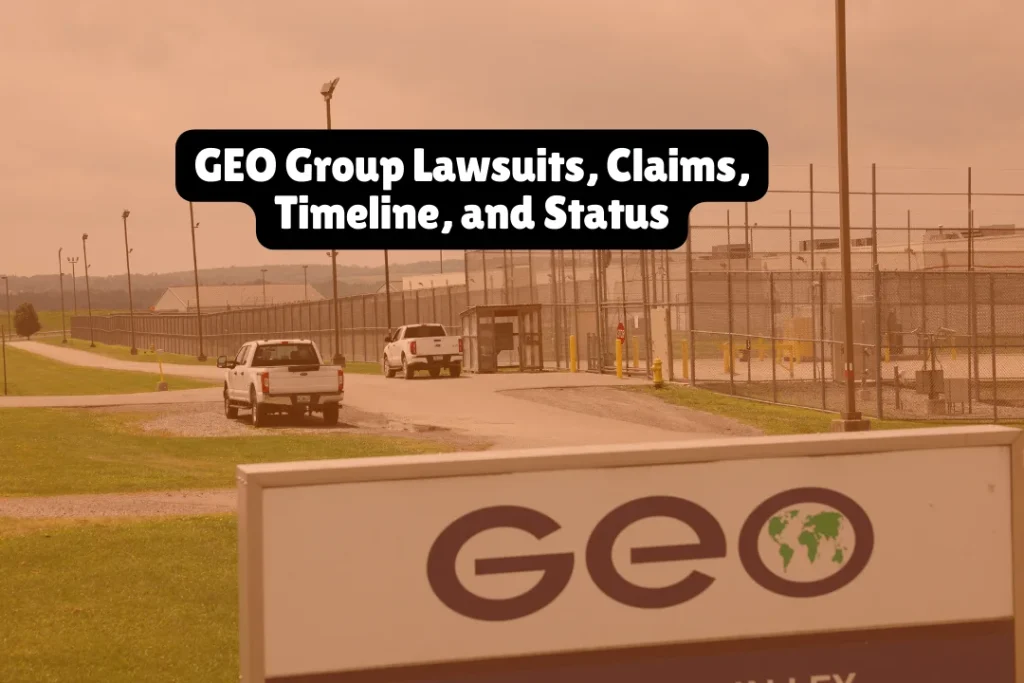
GEO Group Lawsuits, Claims, Timeline, and Status
Former immigration detainee Alejandro Menocal filed a class action against GEO Group in 2014, alleging the company forced detainees to perform unpaid labor at its Aurora, Colorado facility. The case, filed in the U.S. District Court for the District of Colorado, has reached the U.S. Supreme Court. On February 25, 2026, the Supreme Court ruled unanimously that the lawsuit can move forward to trial or settlement.
Case Overview
The parties: Lead plaintiff Alejandro Menocal filed on behalf of a class of current and former detainees held at GEO Group’s Aurora Immigration Processing Center in Aurora, Colorado. The defendant is The GEO Group, Inc., a Florida-based private detention company.
GEO Group is one of the largest private detention providers in the United States, managing or owning roughly 77,000 beds across 98 facilities. The company operates the Aurora facility under a contract with U.S. Immigration and Customs Enforcement (ICE).
In 2014, Alejandro Menocal and other former detainees at the Aurora Immigration Processing Center filed a class action lawsuit against GEO Group under the federal Trafficking Victims Protection Act and a Colorado law against unjust enrichment.
The case was filed on October 22, 2014, in the U.S. District Court for the District of Colorado. After years of procedural proceedings, it reached the U.S. Supreme Court as GEO Group, Inc. v. Menocal, No. 24-758. The Supreme Court issued its decision on February 25, 2026.
Legal Claims Explained
The lawsuit challenges two specific GEO Group labor policies at the Aurora facility.
Claim 1 — Forced Labor (Federal Law)
The lawsuit alleges that GEO Group unlawfully required people in custody at its Aurora facility to work without pay or face up to 72 hours in solitary confinement. The work involved cleaning common areas. Plaintiffs allege this violates the Trafficking Victims Protection Act, a federal law that prohibits forced labor. To prevail on this claim, the plaintiffs must show that GEO compelled the work through threats of serious harm or a scheme of coercion — not that the work itself was unreasonable.
Claim 2 — Unjust Enrichment (Colorado Law)
GEO Group operated a “Voluntary Work Program” at the Colorado facility where detainees could work up to eight hours a day helping in the facility. ICE regulations authorize this program and set a minimum rate of $1 per day. Plaintiffs allege that paying detainees $1 per day for work that generated economic value for GEO constitutes unjust enrichment under Colorado state law — meaning the company received a financial benefit it was not legally entitled to keep.
GEO Group’s Response
GEO Group defended both policies and argued the lawsuit should be dismissed entirely. GEO responded that the suit must be dismissed under Yearsley v. W.A. Ross Construction Co., which held that a federal contractor cannot be held liable for conduct that the government has lawfully “authorized and directed” the contractor to perform. GEO argued that ICE had authorized and directed it to carry out the challenged labor policies.
The district court denied the request, finding that ICE did not direct or require GEO Group to compel detainees to engage in forced labor or to limit payment to detainees to $1 per day. GEO then asked the Tenth Circuit Court of Appeals — and later the Supreme Court — to allow it to immediately appeal that denial before trial.
Current Status of the Case
The Supreme Court unanimously ruled against GEO Group. The company is fighting a lawsuit from 2014 alleging detainees in Aurora had to perform unpaid janitorial work and other jobs for little pay to supplement meager meals. GEO defended its practices and argued that the case should be tossed out because it’s immune from lawsuits as a government contractor. After a judge disagreed, the company asked the Supreme Court to allow it to quickly appeal the ruling. But the justices refused.
The February 25, 2026 ruling is procedural, not a verdict on the merits. The Supreme Court decision is not a final ruling in the case but a procedural one that allows the case to move forward to trial or a settlement between parties.
The case now returns to the lower courts. GEO Group may still raise its immunity defense — but only after a final judgment, not before trial. As Justice Kagan wrote: “If eventually found liable, GEO may of course appeal … But GEO must wait until then.”
Possible Outcomes (Educational)
Dismissal: The district court could still dismiss the case on other grounds if the facts do not support the legal claims.
Settlement: The parties could reach a private settlement agreement at any point before a final verdict. A similar lawsuit in Washington state resulted in the company being ordered to pay more than $23 million. Any settlement in the Colorado case would require court approval given the class action structure.
Trial verdict: If the case proceeds to trial, a jury or judge could find GEO Group liable, partially liable, or not liable. Damages would be determined separately.
Appeal after final judgment: GEO Group retains the right to appeal any adverse ruling after the case concludes at the district court level.
What This Lawsuit Means for Others
This case has broader implications beyond the Aurora facility. The outcome could subject privately-owned prisons currently contracting with ICE or other government agencies to more litigation.
Similar lawsuits have been brought on behalf of immigration detainees elsewhere, including a case in Washington state. Plaintiffs in those cases have relied on similar legal theories — forced labor statutes and unjust enrichment claims — challenging low or no pay for detainee labor at privately operated facilities.
The Supreme Court’s ruling also has procedural significance. The decision will allow lawsuits to proceed more quickly when federal contractors are alleged to have acted unlawfully or outside of their authority. This applies not just to detention companies but to federal contractors in other industries. For immigration detainees specifically, the ruling confirms that private contractors operating ICE facilities do not automatically inherit the federal government’s protection from suit.
If you want to understand your general rights in detention or immigration proceedings, see our related article on Immigration Detainee Rights in the U.S..
Key Dates
| Date | Event |
| October 22, 2014 | Class action lawsuit filed in U.S. District Court, District of Colorado |
| 2016–2022 | Class certification contested and upheld; multiple district and appeals court proceedings |
| 2024–2025 | GEO Group petitioned U.S. Supreme Court; certiorari granted in 2025 |
| November 10, 2025 | Oral argument before the U.S. Supreme Court |
| February 25, 2026 | Supreme Court issues unanimous ruling; case proceeds to lower court |
| TBD | Trial or settlement in U.S. District Court |
Frequently Asked Questions
Has the case been decided?
No, not on the merits. The Supreme Court issued a procedural ruling on February 25, 2026, allowing the case to proceed. The underlying claims — forced labor and unjust enrichment — have not yet been tried or resolved. The case returns to the lower federal courts.
What claims are being alleged?
Plaintiffs allege two things: that GEO Group’s sanitation policy forced detainees to clean common areas without pay under threat of punishment, violating federal forced labor law; and that its $1-per-day work program amounted to unjust enrichment under Colorado law.
What is GEO Group’s response?
GEO Group denies wrongdoing and argues its labor policies were authorized and directed by its ICE contract. The company contends it is entitled to derivative sovereign immunity as a federal contractor and has consistently sought to have the lawsuit dismissed.
What did the Supreme Court actually decide?
The Court ruled unanimously that Yearsley immunity — a defense available to federal contractors acting under lawful government direction — is a defense to liability, not a true immunity from suit. That means GEO cannot immediately appeal a court’s denial of that defense before trial ends.
When is the next hearing?
No specific hearing date has been publicly scheduled as of February 27, 2026. The case has returned to the U.S. District Court for the District of Colorado, where proceedings will resume. Check the PACER federal court docket system at pacer.gov for updates.
Can former detainees at the Aurora facility join the lawsuit?
The case is a certified class action, meaning eligible class members are generally included automatically. If you believe you were detained at the Aurora facility and affected by these policies, consult an immigration attorney or contact Towards Justice, the nonprofit organization representing plaintiffs, at towardsjustice.org.
Are there similar cases at other detention facilities?
Yes. Similar lawsuits challenging detainee labor practices at privately operated ICE facilities have been filed in multiple states, including Washington, where a comparable case resulted in a jury verdict of over $23 million against GEO Group.
What happens if GEO Group loses at trial?
If the district court finds GEO liable, the court would determine damages for the class. GEO Group could then appeal that final judgment to the Tenth Circuit Court of Appeals and potentially the Supreme Court again. Settlement remains possible at any stage.
Last Updated: February 27, 2026
This article is for informational purposes only and does not constitute legal advice. Legal claims and outcomes depend on specific facts and applicable law. For advice regarding a particular situation, consult a qualified attorney.
About the Author

Sarah Klein, JD, is a licensed attorney and legal content strategist with over 12 years of experience across civil, criminal, family, and regulatory law. At All About Lawyer, she covers a wide range of legal topics — from high-profile lawsuits and courtroom stories to state traffic laws and everyday legal questions — all with a focus on accuracy, clarity, and public understanding.
Her writing blends real legal insight with plain-English explanations, helping readers stay informed and legally aware.
Read more about Sarah