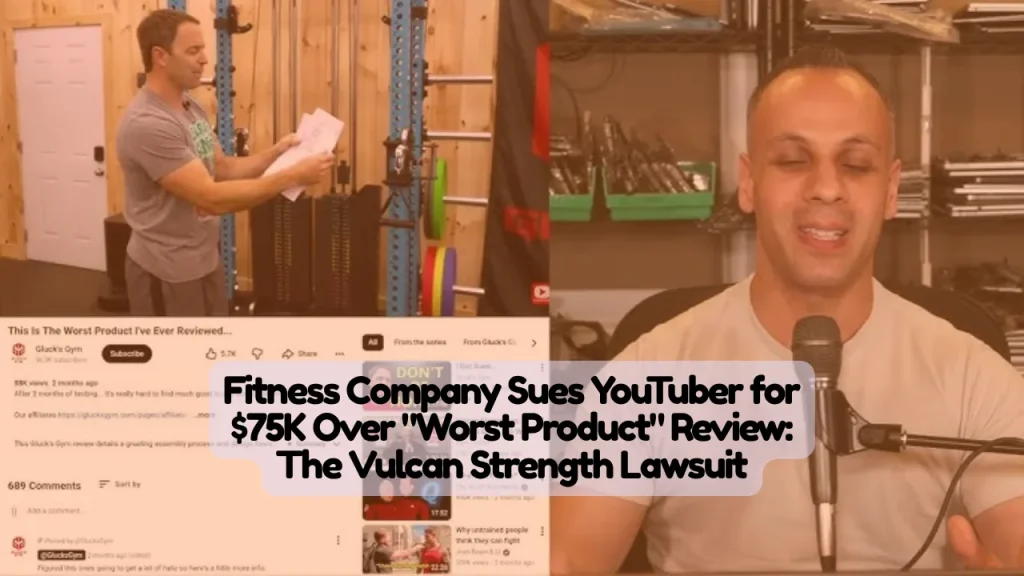
Fitness Company Sues YouTuber for $75K Over “Worst Product” Review, The Vulcan Strength Lawsuit
Vulcan Strength Training Systems sued fitness YouTuber Adrian Gluck on October 31, 2025, alleging defamation and false advertising after he called their $4,000 TALOS All-In-One Gym “the worst product I’ve ever reviewed.” The North Carolina manufacturer is seeking over $75,000 in damages, claiming Gluck made false statements about their product in a video that garnered 99,000 views. The case raises critical questions about where honest product criticism ends and actionable defamation begins.
What Happened: The Product Review That Triggered a Lawsuit
Adrian Gluck operates Gluck’s Gym, a family-run YouTube channel with 91,700 subscribers that reviews fitness equipment. For years, Gluck maintained an affiliate relationship with Vulcan Strength, earning commissions on sales generated through his promotions.
The trouble started in July 2024 when Gluck requested a TALOS All-In-One Gym for review. After repeated requests, Vulcan shipped the $4,000 rack system to Gluck’s Connecticut location in June 2025 at no charge.
Problems emerged immediately. Gluck communicated with Vulcan about missing parts, confusing assembly instructions, loose cables, and quality issues. Over three months, approximately 70 emails were exchanged between Gluck’s team and Vulcan, along with several phone calls.
In mid-August 2025, Vulcan learned that replacement parts would be delayed and offered to retrieve the product. Gluck agreed, saying he had “no way of shipping it back.”
But then Gluck published his review anyway.
In late August 2025, Gluck posted a 60-second video calling the TALOS “a pile of shit.” Days later in early September, he published a 12-minute YouTube video titled “This Is The Worst Product I’ve Ever Reviewed…” The video opened with an image of the TALOS in a flaming trash bin.
“If I paid well over four grand for this thing, I’d be pissed,” Gluck stated in the review.
The video accumulated over 99,000 views and more than 500 comments. For Vulcan, a veteran-owned small business, this was devastating.
On October 31, 2025, Vulcan filed a federal lawsuit.
Related Article: Is Horse Meat Legal in America? Shocking Truth About What You Can’t Buy

The Legal Claims: Defamation and False Advertising
Vulcan’s complaint, filed in the U.S. District Court for the Western District of North Carolina (Case No. 3:25-cv-878), alleges three causes of action:
1. Defamation Vulcan alleges Gluck made false statements that damaged their reputation and business. The complaint identifies specific claims as “objectively false”:
- Cable size claim: Gluck stated pulley grooves were “too small for these big, thick cables,” but Vulcan’s cables are 5mm in diameter and the grooves are 9mm wide
- Tension adjustment: Gluck claimed users cannot adjust cable tension from the trolley, which Vulcan disputes
- Assembly instructions: Gluck said Vulcan’s directions don’t explain how to install the rear crossmember, causing him to install it upside down, but the crossmember only has holes on one side and instructions show proper installation
- Missing instructions: Gluck complained instructions were incomplete, though Vulcan sent comprehensive guides via email when the product shipped and again later
2. Lanham Act Violation (False Advertising) Under Section 43(a) of the Lanham Act (15 U.S.C. § 1125(a)), Vulcan alleges Gluck made false or misleading statements in commercial advertising that harmed Vulcan’s business.
The Lanham Act protects businesses—not consumers—from competitors’ false advertising. To succeed, Vulcan must prove:
- Gluck made false or misleading statements of fact
- The statements were made in commercial advertising or promotion
- The statements deceived or are likely to deceive in a material way
- The statements were in interstate commerce
- The statements caused or will likely cause competitive or commercial injury to Vulcan
3. Unfair Competition Vulcan alleges Gluck engaged in unfair business practices by intentionally publishing false information to damage Vulcan’s reputation while benefiting his own YouTube channel through advertising revenue.
Related article: Hubbard vs Google Lawsuit Settlement, $30M for Kids’ Privacy Violations, Claim by January 21, 2026
Who Are the Defendants?
The lawsuit names two defendants:
Adrian Gluck – Individual fitness equipment reviewer and YouTube personality
Gluck’s Gym LLC – Gluck’s Connecticut-based business entity that operates the YouTube channel, Patreon page, and related review platforms
Gluck describes his operation as a small family business consisting of himself, his wife, and an editor. The channel generates revenue through YouTube advertising, Patreon subscriptions, and affiliate commissions.
What Vulcan Is Seeking in Damages
According to court filings, Vulcan is seeking:
- Monetary damages exceeding $75,000 for lost sales and profits
- Injunctive relief requiring Gluck to stop distributing the video and any similar false statements
- Reputational damages for harm to Vulcan’s standing with consumers and the fitness industry
- Court costs and attorney fees
The complaint states: “The amount of Vulcan’s damages is not reasonably capable of precise assessment at present, but will be proved with specificity at trial.”
For a small business like Vulcan—founded in 2008 and registered as a Small Disadvantaged Business with the U.S. Small Business Administration—a viral negative review can be catastrophic.
Timeline of Events
- July 2024: Gluck first requests TALOS for review
- October 2024, January 2025, May 2025: Gluck makes repeated requests
- Early June 2025: Vulcan ships $4,000 TALOS system to Gluck at no charge
- June-August 2025: Gluck communicates assembly issues; approximately 70 emails exchanged
- Mid-August 2025: Vulcan offers to retrieve product due to parts delay; Gluck agrees
- August 31, 2025: Garage Gyms publishes favorable independent TALOS review
- Late August 2025: Gluck posts 60-second video calling TALOS “a pile of shit”
- Early September 2025: Gluck publishes 12-minute “This Is The Worst Product I’ve Ever Reviewed…” video on YouTube (99,000+ views)
- October 31, 2025: Vulcan files federal lawsuit in Western District of North Carolina
- November 4, 2025: Attorney Rob Freund shares case details on social media
- November 20, 2025: Gluck publishes 17-minute response video titled “I Got Sued…”
- November 2025: Gluck launches GoFundMe campaign for legal defense
- As of December 2025: Case remains active with no settlement announced
Gluck’s Defense: Truth and Opinion
On November 20, 2025, Gluck published a detailed 17-minute response video defending his review. His defense rests on several arguments:
He tested the product thoroughly. Gluck had the TALOS for over three months, conducted extensive testing, and communicated problems to Vulcan throughout.
“I believe I did my due diligence,” Gluck stated. “A more than fair amount of time to test it and to communicate with Vulcan.”
His statements were truthful. Gluck maintains every criticism in his review reflects genuine problems he encountered:
- Assembly took days compared to four hours for similar products from competitors like Rogue
- Instructions consisted of four “easy steps” where “step two is actually like 35 steps in one”
- Cables arrived loose and not smooth
- Parts were missing
- The product arrived with grease stains
Vulcan knew about the problems. Gluck’s response video shows email correspondence where he immediately reported issues upon delivery. Vulcan acknowledged the problems and promised replacement parts that were delayed.
The review represents his honest opinion. Gluck argues that product reviews inherently contain subjective assessments. Calling something “the worst product I’ve ever reviewed” is opinion, not defamation.
This is a bullying tactic. Gluck characterizes the lawsuit as intimidation by a larger corporation against a small family business that can’t afford expensive litigation.
“Vulcan knows we can’t compete with them financially so this bullying tactic is their way of penalizing us for posting the video,” Gluck wrote on his GoFundMe page.
The Legal Battlefield: Where Is the Line Between Opinion and Defamation?
This case hinges on a critical legal distinction: statements of fact versus statements of opinion.
Defamation requires false statements of fact. Opinions cannot be defamatory, even if harsh or negative. The First Amendment protects robust criticism, including negative product reviews.
But where’s the line?
Statements that can be proven true or false are factual claims:
- “The pulley grooves are too small for the cables” (Vulcan argues this is objectively false: 5mm cables, 9mm grooves)
- “You cannot adjust cable tension from the trolley” (Factual claim Vulcan disputes)
- “The instructions don’t explain how to install the rear crossmember” (Factual claim about instruction content)
Statements that express subjective judgment are opinions:
- “This is the worst product I’ve ever reviewed”
- “If I paid well over four grand for this thing, I’d be pissed”
- “This might be the worst experience I’ve had”
The Lanham Act complicates things. While defamation law protects opinion, the Lanham Act’s false advertising provisions have different standards. The Act prohibits false or misleading statements in “commercial advertising or promotion.”
Courts have held that product reviews by competitors can constitute “commercial advertising” when the reviewer derives revenue from the review through advertising, affiliate relationships, or competitive sales.
Gluck’s YouTube channel generates advertising revenue. He had an affiliate agreement with Vulcan. These commercial relationships could support Vulcan’s Lanham Act claim even if some statements qualify as non-defamatory opinion.
Puffery is not actionable. The Lanham Act excludes “puffery”—exaggerated or vague claims that reasonable consumers wouldn’t take literally. Is calling something “the worst product” puffery or a factual assertion?
What the Lanham Act Actually Protects
The Lanham Act (15 U.S.C. § 1125(a)) provides a federal cause of action for false advertising. But it’s designed to protect businesses from competitors, not to give consumers recourse.
Only competitors have standing. Individual consumers cannot sue under the Lanham Act. Courts require plaintiffs to prove “an injury to a commercial interest in sales or business reputation proximately caused by the defendant’s misrepresentations.”
Vulcan and Gluck are competitors. Both sell or promote fitness equipment. Gluck’s affiliate agreements mean he profits when consumers purchase equipment he recommends, making him a commercial competitor to manufacturers he reviews negatively.
Two types of false advertising claims:
- Literally false statements – If a court deems an advertisement literally false, consumer deception is presumed. The plaintiff doesn’t need evidence that consumers were actually misled.
- Misleading but technically true statements – The plaintiff must provide extrinsic evidence (usually consumer surveys) proving the statement deceived or was likely to deceive consumers.
Vulcan’s strongest claims are those alleging literally false statements (cable size, adjustment capabilities, instruction content). If Vulcan can prove these statements are objectively false, the court may presume consumer deception without requiring additional evidence.
Remedies under the Lanham Act include:
- Injunctive relief halting the false advertising
- Monetary damages for lost sales and profits
- Disgorgement of the defendant’s profits from the false advertising
- Corrective advertising at the defendant’s expense
- Attorney fees in exceptional cases
Consumer Rights vs. Corporate Accountability
This lawsuit exposes fundamental tensions in consumer protection law.
Consumers rely on honest reviews. In an era where most people research purchases online, independent product reviews serve a vital consumer protection function. If manufacturers can silence criticism through lawsuits, consumers lose access to truthful information.
Gluck’s supporters argue his loyalty should be “with our viewers, the consumer, not a corporation.”
But reviews must be truthful. Reviewers aren’t immune from accountability. If a reviewer knowingly makes false statements to generate views and revenue, that harms both consumers and manufacturers.
The question is: Did Gluck cross the line from honest criticism to false advertising?
The affiliate relationship complicates things. Gluck had an agreement with Vulcan stating he would “avoid slander, misrepresentation, or disparagement of Vulcan products, services, or reputation.”
Did Gluck violate this agreement? If so, does that transform his review from protected criticism to contractual breach?
Vulcan argues Gluck’s financial incentives created bias. His YouTube channel profits from sensational content. A video titled “This Is The Worst Product I’ve Ever Reviewed…” with a flaming trash bin thumbnail generates more views than balanced criticism.
Gluck counters that his integrity depends on honest reviews. If he only published positive reviews to preserve affiliate relationships, viewers would lose trust and his channel would fail.
Industry Implications: The Chilling Effect on Reviews
Legal experts worry this lawsuit could create a “chilling effect” on honest product reviews.
Small reviewers can’t afford to defend lawsuits. Even if Gluck ultimately wins, the cost of litigation could bankrupt his family business. This creates asymmetric risk: manufacturers can silence criticism simply by filing lawsuits, regardless of merit.
Gluck launched a GoFundMe campaign for legal expenses, but most reviewers don’t have large audiences to rally financial support.
Anti-SLAPP laws may offer protection. Many states have Anti-SLAPP (Strategic Lawsuit Against Public Participation) statutes allowing defendants to dismiss frivolous lawsuits designed to silence speech. North Carolina has limited Anti-SLAPP protections that may apply.
If Gluck can invoke Anti-SLAPP, Vulcan would need to demonstrate a likelihood of success on the merits early in litigation. If Vulcan fails, they could be required to pay Gluck’s attorney fees.
Truth is a complete defense to defamation. If Gluck can prove his factual claims are true—that the cables really don’t fit properly, that assembly really is more difficult than competitors, that instructions really are inadequate—the defamation claims fail.
But proving truth requires discovery, depositions, expert testimony, and potentially trial. That takes time and money.
Comparative Cases: How Courts Handle Product Review Lawsuits
Similar lawsuits have produced mixed results:
Favor reviewers:
- Obsidian Finance Group v. Cox (9th Cir. 2014): Blogger who published negative review of investment firm prevailed on First Amendment grounds
- Global Telemedia Int’l v. Doe 1 (Cal. 2001): Anonymous reviewer won Anti-SLAPP motion against company suing over negative online reviews
Favor manufacturers:
- ONY, Inc. v. Cornerstone Therapeutics (1st Cir. 2013): Competitor’s misleading comparison advertising violated Lanham Act
- Time Warner Cable v. DIRECTV (2d Cir. 2007): False comparative advertising enjoined under Lanham Act
The key factors courts consider:
- Are the challenged statements fact or opinion?
- Did the reviewer have a reasonable basis for factual claims?
- Was the review motivated by actual experience or by competitive animus?
- Did the reviewer derive commercial benefit from the negative review?
The Public Backlash: Vulcan’s Reputation Crisis
Ironically, Vulcan’s lawsuit may have caused more damage than Gluck’s review.
Social media erupted. News of the lawsuit spread across Reddit, YouTube, Instagram, and fitness forums. Thousands of commenters accused Vulcan of censorship and bullying.
Review bombing began. Vulcan’s Trustpilot rating plummeted as users who’d never purchased their products left one-star reviews condemning the lawsuit.
“Sues small youtubers over negative reviews and providing honest and open feedback, absolute scum of a company,” wrote one reviewer. “I will be getting rid of all my vulcan crap now.”
Another stated: “A company that goes out and sues honest constructive reviews isn’t one I would give any more of my business too.”
Better Business Bureau complaints increased. Multiple customers filed complaints about order fulfillment issues, inventory errors, and poor customer service, suggesting broader quality control problems.
One complainant ordered a TALOS in August 2024 and paid $3,230.50. As of their BBB complaint, the product hadn’t shipped and they couldn’t get responses from Vulcan.
The Streisand Effect took hold. Before the lawsuit, Gluck’s review had 99,000 views. After the lawsuit, it went viral. Gluck’s response video explaining the lawsuit garnered additional hundreds of thousands of views. The lawsuit amplified the very criticism Vulcan sought to suppress.
What Consumers Should Know: Your Rights When Products Fail
This case offers lessons for consumers facing disappointing purchases:
You have the right to criticize products. The First Amendment protects honest opinions and truthful statements about your experiences. Companies cannot sue you simply for leaving a negative review.
Stick to truthful factual claims. If you state facts about a product (dimensions, performance, features), make sure they’re accurate. Provide evidence like photos, videos, or measurements.
Opinions are protected. You can say a product is “the worst,” “terrible,” or “not worth the money.” These are subjective judgments courts recognize as protected opinion.
Document everything. Save emails with customer service, take photos of defects, keep receipts and product specifications. If a company challenges your review, documentation proves your claims.
Affiliate relationships require disclosure. If you earn money from product reviews through affiliate links or sponsorships, federal law requires disclosure. But disclosure doesn’t eliminate your right to honest criticism.
Consider Anti-SLAPP protection. If a company sues you over a review, consult an attorney about Anti-SLAPP laws in your state. These statutes can help dismiss frivolous lawsuits early and may require the company to pay your legal fees.
What This Case Reveals About the Influencer Economy
The Vulcan Strength lawsuit exposes tensions at the heart of influencer marketing.
Influencers occupy dual roles. They’re simultaneously content creators providing information to consumers and commercial entities generating revenue from that content. This creates conflicts of interest.
Gluck’s affiliate relationship with Vulcan meant he profited when consumers bought Vulcan products. Once that relationship soured, did his incentives shift toward creating sensational negative content to drive views?
Manufacturers depend on influencer reviews but fear negative coverage. Companies send free products to reviewers hoping for positive coverage that drives sales. But by sending products, they risk negative reviews. The alternative—refusing to send products—can also generate negative coverage (“Company X wouldn’t send us their product for review…”).
Contracts rarely specify review standards. Vulcan and Gluck had an affiliate agreement requiring Gluck to avoid “slander, misrepresentation, or disparagement,” but these terms are vague. What counts as disparagement versus legitimate criticism?
The economics favor sensationalism. YouTube’s algorithm rewards engagement. Titles like “This Is The Worst Product I’ve Ever Reviewed…” with inflammatory thumbnails generate more clicks than balanced assessments. This creates pressure toward extremes.
Current Status and What Happens Next
As of December 2025, the lawsuit remains active with no settlement announced.
Discovery is likely underway. Both sides are gathering evidence:
- Vulcan will seek to prove Gluck’s factual claims were false
- Gluck will defend by proving his claims were true and represented honest assessment based on extensive testing
Key legal battles ahead:
Motion to dismiss: Gluck may file a motion arguing his statements were protected opinion or truthful factual claims, warranting early dismissal.
Anti-SLAPP motion: If North Carolina’s limited Anti-SLAPP protections apply, Gluck could seek early dismissal with attorney fee recovery.
Summary judgment: Either party may seek summary judgment if they believe undisputed facts establish they should win without trial.
Settlement negotiations: Most lawsuits settle. Vulcan may primarily want the video removed rather than damages. Gluck may agree to remove or modify the video to avoid trial costs.
Trial: If the case proceeds to trial, a jury would determine:
- Whether Gluck’s factual claims were false
- Whether false claims were made with actual malice (for defamation) or were material misrepresentations (for Lanham Act)
- What damages Vulcan suffered
- Whether injunctive relief is appropriate
Potential outcomes:
Vulcan wins: Court orders Gluck to remove video, pay damages exceeding $75,000, and potentially issue corrections. This would set precedent that product reviewers face liability for factual errors, potentially chilling honest reviews.
Gluck wins: Court dismisses claims, finding statements were protected opinion or truthful. Under Anti-SLAPP, Vulcan might pay Gluck’s attorney fees. This would reinforce reviewer protections and potentially discourage manufacturers from suing critics.
Settlement: Parties reach compromise—perhaps Gluck removes or modifies video in exchange for Vulcan dropping monetary claims. This resolves the immediate dispute but leaves legal questions unanswered for future cases.
Lessons for Manufacturers and Reviewers
This lawsuit offers guidance for both sides:
For manufacturers:
- Establish clear expectations in reviewer agreements, specifying review standards and dispute resolution procedures
- Respond to criticism constructively rather than legally—address product issues customers identify
- Consider whether lawsuits will worsen reputation damage through the Streisand Effect
- Focus on improving products rather than silencing critics
For reviewers:
- Ensure factual claims are accurate and evidence-based
- Distinguish clearly between fact and opinion
- Document product issues with photos, videos, and measurements
- Disclose affiliate relationships and financial incentives
- Consider potential liability before publishing extreme negative reviews
- Consult attorneys before publishing reviews of products with known quality disputes
Frequently Asked Questions
Q: Why is Vulcan Strength suing Adrian Gluck?
Vulcan alleges Gluck made false and misleading statements about their $4,000 TALOS All-In-One Gym in a YouTube video titled “This Is The Worst Product I’ve Ever Reviewed.” They claim his review contained objectively false technical claims that damaged their business and violated the Lanham Act’s false advertising provisions.
Q: What is the Lanham Act and how does it apply?
The Lanham Act (15 U.S.C. § 1125(a)) is a federal law prohibiting false advertising in commercial competition. Unlike defamation law which protects reputation, the Lanham Act protects businesses from competitors’ false advertising that causes commercial harm. Only businesses—not consumers—can sue under the Lanham Act.
Q: Can you legally sue someone over a negative product review?
Yes, if the review contains false statements of fact that damage your business. However, opinions are protected by the First Amendment and cannot be defamatory. The key is distinguishing factual claims (which can be proven true or false) from subjective opinions (which cannot).
Q: How much is Vulcan seeking in damages?
Vulcan’s complaint states damages “exceed $75,000” but the exact amount will be “proved with specificity at trial.” They’re seeking compensation for lost sales, lost profits, and reputational damage caused by Gluck’s review.
Q: What is Gluck’s defense?
Gluck maintains all his statements were truthful based on more than three months of testing and extensive communication with Vulcan about product problems. He argues his review represents honest criticism and protected opinion, not defamation or false advertising.
Q: What are Anti-SLAPP laws and do they apply here?
Anti-SLAPP (Strategic Lawsuit Against Public Participation) laws help defendants dismiss frivolous lawsuits designed to silence speech. North Carolina has limited Anti-SLAPP protections. If applicable, Gluck could seek early dismissal and potentially recover attorney fees if he prevails.
Q: Could this lawsuit affect other product reviewers?
Yes. Legal experts worry this case could create a “chilling effect” where reviewers self-censor negative opinions to avoid expensive lawsuits, even if their reviews are truthful. This would harm consumers who depend on honest reviews for purchasing decisions.
Q: What is the current status of the lawsuit?
As of December 2025, the case (Western District of North Carolina Case No. 3:25-cv-878) remains active with no settlement announced. Gluck has raised funds through GoFundMe for his legal defense and continues operating his YouTube channel.
This article is for informational purposes only and does not constitute legal advice. If you’re facing a defamation lawsuit or considering legal action over product reviews, consult with a qualified attorney in your jurisdiction.
About the Author

Sarah Klein, JD, is a licensed attorney and legal content strategist with over 12 years of experience across civil, criminal, family, and regulatory law. At All About Lawyer, she covers a wide range of legal topics — from high-profile lawsuits and courtroom stories to state traffic laws and everyday legal questions — all with a focus on accuracy, clarity, and public understanding.
Her writing blends real legal insight with plain-English explanations, helping readers stay informed and legally aware.
Read more about Sarah