
Energy Transfer vs. Greenpeace $345M Judgment, Full Case Explained
Quick Facts
- Lawsuit type: Civil litigation — organizational lawsuit (not a consumer class action; no settlement fund exists)
- Plaintiff: Energy Transfer LP and subsidiary Dakota Access, LLC (Dallas, TX)
- Defendants: Greenpeace International, Greenpeace USA (Greenpeace Fund Inc.), and Greenpeace Fund Inc.
- Case name: Energy Transfer LP v. Greenpeace International et al.
- Court: Southwest Judicial District Court, Morton County, North Dakota (Judge James Gion)
- Original jury verdict: $666.9 million (March 19, 2025)
- Revised judgment amount: $345,358,436 (October 29, 2025)
- Final judgment: Issued February 28, 2026
- Judgment status: Final judgment entered — appeal process now begins
- Appeal court: North Dakota Supreme Court (both parties expected to appeal)
- Allegations: Defamation, tortious interference with business, civil conspiracy, trespass, and nuisance — related to 2016–2017 Dakota Access Pipeline protests
A North Dakota judge issued a final judgment on February 28, 2026, ordering three Greenpeace organizations to pay approximately $345 million to pipeline developer Energy Transfer. The lawsuit, filed in 2019, alleged that Greenpeace allegedly orchestrated unlawful conduct during protests against the Dakota Access Pipeline in 2016 and 2017 and allegedly made false public statements that harmed Energy Transfer’s business. This is organizational civil litigation — it is not a consumer class action and there is no public settlement fund. Both Greenpeace and Energy Transfer have stated their intention to appeal to the North Dakota Supreme Court.
What Is the Lawsuit About?
Energy Transfer sued Greenpeace in 2019 for its involvement in a massive, months-long and sometimes violent protest against its Dakota Access Pipeline, which was installed in 2016 and 2017. The company alleged that Greenpeace organizations went beyond protected protest activity and allegedly took direct steps to disrupt pipeline construction, damage property, and run a coordinated campaign of false statements to harm the company’s financing and reputation.
Energy Transfer alleged that Greenpeace entities helped drive unlawful conduct tied to the anti-pipeline campaign through defamation, conspiracy, trespass-related claims, nuisance, and business interference tied to blockades, project disruption, and added security burdens. The protests took place near the Missouri River crossing upstream of the Standing Rock Sioux reservation in rural south-central North Dakota. The Standing Rock Sioux Tribe has long opposed the pipeline as a potential threat to its water supply.
Greenpeace disputed these allegations throughout the trial. Attorneys for the Greenpeace entities said there was no evidence to support the company’s claims and that Greenpeace employees had little or no involvement in the protests and the organizations had nothing to do with Energy Transfer’s delays in construction or refinancing.
Who Are the Parties?
Energy Transfer LP is a Dallas-based energy company. The $64 billion energy conglomerate owns and operates thousands of miles of pipelines in 44 states. Energy Transfer built the Dakota Access Pipeline — also known as DAPL — to transport crude oil from North Dakota wells to refineries farther south. Its subsidiary Dakota Access, LLC is co-plaintiff in the case.
Greenpeace International is a Netherlands-based environmental advocacy organization that operates globally. Greenpeace USA (formally Greenpeace Fund Inc.) is the U.S.-based affiliate and funding arm. A nine-person jury found Netherlands-based Greenpeace International, Greenpeace USA, and funding arm Greenpeace Fund Inc. liable for defamation and other claims. The jury found Greenpeace USA liable on all counts, including conspiracy, trespass, nuisance, and tortious interference. The other two entities were found liable for some of the claims.
Legal Claims
The jury considered multiple legal claims in this case. Here is what each claim means in plain terms:
Defamation: Energy Transfer alleged that Greenpeace made false statements of fact about the pipeline project — specifically that Greenpeace allegedly lied about whether the pipeline would cross tribal land and threaten the Standing Rock tribe’s water supply — and that those statements were made publicly to damage the company’s reputation and financial standing.
Tortious interference with business: This claim alleges that Greenpeace deliberately interfered with Energy Transfer’s business relationships — such as contracts with lenders, insurers, and construction partners — by engaging in or coordinating unlawful conduct and public pressure campaigns designed to make those relationships collapse.
Civil conspiracy: Energy Transfer alleged that Greenpeace entities conspired with each other and with on-the-ground protesters to plan and execute unlawful activity at the protest site. A civil conspiracy claim requires showing that two or more parties agreed to commit an unlawful act and that harm resulted from that agreement.
Trespass: The lawsuit alleged that Greenpeace aided and encouraged protesters who physically entered and occupied private property and construction equipment belonging to the pipeline companies.
Nuisance: This claim alleged that Greenpeace’s actions created an ongoing interference with Energy Transfer’s lawful use of its property and construction operations.
A jury found Greenpeace liable on all claims Energy Transfer brought against it. However, the judge later reviewed the jury’s damage awards and reduced several of them, finding some lacked sufficient legal support.
Related article: UPS Driver Buyouts Teamsters Lawsuit, What Drivers Need to Know
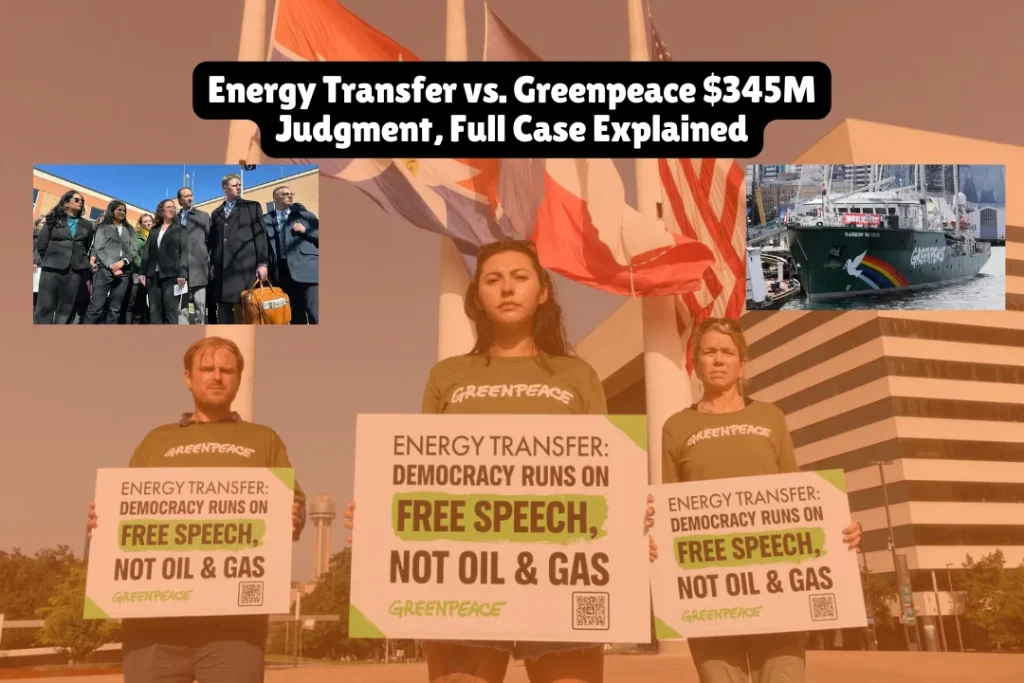
The Judgment: What the Court Ordered and Why It Was Reduced
Original jury verdict (March 19, 2025): The nine-person jury found the environmental group at fault for harming Energy Transfer during anti-pipeline protests and for publishing false statements to harm the company’s reputation. The jury’s award included more than $200 million of compensatory damages — money to address financial harms — plus about $400 million in punitive damages, totaling $666.9 million.
Why the judge cut it nearly in half: Judge Gion reduced the award after finding some of the jury’s damages had no legal basis, were duplicative, or had exceeded statutory caps on punitive damages. Specifically, the court disallowed the jury’s verdict as to the pipeline developers’ claims of trespass to land and aiding and abetting trespass to land, finding that there was no evidence that the developers possessed any interest in real estate. In addition, the court disallowed claims against both the developers and owner for conversion and aiding and abetting conversion, finding that there was no evidence sufficient to support those specific awards. The court’s decision on the motions reduced the damages of almost $667 million awarded by the jury to $345,358,436.
Final judgment (February 28, 2026): Judge James Gion issued the long-awaited final ruling on Friday, February 28, 2026. The ruling represents a sizable reduction from the jury’s March 2025 finding but Greenpeace and its allies warn that even the reduced damages threaten the group’s financial stability and could affect speech and protests across the environmental movement.
The final judgment specifies what each of the three Greenpeace entities is individually responsible for paying. The issuance of a final judgment is the procedural step that formally allows both parties to file appeals.
How Much Can Greenpeace Actually Pay?
Greenpeace has said it cannot afford to pay the amount. AP reported Greenpeace says it lacks the resources to pay the judgment, with only $1.4 million in cash and $23 million in total assets at the end of 2024. Against a liability of roughly $345 million, that implies a judgment about 15 times total assets and more than 240 times cash on hand.
In a financial filing made late last year, Greenpeace USA said it doesn’t have the money to pay the $404 million ordered by the jury “or to continue normal operations if the judgment is enforced.” Greenpeace International General Counsel Kristin Casper stated the organization intends to request a new trial and, if that is denied, will appeal to the North Dakota Supreme Court.
Whether Greenpeace can post the bond required to stay enforcement of the judgment while the appeal proceeds is one of the most significant financial questions in the case. Courts may allow a reduced bond in some circumstances, particularly when a party demonstrates it lacks the financial capacity to post the full amount.
Appeal Status
Both parties have announced their intention to appeal. The long-awaited order is expected to launch an appeal process in the North Dakota Supreme Court from both sides.
What Greenpeace plans to appeal: Greenpeace International General Counsel Kristin Casper said: “We will be requesting a new trial and, failing that, will appeal the judgment to the Supreme Court of North Dakota, where Greenpeace International and the U.S. Greenpeace entities have solid arguments for the dismissal of all legal claims against us.” Greenpeace’s stated grounds for appeal include lack of sufficient evidence to support key jury findings and concerns about whether the Morton County venue allowed for a fair trial. The Greenpeace defendants argued that jury questionnaires, voir dire, and a 2022 survey of potential jurors showed the empaneled jurors were not actually impartial and that Morton County was a “fundamentally unfair venue.”
What Energy Transfer plans to appeal: Energy Transfer said it planned to ask the North Dakota Supreme Court to reverse Judge Gion’s reductions to the defamation and conspiracy awards. The company believes the original jury verdict — or something closer to it — should be restored.
What an appeal means: When a party files an appeal to the North Dakota Supreme Court, the appellate court reviews whether the lower court made legal errors — not whether it agrees with the jury’s conclusions about the facts. The North Dakota Supreme Court can affirm, reverse, or modify the judgment, or send the case back to the trial court for further proceedings. No specific timeline for a Supreme Court decision has been announced publicly. Appeals at this level typically take one to several years.
The Dutch parallel lawsuit: In a related development, Greenpeace International filed a lawsuit in the Netherlands under the European Union’s anti-SLAPP directive, seeking a ruling from a Dutch court that the North Dakota litigation constitutes strategic litigation aimed at silencing advocacy. The North Dakota District Court denied Energy Transfer’s request for an injunction that would have barred Greenpeace from proceeding with its Dutch lawsuit, finding that the threshold requirements for an anti-suit injunction were not satisfied and that the issues in the Dutch case were different since they involved Greenpeace’s own defamation allegations against the developers. The Dutch case is proceeding independently.
What This Means
This case matters on several levels for the organizations directly involved and for broader questions about civil litigation involving protest activity.
For Greenpeace, the financial stakes are severe. Greenpeace has said the case could establish dangerous new legal precedents that could hold any participant at protests responsible for the actions of others at those protests, potentially affecting free speech in the U.S. and beyond.
For Energy Transfer, the company has consistently argued that the lawsuit is about unlawful conduct, not protest rights. The company stated the verdict will “send a clear signal to those who choose to deliberately break the laws of the United States of America.”
For observers and legal analysts, the case raises questions about the boundary between protected advocacy — including fundraising, media campaigns, and on-the-ground support for protests — and conduct that a court may find legally actionable as defamation or civil conspiracy. No appellate ruling has yet addressed those questions in this specific case, and neither side’s legal arguments have been finally resolved.
This is not a consumer class action. It does not involve a settlement fund, claim forms, or any mechanism by which members of the public may receive compensation. If you are following this case due to interest in its legal or policy implications, monitoring the North Dakota Supreme Court docket directly is the most reliable way to track updates.
Key Dates
| Event | Date |
| Lawsuit filed by Energy Transfer | 2019 |
| Trial begins | February 2025 |
| Closing arguments | March 17, 2025 |
| Jury verdict ($666.9 million) | March 19, 2025 |
| Judge reduces damages to $345 million | October 29, 2025 |
| Final judgment issued | February 28, 2026 |
| New trial motion / appeal filing | Pending — both parties announced intent |
| North Dakota Supreme Court decision | Timeline not yet set |
Frequently Asked Questions
What is this lawsuit about?
Energy Transfer, the developer of the Dakota Access Pipeline, sued three Greenpeace organizations in 2019. The company alleged that Greenpeace entities allegedly directed unlawful protest activities and allegedly made false public statements to disrupt construction and damage its business during the 2016–2017 Standing Rock pipeline protests.
Who won the judgment?
Energy Transfer won the jury verdict and the trial court judgment. A jury found Greenpeace liable on all claims Energy Transfer brought against it, including defamation, tortious interference, conspiracy, trespass, and nuisance. The judge later reduced the damages, and Energy Transfer also intends to appeal that reduction.
What does the $345 million judgment mean?
The court reduced the damages of almost $667 million awarded by the jury to $345,358,436 after finding some portions lacked legal support or exceeded statutory limits. The final judgment was entered February 28, 2026. It specifies what each Greenpeace entity owes and formally starts the clock for appeals.
Is this judgment final?
The trial court entered its final judgment on February 28, 2026. However, the judgment is not yet fully resolved because both Greenpeace and Energy Transfer have announced they intend to appeal to the North Dakota Supreme Court. Once the final order is formally entered, both sides are expected to appeal to the North Dakota Supreme Court. The appellate court could affirm, modify, or reverse the judgment.
Has an appeal been filed?
As of February 28, 2026, the final judgment was just issued. Both parties have announced their intent to appeal. Greenpeace has stated it plans to file a motion for a new trial first. If that is denied, it will proceed with an appeal. Energy Transfer has also stated it will appeal the judge’s reductions to the original jury award.
What is a SLAPP lawsuit, and does it apply here?
SLAPP stands for Strategic Lawsuit Against Public Participation. It refers to civil lawsuits that critics argue are filed primarily to burden defendants with legal costs and deter them from advocacy rather than to win on the merits. Greenpeace has characterized this case as a SLAPP lawsuit. Energy Transfer disputes that characterization and argues the case involves unlawful conduct, not protected speech. North Dakota does not have an anti-SLAPP statute. The court’s findings on this characterization have not yet been issued at the appellate level.
What happens next in the appeal?
Greenpeace is expected to first move for a new trial in the trial court. If that motion is denied, the case moves to the North Dakota Supreme Court. The Supreme Court will review whether legal errors occurred during the trial or in the judge’s decisions — not re-weigh the facts the jury considered. No public timeline for the appellate decision has been announced.
Why does this case matter?
The case involves significant questions about the legal liability of organizations that publicly oppose major infrastructure projects, the line between protected advocacy and actionable conduct, and what remedies companies may pursue when they allege organized protest campaigns caused financial harm. The North Dakota Supreme Court’s eventual ruling will address those questions at the appellate level for the first time in this specific legal context.
Last Updated: February 28, 2026
This article is for informational purposes only and does not constitute legal advice. Litigation outcomes and appeal results depend on specific facts, legal arguments, and applicable law. For questions regarding this litigation, consult official court records or a qualified attorney. Information in this article is current as of the last update date and may change as the appeal proceeds.
About the Author
Israr Ahmad is a legal content researcher with 4+ years of experience covering class action settlements and consumer rights cases. He has researched and published coverage of 2,500+ settlements using verified court records, settlement administrator filings, and government sources. Learn more about Israr.