
Dove Deodorant Class Action Lawsuit, Dove Men+Care “Alcohol-Free” Deodorant Actually Contains Alcohol—New Class Action Filed Days Before New Year
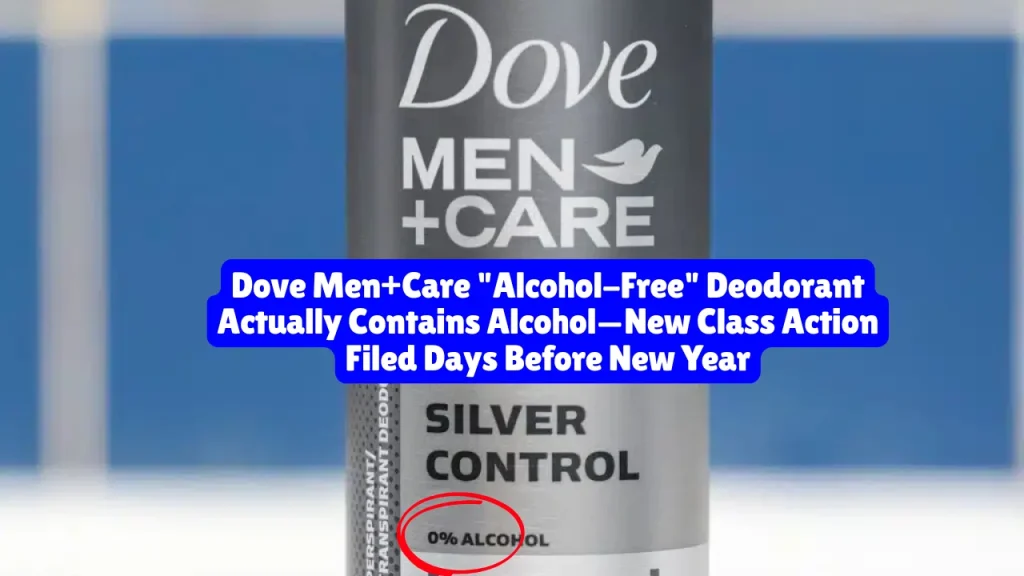
Unilever faces a brand-new class action lawsuit claiming its Dove Men+Care 0% Aluminum Deodorant labeled “no alcohol” actually contains benzyl alcohol. The lawsuit, filed December 29, 2025 in New York federal court, alleges Unilever deliberately misled consumers who specifically avoid alcohol ingredients due to skin irritation, allergic reactions, and health concerns. Case number 1:25-cv-07113 is pending in the U.S. District Court for the Eastern District of New York.
Here’s what makes this shocking: 89% of “hypoallergenic” and “alcohol-free” cosmetics contain at least one contact allergen, according to a study of 187 personal care products. You trusted the label. Unilever allegedly knew better.
What the Lawsuit Alleges: “No Alcohol” Label Hides Benzyl Alcohol
Picture this: You’re standing in the deodorant aisle. You have sensitive skin. You see “no alcohol” right there on the front of the Dove Men+Care package.
You trust it. You buy it. You use it every day.
Then you read the ingredient list on the back: benzyl alcohol.
That’s exactly what happened to Doris Gardner, the lead plaintiff in this class action. And she’s claiming thousands of other US consumers got deceived the same way.
The core allegations:
According to the class action lawsuit, Unilever manufactures, markets and sells Dove Men+Care 0% Aluminum Deodorant in thousands of stores throughout the United States, including in New York. Unilever prominently advertises the product as containing “no alcohol” to appeal to consumers who believe alcohol ingredients can be harmful and cause skin irritation and allergic reactions.
“However, unbeknownst to consumers, the products do contain an alcohol ingredient in the form of benzyl alcohol,” Gardner alleges in court documents.
Why this matters legally:
The lawsuit claims violations of state and federal consumer laws. When you market something as “alcohol-free” but include an alcohol ingredient, you’re allegedly engaging in:
- False advertising (saying something on the label that isn’t true)
- Breach of warranty (the product doesn’t match what you promised)
- Consumer protection violations (misleading reasonable consumers)
Filing details:
- Case name: Gardner v. Unilever United States Inc.
- Case number: 1:25-cv-07113
- Court: U.S. District Court for the Eastern District of New York
- Filed: December 29, 2025
- Plaintiff counsel: Goldberger & Dubin P.C. and Smith Krivoshey P.C.
Related Article: ESPN Caught Tracking Your Every Click, Disney Faces New Privacy Lawsuit Over Secret User Surveillance
Which Dove Products Are Affected?
The lawsuit specifically targets Dove Men+Care 0% Aluminum Deodorant products marketed with “no alcohol” claims.
Product details:
- Brand: Dove Men+Care
- Product line: 0% Aluminum Deodorant
- Label claim: “No alcohol” prominently displayed
- Actual ingredient: Contains benzyl alcohol
- Where sold: Thousands of retail stores nationwide, including major retailers in New York and across the US
Important: The lawsuit focuses on the disconnect between the front-of-package “no alcohol” marketing claim and the presence of benzyl alcohol listed in the ingredients.
What Is Benzyl Alcohol and Why Does It Matter?
Let’s break down what benzyl alcohol actually is and why Unilever’s labeling allegedly deceives consumers.
The Technical Explanation
Benzyl alcohol is an organic alcohol found in many fruits and teas. It has a hydroxyl group (-OH), which makes it chemically an alcohol. The FDA has approved benzyl alcohol for use as a synthetic flavoring agent for direct addition to food, as well as an anesthetic in oral healthcare and topical analgesic drug products.
In cosmetics and personal care products, benzyl alcohol functions as:
- A preservative
- A fragrance ingredient
- A solvent
The Cosmetic Ingredient Review has concluded that it’s safe for use in cosmetic products at concentrations of up to 5 percent, and up to 10 percent in hair dyes.
The Consumer Protection Problem
Here’s where the legal issue arises: benzyl alcohol IS an alcohol.
The FDA defines fragrance as “any natural or synthetic substance or substances used solely to impart an odor to a cosmetic product.” According to that definition, if a fragrance additive is used for another function, then it may legally be included in a fragrance-free product. Examples are benzyl alcohol, which may be used as a preservative.
But this is a loophole that allegedly misleads consumers.
When someone sees “no alcohol” on a deodorant label, they reasonably believe the product contains ZERO alcohol ingredients. They’re not parsing FDA technicalities about whether the alcohol serves a “fragrance” function or a “preservative” function.
Why Consumers Avoid Alcohol in Deodorants
Consumers specifically seek out “alcohol-free” deodorants because:
Health and skin concerns:
- Alcohol can dry out skin
- Can cause irritation, burning, or redness
- Can trigger allergic reactions in sensitive individuals
- Can exacerbate conditions like eczema or dermatitis
Specific to benzyl alcohol:
A 1998 study found that benzyl alcohol “can instigate immune system response that can include itching, burning, scaling, hives, and blistering of skin.”
The Material Data Safety Sheet (MSDS) on benzyl alcohol notes that it is a skin irritant, potentially causing redness and pain, as well as an eye irritant. Prolonged or repeated exposure can cause allergic contact dermatitis.
A small number of people can become allergic to certain fragrance ingredients, according to Unilever’s own allergen information pages.
Legal Claims: What Gardner Is Suing For
The lawsuit pursues multiple legal theories based on Unilever’s alleged deceptive labeling practices.
1. False Advertising
The “no alcohol” claim on the front of the package is allegedly false because the product contains benzyl alcohol. Under federal and state false advertising laws, companies cannot make material misrepresentations about their products.
Why this claim matters: Consumers relied on the “no alcohol” representation when making purchase decisions. They paid a premium for a product they believed was alcohol-free.
2. Breach of Warranty
Unilever allegedly breached both express and implied warranties:
- Express warranty: The “no alcohol” label created an explicit promise about the product’s composition
- Implied warranty of merchantability: The product wasn’t fit for the ordinary purpose for which such goods are used (providing alcohol-free deodorization)
3. Consumer Protection Violations
New York General Business Law § 349 prohibits deceptive acts or practices in the conduct of any business, trade or commerce. The lawsuit claims Unilever’s labeling violates this statute.
Similar consumer protection statutes exist in all 50 states, which is why this could expand into a nationwide class action.
4. Unjust Enrichment
Unilever allegedly profited from consumers who paid more for “alcohol-free” products while knowingly including an alcohol ingredient. This constitutes unjust enrichment—keeping money obtained through misleading practices.
Current Case Status: What’s Happening Now
As of January 2026, the case is in its earliest stages.
Timeline so far:
- December 29, 2025: Complaint filed in New York federal court
- January 2026: Defendant Unilever has not yet responded
- Next steps: Unilever must file an answer or motion to dismiss
What typically happens in false advertising class actions:
- Defendant files motion to dismiss (arguing the claims fail as a matter of law)
- If case survives dismissal: Discovery phase begins (collecting evidence)
- Class certification motion (determining whether case can proceed as a class action)
- Settlement negotiations or trial
Similar recent outcomes:
In a similar Unilever case involving Vaseline products labeled “hypoallergenic,” a judge denied Unilever’s motion to dismiss in June 2025, allowing the case to proceed. The court found that plaintiff adequately alleged the products weren’t truly hypoallergenic despite the labeling.
Can You Join This Lawsuit? Eligibility Requirements
The lawsuit seeks to represent a nationwide class of consumers, though specific class definitions haven’t been certified yet.
Likely eligibility criteria:
- Purchased Dove Men+Care 0% Aluminum Deodorant labeled “no alcohol”
- Purchased in the United States
- Purchased within the applicable statute of limitations period (typically 3-6 years depending on state)
- Would not have purchased or would have paid less if aware of the benzyl alcohol content
You don’t need:
- Receipts (though they help)
- Proof of harm or injury
- To have suffered skin reactions
False advertising cases don’t require physical injury—just economic harm from being misled.
Potential Compensation: What Class Members Could Get
If this lawsuit succeeds through settlement or verdict, class members could receive:
Typical remedies in false advertising settlements:
- Full refund of purchase price (with proof of purchase)
- $3-5 per product (without proof of purchase, capped at certain number of products)
- Injunctive relief (requiring Unilever to change its labeling)
- Attorney fees and costs (paid separately from class funds)
For comparison, recent Unilever settlements:
- Suave benzene deodorant settlement (2024): $2 million fund
- Full refunds with proof of purchase
- $3.29 per product without proof (up to 3 products per household)
- Dry shampoo benzene settlement (2025): $3.625 million fund
- Full refunds with receipts
- $3 per product without proof (up to 4 products per household)
Important: These benzene cases involved health risk allegations (cancer). The Dove alcohol-free case involves “only” economic harm from misleading labeling, so settlements might be smaller.
How This Case Compares to Other Dove/Unilever Lawsuits
Unilever faces an avalanche of consumer protection litigation over product labeling. Here’s the pattern:
Other Active Dove Lawsuits (2023-2025)
1. Dove Advanced Care “Natural” Claims (July 2023)
- Alleged false advertising that products contained only “natural” ingredients
- Claimed significant amounts of “natural oil” when formulation was different
- Status: Pending
2. Dove Retinol Body Wash Claims (December 2025)
- Alleged false advertising about retinol benefits in rinse-off cleansers
- Claimed products don’t deliver advertised results
- Status: Pending
3. Dove Invisible Antiperspirant “White Marks” (2021)
- Alleged deceptive marketing about preventing white marks
- Claimed product caused the very problem it promised to prevent
- Status: Moved to federal court, outcome unclear
Broader Unilever Benzene Litigation (2021-2025)
Unilever has faced massive litigation over benzene contamination in aerosol products:
Suave deodorant benzene:
- $2 million settlement (2024)
- Covered products sold January 2018 – March 2024
Dry shampoo benzene (Dove, Suave, TRESemmé, others):
- $3.625 million proposed settlement (2025)
- Covered products sold January 2014 – December 2022
- Independent testing found dangerous benzene levels
- Company delayed recall for over a year after competitors recalled similar products
The pattern: Unilever repeatedly faces allegations of:
- Misleading labeling claims
- Delayed responses to safety issues
- Prioritizing profits over consumer protection
What This Reveals About Personal Care Product Labeling Standards
The Dove “alcohol-free” case exposes serious gaps in cosmetics regulation.
The Regulatory Loophole
The FDA defines terms like “fragrance-free” and “alcohol-free” in ways that don’t match consumer understanding.
According to FDA guidance, products can claim “alcohol-free” even if they contain alcohol ingredients, as long as:
- The alcohol isn’t ethyl alcohol (ethanol)
- The alcohol serves a function other than being alcohol (like preservative or solvent)
From an FDA perspective: Benzyl alcohol is different from ethyl alcohol, and it’s used as a preservative, not for its alcohol properties. So “no alcohol” isn’t technically false.
From a consumer perspective: Benzyl alcohol IS an alcohol. The label says “no alcohol.” That’s false.
Why This Matters for Consumer Protection
Marketing and safety of personal care products is the responsibility of the manufacturer and is not subject to premarket approval from the FDA.
What that means:
- Companies don’t need FDA approval before selling products
- Companies are responsible for their own safety testing
- FDA regulates reactively, not proactively
- Labeling claims aren’t verified before products hit shelves
The result: Companies can stretch definitions and exploit loopholes until consumers sue them.
Similar Labeling Issues Across the Industry
One study evaluated marketing terms on personal care products. Researchers found that out of 187 cosmetic products, 89% “contained at least 1 contact allergen, 63% 2 or more, and 11% 5 or more” despite being marketed as “hypoallergenic”, “dermatologist recommended/tested”, “fragrance free”, or “paraben free.”
Terms that lack legal definitions:
- “Hypoallergenic”
- “Sensitive skin”
- “Fragrance-free”
- “Alcohol-free”
- “Natural”
- “Clean”
Manufacturers can use these terms however they want because there’s no legal standard defining them.
FAQ: Everything You’re Googling About This Lawsuit
Q: Does the Dove Men+Care “no alcohol” deodorant actually contain alcohol?
Yes, according to the lawsuit. The product contains benzyl alcohol, which is chemically an alcohol, despite front-of-package claims stating “no alcohol.”
Q: Is benzyl alcohol dangerous?
Benzyl alcohol is generally recognized as safe by the FDA at concentrations up to 5% in cosmetics. However, it can cause skin irritation, allergic reactions, and contact dermatitis in sensitive individuals. The Material Data Safety Sheet warns it’s a skin and eye irritant.
Q: Why would Unilever label a product “no alcohol” if it contains benzyl alcohol?
The lawsuit alleges this is deceptive marketing designed to attract consumers who avoid alcohol ingredients. Companies may argue benzyl alcohol is “different” from ethyl alcohol, but consumers reasonably interpret “no alcohol” as meaning ZERO alcohol ingredients.
Q: Can I join this class action lawsuit?
The class hasn’t been certified yet, but if you purchased Dove Men+Care 0% Aluminum Deodorant labeled “no alcohol,” you may be eligible. You don’t need to take action now—if the class is certified, there will be a notice process informing potential class members.
Q: Do I need proof of purchase to join?
It depends on the final settlement terms. In similar cases, consumers without receipts received smaller payments (typically $3-5 per product) versus full refunds with proof of purchase.
Q: Has Unilever responded to the lawsuit?
As of early January 2026, Unilever had not yet filed a response. The company typically has 21 days to answer or file a motion to dismiss after being served.
Q: Could this lawsuit expand to other Dove products?
Possibly. The complaint focuses on Dove Men+Care 0% Aluminum Deodorant, but if other Dove products make “no alcohol” claims while containing benzyl alcohol, plaintiffs could amend the complaint or file additional lawsuits.
Q: How long will this case take?
False advertising class actions typically take 1-3 years from filing to settlement or trial. The case must survive dismissal, complete discovery, achieve class certification, and either settle or go to trial.
Q: What’s the difference between benzyl alcohol and ethyl alcohol?
Chemically, both are alcohols. Ethyl alcohol (ethanol) is what’s in alcoholic beverages and is commonly used in cosmetics as an astringent. Benzyl alcohol is used as a preservative and fragrance ingredient. Both can cause skin irritation, but ethyl alcohol is more drying.
Q: Are there other lawsuits against Dove or Unilever?
Yes. Unilever faces multiple class actions over:
- Dove Advanced Care “natural” claims
- Dove retinol body wash efficacy
- Benzene contamination in Suave deodorants (settled for $2M in 2024)
- Benzene contamination in dry shampoos (proposed $3.625M settlement in 2025)
- Various other product labeling issues
Q: If I had a skin reaction to Dove deodorant, can I sue separately?
Yes. This class action covers economic harm from misleading labeling. If you suffered actual physical injury, you may have a separate personal injury claim with potentially higher damages.
What To Do If You Purchased This Product
Step 1: Check Your Deodorant
Look at your Dove Men+Care deodorant:
- Does the front say “no alcohol” or “0% alcohol”?
- Check the ingredient list on the back for “benzyl alcohol”
Step 2: Save Your Evidence
- Keep the product packaging
- Save any receipts if you have them
- Take photos of the label claims and ingredient list
Step 3: Monitor the Case
- Check AllAboutLawyer for updates
- Watch for class certification notices (if you’re eligible, you’ll receive notice)
- You don’t need to hire a lawyer—class action attorneys work on contingency
Step 4: Consider Your Options
- Wait for settlement: No action required until notice is sent
- File claim when settlement opens: Follow instructions in settlement notice
- Opt out and sue individually: Rare, usually only if you have significant damages
The Bottom Line: What This Case Means for Consumers
You believed the label. You trusted “no alcohol” meant no alcohol.
Unilever allegedly knew benzyl alcohol is an alcohol and put it in the product anyway.
This case is about more than deodorant. It’s about whether companies can hide behind technical FDA definitions to mislead reasonable consumers.
Three things to remember:
- “Alcohol-free” doesn’t always mean alcohol-free (welcome to cosmetics regulation loopholes)
- Benzyl alcohol IS an alcohol (regardless of what FDA technicalities say)
- You have legal rights when labels mislead you (even without physical harm)
If you bought Dove Men+Care “no alcohol” deodorant, save your packaging and watch for class notices.
The case is Gardner v. Unilever United States Inc., Case No. 1:25-cv-07113, pending in the U.S. District Court for the Eastern District of New York.
Your “alcohol-free” deodorant might be neither alcohol-free nor free from legal trouble.
Related Articles:
- Olipop Prebiotic Soda Class Action: $3 Drinks Are Just Sugared Water
- Holmes Nutrition Lawsuit: 75% Protein Powder Had Only 3.4g Protein
- Best Buy Class Action: Fake Sale Prices Tricked Shoppers
Disclaimer: This article is for informational purposes only and does not constitute legal advice. If you need legal assistance regarding this lawsuit, consult with a licensed attorney in your jurisdiction.
About the Author

Sarah Klein, JD, is a licensed attorney and legal content strategist with over 12 years of experience across civil, criminal, family, and regulatory law. At All About Lawyer, she covers a wide range of legal topics — from high-profile lawsuits and courtroom stories to state traffic laws and everyday legal questions — all with a focus on accuracy, clarity, and public understanding.
Her writing blends real legal insight with plain-English explanations, helping readers stay informed and legally aware.
Read more about Sarah