
Donald Trump Lawsuit Today, Elon Musk and Bill Gates Named in $310 Million Trafficking Lawsuit—Court Filing Claims “Epstein-Identical” Operation
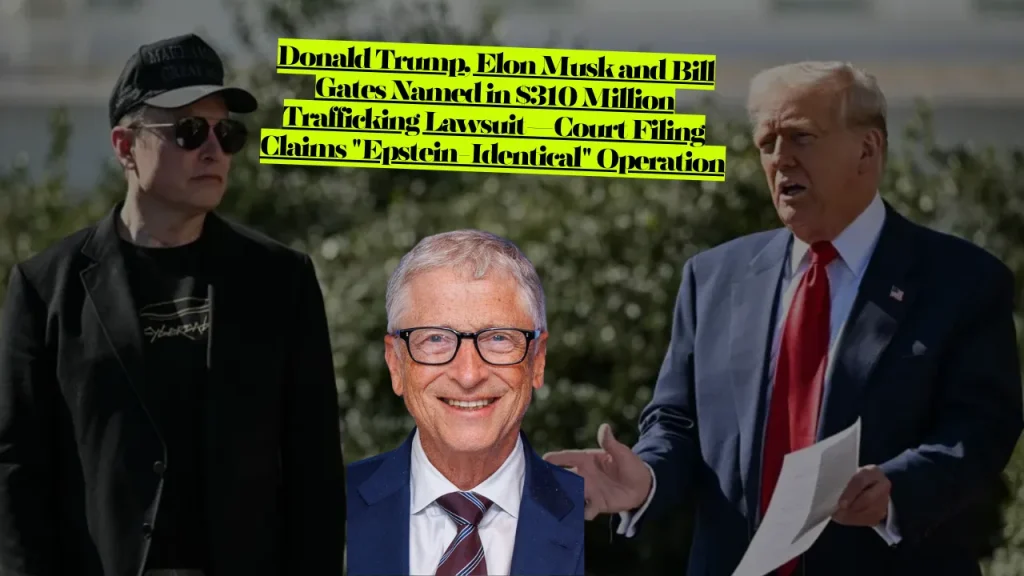
A $310 million lawsuit filed November 24, 2025 in Palm Beach County accuses President Donald Trump, Elon Musk, and Bill Gates of participating in an alleged trafficking operation that plaintiffs claim mirrors Jeffrey Epstein’s methods. The complaint filed in the 15th Judicial Circuit seeks more than $300 million in damages and names Trump in both individual and official capacity as president. The case is now pending review in Palm Beach County, where Trump’s Mar-a-Lago residence contributes to establishing venue.
What Is the $310 Million Trafficking Lawsuit About?
The lawsuit alleges an eight-year trafficking and exploitation venture that began in 2018 and has continued under the current Trump administration. Plaintiffs describe the alleged conduct as following a structure identical in every material respect to Epstein’s, citing grooming beginning in 1998, the use of billionaire-backed foundations as silencing mechanisms, and sexual assaults allegedly employing the same blitz-style methods documented in Epstein victim depositions.
The complaint claims defendants engaged in coercion, retaliation, and misappropriation of intellectual property while benefiting financially and politically from proprietary technology plaintiffs say they were pressured to produce.
Who Are the Named Defendants?
President Donald J. Trump: Accused of grooming the lead plaintiff since 1998, the exact year the plaintiff was born.
Elon Musk: Accused along with affiliated institutions of misappropriating confidential innovations.
Bill Gates: The lawsuit accuses Trump of using the Gates Foundation as cover and silencing mechanism to continue the operation.
The filing also names federal agencies and other high-profile figures.
Related Lawsuit: Cassie Lawsuit Settlement Amount, $20 Million Details Revealed, Legal Timeline and What It Means for Sexual Assault Cases
Specific Allegations Against Each Defendant
The unnamed plaintiffs make several specific claims:
Against Trump:
- Grooming the lead plaintiff since 1998
- Using the Gates Foundation as cover and facilitating coordinated sexual assaults
- Engaging in coercion and retaliation
Against Musk and Gates:
- Misappropriating confidential innovations including a cybersecurity system, a defense-architecture platform, and a non-hormonal contraceptive technology
- Plaintiffs say these were provided under promises of support but later used without permission, echoing past claims that Epstein associates exploited victims’ business ideas and creative works under the guise of philanthropy
Retaliation Claims:
- Plaintiffs claim the lead plaintiff’s infant daughter was taken from her as retaliation for filing lawsuits
- The lawsuit alleges that between 2023 and November 2025, there had been 5 different attempts to murder the lead plaintiff employing poisoning, vehicular assaults and orchestrated physical attacks designed to appear accidental
What Laws Apply to This Trafficking Lawsuit?
The lawsuit operates under federal trafficking statutes established by comprehensive anti-trafficking legislation enacted by Congress beginning in 2000.
Federal Trafficking Victims Protection Act (TVPA)
The Trafficking Victims Protection Act of 2000, signed into law by President Clinton on October 28, 2000, equipped the U.S. Government with new tools and resources to mount a comprehensive and coordinated campaign to eliminate modern forms of slavery domestically and internationally. Prior to 2000, the Department of Justice filed human trafficking cases under several narrow federal statutes related to involuntary servitude and slavery.
The Trafficking Victims Protection Reauthorization Act of 2003 (TVPRA 2003), Pub. L. No. 108-193, refined federal criminal provisions against trafficking, including adding human trafficking crimes as a Racketeer Influenced and Corrupt Organizations Act (RICO) predicate, and created a civil remedy enabling trafficking victims to file lawsuits against their traffickers in federal district court. This civil remedy provision is the legal foundation for most trafficking-related civil litigation in the United States.
Civil Liability Under 18 U.S.C. § 1595
According to Cornell Law School’s Legal Information Institute, Section 1595(a) states: “An individual who is a victim of a violation of this chapter may bring a civil action against the perpetrator (or whoever knowingly benefits, financially or by receiving anything of value from participation in a venture which that person knew or should have known has engaged in an act in violation of this chapter) in an appropriate district court of the United States and may recover damages and reasonable attorneys fees.”
Section 1595 provides a civil remedy for victims of human trafficking, enabling survivors to file lawsuits in federal court to recover damages against direct perpetrators and third parties who knowingly benefit, financially or otherwise, from participating in or supporting a trafficking venture. The 2008 amendment to the TVPA expanded Section 1595(a) by striking out “of section 1589, 1590, or 1591” and inserting the broader “knowingly benefits” language, which legal scholars have noted eliminates the need for more complex theories of liability such as aiding and abetting.
Damages Available:
- Victims can seek both compensatory and punitive damages under this statute
- Compensatory damages cover the harm caused, including physical, emotional, and economic injuries, while punitive damages aim to punish the wrongdoers and deter similar actions
- Attorney’s fees are often awarded to ensure victims have the resources to pursue justice
Statute of Limitations: According to the statute codified at 18 U.S.C. § 1595(c), victims have 10 years after the cause of action arose to file a lawsuit under Section 1595. For minors, the statute provides an extension: no action may be maintained unless it is commenced not later than 10 years after the victim reaches 18 years of age, if the victim was a minor at the time of the alleged offense. This extended timeline ensures survivors who were trafficked as children have ample opportunity to seek justice.

RICO Predicate Offenses and Trafficking
The Trafficking Victims Protection Reauthorization Act of 2003 established human trafficking as a chargeable crime under the Racketeering Influenced Corrupt Organizations (RICO) statute, 18 U.S.C. § 1961. RICO was created to be a tool for the federal government to more effectively prosecute members of organized crime for racketeering offenses. Federal human trafficking offenses are now included as racketeering offenses under 18 U.S.C. § 1961(1)(A).
This addition to RICO provides trafficking victims with additional legal theories for civil recovery. According to the Human Trafficking Legal Center, RICO’s inclusion of trafficking offenses means that victims can pursue civil RICO claims under 18 U.S.C. § 1964(c), which provides that “any person injured in his business or property by reason of a violation of section 1962” may sue and “recover threefold the damages he sustains.”
Corporate and Third-Party Liability
The TVPA imposes civil liability for corporate negligence towards forced labor in supply chains as well as sex trafficking within business operations. According to the U.S. Department of Justice, the TVPA strengthened penalties for existing trafficking crimes and mandated that traffickers pay restitution to their victims.
Section 1595’s beneficiary liability provision is particularly significant for corporate accountability. Legal scholars at Columbia Human Rights Law Review have noted that the “knowingly benefits” language in Section 1595(a) was added by Congress specifically to eliminate barriers to corporate liability that arise from the intricate relationship between forced labor and global supply chains. This provision extends civil liability directly to those who financially benefit from human trafficking without requiring proof of more complex legal theories like aiding and abetting.
Many jurisdictions including Alaska, Florida, Hawaii, North Carolina, Washington, Wisconsin and the District of Columbia have specifically followed the TVPA’s criminal provisions by authorizing state law enforcement to investigate and prosecute companies that benefit from either forced labor or sex trafficking in reckless disregard that the business venture has engaged in such exploitation.
Current Case Status and Court Jurisdiction
The case, filed November 24, 2025, is now pending review in Palm Beach County. The filing was submitted in the 15th Judicial Circuit.
Connection to Prior Cases
The lawsuit links the allegations to two prior cases in Arizona and New Jersey, where default judgments were entered against related defendants after they failed to respond. Plaintiffs argue that those unrebutted findings should carry over to the Florida action, effectively establishing the alleged trafficking venture, the claimed intellectual-property theft, and the retaliatory acts described.
The filing includes references to dozens of police reports, alleged assaults, judicial threats, and what the plaintiffs describe as coordinated efforts to obstruct their attempts to seek help.
Venue and Jurisdiction
Trump’s Mar-a-Lago residence contributes to establishing venue in Palm Beach County. The lawsuit was filed in state court rather than federal court, though federal trafficking laws provide the underlying legal framework for civil liability claims.
Relief Sought by Plaintiffs
The lawsuit asks for more than $310 million in compensatory damages, additional punitive damages, the restoration of custody rights, and sweeping injunctions blocking defendants from using any of the disputed technologies.
Specific Remedies Requested:
- More than $134 million in attorneys’ fees
- Injunctive relief that would include the immediate return of full legal and physical custody of the lead plaintiff’s daughter
- Mandatory federal contracting remedies
- Plaintiffs asked the court that the trial be expedited so that a trial by jury is held by December 20
Legal Precedents in Trafficking Litigation
Corporate Liability Cases
According to legal research published by the Human Trafficking Legal Center, hotels have been sued under Section 1595 for knowingly allowing trafficking to occur on their premises without taking adequate steps to prevent it. These cases establish that third parties who enable or profit from trafficking can face civil liability even without directly engaging in trafficking acts.
The hospitality industry has faced particular scrutiny under TVPA civil litigation. Hotels, motels, and other hospitality businesses have been held accountable when they knowingly allow traffickers to use their facilities, fail to intervene despite clear warning signs, or otherwise enable trafficking operations.
Evolution of Civil Remedies
The inclusion of a civil remedy under the TVPA reflects Congress’s understanding that criminal prosecutions alone may not be enough to address the harm caused by trafficking. As noted by Human Rights First, civil lawsuits empower survivors by giving them control over their case and providing an opportunity to secure financial resources for their recovery. Although monetary judgments and publicly available civil settlements under the TVPA amount to nearly $298 million total, this represents a small fraction of the estimated $144 billion worth of goods made by forced labor that enter the U.S. market annually.
Statute of Limitations Extensions
Congress extended the statute of limitations for persons to bring civil actions for injuries received while they were minors that were caused by sex- or forced labor-related violations of federal criminal law. According to 18 U.S.C. § 1595(c), no action may be maintained under subsection (a) unless it is commenced not later than 10 years after the victim reaches 18 years of age, if the victim was a minor at the time of the alleged offense. This provision is particularly relevant given the plaintiffs’ allegations of grooming beginning in 1998 when the lead plaintiff was born, potentially allowing claims extending well beyond the standard statute of limitations.
Beneficiary Liability
The U.S. Department of Justice and state law enforcement are expected to investigate and prosecute businesses that benefit from forced labor or sex trafficking in reckless disregard that their business venture has engaged in such exploitation. This establishes precedent for holding parties liable who benefit financially from trafficking operations even without direct participation.
What Federal Agencies Are Implicated?
The uncertified copy of the lawsuit alleges that the US Department of Homeland Security was aware of the trafficking against the plaintiff but failed to intervene. This claim raises questions about federal agency responsibilities under trafficking victim protection protocols.
Federal Agency Obligations Under TVPA
Federal law enforcement officials who, during the performance of their duties, encounter a person whom they believe may be a victim of a severe form of trafficking in persons are responsible for bringing such an individual to the attention of those federal law enforcement officials primarily responsible for enforcing trafficking laws.
Each federal agency having law enforcement responsibilities should ensure that its officers are trained in identifying victims of severe forms of trafficking in persons, and are familiar with the rights, services, and protections such victims are to be accorded.
Trump’s Response and Legal Context
Trump is not facing any active criminal charges, and has and continues to deny any wrong-doing as it relates to Epstein, who died in 2019 awaiting trial on sex-trafficking charges.
Recent Court Developments
The court will determine whether the filing meets the threshold to proceed, including verifying the plaintiffs, evaluating the statute of limitations, and assessing whether the claims are sufficiently substantiated.
The lawsuit has not yet been independently verified by major national outlets, and no official docket has been published through state or federal court databases.
What This Means for the Defendants
Presidential Immunity Questions
The lawsuit names Trump in both his individual and official capacity as president, raising complex questions about presidential immunity from civil lawsuits while in office. In the landmark 1997 Supreme Court case Clinton v. Jones, 520 U.S. 681, the Court unanimously ruled that the Constitution does not grant a sitting President immunity from civil litigation for acts done before taking office and unrelated to official duties.
Justice John Paul Stevens, writing for the unanimous Court, held that separation of powers does not mandate that federal courts delay all private civil lawsuits against the President until the end of his term in office. The Court explained that “the principal rationale for affording Presidents immunity from damages actions based on their official acts—i.e., to enable them to perform their designated functions effectively without fear that a particular decision may give rise to personal liability—does not apply to unofficial conduct.”
However, the Court noted it did not need to address “whether a claim comparable to petitioner’s assertion of immunity might succeed in a state tribunal” since Clinton v. Jones involved federal court jurisdiction. The current Palm Beach County lawsuit is filed in state court, which may present novel jurisdictional questions.
Potential Liability Exposure
According to the U.S. Department of Justice, the TVPA’s inclusion of a civil remedy reflects the understanding that criminal prosecutions alone may not be enough to address the harm caused by trafficking. Civil lawsuits provide survivors control over their case and opportunity to secure financial resources for recovery.
Under 18 U.S.C. § 1595(a), victims can seek both compensatory and punitive damages. Legal experts at employment discrimination law firms specializing in trafficking cases note that compensatory damages cover physical, emotional, and economic injuries, while punitive damages aim to punish wrongdoers and deter similar actions. Additionally, attorney’s fees are often awarded to ensure victims have the resources to pursue justice.
The “knowingly benefits” provision in Section 1595(a) creates broad liability exposure for anyone who financially benefits from participation in a trafficking venture, even without direct involvement in trafficking acts. This standard has been interpreted to mean defendants cannot feign ignorance if there were clear indications of trafficking.
Intellectual Property Claims
The suit also accuses Musk, Gates, and affiliated institutions of misappropriating confidential innovations including a cybersecurity system, a defense-architecture platform, and a non-hormonal contraceptive technology. These claims extend beyond traditional trafficking allegations to include intellectual property theft, potentially creating additional legal exposure.
Broader Implications for Trafficking Law
Expansion of Civil Liability
This case represents the intersection of trafficking law, civil liability, and high-profile litigation. According to legal scholars writing for the Oklahoma Bar Association, employing trafficking laws in high-profile cases “reenvisions” gender-based abuse cases, enabling creative remedies where traditional approaches have fallen short. The allegations demonstrate how modern trafficking litigation increasingly targets not just direct perpetrators but also those who allegedly benefit from or enable trafficking operations.
The Human Trafficking Legal Center’s research shows that TVPA civil litigation has become an essential tool for seeking justice for corporate conduct that prosecutors do not pursue, noting that only about five percent of federal prosecutions of human trafficking in the United States are for forced labor, and virtually none involve corporate defendants.
Use of Default Judgments
The plaintiffs’ strategy of obtaining default judgments in Arizona and New Jersey before filing in Florida represents a tactical approach to establishing findings that could influence the Palm Beach County case. However, whether these prior default judgments will be given preclusive effect in Florida remains an open legal question that will likely be contested by defendants.
Default judgments occur when defendants fail to respond to lawsuits, resulting in judgments entered against them without trial. While such judgments are valid, they can be challenged and set aside under certain circumstances, particularly when defendants argue they lacked proper notice or jurisdiction was improper.
Intellectual Property and Trafficking Nexus
The allegations echo past claims that Epstein associates exploited victims’ business ideas and creative works under the guise of philanthropy. This connection between trafficking and intellectual property exploitation may establish new legal theories for trafficking victim compensation, though such claims remain relatively novel in TVPA civil litigation.
Legal scholars at Columbia Human Rights Law Review have noted that the TVPA’s civil remedy provision has been described as eliminating the need for more complex theories of liability by extending civil liability directly to those who financially benefit from human trafficking, which could encompass intellectual property theft committed as part of a broader trafficking scheme.
Frequently Asked Questions About the $310 Million Trafficking Lawsuit
Is this a criminal or civil case?
This is a civil lawsuit seeking monetary damages and injunctive relief. Trump is not facing any active criminal charges related to these allegations. Civil trafficking cases operate under different standards than criminal prosecutions, with plaintiffs needing to prove claims by a preponderance of evidence rather than beyond a reasonable doubt.
Why was the lawsuit filed in Palm Beach County?
The case was filed in Palm Beach County where Trump’s Mar-a-Lago residence contributes to establishing venue. Florida courts have jurisdiction over civil claims when defendants reside in or conduct business in the state.
What are the plaintiffs’ identities?
The names of the plaintiffs have been redacted for privacy reasons. This is common practice in trafficking cases to protect victim identities and prevent retaliation.
How do the prior Arizona and New Jersey cases relate to this lawsuit?
The lawsuit links the allegations to two prior cases in Arizona and New Jersey where default judgments were entered against related defendants after they failed to respond. Plaintiffs argue that those unrebutted findings should carry over to the Florida action.
What is the likelihood this case proceeds to trial?
The court will determine whether the filing meets the threshold to proceed, including verifying the plaintiffs, evaluating the statute of limitations, and assessing whether the claims are sufficiently substantiated. The defendants are expected to file motions to dismiss or for summary judgment.
Can the president be sued while in office?
The lawsuit names Trump in both individual and official capacities. According to the Supreme Court’s unanimous decision in Clinton v. Jones, 520 U.S. 681 (1997), sitting presidents have no immunity from civil lawsuits in federal court for acts done before taking office and unrelated to official duties. The Court held that “the Constitution does not grant a sitting President immunity from civil litigation except under highly unusual circumstances.”
However, Clinton v. Jones specifically addressed federal court jurisdiction and noted the Court did not need to decide “whether a claim comparable to petitioner’s assertion of immunity might succeed in a state tribunal.” The current lawsuit is filed in state court (Palm Beach County’s 15th Judicial Circuit), which may present different immunity questions than federal court proceedings.
The Court in Clinton v. Jones emphasized that immunity for official acts—to enable presidents to perform their designated functions without fear of personal liability—does not apply to unofficial conduct. Whether the allegations in this lawsuit would be considered official or unofficial conduct presents complex questions given the timing (some alleged conduct before presidency, some during) and nature of the claims.
What happens if plaintiffs win a default judgment?
Plaintiffs asked the court that the trial be expedited so that a trial by jury is held by December 20. If defendants fail to respond properly, plaintiffs could seek default judgment, though such judgments can be challenged and set aside under certain circumstances.
How does this relate to the Jeffrey Epstein case?
The filing explicitly argues that the alleged trafficking scheme follows a structure identical in every material respect to Epstein’s. However, this lawsuit is separate from any Epstein-related criminal or civil proceedings.
Key Takeaways for Understanding This Case
Legal Framework: The case operates under federal trafficking statutes (TVPA) and state civil procedure, with claims for both compensatory and punitive damages.
Current Status: Filed November 24, 2025 in Palm Beach County, pending initial court review to determine whether it meets threshold requirements to proceed.
Scope of Allegations: Claims extend beyond traditional trafficking to include intellectual property theft, retaliation, and attempted murder.
Defendants’ Positions: Trump continues to deny any wrongdoing related to Epstein or trafficking allegations.
Prior Litigation: Plaintiffs obtained default judgments in Arizona and New Jersey cases involving related defendants.
Relief Sought: Over $310 million in compensatory damages, $134 million in attorneys’ fees, custody restoration, and technology use injunctions.
This lawsuit represents a significant development in trafficking litigation, combining traditional trafficking claims with intellectual property theft allegations against high-profile defendants. The case’s progression will depend on whether plaintiffs can satisfy initial procedural requirements and whether defendants’ anticipated motions to dismiss succeed.
Legal Resources and Authoritative Sources
Federal Statutes:
- 18 U.S.C. § 1595 – Civil Remedy (Cornell Law School Legal Information Institute)
- Trafficking Victims Protection Act – U.S. Department of Justice
- 18 U.S.C. Chapter 77 – Peonage, Slavery, and Trafficking in Persons
Supreme Court Precedent:
Legal Analysis and Research:
- Human Trafficking Legal Center – Federal Civil Litigation Reports
- Columbia Human Rights Law Review – TVPA Corporate Accountability
- Human Rights First – Lawyers Combating Human Trafficking
Government Resources:
- U.S. Citizenship and Immigration Services – T Nonimmigrant Status
- National Human Trafficking Hotline – Federal Law
- Polaris Project – Policy and Legislation
Court Information:
This article provides factual information about pending litigation based on official court filings, federal statutes, Supreme Court precedent, and legal scholarship. No attorney-client relationship is created by reading this content. For legal advice about trafficking claims or civil litigation, consult a qualified attorney licensed in your jurisdiction.
About the Author

Sarah Klein, JD, is a licensed attorney and legal content strategist with over 12 years of experience across civil, criminal, family, and regulatory law. At All About Lawyer, she covers a wide range of legal topics — from high-profile lawsuits and courtroom stories to state traffic laws and everyday legal questions — all with a focus on accuracy, clarity, and public understanding.
Her writing blends real legal insight with plain-English explanations, helping readers stay informed and legally aware.
Read more about Sarah