
Diego Pavia Lawsuit Update, How Vanderbilt QB Is Killing NCAA’s JUCO Eligibility Rules Forever
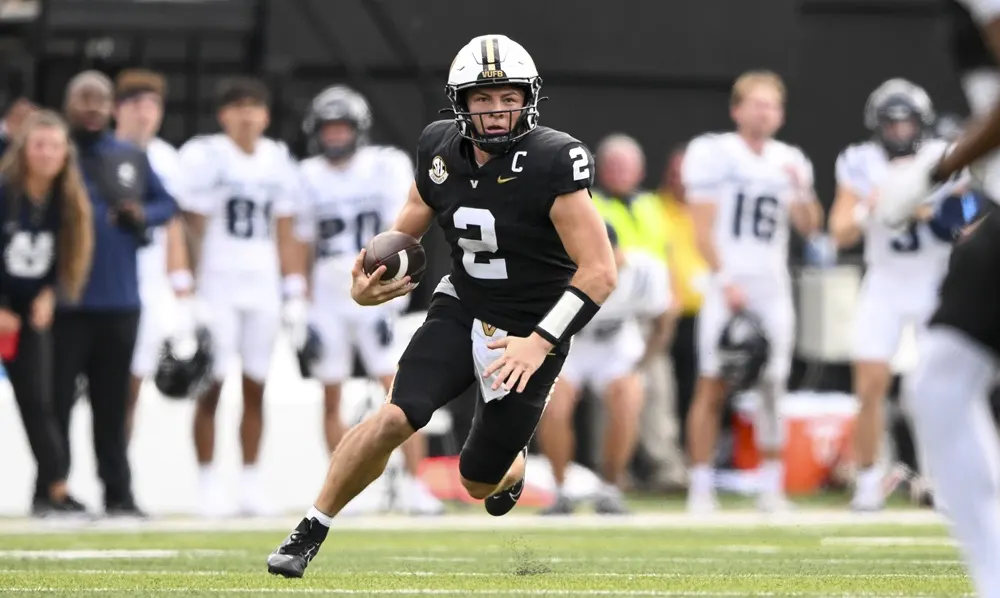
Vanderbilt quarterback Diego Pavia won a preliminary injunction in December 2024 that granted him an extra year of eligibility, arguing NCAA rules counting junior college seasons against Division I eligibility violate antitrust law. The case challenges the NCAA’s Five-Year Rule and is now expanding into a class-action lawsuit with multiple plaintiffs from different schools. The lawsuit could permanently change how the NCAA counts JUCO seasons.
What the Diego Pavia Lawsuit Is About
Pavia sued the NCAA in November 2024 under the Sherman Antitrust Act, claiming NCAA eligibility bylaws unfairly restrict former junior college players from competing and earning NIL money.
The lawsuit targets three specific NCAA rules:
- Bylaw 12.8 (Five-Year Rule): Limits athletes to four seasons in five years
- Bylaw 12.02.6: Counts junior college seasons toward NCAA eligibility even though JUCO schools aren’t NCAA members
- JUCO Transfer Cap: Limits junior college transfers to maximum three years at Division I schools
Pavia played two seasons at New Mexico Military Institute (2020-2021), then two seasons at New Mexico State (2022-2023), before transferring to Vanderbilt for 2024. Under current NCAA rules, his eligibility should have ended after the 2024 season.
The Groundbreaking December 2024 Ruling
U.S. District Judge William Campbell granted Pavia’s preliminary injunction on December 18, 2024, allowing him to play the 2025 season.
Judge Campbell’s reasoning centered on the NIL era fundamentally changing college sports. He found NCAA eligibility rules now directly affect athletes’ ability to enter “the labor market for NCAA Division I football” and negotiate commercial transactions.
The judge rejected the NCAA’s arguments based on pre-NIL cases from the 2000s, stating those decisions “were grounded in a pre-NIL world” and designed to keep commercial interests out. With NIL now part of college sports, Campbell determined the rules harm competition by denying former JUCO players equal time in the Division I market.
Related article: Roseanne Barr Lawsuit, Why Roseanne Barr Can’t Sue ABC: Legal Experts Explain the Reality Behind the Viral Claims
Why JUCO Seasons Shouldn’t Count: Pavia’s Core Argument
Pavia’s attorneys argue junior college football provides dramatically less opportunity than Division I:
NIL Opportunities:
- JUCO offers minimal to no NIL earning potential
- No television exposure
- No major brand partnerships
- Limited social media reach
Professional Development:
- Lower level of competition
- Less exposure to NFL scouts
- Inferior coaching and facilities
- Minimal media coverage
The Comparison That Matters: The lawsuit points out NCAA rules don’t penalize athletes who:
- Attend prep school after high school
- Serve in the military
- Play professionally in another sport (example: Chris Weinke played baseball before football)
- Take time off for other reasons
Former Auburn/Oregon quarterback Bo Nix played five full Division I seasons. Pavia argues junior college seasons shouldn’t be equivalent to NCAA seasons when they offer none of the same benefits.
The NCAA’s Response and Blanket Waiver
The NCAA initially fought the injunction but changed strategy after losing in district court.
In late December 2024, the NCAA granted a blanket waiver allowing all former JUCO athletes to receive an extra year of eligibility for the 2025 season. This waiver applied to any athlete who “competed at a non-NCAA school for one or more years” and would have exhausted eligibility after 2024-25.
The NCAA’s statement expressed disappointment and called for Congressional intervention: “Altering the enforcement of rules overwhelmingly supported by NCAA member schools makes a shifting environment even more unsettled.”
However, the waiver is temporary—only for one season—and doesn’t represent a permanent rule change.
The Sixth Circuit Dismisses NCAA’s Appeal
The NCAA appealed Judge Campbell’s injunction to the Sixth Circuit Court of Appeals, but in October 2025, the appellate court dismissed the appeal as moot.
The court reasoned that since the NCAA granted Pavia the waiver guaranteeing he could play 2025, the appeal no longer provided “effectual relief.” The preliminary injunction it was appealing had effectively been rendered meaningless by the NCAA’s own blanket waiver.
Pavia Turns His Case Into a Class Action
In October 2025, Pavia’s attorney Ryan Downton announced plans to file an amended complaint adding multiple plaintiffs to create a proposed class action.
New Plaintiffs Include:
- Tre Richardson (Vanderbilt)
- Andrew Burnette (Louisiana Tech)
- James Djonkam (Virginia Tech)
- Iman Oates (Oklahoma State)
- Joey Aguilar (Tennessee) – added November 2025
The goal: permanently eliminate the NCAA rule requiring JUCO seasons to count against Division I eligibility for all affected athletes, not just Pavia.
Downton told Front Office Sports the objective isn’t destroying all eligibility rules. He believes players should have five full years to play NCAA sports once they enroll at a four-year institution.
The Flood of Similar Lawsuits
Pavia’s victory opened the floodgates. More than 35 athletes have filed their own lawsuits challenging various NCAA eligibility restrictions since December 2024.
The problem: federal judges in different districts have issued conflicting rulings, leaving eligibility to the whims of local courts. Some athletes won injunctions while others were denied.
“Pavia’s impact has been huge,” Boise State law professor Sam Ehrlich told Front Office Sports. “The more exposure his legal victory gets, the more other athletes wonder why they can’t get the same treatment.”
This inconsistency is precisely why Pavia’s lawyers are pursuing the class-action route—to establish nationwide precedent.
What Legal Experts Say About the Case
The lawsuit relies on landmark precedents where college athletes defeated the NCAA:
O’Bannon v. NCAA (2014): Established the NCAA violated antitrust law by restricting compensation related to athletes’ names, images, and likenesses.
Alston v. NCAA (2021): Supreme Court unanimously ruled NCAA limits on education-related benefits violated antitrust law. Justice Brett Kavanaugh’s concurrence questioned the entire amateurism model.
These cases signaled courts are increasingly skeptical of NCAA arguments that eligibility rules serve important academic or competitive balance objectives.
Campbell’s ruling in Pavia follows this trend, explicitly stating we’re in a “post-Alston world” where NCAA rules must be scrutinized as restraints on competition in a labor market.
Pavia’s Future: NFL Draft But Staying in the Fight
Pavia announced he’ll declare for the 2026 NFL Draft and won’t seek a seventh season of college eligibility.
However, he’s remaining part of the lawsuit to ensure future athletes have the opportunities he fought for. His attorney has indicated they may seek to extend Pavia’s eligibility to 2026 if the class action succeeds—arguing that without counting JUCO years, he’d be pursuing his fifth season in five years.
Pavia led Vanderbilt to a 6-6 record in 2024, including a stunning 40-35 upset over No. 1 Alabama—Vanderbilt’s first win over the Crimson Tide in 40 years. He’s remained with the Commodores for 2025.
What This Means for Junior College Transfers
If the class action succeeds, the implications are massive:
For Current JUCO Players:
- JUCO seasons wouldn’t count against Division I eligibility
- Athletes would have four full years at Division I schools
- Increased NIL earning potential
- More time to develop and showcase skills for NFL scouts
For College Football:
- More experienced players staying longer
- Roster management challenges for coaches
- Potential transfer portal complications
- Recruiting dynamics shift
For the NCAA:
- Loss of control over eligibility standards
- Pressure to fundamentally reform rules
- Heightened Congressional lobbying efforts
The NCAA’s Congressional Lifeline
The NCAA and power conferences are actively lobbying Congress to pass legislation granting antitrust protections.
The proposed SCORE Act has bipartisan support and backing from athletes across all three divisions. It would allow the NCAA to set its own eligibility rules without constant legal challenges.
NCAA lawyers warned in their initial response that Pavia’s case could “adversely disrupt the collegiate experiences and opportunities for tens of thousands of prospective and current student-athletes.”
Current Status and What Happens Next
Where the Case Stands:
- Preliminary injunction granted (December 2024)
- NCAA appeal dismissed as moot (October 2025)
- Amended complaint with additional plaintiffs expected
- Class certification hearings likely in 2026
- Full trial on the merits still pending
Timeline Ahead: The case will move through multiple stages before final resolution. Even if class certification succeeds, the NCAA will vigorously defend its eligibility rules at trial.
However, the preliminary injunction ruling and the NCAA’s blanket waiver signal the governing body recognizes its position is weak.
Frequently Asked Questions
Q: Does this ruling apply to all junior college transfers?
Currently, no. The preliminary injunction technically only applied to Pavia, though the NCAA issued a blanket waiver for 2025. The class action seeks to make the rule change permanent and nationwide.
Q: How many years can college athletes play now?
The standard remains four seasons in five years. However, COVID granted everyone an extra year, and former JUCO players now have the 2025 waiver. If Pavia’s lawsuit succeeds, JUCO years won’t count at all.
Q: Can current junior college players benefit from this?
Yes, if the class action succeeds. The blanket waiver already helps those who would have exhausted eligibility after 2024. Future rulings could establish permanent changes.
Q: What is the Sherman Antitrust Act?
Federal law prohibiting anti-competitive business practices. Pavia argues NCAA eligibility rules illegally restrain competition in the labor market for Division I athletes.
Q: Why does NIL matter in this case?
NIL transformed college athletics into a commercial marketplace. Judge Campbell found that once athletes can earn money, NCAA rules restricting who can compete become restraints on a labor market subject to antitrust scrutiny.
Q: Could this lead to unlimited eligibility?
Unlikely. Pavia’s attorney emphasizes they’re not seeking to eliminate all eligibility rules—just arguing JUCO seasons shouldn’t count against Division I time.
Q: What about other sports?
The lawsuit focuses on football, but the legal principles could extend to all NCAA sports where JUCO participation counts against eligibility.
Q: How does this affect Vanderbilt?
Head coach Clark Lea supported Pavia’s lawsuit but noted he couldn’t leave the program in limbo. With the injunction granted and waiver issued, Vanderbilt benefits from having an experienced quarterback for 2025.
The Bigger Picture: NCAA Losing Control
The Pavia case represents another chapter in the NCAA’s steady loss of authority over college athletics.
Between the House settlement requiring schools to share revenue directly with athletes, multiple states passing NIL laws, and now courts invalidating eligibility rules, the NCAA faces an existential crisis.
Judge Campbell’s ruling makes clear that in the NIL era, courts will apply strict antitrust scrutiny to NCAA rules. The governing body’s traditional justifications—protecting amateurism and competitive balance—no longer carry weight when athletes are openly treated as commercial participants.
Unless Congress intervenes with antitrust protections, expect more lawsuits challenging fundamental NCAA rules around eligibility, transfers, and compensation.
This article provides general information about the Diego Pavia lawsuit. For specific legal advice, consult an attorney. Information is current as of December 24, 2025.
Case Name: Pavia v. NCAA, No. 3:24-cv-01336 (M.D. Tenn.)
Court: United States District Court for the Middle District of Tennessee
Judge: Chief U.S. District Judge William L. Campbell, Jr.
About the Author

Sarah Klein, JD, is a licensed attorney and legal content strategist with over 12 years of experience across civil, criminal, family, and regulatory law. At All About Lawyer, she covers a wide range of legal topics — from high-profile lawsuits and courtroom stories to state traffic laws and everyday legal questions — all with a focus on accuracy, clarity, and public understanding.
Her writing blends real legal insight with plain-English explanations, helping readers stay informed and legally aware.
Read more about Sarah