
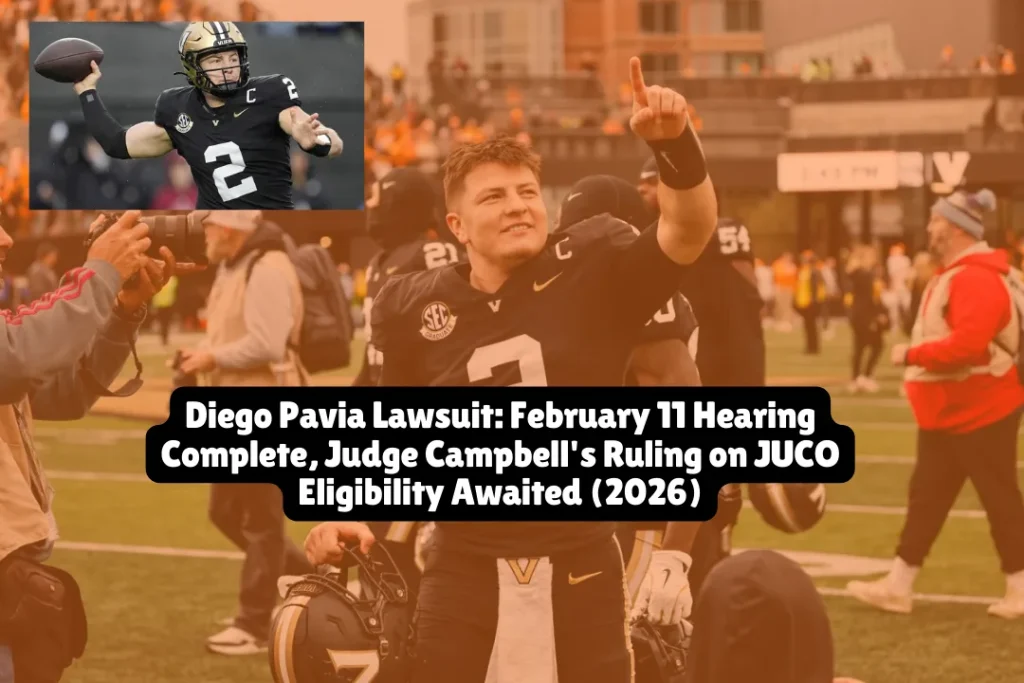
Diego Pavia Lawsuit, February 11 Hearing Complete, Judge Campbell’s Ruling on JUCO Eligibility Awaited 2026
Former Vanderbilt quarterback Diego Pavia and 26 co-plaintiffs await a federal judge’s decision after a February 11, 2026 hearing on whether junior college seasons should count against NCAA Division I eligibility. The ruling could extend playing careers for former JUCO athletes seeking additional years of competition and NIL earnings.
What Is the Diego Pavia Lawsuit About?
The lawsuit, filed as Pavia v. NCAA (Case No. 3:24-cv-01076) in the U.S. District Court for the Middle District of Tennessee, challenges NCAA eligibility rules counting junior college seasons against Division I playing time. According to court filings, Pavia and co-plaintiffs claim these bylaws violate Section 1 of the Sherman Antitrust Act by unfairly restricting former JUCO players’ access to Name, Image, and Likeness compensation.
Chief U.S. District Judge William L. Campbell Jr. granted Pavia a preliminary injunction on December 18, 2024, allowing him to play the 2025 season at Vanderbilt. The NCAA subsequently issued a blanket waiver for all similarly situated former JUCO athletes through the 2025-26 academic year.
Pavia’s legal team argues the NCAA unfairly treats former junior college players differently than other older athletes, limiting their earning potential in the college football market while allowing graduate transfers and other older players more flexibility.
Which NCAA Rules Are Being Challenged?
The lawsuit targets two specific NCAA eligibility bylaws. Bylaw 12.8.2 limits athletes to four seasons of competition within a five-year period, counting all collegiate competition including JUCO and Division II seasons.
Bylaw 12.02.6 specifically counts junior college seasons toward NCAA eligibility even though JUCO institutions aren’t NCAA members. These rules effectively limit former junior college football players to maximum three years at Division I schools if they played two JUCO seasons.
The legal claims center on antitrust violations under federal law. Plaintiffs argue these eligibility restrictions constitute an illegal group boycott of experienced college players designed to constrain labor costs and NIL earnings in the Division I football market.
Who Are the Key Parties in This Case?
Diego Pavia served as the original plaintiff. The 24-year-old quarterback started at New Mexico Military Institute in 2020, led the junior college to the 2021 national championship, then played at New Mexico State from 2022-2023 before transferring to Vanderbilt for the 2024 and 2025 seasons.
Twenty-six additional players joined as co-plaintiffs in late 2025, representing schools across Division I football. Tennessee quarterback Joey Aguilar initially joined but voluntarily dismissed himself on January 30, 2026, after hiring separate counsel.
The defendant is the National Collegiate Athletic Association. Judge William L. Campbell Jr. presides over the case in Nashville federal court. Pavia’s attorneys include Ryan Downton and Salvador Hernandez from The Texas Trial Group and Riley & Jacobson.
What Happened at the February 11, 2026 Hearing?
Judge Campbell heard arguments from both sides on Tuesday, February 11, 2026 regarding the plaintiffs’ motion for a preliminary injunction covering the 2026 season and beyond. Court documents indicate the NCAA and plaintiffs presented competing arguments about whether former JUCO players deserve full Division I eligibility.
The plaintiffs seek to exclude junior college seasons from counting against Division I eligibility limits. If successful, players like Pavia could theoretically play through the 2026 or even 2027 seasons depending on their individual circumstances and remaining eligibility.
As of February 13, 2026, Judge Campbell has not issued a ruling. Legal experts expect a decision within weeks rather than months, though no specific timeline has been announced. The outcome will determine whether 27 plaintiffs can continue their college football careers beyond the 2025 season.
What Legal Standards Apply to This Antitrust Case?
The lawsuit invokes the Sherman Antitrust Act, the primary federal law prohibiting anticompetitive business practices. Section 1 specifically prohibits contracts, combinations, or conspiracies that unreasonably restrain trade.
Courts evaluate antitrust challenges to NCAA rules under a “rule of reason” analysis. This requires examining whether the challenged rules promote competition and consumer welfare or whether they primarily serve to restrain trade and limit athlete compensation.
The Supreme Court’s NCAA v. Alston decision in 2021 established that NCAA amateurism rules receive no special antitrust immunity. Justice Brett Kavanaugh’s concurring opinion questioned whether many NCAA eligibility restrictions would survive antitrust scrutiny, providing legal foundation for cases like Pavia’s.
How Does This Compare to Other NCAA Eligibility Lawsuits?
This case is part of broader legal challenges to NCAA eligibility rules. The related NCAA lawsuit landscape includes multiple antitrust cases targeting various NCAA restrictions on athlete compensation and playing opportunities.
A separate case, Patterson v. NCAA, challenged the four-season limitation more broadly. Vanderbilt linebacker Langston Patterson and other plaintiffs sought to play a fifth season of competition within their five-year window. On January 15, 2026, Judge Campbell denied the preliminary injunction in Patterson, ruling the court wasn’t convinced plaintiffs would succeed on the merits.
The Pavia case differs because it specifically targets the unfair treatment of JUCO transfers rather than challenging the four-season rule itself. This narrower focus may strengthen plaintiffs’ antitrust arguments.
What Are the Potential Outcomes?
If Judge Campbell grants the preliminary injunction, the 27 plaintiffs could compete in the 2026 season and potentially 2027 depending on individual circumstances. This would allow former JUCO players to maximize their college football careers and NIL earning potential.
If the injunction is denied, plaintiffs would exhaust their eligibility after the 2025-26 academic year under current NCAA rules. However, they could still pursue the case to trial seeking permanent changes to NCAA eligibility bylaws.
A trial on the merits has not been scheduled. Both sides have suggested dates ranging from June 2026 to February 2027 for a final trial. Settlement remains possible though neither party has publicly indicated settlement discussions.
Where to Find Official Court Documents
Court filings for Pavia v. NCAA (Case No. 3:24-cv-01076) are available through PACER, the federal court electronic filing system. The Middle District of Tennessee website provides public access to case docket information at tnmd.uscourts.gov.
Major sports law outlets including Sports Illustrated, ESPN, and Sportico provide ongoing coverage of case developments. The Sports Litigation Alert newsletter offers detailed legal analysis of NCAA antitrust cases.
Monitor the official court docket for Judge Campbell’s ruling, which could be filed any day following the February 11, 2026 hearing. Court observers expect the decision before March 2026 given the time-sensitive nature of athlete eligibility.
Should You Consult an Attorney?
Former JUCO athletes facing similar eligibility restrictions may benefit from consulting sports law attorneys. The outcome of Pavia’s case could create legal precedent affecting thousands of junior college transfers nationwide.
Law firms specializing in NCAA eligibility disputes can evaluate individual circumstances and advise on potential legal options. Contact the National College Players Association at ncpanow.org for athlete advocacy resources and attorney referrals.
Sports agents and compliance officers at individual universities can also provide guidance on how the Pavia ruling might affect eligibility determinations once Judge Campbell issues his decision.
FAQs
What is the Diego Pavia lawsuit about?
The lawsuit challenges NCAA rules counting junior college seasons against Division I eligibility limits, arguing this violates federal antitrust law by restricting former JUCO players’ access to NIL compensation. Pavia and 26 co-plaintiffs seek to exclude JUCO seasons from NCAA eligibility calculations.
Who are the parties involved in this case?
Plaintiff Diego Pavia, a former Vanderbilt quarterback, leads 26 co-plaintiffs against the NCAA. Judge William L. Campbell Jr. presides in the U.S. District Court for the Middle District of Tennessee (Case No. 3:24-cv-01076).
What are the specific legal claims?
The lawsuit alleges the NCAA violates Section 1 of the Sherman Antitrust Act through eligibility rules (Bylaws 12.8.2 and 12.02.6) that count JUCO seasons against Division I playing time. Plaintiffs claim this constitutes an illegal restraint of trade in the college football labor market.
What is the current status of the lawsuit as of February 13, 2026?
Judge Campbell held a hearing on February 11, 2026 on plaintiffs’ motion for a preliminary injunction covering the 2026 season. As of February 13, 2026, no ruling has been issued, though a decision is expected within weeks.
What legal standards apply to these claims?
Courts apply “rule of reason” analysis to NCAA antitrust challenges, examining whether rules promote competition or primarily restrain trade. The Supreme Court’s 2021 NCAA v. Alston decision established NCAA rules receive no special antitrust immunity.
What could be the potential outcomes?
If the injunction is granted, 27 plaintiffs could compete in 2026 and potentially 2027. If denied, they would exhaust eligibility after the 2025-26 academic year. A full trial could result in permanent changes to NCAA eligibility rules.
Where can I find more information about this lawsuit?
Access court documents through PACER for Case No. 3:24-cv-01076 in the Middle District of Tennessee. Sports law outlets including ESPN, Sports Illustrated, and Sportico provide ongoing coverage of case developments.
Last Updated: February 13, 2026
Disclaimer: This article provides general information about the Diego Pavia lawsuit and does not constitute legal advice.
Need Legal Help? Former JUCO athletes with eligibility questions should consult sports law attorneys specializing in NCAA compliance matters.
Stay informed, stay protected. — AllAboutLawyer.com
About the Author

Sarah Klein, JD, is a licensed attorney and legal content strategist with over 12 years of experience across civil, criminal, family, and regulatory law. At All About Lawyer, she covers a wide range of legal topics — from high-profile lawsuits and courtroom stories to state traffic laws and everyday legal questions — all with a focus on accuracy, clarity, and public understanding.
Her writing blends real legal insight with plain-English explanations, helping readers stay informed and legally aware.
Read more about Sarah