
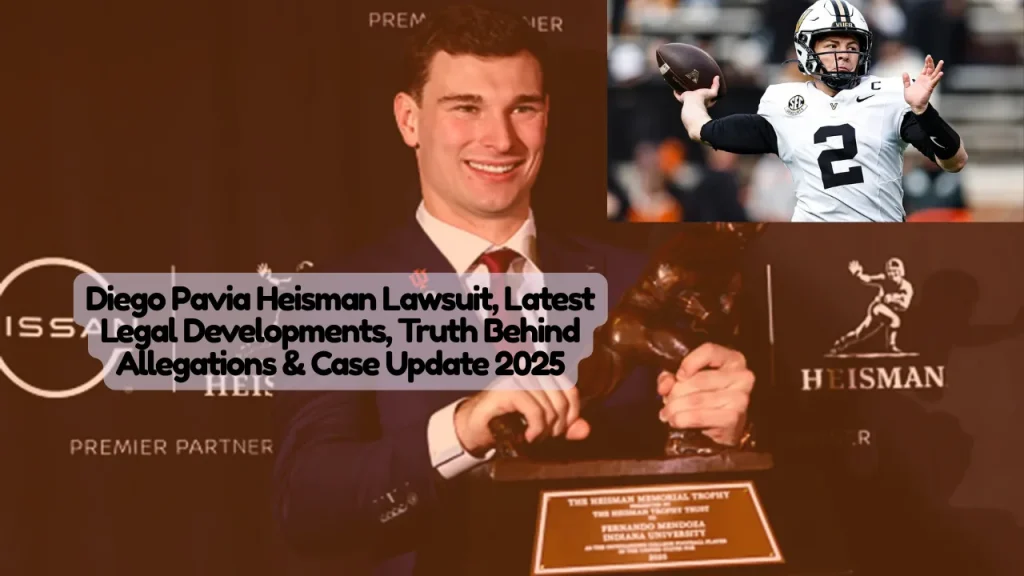
Diego Pavia Heisman Lawsuit, Latest Legal Developments, Truth Behind Allegations & Case Update 2025
Diego Pavia, Vanderbilt’s star quarterback, sued the NCAA in November 2024 challenging eligibility rules that count junior college seasons against Division I playing time. Federal Judge William Campbell granted a preliminary injunction in December 2024, ruling Pavia likely to succeed on antitrust claims under the Sherman Act. The NCAA appealed but then granted a blanket waiver for all affected athletes for 2025-26. The Sixth Circuit dismissed the NCAA’s appeal as moot in October 2025. Pavia’s lawyers now seek class action status, potentially ending JUCO eligibility restrictions permanently.
What Is the Diego Pavia Heisman Lawsuit About?
The Diego Pavia lawsuit challenges NCAA bylaw 12.02.6, which requires junior college playing time to count toward the four-season eligibility limit for Division I athletes. Pavia played two seasons at New Mexico Military Institute (JUCO) from 2020-2021, then two seasons at New Mexico State before transferring to Vanderbilt for 2024. Under NCAA rules, his eligibility should have ended after the 2024 season.
Pavia filed his lawsuit on November 8, 2024, in U.S. District Court for the Middle District of Tennessee. The complaint alleges the NCAA’s JUCO rule violates federal antitrust law by unlawfully restraining competition in the labor market for Division I football players. Specifically, the lawsuit argues the rule limits Pavia’s ability to earn name, image, and likeness (NIL) compensation.
The case names the NCAA as defendant. Pavia, represented by attorney Ryan Downton, seeks an injunction preventing the NCAA from enforcing JUCO eligibility limitations and requests two additional seasons of eligibility. The lawsuit challenges three specific NCAA bylaws: the intercollegiate competition rule (12.02.6), the Five-Year Rule (12.8), and the Three-Year Transfer Limitation (14.3.3).
What Do the Latest Legal Developments Reveal?
December 2024: Preliminary Injunction Granted
On December 18, 2024, Chief U.S. District Judge William L. Campbell Jr. granted Pavia’s preliminary injunction. Judge Campbell ruled Pavia demonstrated a strong likelihood of success on his Sherman Act antitrust claim. The court found NCAA eligibility rules function as restraints on trade with substantial anticompetitive effects in the modern NIL era.
Judge Campbell emphasized that contemporary college athletes sign endorsement, sponsorship, and influencing deals, making NCAA rules about “who can enter the labor market for NCAA Division I football” directly connected to commercial transactions. The injunction blocked the NCAA from ruling Pavia ineligible for 2025 and prohibited penalties against Vanderbilt or any future school Pavia attended.
December 2024: NCAA Grants Blanket Waiver
On December 23, 2024, just five days after the injunction, the NCAA Division I Board of Directors granted a one-time waiver for all athletes in Pavia’s situation. The waiver permits student-athletes “who attended and competed at a non-NCAA school for one or more years to remain eligible and compete in 2025-26 if those student-athletes would have otherwise used their final season of competition during the 2024-25 academic year.” The NCAA simultaneously announced plans to appeal the preliminary injunction.
October 2025: Sixth Circuit Dismisses NCAA Appeal
On October 1, 2025, the Sixth Circuit Court of Appeals dismissed the NCAA’s appeal as moot. Judge Amul R. Thapar wrote: “The NCAA gave Pavia exactly what he wanted — a waiver that guaranteed he could play for Vanderbilt in 2025. Because that waiver provides Pavia complete relief at the preliminary-injunction stage, we dismiss the NCAA’s appeal as moot.”
The three-judge panel unanimously agreed the NCAA’s own blanket waiver rendered the appeal without purpose. Judge Whitney D. Hermandorfer’s concurrence emphasized that antitrust law applies to eligibility rules: “that’s not because the NCAA can immunize any trade restraint from review by deeming it ‘eligibility’ related.” The court left the preliminary injunction intact.
October 2025: Class Action Filing
Pavia’s attorney Ryan Downton filed an amended complaint in October 2025 seeking class action status. New plaintiffs include:
- Tennessee QB Joey Aguilar
- Vanderbilt WR Tre Richardson
- Louisiana Tech’s Andrew Burnette
- Virginia Tech’s James Djonkam
- Oklahoma State’s Iman Oates
The class action aims to permanently change NCAA rules requiring JUCO seasons to count against eligibility. More than 35 similar lawsuits have been filed by other athletes since Pavia’s initial victory, creating legal confusion with judges reaching conflicting decisions across different jurisdictions.
What Is the Truth Behind the Allegations?
Court documents and verified evidence reveal Pavia’s core allegations are factually supported. The truth behind the case rests on documented disparities in how the NCAA treats different athletes.
Verified Fact: NCAA Treats JUCO Players Differently
Judge Campbell’s December 2024 order confirmed the NCAA does not start the eligibility clock for prep school student-athletes, athletes serving in the military, athletes with religious obligations, or athletes with professional careers in other sports. Only JUCO athletes face this restriction despite junior colleges not being NCAA members.
Verified Fact: JUCO Lacks NIL Opportunities
Pavia’s attorneys documented that junior college football provides no meaningful NIL opportunities and minimal television exposure compared to Division I programs. Court filings established Pavia stood to earn over $1 million in NIL compensation in 2025. The NCAA does not dispute these earnings would be unavailable at the JUCO level.
Verified Fact: Rules Evolved Over Time
Judge Campbell noted NCAA eligibility rules have changed significantly over decades. Years ago, freshmen couldn’t play varsity football and athletes had only three seasons of varsity eligibility. Now athletes can play four seasons within five years with relaxed redshirt rules. The court found claims of “natural and standard degree progression” appear pretextual given this evolution.
Verified Fact: Age Distinctions Don’t Hold
The NCAA argued JUCO players are older, pointing to Pavia being 23 years old. However, court documents establish other Division I players reach similar ages through military service, religious missions, professional careers in other sports, or independent academic work. The NCAA allows these older athletes to compete without penalty.
What Are the Legal Claims in This Case?
Sherman Antitrust Act Violation
The primary legal claim alleges NCAA eligibility rules violate Section 1 of the Sherman Antitrust Act (15 U.S.C. § 1). This federal law prohibits agreements in restraint of trade or commerce. Pavia argues the NCAA and its member institutions are competing businesses that unlawfully restrain the labor market for Division I football players.
Judge Campbell found Pavia likely to succeed on this claim because NCAA rules limiting JUCO eligibility are “restraints on trade with substantial anticompetitive effects.” The court determined that in the modern college sports landscape where athletes earn NIL compensation, eligibility rules must be evaluated as economic restraints directly impacting commercial opportunities.
Unlawful Restraint of Trade
The complaint argues NCAA member institutions constitute competitors in a labor market for college athletes. When these competitors agree to limit how long athletes can participate, this functions as illegal price-fixing by capping athletes’ ability to develop skills and earn money. The restraint is particularly significant because the rules are not collectively bargained with a union.
Irreparable Harm
Pavia established he would suffer irreparable harm without an injunction. Court filings demonstrated:
- Loss of over $1 million in NIL compensation for 2025
- Inability to develop football skills at the highest level
- Loss of opportunity for endorsement and sponsorship deals
- Decreased NFL draft prospects
- Cannot relive his short college career
What Laws and Regulations Apply?
Federal Antitrust Law
The Sherman Antitrust Act, enacted in 1890, prohibits contracts, combinations, or conspiracies in restraint of trade. Section 1 applies when multiple entities agree to restrain commerce. The U.S. Supreme Court’s 2021 decision in NCAA v. Alston established that NCAA compensation rules are subject to antitrust scrutiny.
While Alston addressed compensation rules rather than eligibility rules, Judge Campbell and the Sixth Circuit judges indicated eligibility rules affecting NIL opportunities fall within antitrust law’s scope. Justice Brett Kavanaugh’s Alston concurrence, which the NCAA cited in its defense, emphasized that NCAA rules must withstand antitrust scrutiny when they restrain competition.
NCAA Bylaws at Issue
- Bylaw 12.02.6 (Intercollegiate Competition Rule): Requires JUCO seasons count toward four-season eligibility limit
- Bylaw 12.8 (Five-Year Rule): Athletes must complete four seasons within five years of initial enrollment
- Bylaw 14.3.3 (Three-Year Transfer Limitation): Limits transfers after three years
Relevant Precedent
The case builds on NCAA v. Board of Regents (1984), which established NCAA rules are subject to antitrust scrutiny, and NCAA v. Alston (2021), which found NCAA compensation restrictions violated antitrust law. However, conflicting rulings exist: the Seventh Circuit sided with the NCAA in Fourqurean v. NCAA, creating a potential circuit split that could reach the Supreme Court.
Who Can Be Held Legally Liable?
The NCAA bears primary liability as the defendant in this case. As a membership organization of colleges and universities, the NCAA creates and enforces eligibility rules. Judge Campbell’s preliminary injunction suggests the NCAA likely violated antitrust law through these rules.
Member institutions face potential liability as co-conspirators. The Sherman Act applies when competing businesses agree to restrain trade. NCAA member schools are competing businesses in the market for college athletes. Their agreement to enforce JUCO eligibility limitations could constitute an illegal agreement in restraint of trade.
However, the preliminary injunction specifically protects Vanderbilt and any future school Pavia attends from NCAA penalties. This provision acknowledges that schools face pressure from the NCAA’s enforcement structure and may not be primary wrongdoers in the eligibility rule scheme.
Potential Legal Consequences for NCAA
- Permanent injunction blocking JUCO eligibility rules
- Mandatory rule changes for all member institutions
- Class action damages to affected athletes
- Loss of ability to enforce eligibility restrictions
- Precedent allowing broader challenges to NCAA rules
What Damages Are Being Sought?
Pavia’s lawsuit seeks both equitable relief and potential monetary damages. The complaint prioritizes injunctive relief over financial compensation, focusing on restoring eligibility rather than recovering past losses.
Equitable Relief Requested
- Preliminary and permanent injunctions blocking NCAA enforcement of JUCO eligibility limitations
- Two additional seasons of Division I eligibility
- Protection from NCAA penalties for Vanderbilt and future schools
- Declaratory judgment that NCAA rules violate antitrust law
Potential Monetary Damages
While the initial complaint focuses on injunctive relief, antitrust violations can result in:
- Treble damages (three times actual damages) under Sherman Act
- Compensation for lost NIL opportunities exceeding $1 million annually
- Recovery for decreased draft stock and professional prospects
- Attorney’s fees and litigation costs
The class action expansion significantly increases potential damages. If successful, the lawsuit could require compensation for hundreds or thousands of former JUCO athletes who lost eligibility and NIL opportunities under NCAA rules.
What Is the Current Status of the Lawsuit?
As of December 2025, the case remains active at the district court level despite the Sixth Circuit’s dismissal of the NCAA’s appeal. The preliminary injunction secured Pavia’s eligibility for 2025, but the underlying lawsuit continues.
Active Proceedings
The case is pending before Chief Judge William L. Campbell Jr. in the U.S. District Court for the Middle District of Tennessee. The October 2025 amended complaint seeking class action status adds complexity and scope. Discovery likely continues as attorneys gather evidence about NCAA practices and their impact on JUCO transfers.
Pavia declared for the 2026 NFL Draft, confirming the 2025 season was his final college campaign. However, he remains a plaintiff in the class action to ensure future athletes receive the same opportunities. His continued participation strengthens the case’s legal standing.
NCAA’s Position
The NCAA argues eligibility rules are non-commercial and therefore exempt from antitrust scrutiny. In appellate briefs, NCAA attorneys cited the 2008 Bassett v. NCAA decision where the Sixth Circuit ruled NCAA enforcement actions were “not related” to “commercial or business activities.”
However, Judge Hermandorfer’s Sixth Circuit concurrence in October 2025 signaled courts may reject this argument in the NIL era: “that’s not because the NCAA can immunize any trade restraint from review by deeming it ‘eligibility’ related.” The NCAA simultaneously lobbies Congress for antitrust immunity through proposed legislation like the SCORE Act.
What Potential Outcomes Exist?
Favorable Outcome for Pavia
If Pavia prevails at trial or through summary judgment, the court could:
- Grant permanent injunction ending JUCO eligibility counting against NCAA limits
- Certify class action covering hundreds of affected athletes
- Award monetary damages including treble damages under Sherman Act
- Force NCAA to rewrite eligibility bylaws
- Create precedent for challenging other NCAA eligibility rules
This outcome would fundamentally alter college athletics by allowing athletes five years of Division I play after two JUCO years, potentially extending careers into athletes’ mid-20s.
NCAA Victory
If the NCAA successfully defends its position, courts could:
- Rule eligibility rules are non-commercial and exempt from antitrust law
- Find NCAA rules reasonable despite competitive effects
- Dissolve the preliminary injunction
- Dismiss class action claims
- Preserve NCAA control over eligibility standards
This outcome becomes less likely given the preliminary injunction finding and the Sixth Circuit’s October 2025 language suggesting antitrust law applies to eligibility rules affecting NIL opportunities.
Settlement
The parties could negotiate a settlement involving:
- Modified eligibility rules giving JUCO transfers additional playing time
- One-time payments to affected class members
- Prospective rule changes without admission of liability
- Creation of special waiver process for JUCO athletes
The NCAA’s December 2024 blanket waiver suggests willingness to compromise rather than face permanent court-ordered changes.
Congressional Intervention
The NCAA lobbies for federal legislation granting antitrust immunity for eligibility rules. The SCORE Act and similar proposals would allow the NCAA to set eligibility standards without court interference. NCAA President Charlie Baker stated lawmakers view eligibility challenges as the most compelling reason to pass legislation.
If Congress passes such legislation, it could moot the lawsuit by exempting NCAA eligibility rules from antitrust scrutiny. However, political challenges make passage uncertain.
Supreme Court Review
The Seventh Circuit’s 2024 ruling in Fourqurean v. NCAA sided with the NCAA on similar eligibility issues, creating a circuit split with the Sixth Circuit’s approach in Pavia. Circuit splits often trigger Supreme Court review. If the Supreme Court accepts certiorari, it could:
- Definitively rule whether eligibility rules face antitrust scrutiny
- Establish national standards for NCAA rule challenges
- Clarify Alston’s application to non-compensation rules
- Resolve inconsistencies between circuit courts
Frequently Asked Questions
When was the Diego Pavia lawsuit filed?
Diego Pavia filed his lawsuit against the NCAA on November 8, 2024, in the U.S. District Court for the Middle District of Tennessee in Nashville. The case is captioned Pavia v. NCAA, Case No. 3:24-cv-01336.
What did Judge Campbell rule in December 2024?
On December 18, 2024, Judge William L. Campbell Jr. granted Pavia’s preliminary injunction, finding he had a strong likelihood of success on his Sherman Act antitrust claim. The court ruled NCAA bylaws limiting JUCO eligibility are restraints on trade with substantial anticompetitive effects. The injunction allowed Pavia to play in 2025 and protected Vanderbilt from NCAA penalties.
What happened with the NCAA’s appeal?
The NCAA appealed Judge Campbell’s preliminary injunction to the Sixth Circuit Court of Appeals. However, the NCAA also granted a blanket waiver allowing all affected athletes to play in 2025-26. On October 1, 2025, the Sixth Circuit dismissed the NCAA’s appeal as moot because the blanket waiver gave Pavia everything he sought at the preliminary injunction stage.
What does the class action expansion mean?
In October 2025, Pavia’s lawyers filed an amended complaint adding multiple plaintiffs and seeking class action status. This expands the case beyond Pavia to potentially cover all former JUCO athletes affected by NCAA eligibility rules. If certified, the class action could permanently end JUCO eligibility restrictions and result in compensation for hundreds or thousands of athletes who lost playing time and NIL opportunities.
Why did Pavia win his injunction?
Judge Campbell found Pavia likely to succeed because NCAA rules restricting JUCO eligibility violate antitrust law in the modern NIL era. The court determined these rules function as restraints on trade by limiting athletes’ ability to earn NIL compensation, develop skills, and compete at the Division I level. The NCAA treats JUCO players differently than prep school athletes, military service members, and athletes with professional careers in other sports, undermining the NCAA’s justifications.
What is the SCORE Act?
The SCORE Act is proposed federal legislation that would grant the NCAA antitrust immunity for setting eligibility rules. The NCAA and power conferences lobby Congress to pass this bill, which would prevent lawsuits like Pavia’s from challenging eligibility restrictions. NCAA President Charlie Baker stated lawmakers view eligibility challenges as the most compelling reason to enact protective legislation. Passage remains uncertain due to political considerations.
Will Pavia play in 2026?
No. Pavia declared for the 2026 NFL Draft and confirmed the 2025 season was his final college campaign. However, he remains a plaintiff in the class action lawsuit to ensure future JUCO transfers receive the same opportunities he fought for. His continued participation strengthens the case even though he won’t personally benefit from additional eligibility.
How many other athletes filed similar lawsuits?
More than 35 college athletes filed lawsuits challenging various NCAA eligibility rules following Pavia’s initial victory. These cases, known as “Pavia lawsuits,” have produced conflicting results across different federal courts. Some judges granted injunctions while others sided with the NCAA, creating legal uncertainty. Pavia’s attorney stated this lack of clarity motivated the push for class action status to achieve a comprehensive, nationwide resolution.
—
Disclaimer: This article provides general information about the Diego Pavia lawsuit for educational purposes only and does not constitute legal advice. Laws and case outcomes may change. Consult a qualified attorney for advice about specific legal situations.
About the Author

Sarah Klein, JD, is a licensed attorney and legal content strategist with over 12 years of experience across civil, criminal, family, and regulatory law. At All About Lawyer, she covers a wide range of legal topics — from high-profile lawsuits and courtroom stories to state traffic laws and everyday legal questions — all with a focus on accuracy, clarity, and public understanding.
Her writing blends real legal insight with plain-English explanations, helping readers stay informed and legally aware.
Read more about Sarah