
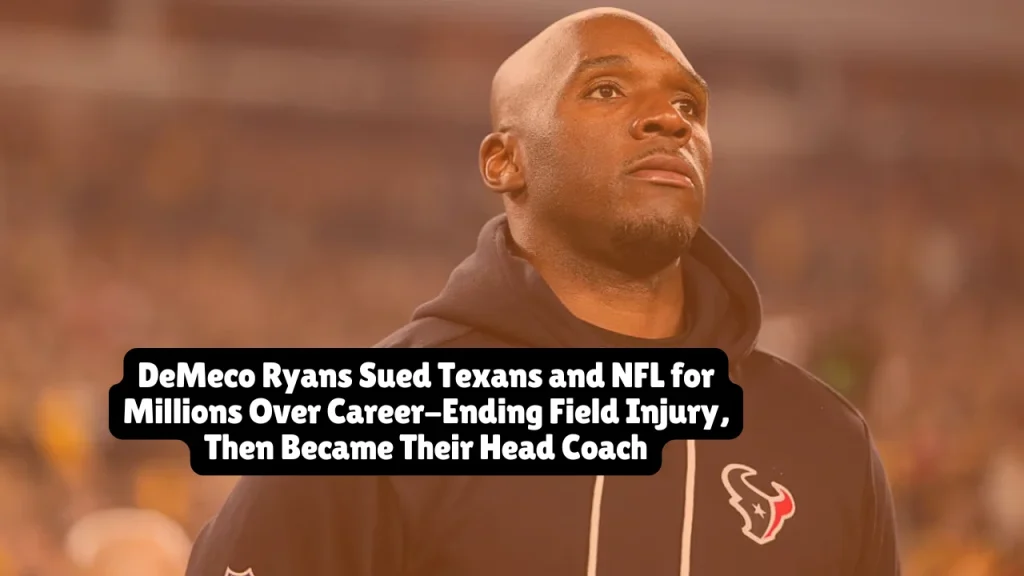
DeMeco Ryans Sued Texans and NFL for Millions Over Career-Ending Field Injury, Then Became Their Head Coach
DeMeco Ryans sued the Houston Texans and NFL in October 2016 seeking over $10 million in damages, alleging a defective playing surface at NRG Stadium ended his career when he tore his Achilles tendon in November 2014. The lawsuit was forced into arbitration in August 2019 and quietly settled, clearing the way for Ryans to become the Texans’ head coach in January 2023—transforming the franchise he once sued into a playoff powerhouse.
What sounds like fiction is the remarkable reality of the Houston Texans’ most successful era.
What DeMeco Ryans Sued The Texans and NFL For
DeMeco Ryans filed his lawsuit on October 14, 2016 in Harris County District Court, seeking more than $10 million in damages for a career-ending Achilles tendon injury suffered on November 2, 2014 at NRG Stadium.
The allegations centered on the stadium’s playing surface. At the time, the Texans used StrathAyr Natural Turf Modules—squares of grass grown in trays outside the stadium and placed by forklift onto the playing surface. Ryans, then playing for the Philadelphia Eagles against his former team, tore his Achilles on a non-contact play.
His lawsuit named five defendants: the NFL, Houston NFL Holdings LP (the Texans), Harris County Convention Sports Corp (stadium owner), SMG (stadium manager), and StrathAyr Turf Systems, the Australian company that manufactured the turf.
The Legal Claims Against the Texans
Ryans asserted a claim for premises liability as an invitee, alleging the Texans as possessor of NRG Stadium owed him a duty of ordinary care including providing a reasonably safe playing field.
The lawsuit claimed the Texans breached this duty by negligently selecting an unreasonably dangerous field design made of hundreds of individual turf modules instead of a single contiguous piece of natural grass. According to court documents, Ryans alleged the Texans further breached their duty by negligently installing and maintaining these modules.
The lawsuit stated that on November 2, 2014, there were points where seams between modules appeared to look like holes filled with sand, the surface was inconsistent as some modules were soft while others were firm, and the modules did not fit together well.
How Much Money Was At Stake
Ryans estimated that if not for the injury he would have played in the NFL for another five years and made at least $10 million. This formed the basis for his damages claim.
The lawsuit argued his injury “prematurely ended his noteworthy NFL career.” Ryans had accumulated 939 tackles, 13.5 sacks, and seven interceptions over his 10-year career before the injury forced his retirement in 2016.
Before the injury, Ryans had 240 combined tackles in the 2012-13 seasons but compiled just 94 tackles over the 2014-15 seasons because of injuries. The Philadelphia Eagles released him in February 2016.
Why Ryans Believed The Field Was Negligent
The lawsuit cited widespread complaints about NRG Stadium’s playing surface from coaches and players across the league.
After Patriots receiver Wes Welker tore his knee during a game against the Texans in January 2010, Patriots coach Bill Belichick spoke candidly about the playing surface, saying it was terrible and inconsistent.
Related Article: Stefon Diggs Lawsuit Update, Patriots Star Faces Criminal Charges Plus Two Civil Cases Over Assault and Extortion Claims (2026)
The lawsuit pointed to another high-profile injury. Texans outside linebacker Jadeveon Clowney, drafted with the No. 1 pick in 2014, said a hole in the turf caused a knee injury in his first regular season game at NRG Stadium. According to the complaint, only after Clowney’s injury did the Texans take action to fix the problem.
The Legal Battle: Courts vs. Arbitration
The case became a procedural nightmare spanning three years before reaching resolution.
The Texans removed the case to federal district court based on federal-question jurisdiction, arguing Ryans’ premises-liability claim was preempted by Section 301 of the Labor Management Relations Act because resolution required interpretation of the NFL Collective Bargaining Agreement.
The federal district court disagreed and remanded the case back to state court. Then in June 2018, the Texans filed a motion to compel arbitration under Article 43 of the CBA, which requires arbitration of disputes involving interpretation or application of the CBA or NFL Rules.
The trial court denied the arbitration motion. The Texans appealed.
The Appeals Court Ruling That Changed Everything
In August 2019, the Texas Court of Appeals reversed the trial court and ordered that the claims against the Texans be sent to arbitration.
The First Court of Appeals found that the district court abused its discretion, holding that Ryans’ claims were too intertwined with the CBA which requires him to arbitrate. The court determined that resolving the premises liability claim required interpreting NFL rules concerning playing fields, which were governed by the collective bargaining agreement.
Ryans petitioned the Texas Supreme Court to reverse the arbitration order. In August 2020, the Texas Supreme Court declined to overturn the ruling that the case must go to arbitration.
How The Case Was Resolved
The lawsuit ended up being settled privately. The settlement terms remain confidential, which is standard in resolved NFL player disputes.
Neither the Texans nor Ryans disclosed the settlement amount or specific terms. Based on the private resolution and absence of public court records detailing payment, the settlement likely included confidentiality provisions preventing either party from discussing financial details.
One tangible outcome: The Texans eventually shifted to AstroTurf a season later. The team replaced the controversial StrathAyr system with artificial turf made by UBU Sports.
The Remarkable Turn: From Plaintiff to Head Coach
On January 31, 2023, the Houston Texans hired DeMeco Ryans as their head coach—just three years after the Supreme Court decision forced his lawsuit into private arbitration.
Ryans signed a six-year contract with the team he had sued, becoming the franchise’s sixth full-time head coach. Owner Cal McNair called Ryans “everything we are looking for in a leader and coach for our organization.”
Ryans had spent his first six NFL seasons (2006-2011) with the Texans, winning Defensive Rookie of the Year in 2006 and making two Pro Bowls before being traded to Philadelphia in 2012. After retiring, he transitioned to coaching with the San Francisco 49ers, earning 2022 Assistant Coach of the Year honors.
NBC Sports reported that Ryans’ interest in the Texans job remained unaffected by his prior lawsuit against the team, noting that the injury case is far less personal than other types of disputes.
What You Must Know
The Legal Precedent This Case Created
The Ryans decision delivered a severe blow to NFL players seeking refuge in courts for their claims and trying to avoid arbitration provisions in their contract and the CBA.
The Texas Court of Appeals established that even premises liability claims—typically state law tort matters—can be forced into NFL arbitration if they involve interpretation of league rules. This significantly limits where injured players can seek legal remedies.
This precedent contrasts with earlier cases like Orlando Brown’s lawsuit against the NFL after a referee’s penalty flag struck and partially blinded him. Brown successfully avoided arbitration. The Ryans case narrowed that escape route.
Why NFL Arbitration Matters
Arbitration under the NFL’s Collective Bargaining Agreement differs dramatically from public court proceedings. The arbitrator is appointed by the league, hearings are private, and decisions aren’t subject to the same appeals process as court judgments.
Critics argue this creates an inherent conflict of interest since the NFL Commissioner—representing team owners—oversees the arbitration system. The Brian Flores lawsuit update NFL petitions Supreme Court after losing arbitration battle January 2026 highlights ongoing disputes about whether NFL-controlled arbitration provides fair resolution for player claims.
How Common Are NFL Field Injury Lawsuits
Player lawsuits over field conditions remain relatively rare but not unprecedented. The Ryans case echoed concerns raised after high-profile injuries on poorly maintained surfaces.
Several factors make these claims difficult: proving causation between field conditions and specific injuries, overcoming arbitration clauses in player contracts, and establishing that teams knew about dangerous conditions but failed to remedy them.
The widespread player complaints about NRG Stadium’s surface—from coaches like Bill Belichick to injured stars like Wes Welker and Jadeveon Clowney—gave Ryans’ allegations credibility. Yet even with this evidence, the case was removed from public courtrooms.
The Franchise Transformation Under Ryans
Ryans was hired as head coach on January 31, 2023 after signing a six-year contract, becoming the third head coach hired in the last three offseasons by the Texans.
The franchise was struggling when Ryans arrived, having finished with five wins or fewer in three consecutive seasons. In his first year, Ryans led the Texans to a 10-7 record, securing a playoff berth and their seventh AFC South title, making Houston the first NFL team to win their division with both a rookie quarterback and first-year head coach.
The Texans defeated the Cleveland Browns 45-14 in the 2023 Wild Card round—the franchise’s first playoff win since 2019. In 2024, Ryans became the fastest coach in franchise history to win 20 games in just 34 total games, leading the team to another 10-7 season and division title.
As of January 2026, Ryans has guided Houston to three consecutive postseason appearances with a playoff win in each season.
What To Do Next
If You’re A Former NFL Player With Similar Claims
Contact a sports litigation attorney with experience in NFL player disputes before your statute of limitations expires. Texas generally allows two years from the injury date to file personal injury claims, though exceptions exist.
Be aware that the NFL’s Collective Bargaining Agreement contains mandatory arbitration clauses that courts increasingly enforce even for state law tort claims. The Ryans precedent makes it harder to keep these disputes in public court.
The Jon Gruden lawsuit former Raiders coach just beat NFL in court now he’s coming for $60 million and Roger Goodell’s emails demonstrates that some former players and coaches have successfully challenged NFL arbitration clauses—but these remain difficult battles.
Resources For Understanding NFL Player Rights
The NFL Players Association (NFLPA) provides resources about collective bargaining agreement provisions, arbitration procedures, and player rights at nflpa.com. Former players can access information about disability benefits, retirement plans, and legal assistance programs.
For current litigation involving NFL employment disputes and arbitration, court dockets in Harris County (Texas), federal district courts, and state appellate courts provide public access to case filings and rulings.
Staying Informed About NFL Litigation Trends
Major legal news outlets like Law360, Bloomberg Law, and Sports Litigation Alert regularly cover NFL player lawsuits, arbitration battles, and employment disputes. These sources tracked the Ryans case from filing through settlement.
ESPN, The Athletic, and NFL-focused media report on how legal cases affect players’ careers and league policies. The shift from StrathAyr turf to artificial surfaces at NRG Stadium demonstrates how litigation can drive operational changes even without public trial outcomes.
Frequently Asked Questions
What did DeMeco Ryans sue the Texans and NFL for?
Ryans filed a lawsuit seeking more than $10 million in damages because an Achilles tendon injury he suffered due to the playing surface at NRG Stadium in 2014 effectively ended his NFL career. He alleged the Texans negligently selected, installed, and maintained a dangerous field made of individual grass modules that created an uneven, unsafe playing surface.
How much money was the DeMeco Ryans lawsuit for?
The lawsuit sought damages exceeding $10 million, representing Ryans’ estimated earnings for the five additional years he would have played if not for the career-ending injury. The actual settlement amount remains confidential under the private resolution reached after the case was forced into arbitration.
When did DeMeco Ryans sue the Texans?
Ryans filed his lawsuit on October 14, 2016—nearly two years after suffering the November 2, 2014 Achilles injury at NRG Stadium. The injury occurred while Ryans was playing for the Philadelphia Eagles against his former team, the Houston Texans.
How was the DeMeco Ryans lawsuit resolved?
The case was forced into NFL-controlled arbitration after a three-year court battle. The Texas Court of Appeals ruled in August 2019 that Ryans must arbitrate his claims under the NFL’s Collective Bargaining Agreement. The lawsuit was subsequently settled privately with confidential terms, allowing Ryans to later become the Texans’ head coach in 2023.
What were the specific allegations about the playing field?
The lawsuit alleged that on November 2, 2014, seams between the turf modules appeared like holes filled with sand, the surface was inconsistent with some modules soft and others firm, and the modules did not fit together well. Multiple players and coaches, including Bill Belichick and Jadeveon Clowney, had complained about the dangerous field conditions before Ryans’ injury.
When did DeMeco Ryans become Texans head coach?
The Texans hired Ryans as head coach on January 31, 2023, signing him to a six-year contract. This occurred approximately three years after the Texas Supreme Court declined to overturn the arbitration order, effectively ending his public lawsuit against the franchise.
How have the Texans performed under DeMeco Ryans?
Ryans has led the Texans to three consecutive playoff appearances (2023-2025) with a playoff victory in each season. He guided Houston to back-to-back 10-win seasons and AFC South division titles in 2023 and 2024, becoming the fastest coach in franchise history to reach 20 wins. The team’s defense has set franchise records for sacks and tackles for loss under his leadership.
Last Updated: January 19, 2026
Disclaimer: This article provides general information about the DeMeco Ryans lawsuit based on public court filings and news reports. It is not legal advice. For questions about NFL player rights, employment disputes, or premises liability claims, consult a qualified attorney.
Need help understanding your legal rights after a workplace injury or premises liability issue? Contact an experienced personal injury attorney to discuss your specific situation.
Stay informed, stay protected. — AllAboutLawyer.com
About the Author

Sarah Klein, JD, is a licensed attorney and legal content strategist with over 12 years of experience across civil, criminal, family, and regulatory law. At All About Lawyer, she covers a wide range of legal topics — from high-profile lawsuits and courtroom stories to state traffic laws and everyday legal questions — all with a focus on accuracy, clarity, and public understanding.
Her writing blends real legal insight with plain-English explanations, helping readers stay informed and legally aware.
Read more about Sarah