
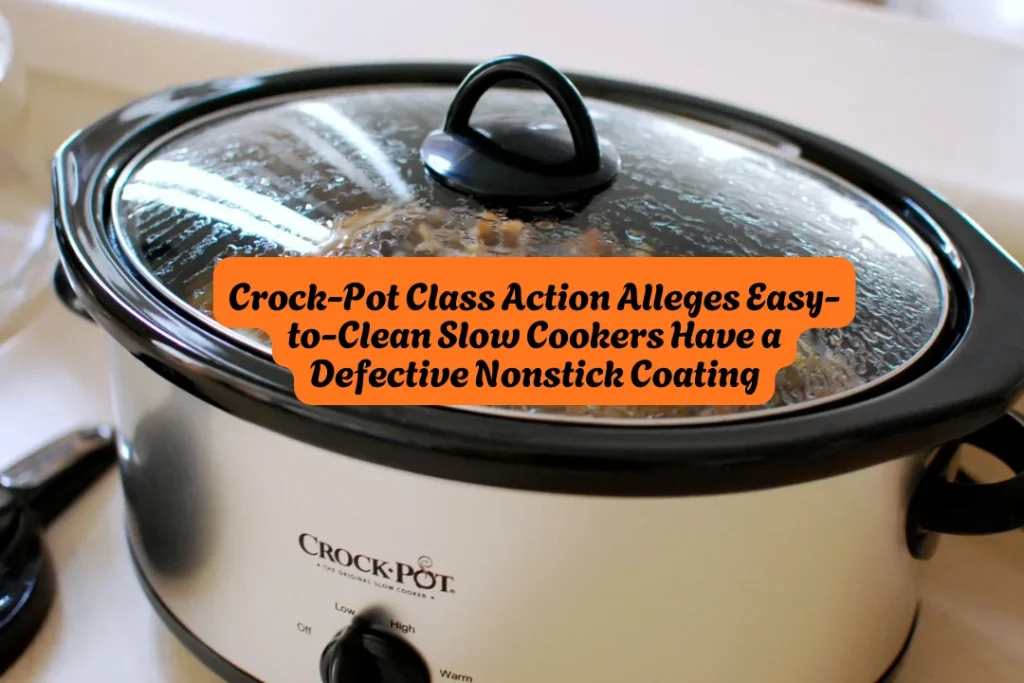
Crock-Pot Class Action Alleges Easy-to-Clean Slow Cookers Have a Defective Nonstick Coating
A proposed class action lawsuit filed in Massachusetts federal court alleges that two specific models of Crock-Pot Easy-to-Clean slow cookers — manufactured and sold by Newell Brands, Inc. and its subsidiary Sunbeam Products, Inc. — contain a manufacturing defect that causes the nonstick Teflon coating to bubble, flake, chip, and peel off during ordinary use, potentially contaminating food with PFAS “forever chemicals.” The lawsuit, Ventullo v. Newell Brands, Inc. and Sunbeam Products, Inc., was filed January 5, 2026, and is supported by expert microscopy testing commissioned by the plaintiff. No settlement has been reached. This case is in its early stages, and no claim form is available.
Quick Facts
| Field | Detail |
| Case Name | Ventullo v. Newell Brands, Inc. and Sunbeam Products, Inc., Case No. 1:26-cv-10027 |
| Court | U.S. District Court, District of Massachusetts |
| Date Filed | January 5, 2026 |
| Defendants | Newell Brands, Inc.; Sunbeam Products, Inc. |
| Products at Issue | Crock-Pot 7-Quart Easy-to-Clean Cook and Carry Slow Cooker (black stainless steel); Crock-Pot One Touch Control 6-Quart Easy-to-Clean Slow Cooker (stainless steel) |
| Alleged Defect | Excess mica in Teflon coating causes separation from ceramic base, producing flaking, bubbling, chipping, and peeling during everyday use |
| Health Concern | Teflon contains PTFE, a PFAS “forever chemical” — ingestion of flaking coating raises food safety concerns |
| Laws Alleged Violated | Magnuson-Moss Warranty Act; Massachusetts Consumer Protection Law (M.G.L. c. 93A) |
| Proposed Class | All U.S. residents who purchased a new qualifying Crock-Pot slow cooker, or received one as a gift from a qualifying purchaser, within the applicable statute of limitations |
| Case Status | Active litigation — early stage; no settlement, no claim form |
| Relief Sought | Class certification, damages, injunctive relief, attorneys’ fees, jury trial |
What Is This Lawsuit About?
The lawsuit targets two specific Crock-Pot slow cooker models marketed under the brand’s “Easy-to-Clean” line: the 7-Quart Easy-to-Clean Cook and Carry Slow Cooker in black stainless steel, and the One Touch Control 6-Quart Easy-to-Clean Slow Cooker in stainless steel. Both products are manufactured by Sunbeam Products, Inc., a subsidiary of Newell Brands, Inc. — the parent company of the Crock-Pot brand.
According to the 58-page complaint, the plaintiff commissioned expert microscopy testing of the slow cookers before filing. That testing revealed that the nonstick coating used in both products was produced with an “excess amount” of mica — a mineral additive used in the coating manufacturing process. The lawsuit alleges this excess mica creates separation between the Teflon and the ceramic base materials beneath it, preventing the Teflon from properly adhering to the ceramic surface. The result, the complaint says, is a coating that inevitably bubbles, flakes, chips, and peels away from the cooker’s interior during ordinary, foreseeable cooking use.
The plaintiff purchased one of the affected slow cookers from Target in 2023 for everyday household use, relying on Crock-Pot’s representations about the product’s “performance, quality, and use.” The coating began to fail and flake off within one year of purchase — well within the product’s stated one-year warranty period.
Notably, the lawsuit points out that both affected models were removed from sale on Crock-Pot’s own website by November 1, 2025 — a detail the complaint characterizes as consistent with the defendants’ awareness of the defect.
The PFAS Connection: Why the Flaking Coating Is a Health Concern
The complaint does not allege simply that the coating is inconvenient or cosmetically damaged. It raises a specific food safety concern rooted in what the coating is actually made of.
Crock-Pot markets the products as having an “Easy to Clean Non-Stick PFOA-Free Coating.” The lawsuit argues that this label is misleading in two ways. First, while the coating may be free of PFOA (perfluorooctanoic acid — one specific PFAS compound), the Teflon coating contains PTFE (polytetrafluoroethylene) — a plastic coating that is itself a member of the broader PFAS chemical family. Second, the complaint argues that a reasonable consumer who reads “PFOA-Free” on a product labeled as “Non-Stick” would understand that to mean the product contains no PFAS at all, or no chemicals that could be harmful to human health if ingested.
PFAS — per- and polyfluoroalkyl substances — are a family of more than 12,000 synthetic chemicals used in manufacturing since the 1950s. They are commonly called “forever chemicals” because they do not break down in the environment or in the human body. Studies have linked PFAS exposure to a range of health concerns including increased risk of certain cancers, thyroid disease, immune system disruption, and reproductive harm. When the Teflon coating flakes off and migrates into food being cooked, the complaint argues, consumers are ingesting a substance Crock-Pot itself has told them is safe — when it may not be.
The filing states that Crock-Pot “fails to acknowledge the defect or otherwise advise consumers about…the safety risks from Teflon ingestion.”
The Warranty Claims
The lawsuit also advances a breach of warranty theory under the Magnuson-Moss Warranty Act — the federal statute that governs written warranties on consumer products sold in the United States.
Crock-Pot’s warranty states that the products are “free from defects in material and workmanship” and is valid for one year after purchase. The complaint argues the coating defect constitutes exactly such a defect in material — the excess mica that prevents proper Teflon adhesion was present from the moment the product was manufactured, making it defective at the time of sale.
The warranty also excludes coverage for “normal wear and tear.” The lawsuit anticipates this defense and argues that nonstick coating failure caused by a manufacturing defect — rather than consumer misuse or abuse — does not qualify as normal wear and tear. The complaint emphasizes that the defect is latent: consumers cannot reasonably foresee that regular, ordinary use of the product would cause the nonstick coating to fail, because the excess mica manufacturing defect is invisible and unknowable at the time of purchase.
How This Case Fits a Broader Pattern
The Crock-Pot coating lawsuit is part of a growing wave of PFAS and nonstick cookware class actions targeting the gap between “PFOA-free” marketing language and the broader presence of PTFE and other PFAS compounds in consumer products. Courts across the country are being asked to decide whether “PFOA-free” is materially misleading when the product still contains PTFE — a closely related PFAS compound.
The most direct parallel is the HexClad cookware litigation, which followed the same legal theory — that “PFAS-free” and “non-toxic” labels were deceptive because HexClad’s nonstick coating contained PTFE. That case reached a $2.5 million settlement. For AllAboutLawyer.com readers who followed that case, the HexClad “non-toxic” pans lawsuit and settlement received final court approval in February 2026 — and established the pattern that PTFE presence in “PFOA-free” labeled cookware can support consumer protection claims at the class certification stage.
The Crock-Pot lawsuit adds a distinct manufacturing defect dimension absent from most nonstick labeling cases: the expert microscopy evidence of excess mica as the root cause of the coating’s physical failure. This makes it both a false advertising case and a traditional product liability defect case — a combination that may broaden the available legal theories and potential damages.
What Can You Do If You Own One of These Crock-Pots?
There is no claim form, no settlement fund, and no action required at this time. The case was filed in January 2026 and has not yet progressed through initial pleadings, class certification, or discovery. No class has been certified.
If you own or previously owned the Crock-Pot 7-Quart Easy-to-Clean Cook and Carry Slow Cooker (black stainless steel) or the Crock-Pot One Touch Control 6-Quart Easy-to-Clean Slow Cooker (stainless steel) and experienced nonstick coating failure, here is what you should know:
- You do not need to take any action to potentially be included in a future settlement. Consumer product class actions typically provide automatic notice to identified purchasers if and when a settlement is reached.
- Document the defect if your coating has already begun to flake, bubble, chip, or peel. Photographs of the damaged interior, your receipt or order confirmation, and any record of where and when you purchased the product may all be relevant if the case progresses.
- If you still own the product and the coating has begun to fail, consider whether continued use is appropriate given the complaint’s allegations about PFAS ingestion risk. The lawsuit does not constitute a government recall, and no government agency has issued a recall for these specific models at this time.
- The affected models were pulled from Crock-Pot’s own website by November 1, 2025. If you purchased one of these models secondhand or as a gift, you may still qualify for class membership — the proposed class includes people who received a qualifying slow cooker as a gift from a qualifying purchaser.
- This lawsuit is entirely separate from the Crock-Pot Express Pressure Cooker litigation involving explosion and burn injury claims. The Crock-Pot slow cooker coating defect case involves only the two named Easy-to-Clean slow cooker models and does not involve any explosion, burn, or pressure hazard.
Important Case Timeline
| Milestone | Date |
| Plaintiff Purchases Affected Crock-Pot at Target | 2023 |
| Coating Begins to Flake (within one year of purchase) | 2024 |
| Both Affected Models Removed from Crock-Pot Website | November 1, 2025 |
| Complaint Filed | January 5, 2026 |
| ClassAction.org Reports Case | February 20, 2026 |
| Defendants’ Answer / Response Deadline | TBD |
| Class Certification Motion | TBD |
| Trial / Settlement | TBD |
Frequently Asked Questions
Is there a settlement I can claim right now?
No. This lawsuit was filed on January 5, 2026, and is in its earliest stages. No settlement has been reached, no settlement fund exists, and no claim form is available. If and when a settlement is reached, consumers who purchased the affected Crock-Pot models will typically receive notice automatically and have an opportunity to submit a claim.
Which specific Crock-Pot models are covered by this lawsuit?
The lawsuit specifically names two models: the Crock-Pot 7-Quart Easy-to-Clean Cook and Carry Slow Cooker in black stainless steel, and the Crock-Pot One Touch Control 6-Quart Easy-to-Clean Slow Cooker in stainless steel. Both were removed from Crock-Pot’s own website by November 1, 2025. Other Crock-Pot slow cooker models — including models without the “Easy-to-Clean” designation or with traditional stoneware interiors — are not named in this complaint.
What exactly is the coating defect, and what caused it?
The plaintiff commissioned expert microscopy testing before filing the lawsuit. That testing identified an excess amount of mica in the Teflon coating used in the affected models. The complaint explains that mica in excessive amounts creates separation between the Teflon layer and the ceramic base material, preventing the two from bonding properly. The result is a coating that begins to physically detach during ordinary cooking use — bubbling, flaking, chipping, and peeling off the cooker’s interior surface.
Is PTFE dangerous if ingested?
The scientific consensus on PTFE ingestion from flaking nonstick coatings is still developing. PTFE is a member of the PFAS chemical family, and PFAS compounds as a class have been linked to health concerns including certain cancers, thyroid disease, and immune system disruption. The complaint argues that because the coating contains PTFE — a PFAS compound — consumers who ingest flaked coating particles may face health risks. The lawsuit does not constitute a finding by any government agency or scientific body that these specific slow cookers are unsafe. Consumers with specific health concerns should consult a physician.
Does the “PFOA-Free” label mean the product is safe?
The complaint argues that “PFOA-Free” is misleading because it refers only to one specific PFAS compound — perfluorooctanoic acid — while the product’s Teflon coating still contains PTFE, a different compound in the same PFAS family. The lawsuit contends that a reasonable consumer reading “PFOA-Free” on a nonstick product would understand it to mean the product contains no PFAS at all. Whether courts agree with this interpretation will be a central legal question as the case develops.
Is this the same as the Crock-Pot pressure cooker explosion lawsuits?
No. The pressure cooker explosion lawsuits — which involve the Crock-Pot Express Pressure Cooker and lid detachment causing burn injuries — are entirely separate litigation involving different products, different defendants, and different legal theories. This coating defect lawsuit involves only the two named Easy-to-Clean slow cooker models and concerns nonstick coating failure and PFAS exposure during ordinary slow cooking. No explosion, burn injury, or pressure hazard is alleged in this case.
Who are the defendants, and what is their relationship to Crock-Pot?
The defendants are Newell Brands, Inc. and its subsidiary Sunbeam Products, Inc. Sunbeam Products manufactures and sells products under the Crock-Pot brand. Newell Brands is the publicly traded parent company that owns Sunbeam Products. Both entities are named as defendants because they are alleged to have jointly manufactured, marketed, and sold the defective products.
How does this case compare to the HexClad cookware lawsuit?
The HexClad case and the Crock-Pot case share the same foundational claim: that a nonstick cookware product was marketed as “PFOA-free” while still containing PTFE, a PFAS compound, and that this label misled consumers. The HexClad “non-toxic” pans lawsuit settled for $2.5 million and received final court approval in February 2026 — providing a recent reference point for how PTFE-in-PFOA-free-cookware cases can resolve. The Crock-Pot case adds an additional manufacturing defect layer — the excess mica finding from expert microscopy testing — that the HexClad case did not involve. For a parallel active litigation article on a consumer product defect case, the Tide Pods class action lawsuit covers how defective household consumer product litigation develops before a settlement is reached.
Sources & References
- PACER Docket — Ventullo v. Newell Brands, Inc. and Sunbeam Products, Inc., Case No. 1:26-cv-10027 (D. Mass.): ecf.mad.uscourts.gov
- EPA — PFAS Overview and Health Effects: epa.gov/pfas
- FDA — Teflon and Nonstick Cookware Safety FAQ: fda.gov
- Magnuson-Moss Warranty Act, 15 U.S.C. §§ 2301–2312: ftc.gov/legal-library/browse/statutes/magnuson-moss-warranty-federal-trade-commission-improvement-act
Last Updated: March 11, 2026
Disclaimer: This article covers an active lawsuit where no findings of liability have been made and no settlement has been reached. All allegations described are claims by the plaintiff and have not been proven in court. This article is for informational purposes only and does not constitute legal advice. For advice regarding a particular situation, consult a qualified attorney.
About the Author

Sarah Klein, JD, is a licensed attorney and legal content strategist with over 12 years of experience across civil, criminal, family, and regulatory law. At All About Lawyer, she covers a wide range of legal topics — from high-profile lawsuits and courtroom stories to state traffic laws and everyday legal questions — all with a focus on accuracy, clarity, and public understanding.
Her writing blends real legal insight with plain-English explanations, helping readers stay informed and legally aware.
Read more about Sarah