
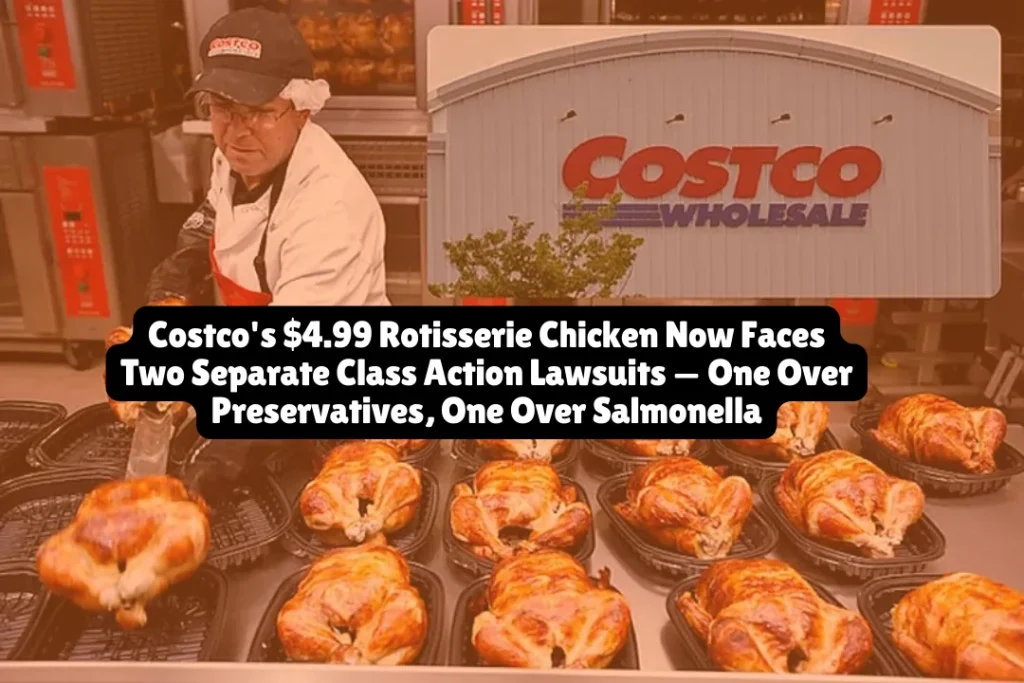
Costco’s $4.99 Rotisserie Chicken Now Faces Two Separate Class Action Lawsuits, One Over Preservatives, One Over Salmonella
Costco’s iconic $4.99 rotisserie chicken — one of the most recognizable bargains in American retail — is now at the center of two separate proposed class action lawsuits filed within weeks of each other in early 2026. The first, filed January 22, accuses Costco of falsely advertising the chicken as containing “no preservatives.” The second, filed February 12 in Seattle, alleges that Costco’s Nebraska poultry plant has been chronically contaminated with salmonella and that the company failed to tell consumers. Neither lawsuit has been certified as a class action. No settlement exists. Costco has not admitted wrongdoing in either case.
Case Snapshot: Two Lawsuits, Two Very Different Allegations
| Lawsuit 1 — Preservatives | Lawsuit 2 — Salmonella | |
| Filed | January 22, 2026 | February 12, 2026 |
| Case Number | S.D. Cal. (San Diego) | 2:26-cv-00528 (W.D. Wash., Seattle) |
| Plaintiffs | Bianca Johnston & Anastasia Chernov (California) | Lisa Taylor (Missouri) |
| Defendant | Costco Wholesale Corporation | Costco Wholesale Corporation |
| Core Allegation | “No preservatives” claim is false | Salmonella contamination not disclosed |
| Law Cited | California & Washington Consumer Protection | Washington Consumer Protection Act |
| Status | Proposed class action, pending | Proposed class action, pending |
| Settlement | None | None |
| Costco Response | Removed “no preservatives” signage | No public response as of Feb. 18 |
Lawsuit 1: The “No Preservatives” Case
What the Plaintiffs Allege
In a proposed class action lawsuit filed January 22, 2026, two people from California claim that Costco “systematically cheated customers out of tens — if not hundreds — of millions of dollars” by falsely advertising that its signature Kirkland seasoned rotisserie chicken had no preservatives.
The lawsuit states that prominently displayed signs in stores and online details advertise that the rotisserie chickens are free of gluten, MSG, preservatives, artificial flavors, and artificial colors. The lawsuit alleges that despite its “no preservatives” representations, Costco uses sodium phosphate and carrageenan additives in its chicken. Sodium phosphate is used to inhibit microbial growth and spoilage, and carrageenan is used to preserve food texture and extend shelf life.
The lawsuit, lodged by Bianca Johnston of Big Bear and Anastasia Chernov of Escondido, claims that Costco’s in-store signs and online listings created a misleading “overall net impression” of the product they were selling. Customers like Johnston and Chernov would purchase the rotisserie chickens believing they were free of preservatives only to discover the problematic ingredients when squinting at the fine print.
The Small Print Problem
This inconsistency is not apparent to consumers at the time of purchase because, compared to the “No Preservatives” representations, the “back of the label” ingredient list is less prominent, appearing in smaller print on the rotisserie chicken’s packaging.
This is a central argument in food labeling law — and it matters. Federal courts have repeatedly held that a fine-print disclosure does not automatically neutralize a prominent front-label claim if the overall impression the product creates is misleading. Whether that principle applies here is a legal question a court must decide.
What Are Sodium Phosphate and Carrageenan?
Both ingredients are federally classified as safe. The U.S. Food and Drug Administration deems sodium phosphate generally safe for healthy individuals when consumed in food, but it may pose risks for people with kidney disease, potentially causing mineral imbalances, bone issues, and heart problems. Carrageenan, derived from red seaweed, is used to thicken and preserve processed foods. While the FDA considers food-grade carrageenan safe, some studies link it to digestive issues and inflammation.
The legal debate here is not whether the ingredients are dangerous — both the FDA and Health Canada classify them as safe. The debate is whether their presence contradicts the “no preservatives” marketing claim. The plaintiffs say yes. Costco’s response has been to remove the signage rather than defend it in court.
Costco’s Response: Remove the Signs, Deny Wrongdoing
Costco responded to the controversy by removing all references to preservatives from its signage and online descriptions, saying in a statement that the company wanted to “maintain consistency among the labeling on our rotisserie chickens and the signs in our warehouses and online presentations.” The retailer did not claim wrongdoing.
The plaintiffs’ attorneys called that removal a confirmation of their core legal theory: “We are pleased to see that Costco promptly dropped its false advertising claims of ‘no preservatives’ in response to our lawsuit. It’s confirmation of our core legal theory — the ‘no preservative’ claims were false.”
Whether a court would view Costco’s removal of the signage as an admission or simply as a business decision to avoid further controversy has not yet been determined.
What Plaintiffs Are Seeking
The complaint notes that the plaintiffs demand a trial by jury, and that they’re seeking certifications for two classes — one for anyone in the U.S. who has purchased a Costco rotisserie chicken, and a subclass for people in California. Plaintiffs are requesting unspecified monetary damages.
Lawsuit 2: The Salmonella Contamination Case
What the Plaintiff Alleges
The proposed class action lawsuit, filed in federal court in Seattle on February 12 and obtained by USA TODAY, points to a study by Farm Forward that criticized safety conditions at Costco’s Lincoln Premium Poultry plant in Fremont, Nebraska. The study claims that the plant “consistently fails USDA salmonella safety standards year after year” and that it sends “unsafe chickens to stores nationwide.”
The 37-page lawsuit says that Costco’s poultry operation, based at the Lincoln Premium Poultry facility in Nebraska, has earned the United States Department of Agriculture’s (USDA) worst food safety rating — Category 3 — in nearly all reporting periods since 2019. According to the suit, the plant failed every monthly salmonella test from late 2023 through mid-2025, “reflecting chronic, uncontrolled and unresolved contamination levels.”
In plain terms: Category 3 is the lowest rating the USDA assigns to poultry plants. It means the facility has exceeded allowable salmonella contamination rates — the equivalent of a failing grade on federal food safety standards.
The Numbers Behind the Allegations
According to the complaint, the Fremont, Nebraska plant “consistently” fails U.S. Department of Agriculture safety standards, with more than 9.8% of whole chickens and 15.4% of chicken parts testing positive for salmonella contamination.
For context, the USDA’s Food Safety and Inspection Service (FSIS) sets maximum allowable contamination thresholds for poultry processing plants. Exceeding those thresholds — especially repeatedly over multiple years — triggers the Category 3 designation cited in this lawsuit.
How Costco’s $4.99 Price Point Fits Into the Legal Theory
The Costco class action lawsuit pins the apparent food safety crisis on “conscious business decisions,” which the suit claims stem from the retailer’s desire to keep its Kirkland rotisserie chickens at the $4.99 price point — without meaningfully disclosing to consumers the alleged litany of problems at its poultry production plant. “What began as a strategy to keep prices low has spiraled into a serious public health concern,” the complaint emphasizes.
In 2019, Costco began to source its chicken products in-house, rather than from other suppliers, after opening a $450 million poultry complex in Nebraska that included hatcheries, feed mills, breeder and grow-out barns, and slaughter and processing plants. The decision to open this plant, which now processes over 100 million chickens every year for Costco exclusively, came out of the wholesaler’s desire to vertically integrate and maintain control from egg-to-shelf with the goal to reduce overall costs.
The legal argument is that vertical integration gave Costco complete visibility into its supply chain — and therefore complete knowledge of the contamination data. The lawsuit argues that Costco chose to keep selling the chicken without disclosing what its own USDA ratings showed.
Who Is the Plaintiff and What Is She Seeking?
The plaintiff in the lawsuit, Lisa Taylor, of Affton, Missouri, regularly purchased the rotisserie chicken in the St. Louis area and “suffered economic injury” by overpaying for the potentially contaminated chicken, according to the lawsuit. It seeks damages for Costco customers who purchased rotisserie chicken and raw chicken parts after January 1, 2019.
Taylor is pursuing compensatory and triple damages for shoppers who purchased Kirkland Signature rotisserie chickens and raw chicken parts since January 1, 2019, claiming that Costco violated Washington consumer protection laws and broke an implied promise that its chickens are safe to eat.
The proposed class is defined as all U.S. individuals and their territories who purchased a Kirkland Signature rotisserie chicken or raw chicken product sold by Costco for personal or household use since January 1, 2019. Costco sold more than 157 million rotisserie chickens worldwide in 2025 alone.
Costco’s Response
USA TODAY reached out to Costco for comment on February 17, 2026. Costco did not receive an immediate response. No public statement addressing the salmonella lawsuit has been issued as of the date of this article.
What Both Lawsuits Have in Common — and Why That Matters
Both cases allege that Costco knew something important about its product and chose not to tell consumers. Both cases invoke Washington state’s Consumer Protection Act, where Costco is headquartered. Both are proposed class actions that have not yet been certified.
The convergence of these two lawsuits — within three weeks of each other, targeting the same product from different directions — puts Costco in an unusual legal position. The preservatives lawsuit challenges what Costco said about its chicken. The salmonella lawsuit challenges what Costco did not say. Together, they frame the $4.99 price point not as a straightforward bargain but as a product whose marketing and safety record are now simultaneously under court scrutiny.
What “Proposed Class Action” Means Right Now
Neither lawsuit has been certified as a class action. That is a critical distinction. Certification is a formal court determination that the claims are common enough across all proposed class members to be handled together. Until certification is granted, these are individual lawsuits that aspire to represent larger groups.
For most Costco members, there is nothing to do right now. No claim form exists. No settlement fund has been established. If either lawsuit is certified and reaches a resolution — whether through settlement or verdict — class members would be notified through court-approved procedures.
For anyone with questions about their specific legal rights as a consumer or Costco member, the Federal Trade Commission’s consumer information resource on product labeling and the USDA’s Food Safety and Inspection Service provide authoritative, non-commercial information on food labeling standards and food safety requirements.
Key Dates
- January 1, 2019 — Start of proposed class period for salmonella lawsuit; date Costco opened Lincoln Premium Poultry plant in Nebraska
- January 22, 2026 — Preservatives class action filed, U.S. District Court, Southern District of California
- January 28, 2026 — Costco removes “no preservatives” signage from stores and website
- February 12, 2026 — Salmonella class action filed, U.S. District Court, Western District of Washington (Seattle), Docket No. 2:26-cv-00528
- February 18, 2026 — Both cases active; no certification, no settlement, no verdict
Frequently Asked Questions
Is there a settlement I can file a claim for right now?
No. Neither lawsuit has been certified as a class action, and no settlement fund or claim form exists in either case. Anyone directing you to file a claim right now should be treated with significant caution.
Do I need to stop buying Costco rotisserie chicken?
This article cannot provide health or safety advice. No recall has been issued by the USDA or FDA. The USDA’s Food Safety and Inspection Service at fsis.usda.gov maintains the current list of all active poultry recalls. As of February 18, 2026, Costco rotisserie chicken is not subject to a recall.
What are sodium phosphate and carrageenan?
Sodium phosphate is a compound used in processed foods to inhibit microbial growth and retain moisture. Carrageenan is a seaweed-derived ingredient used to preserve texture and extend shelf life. Both are classified as safe by the FDA for healthy adults. The preservatives lawsuit argues their presence contradicts Costco’s “no preservatives” marketing — not that the ingredients themselves are harmful at the levels present.
What does Category 3 USDA rating mean?
Category 3 is the lowest food safety rating assigned by the USDA’s Food Safety and Inspection Service to poultry processing plants. It means the plant has exceeded allowable salmonella contamination limits. The salmonella lawsuit alleges Costco’s Nebraska plant has received this rating in 92% of reporting periods since 2019.
Did Costco admit the “no preservatives” claim was wrong?
ostco removed the “no preservatives” signage from its stores and website in late January 2026, stating it did so to “maintain consistency” with product labeling. The company has not admitted wrongdoing.
Who are the plaintiffs in these cases?
The preservatives lawsuit is brought by Bianca Johnston of Big Bear, California, and Anastasia Chernov of Escondido, California. The salmonella lawsuit is brought by Lisa Taylor of Affton, Missouri.
What laws are being cited?
The preservatives lawsuit cites California consumer protection laws and Washington’s Consumer Protection Act. The salmonella lawsuit cites the Washington Consumer Protection Act and an implied warranty that the product is safe for consumption.
When will these cases be resolved?
Class action cases of this complexity typically take one to several years to resolve. Both cases must first survive motions to dismiss, then proceed through class certification, discovery, and ultimately trial or settlement. No timeline can be predicted at this stage.
Last Updated: February 18, 2026
Disclaimer: This article is for informational purposes only and does not constitute legal advice. Legal claims and outcomes depend on specific facts and applicable law. For advice regarding a particular situation, consult a qualified attorney.
About the Author

Sarah Klein, JD, is a licensed attorney and legal content strategist with over 12 years of experience across civil, criminal, family, and regulatory law. At All About Lawyer, she covers a wide range of legal topics — from high-profile lawsuits and courtroom stories to state traffic laws and everyday legal questions — all with a focus on accuracy, clarity, and public understanding.
Her writing blends real legal insight with plain-English explanations, helping readers stay informed and legally aware.
Read more about Sarah