
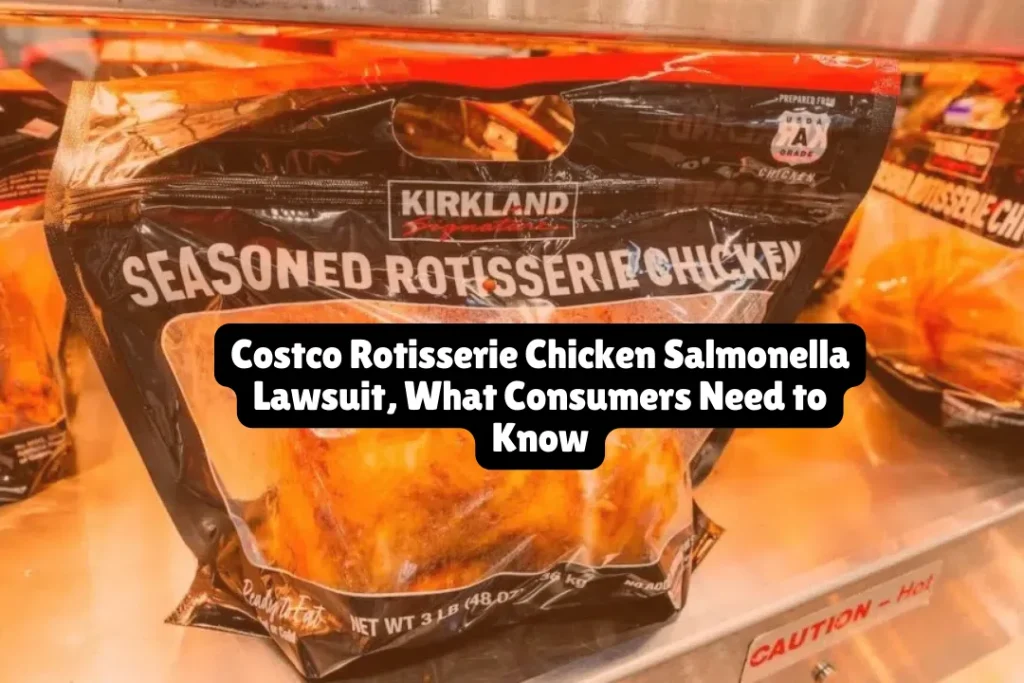
Costco Rotisserie Chicken Salmonella Lawsuit, What Consumers Need to Know
A proposed class action lawsuit filed February 12, 2026, in U.S. District Court in Seattle alleges that Costco’s $4.99 Kirkland Signature rotisserie chicken poses a Salmonella risk because the company’s Nebraska poultry processing plant has chronically exceeded federal contamination limits — and that Costco failed to disclose this to consumers. The case is in its earliest stage. No class certification, no settlement, and no claim form currently exist. Consumers cannot file a claim at this time.
Quick Facts
- Case name: Lisa Taylor v. Costco Wholesale Corp., Case No. 2:26-cv-00528
- Court: U.S. District Court, Western District of Washington (Seattle)
- Defendant: Costco Wholesale Corp.
- Nature of allegations: Failure to disclose alleged chronic Salmonella contamination at the Lincoln Premium Poultry facility in Fremont, Nebraska; violation of the Washington Consumer Protection Act; breach of implied warranty of merchantability; unjust enrichment
- Filing date: February 12, 2026
- Current litigation status: Proposed (putative) class action — not yet certified; no settlement; no verdict
- Who may be affected (if class is certified): U.S. consumers who purchased Kirkland Signature rotisserie chicken or Kirkland Signature raw chicken products from Costco between January 1, 2019, and the present
- Claim deadline: None — no claim period is open
- No recall in effect: As of February 28, 2026, the USDA has not issued a recall for Costco rotisserie chicken
- Official case information: U.S. District Court, Western District of Washington, PACER docket, Case No. 2:26-cv-00528
Current Status and What Happens Next
Taylor v. Costco Wholesale Corp. was filed on February 12, 2026, and is in its earliest stage of litigation. The court has not yet ruled on class certification, and Costco has not filed a formal response to the complaint. No settlement negotiations have been publicly reported. No trial date has been set.
Before this case can proceed as a class action, a judge must certify the proposed class — a process that requires the plaintiff to demonstrate that common legal questions apply to all proposed class members and that class action is the appropriate vehicle for the claims. That determination often takes months or years. If the court certifies the class and the parties later agree to a settlement, AllAboutLawyer.com will update this article with eligibility criteria, claim forms, and deadlines. At this time, consumers do not need to do anything to preserve potential rights in this case.
What the Lawsuit Alleges
The 37-page complaint alleges that Costco’s poultry operation, centered at the Lincoln Premium Poultry facility in Fremont, Nebraska, has received the USDA’s lowest food safety rating — Category 3 — in approximately 92 percent of reporting periods since the plant opened in 2019. Category 3 is assigned by the USDA’s Food Safety and Inspection Service (FSIS) when a plant exceeds allowable Salmonella contamination rates. According to the lawsuit, the plant failed every monthly Salmonella test from late 2023 through mid-2025, reflecting what the complaint calls “chronic, uncontrolled and unresolved contamination levels.”
The complaint also cites a December 2025 study by Farm Forward, an animal rights nonprofit, which found that more than 9.8% of whole chickens and 15.4% of chicken parts from the Lincoln Premium Poultry plant tested positive for Salmonella contamination. The lawsuit further cites an October 2025 Consumer Reports analysis covering five years of data that identified Costco’s Nebraska plant as one of the most contaminated poultry facilities in the United States.
The legal claims in the complaint allege that Costco violated the Washington Consumer Protection Act by making representations about the safety and quality of its rotisserie chicken without disclosing the alleged contamination record at its processing facility. The complaint also asserts breach of implied warranty of merchantability — the implied promise that a product is fit for its ordinary purpose, including safe consumption — and unjust enrichment. The complaint seeks compensatory damages, treble (triple) damages under the Washington Consumer Protection Act, restitution, and injunctive relief requiring Costco to change its practices and disclosures.
The complaint does not allege that any specific consumer has contracted Salmonella illness from a Costco rotisserie chicken. The plaintiff, Lisa Taylor, alleges economic injury — she claims she overpaid for a product whose safety risks were not disclosed to her.
Related article: Johnson & Johnson Talc Lawsuit, $250K Philadelphia Verdict & What It Means for Other Claims
Costco has not issued a public statement addressing the Salmonella lawsuit as of the date of this article. Costco denies no allegations in any court filing yet, as no responsive pleading has been filed.
Who Could Be Included
The plaintiff seeks to represent a class of all persons in the United States who purchased, for personal or household use, any Kirkland Signature branded rotisserie chicken or raw chicken product sold by Costco during the period from January 1, 2019, to the present. This is a nationwide proposed class.
The proposed class definition is broad and covers both cooked rotisserie chickens and Kirkland Signature raw chicken products — not just the $4.99 rotisserie chicken specifically. The class period begins January 1, 2019, which corresponds approximately to when the Lincoln Premium Poultry facility opened. The proposed class requires only that a consumer purchased the covered products during that period; it does not require that the consumer became ill.
However, this proposed class definition has not been reviewed or approved by the court. Class certification requires the court’s independent determination that the proposed class meets the legal requirements. The final class definition — if the case is certified — may be narrower or broader than what the plaintiff has proposed.
The Salmonella Allegations and What They Mean
The lawsuit’s core allegation is not that Costco’s chicken has caused documented consumer illnesses, but that the contamination levels at the processing facility were materially higher than what a reasonable consumer would expect from a product marketed as safe and high-quality. The complaint attributes the alleged contamination problems to “conscious business decisions” tied to Costco’s strategy of keeping the rotisserie chicken at the $4.99 price point — without meaningfully disclosing the food safety record of its poultry production plant.
Salmonella is a bacterial pathogen and one of the leading causes of foodborne illness in the United States. Raw poultry commonly carries Salmonella, and federal food safety regulations set allowable thresholds for contamination at processing facilities — thresholds the lawsuit alleges the Lincoln Premium Poultry plant has repeatedly exceeded. Proper cooking of chicken to an internal temperature of 165°F kills Salmonella bacteria, and the USDA has not issued a recall for Costco rotisserie chicken as of February 28, 2026.
The allegations in this lawsuit remain disputed. No court has found Costco liable. No government agency has issued a formal finding of violation in connection with this complaint.
No Settlement Exists
No settlement fund, trust, claim form, or settlement administrator exists for this case as of February 28, 2026. Anyone directing consumers to file a claim right now should be treated with significant caution. This case was filed fewer than three weeks ago and has not progressed to a stage where consumer claims are actionable under any settlement terms.
If a settlement is eventually proposed and approved, eligible consumers will typically receive notice by mail or email and will have a defined window to submit claims. AllAboutLawyer.com will publish updated eligibility and claim information if and when a settlement is reached and approved.
Prior Related Cases and Context
The Salmonella lawsuit is one of two proposed class actions filed against Costco targeting the $4.99 rotisserie chicken within weeks of each other in early 2026. The first lawsuit, filed January 22, 2026, accuses Costco of falsely advertising its Kirkland Signature Seasoned Rotisserie Chicken as containing “no preservatives,” when in fact the product contains sodium phosphate and carrageenan. That case was filed in San Diego federal court and involves two California plaintiffs. The preservatives lawsuit and the Salmonella lawsuit are legally distinct cases with different allegations, different plaintiffs, different attorneys, and different proposed class definitions.
Food safety class actions against poultry processors are not unusual in U.S. litigation. Several major processors have faced similar claims in recent years based on USDA inspection data, Consumer Reports testing, or other third-party studies. Courts have varied in their willingness to certify classes in food safety cases where plaintiffs allege economic injury — overpayment for a product — rather than documented personal illness, and this legal distinction is likely to be contested in the Costco proceedings. The USDA’s FSIS publishes Salmonella performance standards and plant-by-plant performance data as a matter of public record at fsis.usda.gov.
FAQs
What is the Costco rotisserie chicken Salmonella lawsuit about?
A proposed class action filed February 12, 2026, alleges that Costco’s Nebraska poultry processing plant has chronically exceeded USDA Salmonella contamination limits since 2019 and that Costco failed to disclose this record to consumers who purchased its $4.99 Kirkland Signature rotisserie chicken. No court has ruled on the merits.
Has the USDA recalled Costco rotisserie chicken for Salmonella?
No. As of February 28, 2026, the USDA has not issued a recall for any Costco rotisserie chicken product. The current list of active USDA poultry recalls is published at fsis.usda.gov.
Is this a certified class action lawsuit?
No. Taylor v. Costco Wholesale Corp. is a proposed (putative) class action. A federal judge in the Western District of Washington must certify the class before it proceeds as a class action. Class certification often takes months to years after a lawsuit is filed.
Who may be eligible if the case settles?
The plaintiff proposes to represent all U.S. consumers who purchased Kirkland Signature rotisserie chicken or raw chicken products from Costco between January 1, 2019, and the present. This definition has not been approved by any court. The final class, if certified, may differ.
Can I file a claim right now?
No. There is no settlement, no claim form, and no settlement administrator in this case. No claim process exists at this time. If a settlement is reached and approved in the future, eligible consumers will receive notice and instructions.
Where can I find official case information?
The case is Lisa Taylor v. Costco Wholesale Corp., Case No. 2:26-cv-00528, in the U.S. District Court for the Western District of Washington. Court filings are publicly accessible through the federal PACER system at pacer.uscourts.gov.
What should I do if I think I got sick from Costco chicken?
Seek medical attention and document your symptoms and diagnosis. Report foodborne illness to your local health department or to the CDC through its foodborne illness complaint system. Individuals who believe they suffered personal illness linked to a food product should consult a qualified attorney to evaluate legal options.
What happens next in this case?
Costco will file a formal response to the complaint, likely either answering the allegations or moving to dismiss. The court will then manage discovery and, eventually, rule on whether to certify the proposed class. This process typically takes one to several years. AllAboutLawyer.com will update this article as the case progresses.
Last Updated: February 28, 2026
This article is for informational purposes only and does not constitute legal advice. Legal claims and outcomes depend on specific facts and applicable law. For advice regarding a particular situation, consult a qualified attorney.
About the Author

Sarah Klein, JD, is a licensed attorney and legal content strategist with over 12 years of experience across civil, criminal, family, and regulatory law. At All About Lawyer, she covers a wide range of legal topics — from high-profile lawsuits and courtroom stories to state traffic laws and everyday legal questions — all with a focus on accuracy, clarity, and public understanding.
Her writing blends real legal insight with plain-English explanations, helping readers stay informed and legally aware.
Read more about Sarah