
California’s Glock Ban Explained, What AB 1127 Does, What It Doesn’t, and What Comes Next
California’s Assembly Bill 1127 — widely called the “Glock ban” — prohibits licensed gun dealers from selling a broad category of striker-fired handguns starting July 1, 2026. The law is already being challenged in federal court by three of the country’s largest gun rights organizations. Here is a plain-English explanation of what the law does, which guns are affected, what it does not change, and where the legal challenge stands.
What Is AB 1127 and Why Is It Called the Glock Ban?
Governor Gavin Newsom signed Assembly Bill 1127 into law in October 2025. Effective July 1, 2026, the bill adds Penal Code section 27595, prohibiting licensed firearms dealers from selling, offering for sale, exchanging, giving, transferring, or delivering “semiautomatic machinegun-convertible pistols.”
The law does not mention Glock by name. However, while AB 1127 would not apply only to Glock handguns, the practical effect of the bill is to prohibit the sale of Glock handguns in California. Currently, there are 54 Glock handguns approved for sale in California on the DOJ’s roster of not unsafe handguns, all of which would no longer be available for civilian retail sale after July 1, 2026.
The law also captures other brands built on the same platform. This includes all Glocks that are currently on the California roster of “safe firearms” and Glock clones such as Shadow Systems handguns.
What Is a “Machinegun-Convertible Pistol” — The Technical Definition
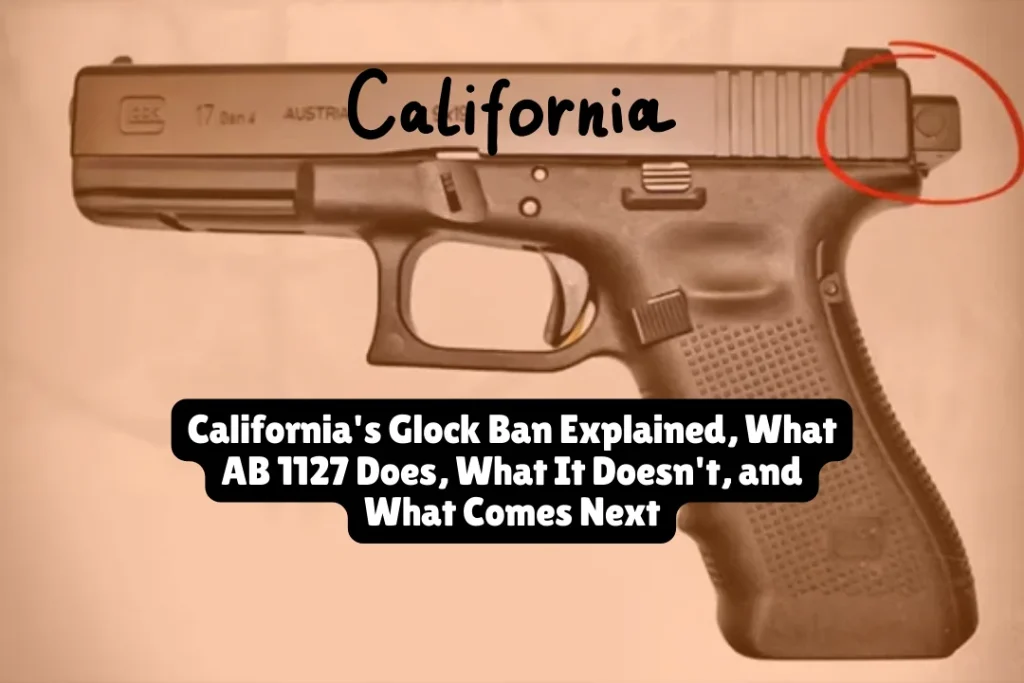
The legal trigger for the ban is a specific mechanical feature. The law, codified at California Penal Code § 27595(a), prohibits licensed firearms dealers from selling any “semiautomatic machinegun-convertible pistol,” defined as any semiautomatic pistol with a cruciform trigger bar that can be readily converted by hand or with common household tools into a machinegun by the installation or attachment of a pistol converter as a replacement for the slide’s backplate, without any additional engineering, machining, or modification of the pistol’s trigger mechanism. The law excludes hammer-fired semiautomatic pistols and striker-fired semiautomatic pistols lacking a cruciform trigger bar.
In plain terms: a cruciform trigger bar is a cross-shaped internal component that is part of Glock’s distinctive trigger design. The concern is that this design allows an illegal device called a “Glock switch” or “pistol converter” to be attached to the back of the slide — converting it from semi-automatic to fully automatic fire.
A pistol converter is defined as any device that, when installed in or attached to the rear of the slide of a semiautomatic pistol, replaces the backplate and interferes with the trigger mechanism, thereby enabling the pistol to shoot automatically more than one shot by a single function of the trigger — including converters manufactured using a 3D printer.
Why Did California Pass This Law?
The stated justification centers on a documented rise in illegal machine gun conversion devices in the United States. Recoveries of machine gun conversion devices by police, including Glock switches, increased by 784% between 2019 and 2023. In 2023 alone, 5,816 of these devices were recovered across the country.
Assemblymember Jesse Gabriel, who introduced AB 1127, said he hopes this legislation forces Glock to change its design so switches no longer work. Gabriel told CBS News California that Glock has known about this design vulnerability for a long time and could help save lives by addressing it.
Critics of the law — including gun rights groups — argue that Glock switch devices are already illegal under both federal and California state law, making the ban on the base firearm a significant overreach. Federal law already prohibits devices that convert semi-automatic firearms to fire automatically, and gun rights advocates argue that banning the underlying firearm punishes law-abiding gun owners for criminal misuse of an already-illegal accessory.
Related article: Can You Open Carry in California Now? What the 2026 Court Ruling Actually Means
What the Law Does NOT Do
This is where significant public confusion exists. AB 1127 is narrower than most media coverage suggests.
The law would not require current gun owners to dispose of the machinegun-convertible pistols they already own. It will not be illegal to possess these guns under the new law, and it does not impact a current gun owner’s ability to buy ammunition for their weapon, take it to a gunsmith, sell it in a private sale, or pass it down to family members.
The measure would not impact guns Californians already own, nor would it govern private sales. Police officers and military personnel would be exempt from the sales ban.
What the law does is restrict licensed dealers from selling these firearms to civilians. If you already own a Glock, nothing changes. If you want to buy one new from a dealer after July 1, 2026, you cannot — unless a court blocks the law first.
The Dealer Transition Period and the Inventory Rule
Gun dealers will still be allowed to sell these pistols until July 1, 2026, and will be able to continue selling inventory they acquired before January 1, 2026, avoiding sudden financial losses and giving them time to adjust.
This inventory rule created an unusual dynamic. Dealers who purchased their affected Glock inventory before January 1, 2026 can sell down that stock until July 1, 2026. Any inventory acquired after January 1, 2026 cannot be sold under the new law. For consumers who want to purchase a Glock through a licensed dealer, the window is closing fast.
The Pawn Shop Problem — An Unintended Consequence
One significant gap in the law has received little attention outside specialist legal circles. While the law includes several exemptions — such as sales to law enforcement, transfers for repair, and private party transactions — it notably omits one critical area: pawn transactions. This oversight exposes unique vulnerabilities in the pawn industry and creates cascading problems for firearm owners and businesses alike.
Individuals who pawned their pistols before July 1, 2026, risk permanent forfeiture if unredeemed by that date. This could affect veterans, hunters, or self-defense users who rely on pawn for emergency cash, raising due process concerns. DOJ guidance indicates the lack of a pawn exemption means no exemption exists — violations could trigger misdemeanor charges, fines, or license losses for pawn shops unaware of the gap.
Pawn operators and gun owners with firearms currently in pawn should consult a qualified firearms attorney before July 1, 2026, to understand their specific situation under the new law.
Does Glock Have a Path Back to the California Market?
Yes — and this is a crucial detail most coverage misses. If gun manufacturers affected by this legislation take steps to ensure their pistols are no longer convertible with switches and otherwise comply with California law, they can sell them again at retail.
AB 1127 would give Glock six months following its effective date — until January 1, 2027 — to redesign those older generation models to prevent illegal modification with machinegun conversion devices, in order to be re-grandfathered onto the roster. Whether Glock will pursue this redesign for the California market — the third-largest gun market in the country — remains to be seen. The company has not made a public statement about its intentions as of March 2026.
The Legal Challenge — Jaymes v. Bonta
The law is being challenged in federal court by a coalition of the three largest gun rights organizations in the country. The Second Amendment Foundation (SAF), National Rifle Association (NRA), and Firearms Policy Coalition (FPC) have joined forces to challenge AB 1127. The lawsuit, Jaymes v. Bonta, was filed in the U.S. District Court for the Southern District of California just days after Governor Newsom signed the bill into law.
The groups argue that AB 1127 violates the Second and Fourteenth Amendments by outlawing one of the most popular and commonly owned handgun platforms in America. Under the Bruen framework, states may not rely on mere interest balancing or public safety arguments alone — new gun regulations must align with the original text of the Second Amendment and with the historical tradition of firearm regulation circa 1791.
The core legal argument is rooted in District of Columbia v. Heller (2008). The Supreme Court in Heller emphasized that the Second Amendment protects arms “in common use” for lawful purposes. Because Glock-style handguns are widely held by law-abiding citizens, they are strong candidates for constitutional protection — and the complaint in Jaymes v. Bonta argues that under the Second Amendment, Californians will have no practical way to acquire them if the ban is enforced.
Plaintiffs are seeking injunctive relief to block enforcement of the law and a declaratory judgment that the statute is unconstitutional. AB 1127 is set to take effect in mid-2026 unless the court intervenes. As of March 2026, no injunction has been issued and the July 1, 2026 effective date remains in place. Gun owners should not assume the court will block the law before the deadline.
What This Means for California Gun Owners Right Now
The practical implications depend on your situation. If you already own a Glock or Glock-platform pistol, nothing changes — possession remains fully legal and you can continue to use, maintain, and privately sell your firearm. If you are considering purchasing one through a licensed dealer, the window is open until July 1, 2026 — but only for inventory dealers acquired before January 1, 2026.
If the Jaymes v. Bonta lawsuit results in an injunction before July 1, 2026, the law would be blocked pending further litigation. If no injunction is granted, licensed dealer sales of affected models will end on that date regardless of the lawsuit’s ultimate outcome. Monitoring the case through the California DOJ’s website at oag.ca.gov or consulting a qualified firearms attorney is the most reliable way to stay informed.
FAQs
Is the California Glock ban real and when does it take effect?
Yes. Governor Gavin Newsom signed Assembly Bill 1127 into law in October 2025, effective July 1, 2026. The law prohibits licensed dealers from selling semiautomatic machinegun-convertible pistols — a category that includes virtually all Glock and Glock-platform handguns currently on California’s roster.
Does the Glock ban make it illegal to own a Glock in California?
No. The law would not require current gun owners to dispose of the machinegun-convertible pistols they already own. It will not be illegal to possess these guns under the new law. The ban applies to licensed dealer sales only — not possession or private sales.
What exactly is a “cruciform trigger bar” and why does it matter?
A cruciform trigger bar is a cross-shaped internal mechanical component found in Glock and Glock-pattern pistols. It is the specific design feature that allows a “Glock switch” to be attached and convert the firearm to automatic fire. The law excludes hammer-fired pistols and striker-fired pistols that do not have a cruciform trigger bar — meaning many non-Glock handguns are unaffected.
Can I still buy a Glock in California before July 1, 2026?
Possibly — but only from dealers who have remaining inventory acquired before January 1, 2026. Dealers will be able to continue selling inventory they acquired before January 1, 2026 until July 1, 2026. Stock is limited and diminishing. After July 1, 2026, new dealer sales end unless a court blocks the law.
Are there any exceptions to the ban?
Yes. Exceptions include sales or transfers to law enforcement agencies and personnel, transfers to gunsmiths for service or repair, transfers back to private parties after temporary safekeeping storage, sales to federally licensed manufacturers or dealers outside California, and transfers to forensic laboratories. Private party sales between individuals are also not covered by the ban.
Is the Glock ban being challenged in court?
Yes. The SAF, NRA, and FPC have joined forces to challenge AB 1127 in Jaymes v. Bonta, filed in the U.S. District Court for the Southern District of California. Plaintiffs are seeking injunctive relief to block enforcement of the law. AB 1127 is set to take effect in mid-2026 unless the court intervenes. As of March 2026, no injunction has been issued.
Could Glock redesign its pistols to get back on the California roster?
AB 1127 would give Glock six months following its effective date to redesign older generation models to prevent illegal modification with machinegun conversion devices, in order to be re-grandfathered onto the roster. Whether Glock will pursue a California-specific redesign has not been publicly confirmed.
Last Updated: March 3, 2026
Disclaimer: This article is for informational purposes only and does not constitute legal advice. Laws and legal procedures vary by jurisdiction and may change over time. For advice regarding a specific situation, consult a qualified attorney or the appropriate authority.
About the Author

Sarah Klein, JD, is a licensed attorney and legal content strategist with over 12 years of experience across civil, criminal, family, and regulatory law. At All About Lawyer, she covers a wide range of legal topics — from high-profile lawsuits and courtroom stories to state traffic laws and everyday legal questions — all with a focus on accuracy, clarity, and public understanding.
Her writing blends real legal insight with plain-English explanations, helping readers stay informed and legally aware.
Read more about Sarah