
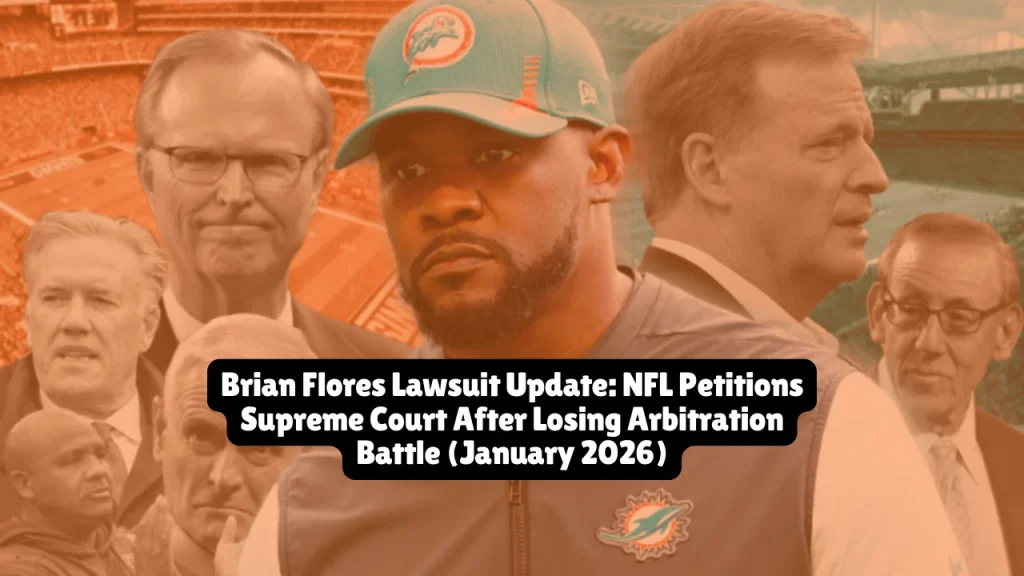
Brian Flores Lawsuit Update, NFL Petitions Supreme Court After Losing Arbitration Battle (January 2026)
The NFL petitioned the U.S. Supreme Court on January 8, 2026, seeking to force Brian Flores’s racial discrimination lawsuit into arbitration after repeatedly losing in lower courts. The league asks the Supreme Court to decide whether employment disputes can be resolved through arbitration when NFL Commissioner Roger Goodell serves as both the employer’s representative and the arbitrator.
This development comes after the Second Circuit Court of Appeals ruled in August 2025 that Flores’s claims against the Broncos, Giants, and Texans can proceed to trial because he never signed employment contracts with those teams. Nearly four years after the lawsuit’s February 2022 filing, the case remains stalled in procedural battles with no trial date set.
What Is the Brian Flores Lawsuit About?
The Racial Discrimination Claims Against NFL Teams
Brian Flores, currently the Minnesota Vikings defensive coordinator, filed a class action lawsuit in February 2022 alleging the NFL and multiple teams engaged in systemic racial discrimination against Black coaches. Flores was fired by the Miami Dolphins in January 2022 despite leading the team to back-to-back winning seasons with a 24-25 record over three years.
The lawsuit alleges violations of Title VII of the Civil Rights Act—the federal law prohibiting employment discrimination based on race—and 42 U.S.C. Section 1981, which protects equal contract rights regardless of race. Flores claims he faced discriminatory hiring practices when interviewing for head coaching positions and was terminated from the Dolphins based on racial animus rather than performance.
Two additional Black coaches joined the lawsuit as plaintiffs: Steve Wilks, now the New York Jets defensive coordinator, and Ray Horton. Their inclusion expanded the lawsuit to include claims against the Arizona Cardinals and Tennessee Titans, bringing the total defendant teams to five: the Dolphins, Giants, Broncos, Texans, and Cardinals.
The Sham Interview Allegations and Rooney Rule Violations
The lawsuit’s most explosive allegation involves what Flores describes as “sham interviews” designed to create the illusion of compliance with the NFL’s Rooney Rule. The Rooney Rule requires teams to interview at least two minority candidates from outside their organization for head coaching vacancies.
Flores alleges that New England Patriots head coach Bill Belichick accidentally revealed in a January 24, 2022 text message exchange that the New York Giants had already decided to hire Brian Daboll—who is white—as head coach. This text came three days before Flores’s scheduled January 27 interview with the Giants.
According to the complaint, Flores was forced to participate in an extensive interview for a position already filled, serving only as a prop to demonstrate false Rooney Rule compliance to Commissioner Roger Goodell and the public. The Giants officially hired Daboll two days after interviewing Flores. The team later fired Daboll midway through the 2025 season.
Flores also alleges he experienced a sham interview with the Denver Broncos in January 2019. The lawsuit claims Broncos executives arrived at the interview disheveled and appeared hungover, treating the interview as a mere formality rather than a genuine opportunity.
The Current Legal Battle Over Arbitration
The central legal fight now before courts involves whether Flores must resolve his claims through NFL-controlled arbitration or can proceed to jury trial in open court. This procedural battle has consumed nearly four years without addressing the merits of Flores’s discrimination allegations.
In March 2023, U.S. District Judge Valerie Caproni ruled that Flores’s claims against the Dolphins must go to arbitration because his employment contract contained mandatory arbitration clauses. However, the judge allowed claims against the NFL, Giants, Broncos, and Texans to proceed in court because Flores never signed employment contracts with those organizations.
The NFL appealed, arguing all claims should be arbitrated under broad dispute resolution provisions in the NFL Constitution. In August 2025, a three-judge panel of the Second Circuit Court of Appeals sided with Flores, finding that allowing Commissioner Goodell to serve as arbitrator created insurmountable conflicts of interest.
What You Must Know About the Supreme Court Appeal
Why NFL Commissioner Arbitration Is Controversial
The Second Circuit rejected the NFL’s arbitration scheme because it permits Commissioner Roger Goodell—who works for and is compensated by team owners—to serve as the neutral arbitrator in employment disputes between coaches and those same owners. Courts found this arrangement fundamentally unfair and lacking the neutrality arbitration requires.
As legal analyst Mike Florio noted, if this reasoning were applied throughout corporate America, it would prevent companies from rigging arbitration by putting employment disputes in the hands of their own CEOs. The NFL’s position essentially argues that the league commissioner should retain power over disputes involving the very teams that hire and compensate him.
Similar to issues in H1B visa discrimination lawsuits where systematic bias against American workers led to $25 million+ verdicts, the Flores case challenges whether professional sports leagues can maintain fair employment practices when those with power over disputes have financial ties to the accused discriminators.
The Arbitration Proceedings Remain at Complete Standstill
While the court fight continues over arbitration, Flores’s claims against the Dolphins that were sent to arbitration in 2023 have made no progress. In September 2025, Flores, Wilks, and Horton filed for reconsideration, arguing the NFL’s arbitration process was at a “complete standstill” because the league stalled proceedings since November 2024.
The NFL-appointed arbitrator, Peter Harvey, then attempted to restart the process, prompting Flores’s attorneys to ask the court to halt proceedings and claim Harvey demonstrates “bias on behalf of the NFL’s interests.” This procedural gridlock means nearly four years after filing, no evidence has been presented and no witnesses examined on the discrimination allegations.
Related Article: Michael Irvin Lawsuit, Settled $100M Defamation Case After 45-Second Hotel Chat Nearly Destroyed Career
In October 2025, the Second Circuit denied the NFL’s request for full court review of the August decision. The league then escalated to the Supreme Court in January 2026, asking the justices to resolve whether arbitration agreements designating the league commissioner as arbitrator are automatically unenforceable under federal law.
Common Misconceptions About NFL Coaching Diversity
Many assume the Rooney Rule ensures fair hiring practices. However, Flores’s lawsuit argues the rule has become a tool for performative compliance rather than genuine opportunity. Teams can satisfy the rule by interviewing minority candidates they have no intention of hiring, creating what Flores describes as humiliating exercises in futility.
NFL coaching diversity statistics support Flores’s concerns. Despite approximately 70% of NFL players being Black, only a small percentage of head coaching positions go to Black coaches. As of January 2026, the proportion remains disproportionately low compared to player demographics.
The lawsuit also challenges perceptions that coaching hires are purely meritocratic. Flores compiled a winning record with the Dolphins yet was fired, while coaches with losing records often receive multiple opportunities. The complaint alleges race plays a significant role in who receives second and third chances in the NFL coaching ranks.
What to Do Next to Follow Case Developments
How to Monitor Supreme Court Proceedings
The Supreme Court will decide whether to hear the NFL’s petition. The Court accepts only a small percentage of petitions for review, typically those involving significant legal questions with broader implications beyond the immediate parties. A decision on whether to grant certiorari—the legal term for agreeing to hear a case—typically takes several months.
If the Supreme Court accepts the case, oral arguments would occur during the Court’s 2026-2027 term with a decision likely by June 2027. If the Court declines, the Second Circuit’s August 2025 ruling stands and Flores’s claims against the Giants, Broncos, and Texans can proceed to trial.
Track case developments through the Supreme Court’s public docket system at supremecourt.gov. Search for the case name or docket number once assigned. Legal news sources including Law.com, SCOTUSblog, and major sports outlets provide analysis of employment discrimination cases with industry-wide implications.
Official Resources for Employment Discrimination Claims
If you believe you experienced racial discrimination in hiring or employment, visit the Equal Employment Opportunity Commission at eeoc.gov to file complaints. The EEOC enforces Title VII and investigates discrimination claims, issuing right-to-sue notices when appropriate.
For sports industry professionals facing discrimination, document all communications, interview experiences, and employment decisions. Save emails, text messages, and written feedback. Note dates, times, witnesses, and specific statements that suggest discriminatory motives.
Consult employment discrimination attorneys experienced in Title VII and Section 1981 claims. Many offer free consultations to evaluate whether your circumstances support legal action. Time limits for filing discrimination complaints are strict—typically 180 to 300 days depending on jurisdiction—making prompt action critical.
FAQs About the Brian Flores Lawsuit Update
What is the latest update on the Brian Flores lawsuit?
On January 8, 2026, the NFL petitioned the U.S. Supreme Court asking justices to force Brian Flores’s racial discrimination lawsuit into arbitration. This follows the NFL’s August 2025 loss in the Second Circuit Court of Appeals, which ruled Flores’s claims against the Giants, Broncos, and Texans can proceed to trial because he never signed employment contracts with those teams.
Did Brian Flores win his lawsuit against the NFL?
No case resolution has occurred. The lawsuit filed in February 2022 remains stalled in procedural battles over whether claims must be arbitrated or can proceed to jury trial. Courts have ruled some claims can go to trial while others must be arbitrated, but no trial date has been set and no evidence presented on the discrimination allegations after nearly four years.
What is the Brian Flores lawsuit about?
Brian Flores alleges the NFL and five teams—the Dolphins, Giants, Broncos, Texans, and Cardinals—engaged in systemic racial discrimination against Black coaches. Flores claims he experienced sham interviews designed to create false Rooney Rule compliance, was fired by the Dolphins based on race despite winning records, and faces an industry-wide pattern of discrimination denying Black coaches equal opportunities for head coaching positions.
Who else joined the Brian Flores lawsuit?
Former coaches Steve Wilks and Ray Horton joined as co-plaintiffs. Wilks is now the New York Jets defensive coordinator after coaching the Arizona Cardinals. Ray Horton previously coached for the Tennessee Titans. Their inclusion expanded the lawsuit to include claims against the Cardinals and Titans, making it a broader class action challenging NFL-wide discrimination.
Has the Brian Flores case been settled?
No. No settlement has been reached or publicly discussed. The case remains in litigation with ongoing disputes over arbitration. The NFL’s January 2026 Supreme Court petition seeks to move all claims to arbitration, which would likely be resolved privately and confidentially if it occurs.
What are the legal claims in the Flores lawsuit?
Flores alleges violations of Title VII of the Civil Rights Act prohibiting employment discrimination based on race, and 42 U.S.C. Section 1981 protecting equal contract rights. Specific claims include discriminatory hiring practices, sham interviews violating the Rooney Rule, retaliation for advocacy, wrongful termination, hostile work environment, and systemic patterns of discrimination against Black coaches throughout the NFL.
What does this mean for NFL coaching diversity?
If Flores prevails, the NFL may face mandatory policy reforms, financial damages, and stricter Rooney Rule enforcement. The case could force transparency in hiring practices, require documentation of interview processes, and create accountability for teams conducting sham interviews. However, the case’s four-year procedural stall means no substantive changes have occurred yet in NFL diversity practices.
Last Updated: January 18, 2026
Disclaimer: This article provides general information about the Brian Flores lawsuit for educational purposes only and does not constitute legal advice. For guidance specific to your employment discrimination situation, consult a qualified civil rights attorney licensed in your state.
Experiencing workplace discrimination? Document incidents immediately and consult an employment attorney to understand your rights under Title VII and state anti-discrimination laws.
Stay informed, stay protected. — AllAboutLawyer.com
About the Author

Sarah Klein, JD, is a licensed attorney and legal content strategist with over 12 years of experience across civil, criminal, family, and regulatory law. At All About Lawyer, she covers a wide range of legal topics — from high-profile lawsuits and courtroom stories to state traffic laws and everyday legal questions — all with a focus on accuracy, clarity, and public understanding.
Her writing blends real legal insight with plain-English explanations, helping readers stay informed and legally aware.
Read more about Sarah