
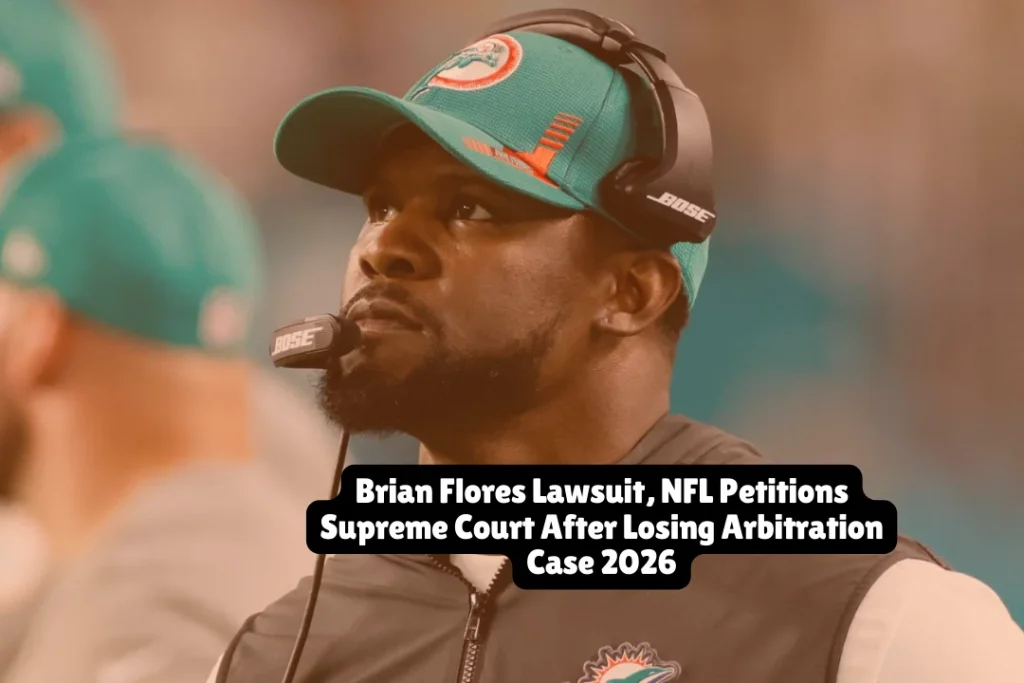
Brian Flores Lawsuit, NFL Petitions Supreme Court After Losing Arbitration Case 2026
As of February 2026, the NFL has petitioned the U.S. Supreme Court seeking to force Brian Flores’s racial discrimination lawsuit into arbitration after losing repeatedly in lower courts.
The league filed its petition on January 8, 2026, asking justices to decide whether employment disputes can be resolved through arbitration when NFL Commissioner Roger Goodell serves as both the employer’s representative and the arbitrator.
This follows the Second Circuit Court of Appeals’ August 2025 ruling that Flores’s claims against the Broncos, Giants, and Texans can proceed to trial because he never signed employment contracts with those teams. Nearly four years after the lawsuit’s February 2022 filing, the case remains stalled in procedural battles with no trial date set.
Who Brian Flores Is and Why He Sued the NFL
Brian Flores is currently the Minnesota Vikings defensive coordinator and former Miami Dolphins head coach.
He filed a class action lawsuit on February 1, 2022, in the U.S. District Court for the Southern District of New York against the NFL, Miami Dolphins, New York Giants, Denver Broncos, and Houston Texans.
Flores, who is Black, alleged the NFL and teams engaged in systemic racial discrimination against Black coaches in hiring and promotion practices.
The lawsuit came after Flores was fired by Miami following a 24-25 record over three seasons despite consecutive winning seasons. He claims he was subjected to “sham” interviews designed only to satisfy the NFL’s Rooney Rule, which requires teams to interview minority candidates for head coaching positions.
Flores alleged the Giants had already decided to hire Brian Daboll, who is white, before interviewing him. He also claimed the Broncos’ 2019 interview was a sham, with executives arriving late and appearing unprepared.
What Legal Claims Flores Filed Against NFL Teams
Flores’s lawsuit includes multiple civil rights and discrimination claims under federal and state law.
He sued under 42 U.S.C. § 1981, a Reconstruction-era federal civil rights law prohibiting racial discrimination in contracts. He also brought claims under New York and New Jersey state anti-discrimination statutes.
The complaint alleges race discrimination in hiring, retaliation for filing the lawsuit, and breach of contract. Two other Black coaches later joined as plaintiffs: Steve Wilks (former Arizona Cardinals coach) and Ray Horton (former Tennessee Titans candidate).
Flores seeks injunctive relief requiring the NFL to implement policies increasing Black ownership, giving Black players and coaches input into hiring, increasing Black coach numbers, and mandating transparency in hiring procedures.
He also seeks compensatory damages, punitive damages, and declaratory relief. The lawsuit does not specify a dollar amount but demands a jury trial.
August 2025 Court Ruling Allows Trial to Proceed
On August 14, 2025, the Second Circuit Court of Appeals issued a major ruling allowing most of Flores’s claims to proceed to trial rather than arbitration.
The appeals court found insurmountable flaws with the NFL’s arbitration process that would permit Commissioner Roger Goodell to serve as arbitrator. The court ruled this arrangement lacks independence and fairness.
Specifically, the Second Circuit held Flores’s claims against the Broncos, Giants, and Texans can go to trial because he never signed employment contracts with those teams containing arbitration clauses.
However, the court ruled claims against the Dolphins must be arbitrated because Flores signed an employment agreement with Miami containing an arbitration provision. In September 2024, Goodell designated Peter Harvey, former New Jersey Attorney General, as the arbitrator for those claims.
Judge Valerie Caproni had ruled in March 2023 that it was “difficult to understand” how only one Black head coach existed in a league where approximately 70% of players are Black.
January 2026 NFL Supreme Court Petition
The NFL filed its Supreme Court petition on January 8, 2026, after the Second Circuit denied full court review in October 2025.
The league asks the Supreme Court to resolve whether arbitration agreements designating the league commissioner as arbitrator are automatically unenforceable under the Federal Arbitration Act.
The NFL’s 25-page petition presents this legal question: “Whether an arbitration agreement governing disputes in a professional sports league is categorically unenforceable under the Federal Arbitration Act because it designates the league commissioner as the default arbitrator and permits the commissioner to develop arbitral procedures.”
The league argues the Second Circuit created a “novel federal unconscionability doctrine” giving judges discretion to deem arbitration agreements unenforceable based on subjective determinations about fairness.
NFL spokesperson Brian McCarthy stated: “We respectfully disagree with the panel’s ruling, and will be seeking further review.”
What You Must Know About Employment Discrimination and Arbitration
How Federal Civil Rights Law Protects Against Racial Discrimination
Flores’s lawsuit relies primarily on 42 U.S.C. § 1981, enacted during Reconstruction in 1866.
This federal law prohibits racial discrimination in making and enforcing contracts, including employment agreements. Unlike Title VII of the Civil Rights Act, Section 1981 allows unlimited compensatory and punitive damages.
Plaintiffs must prove they were treated differently because of race and that race was a motivating factor in the adverse employment decision. In employment discriminat like cracker-barrelion lawsuits, statistical evidence showing disparate treatment patterns can support claims of systemic discrimination.
The burden of proof requires plaintiffs to show discrimination by a preponderance of the evidence—meaning it’s more likely than not that discrimination occurred.
Why Arbitration Clauses Create Controversy in Employment Cases
Arbitration requires parties to resolve disputes privately rather than in court before a judge or jury.
Many employment contracts contain mandatory arbitration clauses requiring employees to arbitrate rather than litigate claims. Courts generally enforce these clauses under the Federal Arbitration Act.
However, arbitration becomes problematic when the arbitrator lacks independence. The Second Circuit found the NFL’s arbitration process unfair because Commissioner Goodell works for the teams and derives his authority from team owners—the very parties Flores is suing.
This creates an inherent conflict of interest that undermines the neutrality arbitration requires. Courts can refuse to enforce arbitration agreements that are “unconscionable”—meaning so one-sided and unfair that no reasonable person would agree.
What to Do Next If You’re Following This Case
Where to Find Official Court Documents and Case Updates
The Brian Flores lawsuit is Case No. 1:22-cv-00871 in the U.S. District Court for the Southern District of New York.
Court documents are available through PACER (Public Access to Court Electronic Records) at pacer.uscourts.gov. PACER requires registration and charges per-page fees for downloads.
The Supreme Court petition can be tracked through the Supreme Court’s docket at supremecourt.gov. The Court typically takes several months to decide whether to grant certiorari—the legal term for agreeing to hear a case.
If the Supreme Court accepts the petition, oral arguments would occur during the 2026-2027 term with a decision likely by June 2027. The Court accepts only a small percentage of petitions, typically those involving significant legal questions with broader implications.
Legal news outlets including Law360, Bloomberg Law, and Sports Illustrated provide ongoing coverage and analysis of the case developments.
When Legal Advice Helps for Discrimination Claims
Employees facing racial discrimination in employment like h1b-visa-lawsuit should consult civil rights attorneys immediately.
Most discrimination claims have strict filing deadlines. Federal EEOC complaints must be filed within 180 days of the discriminatory act (300 days in states with their own anti-discrimination agencies). State deadlines vary.
Attorneys can evaluate whether you have viable claims under federal laws (Title VII, Section 1981) or state anti-discrimination statutes. Many civil rights lawyers work on contingency, meaning they only get paid if you win.
Document everything: keep records of discriminatory statements, unequal treatment, performance reviews, and witness information. Strong cases typically require clear evidence showing disparate treatment based on protected characteristics like race.
Frequently Asked Questions
Who is Brian Flores and what is his current job?
Brian Flores is the defensive coordinator for the Minnesota Vikings as of February 2026. He previously served as head coach of the Miami Dolphins from 2019-2021, compiling a 24-25 record including consecutive winning seasons. He filed his discrimination lawsuit in February 2022 after being fired by Miami and not hired by other teams.
What is Brian Flores suing the NFL for?
Flores sued the NFL and five teams (Dolphins, Giants, Broncos, Texans, Cardinals) for systemic racial discrimination against Black coaches in hiring and promotion. He alleges teams conducted “sham interviews” to comply with the Rooney Rule while having no intention of hiring Black candidates. He seeks policy changes, compensatory damages, and punitive damages.
What is the current status of the Brian Flores lawsuit as of February 2026?
The NFL filed a Supreme Court petition on January 8, 2026, seeking to force all claims into arbitration. The Second Circuit ruled in August 2025 that claims against the Broncos, Giants, and Texans can proceed to trial. Claims against the Dolphins must be arbitrated. No trial date has been set after nearly four years of litigation.
Can Brian Flores still get hired as an NFL head coach while his lawsuit is pending?
Yes. ESPN insider Adam Schefter stated in December 2025 that the lawsuit likely won’t prevent Flores from getting head coaching opportunities if owners want him. Flores interviewed for several head coaching positions during the 2024-2025 hiring cycle and is considered a top candidate for openings. Dallas Cowboys reportedly expressed interest in hiring him.
What is the NFL’s Rooney Rule that Flores’s lawsuit challenges?
The Rooney Rule requires NFL teams to interview at least one minority candidate for head coaching and general manager positions. Flores argues the rule has become performative compliance rather than genuine opportunity, with teams conducting sham interviews of candidates they never intended to hire just to satisfy the requirement.
What damages is Brian Flores seeking in his lawsuit?
Flores seeks compensatory damages for lost wages and career opportunities, punitive damages to punish the NFL’s alleged discriminatory practices, and injunctive relief requiring policy changes. The complaint does not specify a dollar amount. He also demands policies increasing Black ownership, giving Black players and coaches hiring input, and mandating transparency in hiring procedures.
Will the Supreme Court hear the Brian Flores case?
The Supreme Court has not yet decided whether to grant certiorari and hear the NFL’s appeal. The Court accepts only a small percentage of petitions for review, typically those involving significant legal questions with broader implications. A decision on whether to hear the case typically takes several months. If accepted, oral arguments would occur in the 2026-2027 term.
Disclaimer: This article provides legal information about the Brian Flores lawsuit but does not constitute legal advice for specific situations.
Next Steps: If you’re experiencing workplace discrimination based on race or other protected characteristics, consult an employment discrimination attorney to understand your rights under federal and state civil rights laws.
Stay informed, stay protected. — AllAboutLawyer.com
Last Updated: February 2, 2026
About the Author

Sarah Klein, JD, is a licensed attorney and legal content strategist with over 12 years of experience across civil, criminal, family, and regulatory law. At All About Lawyer, she covers a wide range of legal topics — from high-profile lawsuits and courtroom stories to state traffic laws and everyday legal questions — all with a focus on accuracy, clarity, and public understanding.
Her writing blends real legal insight with plain-English explanations, helping readers stay informed and legally aware.
Read more about Sarah