
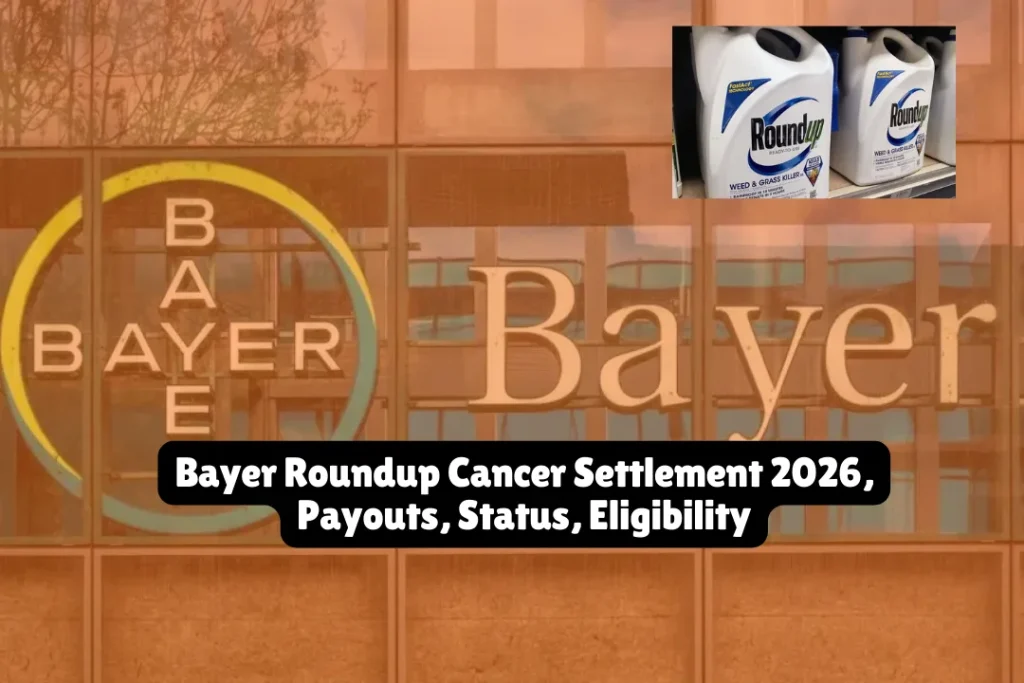
Bayer Roundup Cancer Settlement 2026, Payouts, Status, Eligibility
Monsanto (Bayer) proposed a $7.25 billion nationwide class settlement on February 17, 2026, to resolve Non-Hodgkin lymphoma claims tied to Roundup exposure. The settlement was filed in St. Louis Circuit Court in Missouri and still requires court approval. No claim deadline exists yet, and no payments are being made. If you have an active lawsuit, consult your attorney immediately.
Critical Status Notice
This settlement is PROPOSED, NOT approved. No payments have been made, no claim forms exist, and no administrator has been appointed. Do not submit personal or financial information to any third party claiming to process Roundup settlement claims right now. If you receive a solicitation offering to file a claim on your behalf, verify their credentials carefully — the official settlement process has not begun.
Key Dates at a Glance
| Event | Date / Status |
| Settlement proposed by Monsanto/Bayer | February 17, 2026 |
| Filed in | St. Louis Circuit Court, Missouri |
| Court approval required? | Yes — not yet granted |
| Claim deadline | Not yet set |
| Payment distribution | Not yet scheduled |
| U.S. Supreme Court oral arguments (related case) | April 2026 (expected) |
| Supreme Court decision expected | By June 2026 |
Settlement Status: What Changed This Week
On February 17, 2026, Monsanto announced a proposed nationwide class settlement designed to resolve current and future Roundup claims alleging Non-Hodgkin lymphoma injuries through a long-term claims program. This is the first time a formal class-wide structure has been proposed to cover both existing plaintiffs and future claimants in a single program.
The settlement still needs the court’s approval. About 200,000 Roundup-related claims have been made against Bayer, including more than 125,000 plaintiffs who have sued since 2015. Several leading plaintiff law firms have signed on in support of the proposed deal, according to Bayer’s announcement.
The proposed settlement was filed in St. Louis Circuit Court in Missouri, home to Bayer’s North America crop science division and the state where many of the lawsuits have been brought. The timeline to court approval is unclear and could take months.
What the Lawsuit Is About
Plaintiffs allege that long-term exposure to Roundup — specifically its active ingredient glyphosate — caused them to develop Non-Hodgkin lymphoma (NHL), a type of blood cancer. They further allege that Monsanto (acquired by Bayer in 2018) failed to adequately warn users about this risk despite internal knowledge of the potential danger.
Bayer disputes the assertion that Roundup’s key ingredient, glyphosate, can cause Non-Hodgkin lymphoma. The U.S. EPA has concluded that glyphosate is not likely to be carcinogenic to humans when used as directed. However, the International Agency for Research on Cancer (IARC), part of the World Health Organization, classified glyphosate as “probably carcinogenic” in 2015, which became a key foundation for the lawsuits.
Few cases have gone to trial, with 13 verdicts for Bayer and 11 for plaintiffs, including a $2.1 billion award by a Georgia jury in 2025. These large verdicts intensified pressure on Bayer to reach a global resolution.
The $7.25 Billion Settlement: How It Would Work
This is not a traditional one-time lump sum distribution. The structure is notably different from most class action settlements.
Monsanto will make declining capped annual payments for up to 21 years, totaling up to $7.25 billion, following court approval. This means payments are spread out over more than two decades, with larger amounts in earlier years and smaller ones later. The total $7.25 billion figure is a ceiling, not a guaranteed floor.
The long-term settlement program would cover both current plaintiffs and future claimants diagnosed before or within 16 years of final court approval, according to the filing. Payments would be made annually and are subject to caps and declining funding levels over time.
Because this settlement has not been approved, the attorney fee percentage, administration costs, and net distribution fund have not been publicly established. The settlement documents filed with the court are expected to contain these details, but as of February 21, 2026, they have not been made fully public.
Estimated Payout Math: What We Know and What We Don’t
Important disclosure: The following calculations are illustrative estimates based on publicly available information. They are not official figures, not guaranteed, and may change significantly once the court reviews and potentially modifies settlement terms. Individual payouts in personal injury cases like this vary enormously based on medical factors, legal representation, and claim tier assignments.
Working assumptions for illustration only:
- Total proposed fund: up to $7.25 billion (paid over 21 years)
- Approximate remaining active claimants: ~61,000 as of February 2026 (per Lawsuit Information Center)
- Many cases (~77,000+) were already resolved in prior separate settlements
- Attorney fees in mass tort settlements typically range from 25%–40% of individual recovery
High Scenario — Strong Medical and Exposure Profile
- Profile: Long-term agricultural worker, 10+ years of regular direct Roundup exposure, diagnosed with diffuse large B-cell lymphoma (a recognized NHL subtype), strong medical documentation, filed lawsuit before 2024
- Estimated individual settlement value in prior Roundup settlements for comparable profiles: $150,000–$300,000+
- Attorney fees at 33%: approximately $50,000–$99,000
- Estimated net to claimant: $100,000–$200,000+
This is consistent with reported averages from the earlier 2020 Bayer settlement round, which resolved about 100,000 cases and reportedly averaged approximately $160,000 per claimant before fees.
Mid Scenario — Moderate Exposure, Diagnosed NHL
- Profile: Residential user, 5–8 years of regular lawn use, diagnosed with follicular lymphoma (NHL subtype), some documentation of use, lawsuit filed 2022–2025
- Estimated individual settlement value: $50,000–$100,000
- Attorney fees at 33%: approximately $16,500–$33,000
- Estimated net to claimant: $33,500–$67,000
Low Scenario — Limited Exposure Documentation
- Profile: Occasional residential user, limited purchase records, Non-Hodgkin lymphoma diagnosis but unclear causal link documentation, claim not yet filed as of February 2026
- Estimated individual settlement value: $10,000–$30,000
- Attorney fees at 33%: approximately $3,300–$9,900
- Estimated net to claimant: $6,700–$20,000
These figures are illustrative only. The actual per-claim values under the new $7.25 billion structure will depend entirely on how many claimants participate, how the court-approved point or tier system assigns value, and the pace of annual funding.
Who May Be Eligible
Based on the nature of the claims and prior settlement eligibility criteria, the proposed class is expected to cover people who:
- Were diagnosed with Non-Hodgkin lymphoma (NHL) or a recognized NHL subtype (such as diffuse large B-cell lymphoma, follicular lymphoma, mantle cell lymphoma, or others)
- Had documented exposure to Roundup (glyphosate-based herbicide), either as an agricultural worker, landscaper, groundskeeper, or residential user
- Used Roundup prior to February 17, 2026 (the date the settlement was proposed)
- Have not already settled their claims through a prior Bayer agreement
The long-term settlement program would cover both current plaintiffs and future claimants diagnosed before or within 16 years of final court approval. This means even people diagnosed in the coming years may qualify if they can show exposure predated the court approval date.
Who is likely excluded:
- People diagnosed with cancers other than Non-Hodgkin lymphoma
- People in states (Georgia, North Dakota) that have passed laws barring failure-to-warn pesticide lawsuits
- People who previously settled with Bayer and signed releases
What to Do Right Now if You Think You Have a Claim
Because this settlement has not been court-approved and no claim process is open, the most important step right now is to consult a qualified personal injury attorney who handles toxic tort or mass tort cases. Do not wait — evidence and medical records can become harder to obtain over time.
If you already have an attorney representing you in a Roundup case, contact them to understand how the proposed settlement affects your existing lawsuit. Your attorney will decide whether opting in or continuing to litigate is in your best interest.
Do not submit claims, pay upfront fees to any settlement processing company, or sign agreements with third-party claim aggregators without legal counsel. Once the court approves a settlement, an official administrator will be named and a formal claim process will be announced publicly through court notices and official press releases.
The Supreme Court Case Running Alongside This Settlement
The agreement is part of a broader legal strategy tied to the U.S. Supreme Court’s pending review of Durnell v. Monsanto, a case that could determine whether state-law failure-to-warn claims are preempted by federal pesticide labeling rules.
The U.S. Supreme Court will consider whether the EPA’s approval of Roundup without a cancer warning should rule out state court claims. The Trump administration has weighed in on Bayer’s behalf, reversing the Biden administration’s position. A ruling in Bayer’s favor could dramatically reduce the number of viable future claims. The proposed settlement is structured to resolve claims regardless of how the Supreme Court rules, which protects both sides from the uncertainty of that outcome.
Frequently Asked Questions
Is the Roundup settlement approved and paying out? No. The $7.25 billion settlement was proposed on February 17, 2026, and still requires court approval. No payments are being made and no claim forms are available yet.
How much will I get from the Roundup settlement? Individual payouts are not yet determined. They will depend on your exposure history, diagnosis, medical documentation, the number of participating claimants, and the tier or point system the court approves. Based on prior Roundup settlements, individual recoveries have ranged from tens of thousands to several hundred thousand dollars before attorney fees.
What cancer does the Roundup settlement cover? The settlement addresses Non-Hodgkin lymphoma (NHL) claims. Other cancers are not covered under the current proposed agreement.
Do I need to file a claim form right now? No. There is no claim form. The official claim process has not opened. If you do not have an attorney, you should consult one before the claim window opens.
When is the Roundup settlement claim deadline? No deadline has been set. It will be established as part of court approval proceedings. Follow updates at official court announcements or through your attorney.
I already have a Roundup lawsuit. Does this settlement affect my case? Possibly. Your attorney needs to evaluate whether opting into the class settlement or continuing your individual lawsuit is the better choice for your specific circumstances. Do not make that decision without legal guidance.
Who is the settlement administrator for the Roundup case? No administrator has been appointed yet. One will be named after court approval.
Does Bayer admit wrongdoing in this settlement? No. The settlement agreements do not contain any admission of liability or wrongdoing.
Will the Supreme Court case cancel the settlement? No. The proposed settlement would not be affected by the Supreme Court case. Patients would be assured of receiving settlement money even if the Supreme Court rules in Bayer’s favor.
How long will it take to receive payment if the settlement is approved? Given that payments are structured as annual installments over up to 21 years, most claimants should expect to wait months to years after final court approval before receiving funds. The timeline depends heavily on when approval occurs and how claim processing proceeds.
Last Updated: February 21, 2026
Mandatory Disclaimer
This article is for informational purposes only and does not constitute legal or tax advice. Settlement terms, eligibility, and payment amounts are subject to court approval and may change. For official information, always refer to the settlement administrator or the official settlement website once one is established. Payment examples in this article are illustrative estimates based on publicly available data from prior settlement rounds and are not guaranteed figures for the proposed 2026 settlement.
AllAboutLawyer.com is not a settlement administrator and is not affiliated with Bayer, Monsanto, or any plaintiff law firm. Do not submit personal information to this website to claim a settlement payment.
Sources: Bayer/Monsanto press release (February 17, 2026), Fortune (February 18, 2026), Yahoo Finance (February 18, 2026), Fierce Pharma (February 17, 2026), Lawsuit Information Center (February 2026), Top Class Actions (February 20, 2026).
About the Author

Sarah Klein, JD, is a licensed attorney and legal content strategist with over 12 years of experience across civil, criminal, family, and regulatory law. At All About Lawyer, she covers a wide range of legal topics — from high-profile lawsuits and courtroom stories to state traffic laws and everyday legal questions — all with a focus on accuracy, clarity, and public understanding.
Her writing blends real legal insight with plain-English explanations, helping readers stay informed and legally aware.
Read more about Sarah