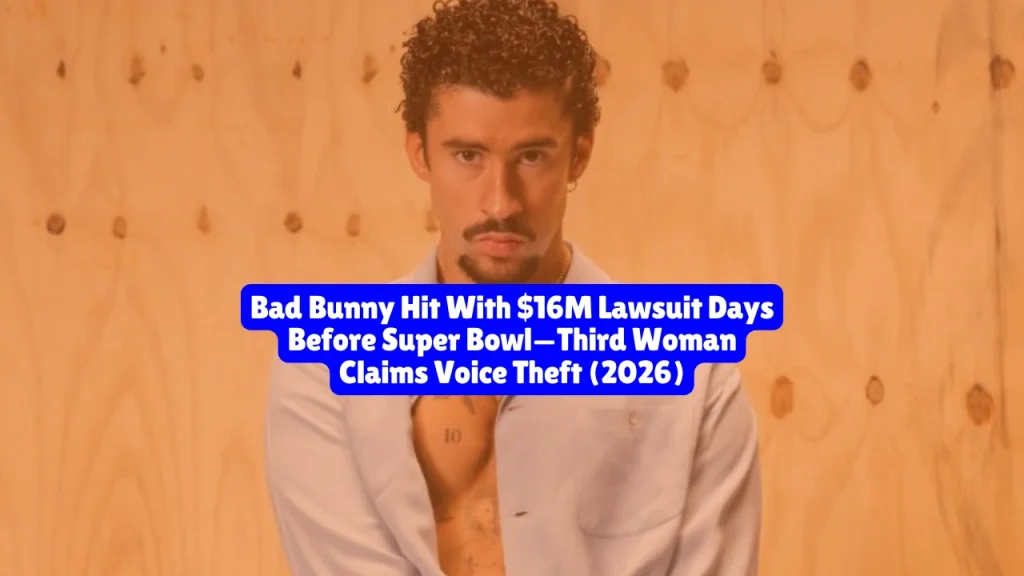
Bad Bunny Hit With $16M Lawsuit Days Before Super Bowl—Third Woman Claims Voice Theft (2026)
Bad Bunny faces a $16 million lawsuit filed January 6, 2026, by Tainaly Y. Serrano Rivera, who claims the reggaeton superstar used her voice without permission on two hit songs. This marks the third voice recording lawsuit against the Puerto Rican artist in three years, revealing a troubling pattern as he prepares for his February 9, 2026 Super Bowl halftime performance.
Why This Matters to You
This affects you if you’re a creator who’s ever recorded audio for someone else, an artist concerned about protecting your intellectual property, or a music industry professional navigating digital-age copyright issues. Understanding this could matter to you if you work in entertainment law, follow celebrity legal disputes, or care about consent and compensation in creative collaborations. The stakes are massive—these cases determine whether artists can profit from others’ creative contributions without permission, and what happens when informal recordings become commercial goldmines.
What the Bad Bunny Lawsuit Is All About
The Latest $16 Million Voice Recording Claim
On January 6, 2026, Tainaly Y. Serrano Rivera filed a 32-page lawsuit in San Juan Court of First Instance against Bad Bunny (real name: Benito Antonio Martínez Ocasio), his record label Rimas Entertainment, and producer Roberto J. Rosado.
The lawsuit centers on a voice recording of Rivera saying “Mira puñ-t-, no me quiten el perreo” (roughly translated: “Look, don’t take my reggaeton away”). This phrase appears prominently on two Bad Bunny songs: “Solo de Mí” from his 2018 debut album X 100PRE, and “EoO” from his January 2025 album Debí Tirar Más Fotos.
Rivera claims she recorded the phrase at producer Rosado’s request when they were students at Interamerican University of Arecibo, but she never authorized commercial use or signed any contracts permitting its exploitation.
Who Is Suing Bad Bunny (and Why)
Current Plaintiff:
- Tainaly Y. Serrano Rivera (voice recording used on “Solo de Mí” and “EoO”)
- Filed: January 6, 2026
- Seeking: $16 million for privacy violations, publicity rights infringement, unjust enrichment, and moral copyright violations
Previous Voice Recording Plaintiff:
- Carliz de la Cruz Hernández (Bad Bunny’s ex-girlfriend)
- Filed: March 2023
- Claim: Unauthorized use of “Bad Bunny, baby” phrase on “Pa Ti” (2017) and “Dos Mil 16” (2022)
- Seeking: $40 million
- Status: Case still pending in Puerto Rican courts as of January 2026
La Casita Home Lawsuit Plaintiff:
- Román Carrasco Delgado, 84-year-old homeowner
- Filed: September 17, 2025
- Claim: Bad Bunny used his Humacao home in the “Debí Tirar Más Fotos” short film and recreated it for 30 concerts without proper consent
- Seeking: $6 million ($5 million damages, $1 million mental anguish)
- Status: Failed settlement negotiations, litigation ongoing
The Legal Claims Explained in Plain English
Rivera’s January 2026 lawsuit alleges violations of multiple legal doctrines:
Puerto Rico’s Moral Copyright Law: This protects creators’ rights to attribution and integrity of their work. Rivera argues her voice constitutes an artistic contribution that requires proper credit and compensation.
Right to One’s Own Image Law: In Puerto Rico, this extends to voice recordings. Using someone’s distinct voice for commercial purposes without permission violates their publicity rights.
Unjust Enrichment: This legal principle holds that when one party unfairly benefits from another’s contributions without compensation, they must provide restitution. Bad Bunny has earned millions from albums and concerts featuring Rivera’s voice while she received nothing.
Privacy Rights: The lawsuit claims Rivera’s privacy was violated when her voice became associated with Bad Bunny’s global brand without her consent.
The Troubling Pattern: Three Voice Cases in Three Years
What makes the Bad Bunny lawsuit situation particularly concerning is the pattern emerging across multiple cases.
In 2015, Bad Bunny asked then-girlfriend Carliz de la Cruz to record herself saying “Bad Bunny, baby.” She recorded it on her phone in several takes. The phrase appeared on “Pa Ti” (which has 355 million YouTube views and 235 million Spotify plays) and later on “Dos Mil 16” in 2022.
When Bad Bunny’s team tried to get permission in May 2022, they allegedly referred to him as “Voldemort” and offered de la Cruz just $2,000 for the rights. She refused. According to court documents, Bad Bunny’s team proceeded to use the recording anyway.
Now Rivera’s case reveals a nearly identical scenario—a casual recording made by someone the artist knew, later used commercially without permission or payment.
Current Status: Where Each Case Stands
Serrano Rivera $16M Lawsuit (January 2026): Newly filed, in early stages of litigation. Producer Rosado has allegedly admitted the use was unauthorized. Legal experts note Rivera has the same attorneys who represented de la Cruz, suggesting coordinated legal strategy.
De la Cruz $40M Lawsuit (March 2023): Still pending in Puerto Rican courts. Bad Bunny’s team initially tried to move the case to federal court citing copyright concerns, but de la Cruz (who is herself an attorney) successfully argued it should remain in Puerto Rico’s jurisdiction.
Carrasco La Casita Lawsuit (September 2025): Settlement negotiations failed in late 2025 when Bad Bunny’s team allegedly made a “disrespectful” low offer. Carrasco’s attorney Juan R. Dávila Díaz told media his 84-year-old client received only $5,200 total despite his home appearing in a short film with 22 million YouTube views and being replicated for a 30-concert residency that generated millions.
What You Must Know About Entertainment Law
How Voice Recordings Became Legal Goldmines
Most people don’t realize that your voice is legally protected property. Under both federal copyright law and state publicity rights statutes, using someone’s distinctive voice for commercial purposes without permission can trigger multiple causes of action.
The legal landscape changed dramatically after cases like Midler v. Ford Motor Co. (1988), where the Ninth Circuit ruled that imitating Bette Midler’s distinctive voice in a commercial violated her publicity rights. Later, in Waits v. Frito-Lay (1992), Tom Waits won $2.6 million when an impersonator mimicked his voice in a Doritos ad.
These precedents established that voice can be protected property, but Bad Bunny’s cases present a unique twist—he’s not using impersonators, he’s using actual recordings made by real people who claim they never consented to commercial exploitation.
The $40 Million Ex-Girlfriend Case Nobody Saw Coming
While some media outlets reported de la Cruz “won” $40 million, court records show the case remains pending as of January 2026. The confusion stems from a May 2024 report by HipLatina citing El Diario NY, but subsequent legal developments suggest the case wasn’t fully resolved.
What’s undisputed: Bad Bunny stopped using the “Bad Bunny, baby” recording after 2016 when the relationship ended. Then in 2022, he started using it again without securing permission. His team’s $2,000 offer seemed to insult de la Cruz, who was handling his bookings and contracts back when he was unknown.
According to court filings, thousands of people comment on de la Cruz’s social media about the phrase wherever she goes, causing her ongoing anxiety and distress.
What Unjust Enrichment Really Means for Creators
Unjust enrichment claims don’t require proving a contract existed. Instead, they’re based on fundamental fairness principles recognized across U.S. jurisdictions.
To win an unjust enrichment claim, plaintiffs must prove three elements: the defendant received a benefit, the benefit came at the plaintiff’s expense, and keeping the benefit without payment would be unfair or unjust.
For Rivera and de la Cruz, the benefits are clear—Bad Bunny built commercial success partly on voice recordings that became signature elements of hit songs. The phrases are played at concerts worldwide, featured on merchandise, and used in promotional materials. Bad Bunny’s enrichment directly connects to the plaintiffs’ contributions, yet they received no compensation.
Entertainment lawyers note these cases could reshape how artists handle informal recordings. Similar cases involving celebrity legal disputes have established precedents about compensating contributors, as seen in the Kat Von D tattoo lawsuit where copyright and creative attribution became central issues.
Pro Tip: If you’re ever asked to record audio for any project—even casually for a friend—get the terms in writing. Specify whether it’s for personal use only, commercial use with compensation, or any other arrangement. A simple email confirming the scope of use can prevent million-dollar disputes later.
What to Do Next
How to Follow These Legal Battles
All three Bad Bunny lawsuits are proceeding in Puerto Rican courts, which means court documents are filed through Puerto Rico’s judicial system.
You can monitor developments through several sources. The Puerto Rico Judicial Branch operates an electronic case filing system accessible at www.ramajudicial.pr. Major entertainment law publications like Billboard, Variety, and The Hollywood Reporter regularly cover high-profile music litigation. Legal news sites such as Law360 and Courthouse News Service provide detailed coverage of entertainment industry lawsuits.
For the most reliable updates, follow statements from the plaintiffs’ attorneys. Rivera and de la Cruz share the same legal team—José M. Marxuach Fagot and Joanna Bocanegra Ocasio—who have experience with entertainment litigation and may provide updates to media.
Where to Find Official Court Documents
Unlike federal court cases available through PACER (Public Access to Court Electronic Records), Puerto Rican court documents require accessing the territorial court system. The San Juan Court of First Instance handles civil cases including these lawsuits.
Legal databases such as Bloomberg Law, Westlaw, and LexisNexis may publish significant court filings and opinions once the cases progress beyond initial pleading stages. Entertainment law blogs often analyze court documents and publish excerpts when cases reach important milestones.
When to Consult an Entertainment Attorney
If you’re a creator, artist, or content producer who has ever provided recordings, performances, or creative contributions to someone else’s work, consider consulting an entertainment attorney if your contributions have been used commercially without your permission, you never signed a written agreement specifying usage rights, you received minimal or no compensation despite significant commercial success, or your identity or creative work has become associated with a commercial product or brand.
The Bad Bunny cases demonstrate that even informal recordings made years ago can generate substantial legal claims if used commercially without proper authorization.
For artists and producers on the other side, these lawsuits highlight the critical importance of obtaining clear, written licenses for any voice recordings, samples, or creative contributions before commercial release. Entertainment attorneys can draft work-for-hire agreements, licensing contracts, and release forms that protect all parties.
Frequently Asked Questions
Did Bad Bunny lose the $40 million lawsuit to his ex-girlfriend?
Not yet. While some reports in mid-2024 claimed Bad Bunny was ordered to pay $40 million to Carliz de la Cruz, the case remains pending in Puerto Rican courts as of January 2026. De la Cruz filed her lawsuit in March 2023, and while she’s seeking $40 million, no final judgment has been publicly confirmed.
How many lawsuits does Bad Bunny currently face?
Bad Bunny faces at least three major active lawsuits as of January 2026: the $16 million Serrano Rivera voice recording case filed January 6, 2026, the $40 million de la Cruz voice recording case filed March 2023, and the $6 million Carrasco “La Casita” home exploitation case filed September 2025. Additional lawsuits involving copyright claims over samples and other issues have been reported but may have been resolved or remain in earlier stages.
What is the Bad Bunny La Casita lawsuit about?
The La Casita lawsuit involves 84-year-old Román Carrasco Delgado, who built his salmon-colored home in Humacao, Puerto Rico by hand in the 1960s. Bad Bunny featured the home in his January 2025 short film “Debí Tirar Más Fotos,” then recreated it as a life-sized replica stage for 30 concerts. Carrasco claims he signed contracts fraudulently, received only $5,200, and his home became a daily tourist destination that destroyed his privacy.
Can Bad Bunny use voice recordings without permission?
No. Using someone’s voice recording for commercial purposes without permission violates multiple legal protections including publicity rights, moral copyright laws (in Puerto Rico), and potentially privacy rights. Even if someone voluntarily made a recording, commercial exploitation requires explicit consent and typically compensation.
What happened with Bad Bunny’s Afrobeats sample lawsuit?
In May 2025, Nigerian producer Dera filed a lawsuit claiming Bad Bunny’s 2022 track “Enséñame a Bailar” from Un Verano Sin Ti sampled his 2019 song “Empty My Pocket” without permission. Bad Bunny’s team claimed they obtained the sample through Lakizo Entertainment, but emPawa Africa (the original label) disputed this authorization. The case status as of January 2026 remains unclear.
Will these lawsuits affect Bad Bunny’s Super Bowl performance?
The January 6, 2026 lawsuit filing came just one month before Bad Bunny’s scheduled February 9, 2026 Super Bowl halftime show. While lawsuits rarely prevent performances, the timing creates public relations challenges. Bad Bunny and his representatives have not publicly commented on any of the pending lawsuits.
Who are Bad Bunny’s lawyers in these cases?
Bad Bunny’s legal representation hasn’t been publicly disclosed in all cases. His record label Rimas Entertainment typically handles legal matters. Both Rivera and de la Cruz are represented by the same Puerto Rican attorneys—José M. Marxuach Fagot and Joanna Bocanegra Ocasio—suggesting coordinated legal strategy.
Last Updated: January 11, 2026 — We keep this current with the latest legal developments
This article provides general information only and does not constitute legal advice. Laws and case outcomes vary by jurisdiction and individual circumstances.
Stay informed, stay protected. — AllAboutLawyer.com
About the Author

Sarah Klein, JD, is a licensed attorney and legal content strategist with over 12 years of experience across civil, criminal, family, and regulatory law. At All About Lawyer, she covers a wide range of legal topics — from high-profile lawsuits and courtroom stories to state traffic laws and everyday legal questions — all with a focus on accuracy, clarity, and public understanding.
Her writing blends real legal insight with plain-English explanations, helping readers stay informed and legally aware.
Read more about Sarah