
Are Fireworks Legal In Texas? New Juneteenth Sales Window Changes Everything
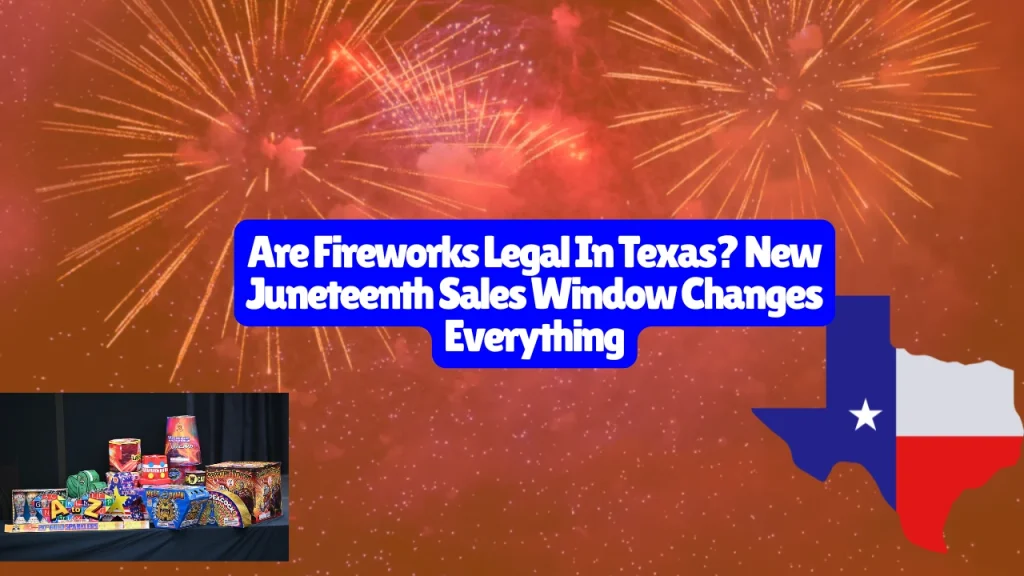
Yes, consumer fireworks are legal in Texas in 2025, but with strict regulations. New legislation (HB 554) now allows fireworks sales June 14-19 for Juneteenth celebrations in counties that approve it. Consumer fireworks classified as “Fireworks 1.4G”—including fountains, sparklers, ground spinners, and Roman candles—are permitted. Illegal fireworks include sky rockets, bottle rockets exceeding size limits, and firecrackers over 50 milligrams of pyrotechnic composition. Violations carry Class C misdemeanor charges with fines up to $2,000 in major cities.
Most major Texas cities ban all fireworks within city limits.
What Types of Fireworks Are Legal in Texas?
Texas law categorizes legal fireworks as “consumer fireworks” or “Fireworks 1.4G” under Texas Occupations Code Chapter 2154. These devices are designed for personal entertainment use.
Legal Fireworks in Texas:
- Fountains and ground-based cones
- Illuminating torches and wheels
- Ground spinners and sparklers
- Smoke devices and novelty items
- Roman candles
- Reloadable shell devices
- Firecrackers containing 50 milligrams or less of pyrotechnic composition
- Aerial devices approved by the U.S. Consumer Product Safety Commission
All legal fireworks must carry CPSC approval. Retailers must verify purchasers are at least 16 years old with valid government-issued ID.
Illegal Fireworks in Texas:
- Sky rockets without CPSC approval
- Bottle rockets with propellant casings 5+ inches long or exterior diameter 3/4+ inch
- Pop rockets under 26 inches total length with casings under 5 inches
- Firecrackers exceeding 50 milligrams of pyrotechnic composition
- Any fireworks not approved by CPSC
- Professional-grade “Fireworks 1.3G” (requires licensed pyrotechnic operator)
Texas Fireworks Sales Periods for 2025
HB 554, passed in May 2025 and effective September 1, 2025, expanded legal fireworks sales periods to include Juneteenth.
Statewide Sales Windows:
- June 24-July 4: Independence Day (all counties)
- December 20-January 1: New Year’s celebrations (all counties)
County-Approved Optional Sales Periods:
- June 14-19: Juneteenth (requires county commissioners court approval)
- May 1-5: Cinco de Mayo (counties within 100 miles of Texas-Mexico border only, requires approval)
- February 25-March 2: Texas Independence Day (requires approval)
- April 16-21: San Jacinto Day (requires approval)
- Wednesday before last Monday through last Monday in May: Memorial Day (requires approval)
- Five days before through last day of Diwali: Diwali celebrations (requires approval)
- Five days before through Lunar New Year: Lunar New Year (requires approval)
County commissioners courts must meet specific deadlines to regulate sales: June 1 for Juneteenth, June 15 for Fourth of July, December 15 for December holidays.
Where You Can and Cannot Use Fireworks in Texas
Texas law prohibits fireworks in specific locations statewide regardless of local ordinances.
Statewide Prohibited Locations:
- Within 600 feet of churches, hospitals (except veterinary), asylums, licensed child care centers, or schools without written authorization
- Within 100 feet of where flammable liquids or compressed gases are stored/dispensed
- Within 100 feet of where fireworks are stored or sold
- In or from motor vehicles
- On U.S. Army Corps of Engineers property (includes Lake Meredith, Lake Ray Hubbard, and most federal park lands)
- Within 5,000 feet of city limits in cities with fireworks bans
Most major Texas cities completely ban fireworks within incorporated city limits.
Major Cities with Complete Fireworks Bans:
- Houston
- Austin
- Dallas
- San Antonio
- El Paso
- Fort Worth
- Waco
- Amarillo
Unincorporated county areas generally allow fireworks on private property with owner permission, except during burn bans or within restricted zones near city limits.
Related article: Are Fireworks Legal in Florida? Only 3 Days Legal—What You Must Know
Texas Occupations Code Chapter 2154: The Governing Statute
Texas Occupations Code Chapter 2154 establishes the comprehensive regulatory framework for fireworks sales, distribution, and use. Section 2154.251 defines prohibited uses, while Section 2154.303 outlines penalties.
Key Statutory Provisions:
- Section 2154.101: Licensing requirements for manufacturers, distributors, and pyrotechnic operators
- Section 2154.202: Retail permit requirements and sales periods
- Section 2154.251: Prohibited uses (8 specific violations)
- Section 2154.254: Employment restrictions for minors
- Section 2154.303: Criminal penalties
- Section 2154.304: Seizure authority for illegal fireworks
The statute defines “Fireworks 1.4G” as consumer fireworks designed for entertainment producing visible or audible effects through combustion, explosion, or deflagration. “Fireworks 1.3G” are professional-grade devices requiring licensed operators.
Penalties for Illegal Fireworks in Texas
Violations of Texas fireworks laws carry criminal penalties under Section 2154.303.
Class C Misdemeanor (Less Serious Violations):
- Property damage under $200 with no bodily injury or death
- Employment of minors under 16 in fireworks sales
- Maximum fine: $500-$2,000 depending on municipality
- Each day of violation constitutes separate offense
Class B Misdemeanor (Standard Violations):
- Most violations of Section 2154.251 prohibited uses
- Selling without proper permits
- Maximum penalties: Up to 180 days jail, $2,000 fine
- Criminal record upon conviction
Enhanced Penalties: Fort Worth, Keller, and Southlake impose fines up to $2,000 for possession, sale, or discharge within city limits. Houston fines range $200-$5,000 per individual firework, with $500-$2,000 typical for Harris County violations.
Arson Charges: New legislation effective September 2025 allows prosecutors to charge individuals with arson if they recklessly cause fires damaging structures or vehicles. Arson convictions carry fines up to $10,000 and potential incarceration.
State Jail Felony: Texas Penal Code Section 50.02 creates a specific felony for using fireworks to interfere with law enforcement or flee from arrest. This carries 180 days to 2 years in state jail plus $10,000 maximum fine. Using commercial-grade fireworks against officers elevates charges to second-degree felony (2-20 years prison).
County Burn Bans and Emergency Restrictions
County judges can declare local disasters during drought conditions, restricting or prohibiting fireworks use. The Texas A&M Forest Service determines drought conditions using measurement index guidelines.
2025 Burn Ban Deadlines:
- February 14: Texas Independence Day season
- April 1: San Jacinto Day season
- April 25: Cinco de Mayo season
- May 15: Memorial Day season
- June 1: Juneteenth season
- June 15: Fourth of July season
- October 2: Diwali season (15 days before)
- December 15: December holiday season
Check the Texas A&M Forest Service Burn Ban Map or contact your county fire marshal before purchasing or using fireworks. Burn bans override normal permissions even in unincorporated areas.
Local Ordinances by Major Cities and Counties
Texas grants municipalities broad authority to enact stricter fireworks regulations than state law.
Harris County: Fireworks legal in unincorporated areas including neighborhoods in Atascocita, Crosby, Cypress, South Belt, Spring, and Channelview. Houston Fire Department enforces bans in Limited Purpose Annexation Areas. Use Harris County Address Lookup to verify your location status.
Galveston: Complete ban including public beaches and parks. Violations result in Class C misdemeanor charges with $500 fines.
Bolivar Peninsula: Completely unincorporated—fireworks legal in Crystal Beach, Gilchrist, High Island with standard state restrictions.
Denton County: Legal on private property in unincorporated areas with owner permission. Cities can enforce ordinances within 5,000 feet of city limits. Prohibited on U.S. Corps of Engineers property (Lake Lewisville, Lake Ray Roberts). Violations carry $500 fines per occurrence.
Travis County: Frequent seasonal burn bans affecting rural celebrations. Check with county fire marshal before planned events.
Homeowners associations may impose additional restrictions. Review HOA covenants before purchasing fireworks.
Recent Legislative Changes: HB 554 and HB 1899
HB 554 (Juneteenth Sales): Passed May 2025, effective September 1, 2025. Allows retail fireworks sales June 14-19 in counties where commissioners courts approve. Requires Texas A&M Forest Service to provide drought condition determinations during Juneteenth season. Counties must adopt restriction orders by June 1 deadline.
HB 1899: Amended examination and licensing requirements for pyrotechnic operators effective September 1, 2025. Grants State Fire Marshal authority to establish examination scope and enter agreements with testing services. Streamlines license application processes.
These changes reflect growing recognition of Juneteenth as major celebration while maintaining safety-focused regulatory framework.
How Texas Compares to Neighboring States
Texas maintains more permissive fireworks laws than several neighboring states but stricter local enforcement.
Oklahoma: All consumer fireworks legal statewide. Sales permitted year-round with peak seasons around July 4 and New Year’s. Cities can restrict discharge but not possession.
Louisiana: All consumer fireworks legal. Sales windows similar to Texas. Fewer municipal bans than Texas cities.
New Mexico: Consumer fireworks legal with state permits. Retailers must obtain licenses. Similar seasonal restrictions.
Arkansas: Consumer fireworks legal with permits. More restrictive than Texas on aerial devices.
Mexico (Border Regions): Less regulated fireworks markets contribute to cross-border purchases, though importing fireworks into Texas without proper documentation violates federal and state law.
Texas’s unique feature is extensive municipal authority allowing complete city bans, creating significant variation within the state.
Enforcement Mechanisms and Compliance
Multiple agencies enforce Texas fireworks laws with overlapping jurisdiction.
Enforcement Authority:
- State Fire Marshal and deputies
- County fire marshals
- City fire chiefs and fire marshals
- Peace officers (police, sheriffs, constables)
- Local fire prevention officers
Law enforcement can issue criminal citations, confiscate illegal fireworks, and pursue injunctive relief for public safety threats. Section 2154.304 requires seized fireworks be held by the seizing agent or county sheriff.
Prosecution Venue: Violations can be prosecuted in the county where committed or Travis County, providing state prosecutors flexibility for enforcement actions.
Insurance Implications: Homeowners and property insurance policies may deny claims for fire or explosion damage caused by illegal fireworks use. This leaves property owners facing uninsured losses. Some insurers pursue subrogation against responsible parties.
Permits for Public Fireworks Displays
Professional displays using “Fireworks 1.3G” require licensed pyrotechnic operators and proper permits.
Requirements for Public Displays:
- Licensed pyrotechnic operator (minimum age 21)
- Approval from local fire prevention officer
- Compliance with National Fire Protection Association standards
- Proof of insurance coverage
- Detailed display plan including safety protocols
- Payment of applicable permit fees (set by State Fire Marshal)
Pyrotechnic operator applicants must pass examinations established by the State Fire Marshal or hold equivalent licenses from states with substantially equivalent requirements.
Proximate displays following NFPA 1126 standards require licensed operators regardless of fireworks classification.
Safety Data and Fire Prevention
The National Fire Protection Association reports fireworks cause approximately 19,500 fires annually nationwide, with 66% of injuries occurring around July 4.
Texas-Specific Safety Concerns:
- Extended drought conditions increase wildfire risks
- Urban-wildland interface zones particularly vulnerable
- Sparklers reach 1,200-1,800°F (can ignite clothing, grass)
- Most injuries affect children under 15 (one-third of all victims)
- Burns account for 44% of injuries, primarily to hands/fingers
Texas’s seasonal approach aligns fireworks availability with celebrations while allowing county-level drought restrictions. The Texas A&M Forest Service monitoring system provides real-time drought assessments helping counties make informed restriction decisions.
What You Need to Know for 2025
Key Takeaways:
- Consumer fireworks (1.4G) are legal under state law
- New Juneteenth sales window (June 14-19) requires county approval
- Most major cities ban all fireworks within city limits
- Unincorporated areas generally permit private property use with owner consent
- Minimum age 16 to purchase fireworks
- Violations carry criminal misdemeanor charges, not civil infractions
- Burn bans override normal permissions
- Using fireworks against police is a felony
- Insurance may deny claims for illegal fireworks damage
Before Using Fireworks:
- Verify your city/county allows fireworks at your specific location
- Check for active burn bans (Texas A&M Forest Service website)
- Confirm you’re outside 600-foot restricted zones
- Get written permission if using on others’ property
- Have water, hose, and fire extinguisher available
- Supervise children constantly
- Never relight malfunctioning fireworks
- Soak used fireworks in water before disposal
Legal Expert Perspectives
Texas fireworks regulation exemplifies the state’s approach to local control. While state law establishes baseline permissibility, municipalities exercise substantial authority to impose complete bans within their jurisdictions.
The 2025 HB 554 addition of Juneteenth sales windows demonstrates legislative responsiveness to evolving cultural celebrations while maintaining county-level discretion through required commissioners court approvals.
Legal experts note the criminal misdemeanor classification for violations means convictions create permanent records affecting employment, professional licensing, and other opportunities—consequences extending far beyond monetary fines.
The 2021 creation of felony penalties for using fireworks against law enforcement (Texas Penal Code 50.02) reflects concerns from 2020 protests. This enhancement treats fireworks as dangerous weapons when deployed against officers.
Insurance implications create additional compliance incentives. Denied claims for fire damage can result in catastrophic financial losses, particularly for homeowners in wildfire-prone areas.
Frequently Asked Questions
Can I buy fireworks in another state and bring them to Texas?
Possibly, but only if they’re legal in Texas. Fireworks legal in neighboring states may exceed Texas restrictions. Transporting illegal fireworks across state lines violates both state and federal law. Verify any purchases comply with Texas standards before transporting.
Are sparklers legal everywhere in Texas?
No. While sparklers are legal under state law, cities like Houston, Austin, Dallas, Fort Worth, and San Antonio ban all fireworks including sparklers within city limits.
What happens if my fireworks cause a fire?
You face potential arson charges under new 2025 legislation if you recklessly caused the fire. Penalties include up to $10,000 fines and incarceration. You’re also civilly liable for damages. Your insurance likely won’t cover losses if fireworks use was illegal.
Can I use fireworks in my backyard inside city limits?
Only if your city allows it. Most major Texas cities completely ban fireworks within incorporated limits. Check your city’s municipal code or contact the fire marshal’s office.
Do I need a permit for a backyard party with fireworks?
Not for consumer fireworks (1.4G) on private property in areas where they’re legal. Professional displays using 1.3G fireworks require licensed operators and permits regardless of location.
What’s the difference between 1.4G and 1.3G fireworks?
1.4G are consumer-grade fireworks for personal use. 1.3G are professional-grade devices producing larger effects, requiring licensed pyrotechnic operators. Using 1.3G without proper licensing is a Class B misdemeanor.
How do I report illegal fireworks?
Contact local non-emergency police numbers (not 911 unless immediate danger exists). In Houston, call 713-884-3131. Provide location details and description of violations.
Can counties ban fireworks during normal sales periods?
Yes, through burn bans declared during drought conditions. County judges can restrict or prohibit fireworks use regardless of normal permissions. These temporary restrictions override state law sales windows.
What if I’m caught with fireworks during a burn ban?
You face Class C misdemeanor charges with fines up to $2,000 depending on jurisdiction, plus confiscation of all fireworks. Each day of violation constitutes a separate offense.
Texas fireworks laws balance celebrating traditions with public safety through state baseline permissibility, local control mechanisms, and responsive drought restrictions. Understanding both state statutes and local ordinances ensures legal compliance while protecting property and lives during celebrations.
About the Author

Sarah Klein, JD, is a licensed attorney and legal content strategist with over 12 years of experience across civil, criminal, family, and regulatory law. At All About Lawyer, she covers a wide range of legal topics — from high-profile lawsuits and courtroom stories to state traffic laws and everyday legal questions — all with a focus on accuracy, clarity, and public understanding.
Her writing blends real legal insight with plain-English explanations, helping readers stay informed and legally aware.
Read more about Sarah