
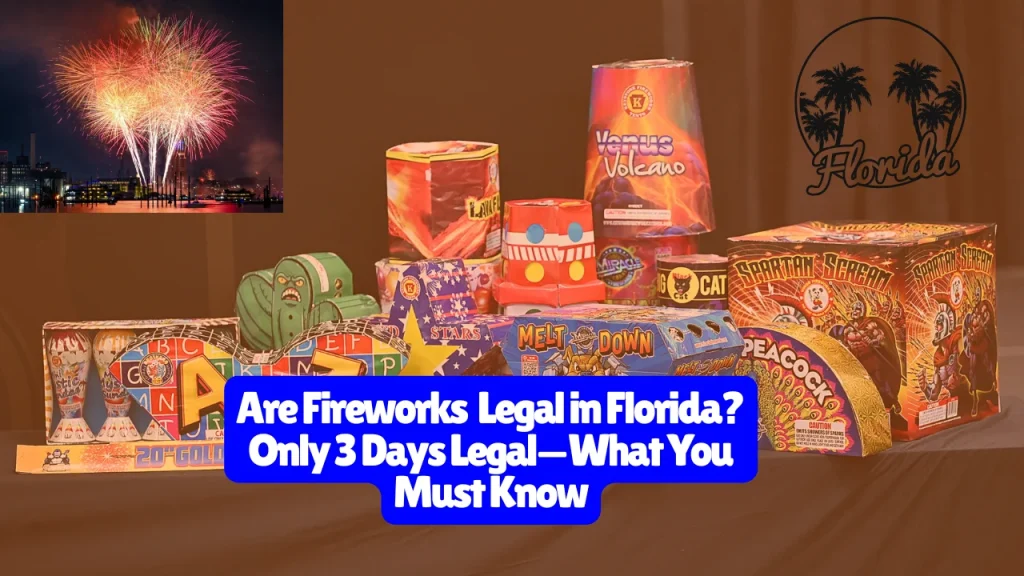
Are Fireworks Legal in Florida? Only 3 Days Legal—What You Must Know
Fireworks are legal in Florida only on three designated holidays in 2025: July 4, December 31, and January 1. The 2020 law (SB 140) permits consumer fireworks—including firecrackers, Roman candles, skyrockets, and aerial devices—exclusively on these dates. Sparklers, party poppers, smoke devices, and novelty items remain legal year-round. Using fireworks outside these three days without permits is a first-degree misdemeanor carrying up to one year jail and $1,000 fines, though enforcement varies. Local ordinances override state law in counties like Pinellas, which completely bans aerial fireworks even on designated holidays.
The “agricultural waiver” loophole allows purchases anytime but doesn’t legalize use.
What Types of Fireworks Are Legal in Florida?
Florida Statute Chapter 791 distinguishes between items classified as “fireworks” and those exempted from regulation.
Legal Year-Round (Not Classified as Fireworks):
- Sparklers approved by Division of State Fire Marshal
- Party poppers and snappers
- Snakes and glow worms
- Smoke devices
- Trick noisemakers and trick matches
- Toy pistols, toy canes, toy guns using paper caps (25 hundredths grains or less explosive)
- Cigarette loads and auto burglar alarms
Legal ONLY on Three Designated Holidays:
- Firecrackers
- Torpedoes
- Skyrockets
- Roman candles
- Dago bombs
- Blank cartridges and toy cannons using explosives
- Fire balloons
- Aerial fireworks producing visible or audible effects
- Any fireworks containing explosives or flammable compounds
These restricted items can be purchased anytime through the agricultural waiver but legally used only July 4, December 31, and January 1.
Florida Statute 791.08: The 2020 Game-Changer
Governor Ron DeSantis signed Senate Bill 140 on April 8, 2020, creating Florida Statute Section 791.08, which established “designated holidays” exempting fireworks use from criminal penalties.
Section 791.08 Defined “Designated Holiday” as:
- July 4 (Independence Day)
- January 1 (New Year’s Day)
- December 31 (New Year’s Eve)
Before this law, Florida prohibited using fireworks except for limited agricultural purposes or permitted public displays. The 2020 legislation fundamentally changed enforcement by creating specific dates when consumers can legally ignite fireworks without obtaining Board of County Commission permits.
Critical Limitations:
- Section 791.08 doesn’t supersede local ordinances enacted before 2020
- Pre-existing HOA covenants prohibiting fireworks remain enforceable
- New HOA rules can’t ban fireworks on designated holidays
- Counties and municipalities retain authority to impose stricter regulations
The law explicitly states: “This chapter does not prohibit the use of fireworks solely and exclusively during a designated holiday”, creating a narrow exemption rather than broad legalization.
Related article: Are Fireworks Legal In Washington DC? Almost Everything Banned—$2,000 Fines Enforced
Penalties for Illegal Fireworks in Florida
Florida imposes criminal penalties for unauthorized fireworks sales and use under Chapter 791.
First-Degree Misdemeanor (§791.02): Using or selling fireworks without proper permits outside designated holidays constitutes a first-degree misdemeanor punishable by:
- Up to one year in county jail
- Fines up to $1,000
- Criminal record
Corporate/Partnership Penalties (§791.06): Firms, copartnerships, or corporations violating Chapter 791 face $1,000 fines per violation.
Enforcement Reality: Officers must witness individuals lighting fireworks to pursue charges, making enforcement challenging. Most arrests occur when officers investigating fireworks complaints discover other violations like drug possession.
No Specific Use Penalty: Florida law contains no specific criminal penalty for individuals using fireworks unlawfully. However, violators may face:
- Local noise ordinance violations
- Public nuisance charges
- Civil liability for property damage or injuries
- HOA fines and penalties
Law enforcement can seize illegal fireworks under §791.05, with seizure costs charged to owners.
The Agricultural Waiver Loophole
Florida’s most exploited legal loophole involves the agricultural exemption in §791.01(4)(a).
How It Works: Retailers require purchasers to sign waivers stating fireworks will be used for:
- Scaring birds from agricultural works
- Frightening birds from fish hatcheries
The waiver protects sellers from liability but provides no legal protection for buyers. Signing the waiver doesn’t give you a permit to use the fireworks. The document exists solely to allow legal sales.
Legal Reality:
- Waivers don’t authorize illegal use
- Buyers remain subject to designated holiday restrictions
- False statements on agricultural waivers could constitute fraud
- Using “agricultural” fireworks recreationally violates state law
This creates the paradox where fireworks are widely available for purchase but narrowly restricted for use—a system critics call deliberately confusing.
Local Ordinances: Where Stricter Rules Apply
Florida Statute §791.001 grants local governments authority to enact more stringent fireworks regulations.
Pinellas County—Strictest in State: Pinellas County outright bans “the sale, purchase or use of fireworks that explode or project into the air,” even on the state’s three designated holidays. This includes St. Petersburg, Clearwater, and surrounding municipalities.
Orange County: Recent ordinance restricts all fireworks to just July 4, New Year’s Eve and New Year’s Day, with time restrictions typically ending around 10-11 p.m.
Volusia County: Fireworks are banned on all beaches. Cities including Daytona Beach, DeLand, Deltona, Edgewater, New Smyrna Beach, and Ponce Inlet maintain ordinances prohibiting fireworks entirely.
Jacksonville: City ordinance bans fireworks “within any park, beach, dock, marina or other recreational facility” with minimum $500 fines.
Jacksonville Beach: Permits legal year-round items (sparklers, party poppers) but restricts aerial fireworks to designated holidays.
Tampa: Fireworks cannot be sold within city limits, and the Fire Marshal can seize stocks offered for sale in violation of ordinances.
Miami-Dade County: No approved vendors authorized to sell restricted fireworks within county limits. Only state-defined “sparklers” available for purchase.
Cocoa Beach: Fireworks are prohibited on the beach and in public parks.
Naples: City Ordinance 24-202 prohibits possession or use of fireworks including sparklers on beaches, public parks, city fishing pier, and beach access rights-of-way west of Gulf Shore Boulevard.
Manatee County: Public fireworks display permits required before setting off fireworks.
Check your specific municipality’s code or contact local fire marshals before purchasing or using fireworks.
Homeowners Association Restrictions
Florida Statute §791.08(3) addresses HOA authority over fireworks.
Pre-2020 Restrictions Remain Valid: HOA covenants recorded before April 8, 2020 can still prohibit fireworks 365 days per year, including designated holidays.
Post-2020 Restrictions Prohibited: HOA boards cannot “promulgate rules that attempt to abrogate a homeowner’s right to use fireworks during a designated holiday” unless restrictions existed before the 2020 law.
Practical Implications:
- Review your HOA’s recorded declaration of covenants
- Check covenant dates against April 8, 2020
- Pre-existing bans remain enforceable even on July 4, New Year’s
- Post-2020 HOAs can restrict fireworks 362 days but not the three holidays
This creates subdivision-by-subdivision variations requiring residents to verify their specific community rules.
How Florida Compares to Neighboring States
Florida’s three-holiday approach sits between highly restrictive and fully permissive state models.
Georgia: Permits consumer fireworks year-round. Sales allowed to individuals 18+. Cities and counties can restrict discharge times but not possession.
Alabama: All consumer fireworks legal statewide with few restrictions. No specific designated holidays required.
South Carolina: Consumer fireworks legal year-round. No designated holiday restrictions, though local ordinances may impose limits.
Mississippi: Permits most consumer fireworks. Local jurisdictions can regulate discharge but cannot ban possession.
Florida’s model represents a middle ground—allowing sales to generate tax revenue while restricting use to specific dates ostensibly for safety. Critics argue this creates confusion and encourages selective enforcement.
Professional Fireworks Displays and Permits
Public displays using professional-grade fireworks require Board of County Commission permits under §791.02.
Permit Requirements:
- Written application submitted 15+ days before display
- Competent operator approved by police and fire chiefs
- Location approval from fire department after inspection
- Character assessment determining display won’t endanger persons or property
- Displays must comply with National Fire Protection Association (NFPA) 1123 Code for Fireworks Display (1995 Edition)
- Permits are non-transferable
NFPA Safety Standards: §791.012 mandates outdoor fireworks displays follow NFPA 1123 standards. Local jurisdictions can impose stricter regulations but cannot provide less stringent requirements than NFPA codes.
Who Can Obtain Permits:
- Fair associations
- Amusement parks
- Organizations conducting public celebrations
- Professional pyrotechnicians with proper certifications
The Code for Fireworks Display doesn’t govern displays on private residential property or items exempted under §791.01(4)(b) and (c).

Enforcement Mechanisms and Compliance
Florida enforcement involves state and local authorities with overlapping jurisdiction.
Seizure Authority (§791.05): Sheriffs and police officers can “seize, take, remove or cause to be removed at the expense of the owner, all stocks of fireworks or combustibles offered or exposed for sale, stored, or held” in violation of Chapter 791.
Enforcement Personnel:
- State Fire Marshal Division personnel
- County fire marshals
- Municipal fire prevention officers
- Law enforcement officers (police, sheriffs, deputies)
Practical Enforcement Challenges: Officers must witness people lighting fireworks to pursue charges, creating practical enforcement difficulties. The widespread availability through agricultural waivers and designated holiday exemptions complicate consistent enforcement.
Local Ordinance Enforcement: Municipal codes often provide clearer enforcement mechanisms than state statutes. Cities can impose time restrictions (typically 10-11 p.m. cutoffs), location bans (beaches, parks), and higher fines than state law.
Safety Statistics and Injury Data
National fireworks injury data demonstrates risks even with legal use.
2022 National Statistics: About 10,200 people were injured and 11 died in fireworks accidents in 2022, with nearly three-fourths (73%) of injuries occurring in the weeks before and after July 4.
Injury Breakdown: About 38% of injured people sustained burns, most commonly (29%) to hands and fingers, followed by head, face and ears (19%), eyes (16%), and trunk or other body parts (12%).
Florida-Specific Concerns:
- High humidity can affect fuse reliability
- Dense residential developments increase property damage risks
- Tourist populations unfamiliar with local restrictions
- Year-round warm weather enables outdoor gatherings when fireworks injuries occur
Consumer Product Safety Commission data shows fireworks injuries increased 25% between 2006 and 2021 nationwide, with Florida’s 2020 law expanding access during this upward trend.
What You Need to Know for 2025
Key Takeaways:
- Fireworks legal only July 4, December 31, January 1 under state law
- Sparklers, party poppers, smoke devices legal year-round
- Agricultural waivers allow purchases but don’t authorize illegal use
- First-degree misdemeanor penalties: up to one year jail, $1,000 fine
- Local ordinances frequently ban fireworks even on designated holidays
- Pinellas County maintains Florida’s strictest ban (no aerial fireworks ever)
- Pre-2020 HOA covenants can prohibit fireworks on all dates
- No specific penalty exists for individual use violations
- Enforcement occurs primarily through noise complaints and property damage claims
Before Using Fireworks:
- Verify your county/city allows fireworks on designated holidays
- Check HOA declaration of covenants recording date
- Confirm you’re outside prohibited locations (parks, beaches)
- Review local time restrictions (typically 10-11 p.m. cutoffs)
- Keep water, hoses, and fire extinguishers accessible
- Designate sober adults as sole fireworks handlers
- Never allow children to handle aerial fireworks
- Soak used fireworks in water before disposal
Florida State Fire Marshal Safety Guidelines:
- Use only approved sparklers from annual approved list
- Maintain adult supervision at all times
- Light fireworks on flat, cleared surfaces away from structures
- Point devices away from people, buildings, vehicles
- Never attempt to relight malfunctioning fireworks
- Dispose properly by soaking in water overnight
Legal Expert Perspectives
Florida’s fireworks framework reflects competing priorities: consumer demand, tax revenue generation, public safety, and local control.
The agricultural waiver system demonstrates legislative compromise that satisfies fireworks industry economic interests while maintaining nominal safety restrictions. Retailers require buyers to sign waivers affirming agricultural purposes, creating legal fiction that protects sellers while providing no actual compliance pathway for recreational users.
The 2020 designated holiday law responded to widespread non-enforcement and interstate commerce issues. Floridians crossed into Georgia and Alabama to purchase fireworks, depriving Florida of sales tax revenue while creating identical safety concerns.
Legal experts note the absence of specific individual-use penalties creates enforcement gaps. Without dedicated criminal provisions for personal use violations, prosecutors must rely on generic noise ordinances or property damage claims—civil matters rather than criminal enforcement.
The HOA provisions in §791.08(3) demonstrate tension between state preemption and private property rights. By grandfathering pre-2020 restrictions while prohibiting new ones, the legislature attempted to balance existing community expectations against expanded consumer rights.
Frequently Asked Questions
Can I use fireworks in my backyard on July 4?
Depends on your location. While state law permits it, many cities and counties ban fireworks entirely even on designated holidays. Check your municipal code and HOA covenants before purchasing.
Does signing the agricultural waiver make fireworks legal to use?
No. The waiver allows legal sales but provides no authorization for recreational use. You’re still restricted to designated holidays unless you genuinely use fireworks for agricultural bird-scaring purposes.
What happens if my fireworks cause property damage?
You face civil liability for damages regardless of whether use was on designated holidays. Insurance may deny claims if fireworks use violated local ordinances. Criminal charges possible if damage was reckless or intentional.
Are sparklers really safe for kids?
Sparklers burn at 1,200-1,800°F and cause one-third of fireworks injuries. Florida law permits year-round sparkler use but only with close adult supervision using approved products.
Can my HOA fine me for using fireworks on July 4?
Yes, if your HOA’s covenants recorded before April 8, 2020 prohibit fireworks. Post-2020 HOAs cannot ban fireworks on the three designated holidays.
Why are fireworks sold if they’re mostly illegal to use?
The agricultural waiver loophole (§791.01(4)(a)) permits sales for bird-scaring purposes. This creates legal sales channels while maintaining nominal use restrictions—a compromise satisfying industry revenue while appearing to address safety concerns.
What’s the penalty for using fireworks on non-designated days?
First-degree misdemeanor for sale or use without permits (up to one year jail, $1,000 fine) under §791.02. However, no specific penalty exists for individual use violations—enforcement typically occurs through noise ordinances or property damage claims.
Can I bring fireworks bought in Georgia back to Florida?
Yes for purchase, but use remains restricted to designated holidays and compliant locations. Interstate transport doesn’t change Florida’s use restrictions.
Do police actually enforce fireworks laws?
Enforcement is inconsistent—officers must witness lighting to pursue charges. Most enforcement occurs when investigating other complaints or when fireworks cause property damage or injuries.
What if I’m injured by someone else’s fireworks?
You may pursue personal injury claims for medical expenses, lost wages, and pain and suffering. Contact a Florida personal injury attorney to evaluate negligence claims and available compensation.
Florida’s fireworks laws balance consumer access, local control, and safety concerns through a complex framework of state statutes, local ordinances, and HOA restrictions. Understanding all three layers ensures legal compliance while protecting yourself, your property, and your neighbors during celebrations.
About the Author

Sarah Klein, JD, is a licensed attorney and legal content strategist with over 12 years of experience across civil, criminal, family, and regulatory law. At All About Lawyer, she covers a wide range of legal topics — from high-profile lawsuits and courtroom stories to state traffic laws and everyday legal questions — all with a focus on accuracy, clarity, and public understanding.
Her writing blends real legal insight with plain-English explanations, helping readers stay informed and legally aware.
Read more about Sarah