
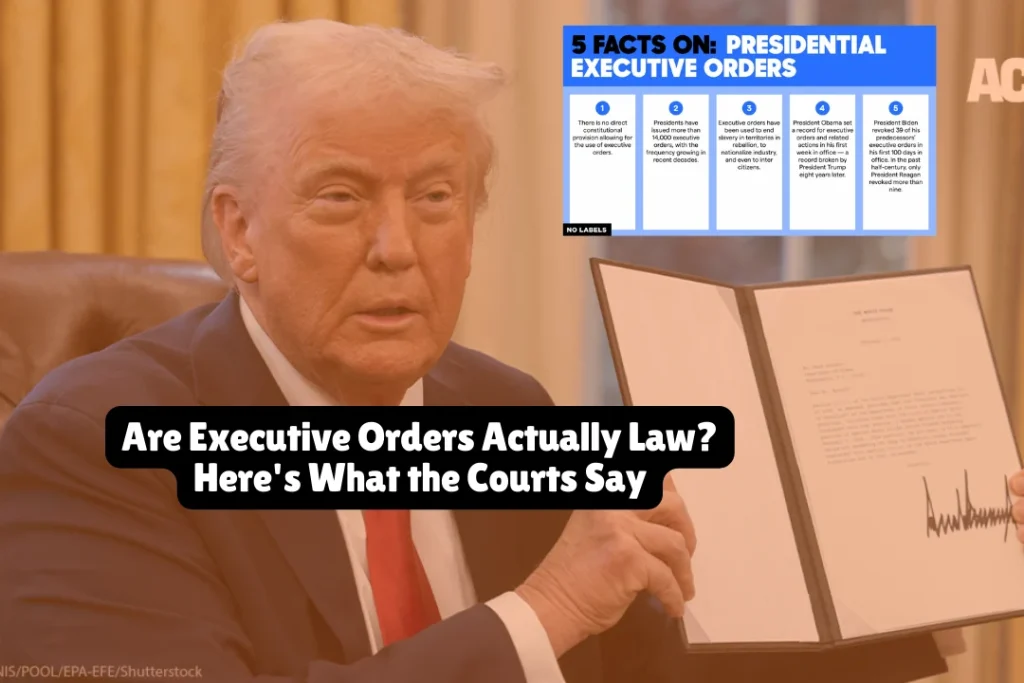
Are Executive Orders Actually Law? Here’s What the Courts Say
Executive orders are not laws. They’re presidential directives that carry legal force within the executive branch but cannot override statutes passed by Congress. The Constitution gives Congress—not the president—the power to make laws. Executive orders implement and enforce existing laws, but they’re subordinate to congressional legislation and subject to judicial review.
Why This Distinction Matters
You’re seeing headlines about executive orders daily. You’re wondering if the president can actually do what these orders claim. Your business might be affected by new directives.
Here’s the truth: The difference between executive orders and laws determines what the president can and cannot do. It affects your rights, your business operations, and how government works. With over 300 legal challenges filed against executive orders in 2025 alone, understanding this distinction isn’t academic—it’s practical.
Whether you’re a legal professional advising clients, a business owner navigating compliance, or a citizen trying to understand your government, knowing what executive orders can and cannot do affects how you respond to them.
What You Came to Know
Executive Orders Are Not Laws—Here’s Why
Congress makes laws through the legislative process outlined in Article I of the Constitution. The president signs or vetoes those laws. That’s the constitutional framework.
Executive orders are directives the president issues to federal agencies and employees under Article II authority. They tell the executive branch how to implement and enforce laws that Congress already passed.
Bottom line: An executive order cannot create new legal obligations for private citizens the way a statute can. It can only direct how the executive branch operates within existing legal boundaries.
The Constitutional Basis for Executive Orders
Article II makes the president the chief executive officer of the federal government. Section 3 requires the president to “take Care that the Laws be faithfully executed.” This is called the Take Care Clause.
Presidents claim authority to issue executive orders from two sources:
- Statutory delegation: Congress passes a law giving the president specific authority to act
- Inherent executive power: The president’s constitutional role as chief executive
The first category is on solid legal ground. When Congress authorizes the president to act and the president issues an order within that authorization, courts generally uphold it.
The second category is where legal battles happen. Presidents sometimes claim inherent authority to act even without congressional approval. Courts scrutinize these orders carefully and often strike them down when they exceed constitutional limits.
How Executive Orders Function Legally
While executive orders aren’t laws, they do carry legal force for federal agencies, federal employees, and contractors working with the government. If you work for a federal agency or receive federal contracts, executive orders bind you.
Executive orders can also affect private citizens indirectly by changing how laws are enforced. For example, an order directing immigration officials to prioritize certain deportations changes enforcement priorities without changing immigration law itself.
PRO TIP: If an executive order affects your business or rights, research its legal foundation before complying. Check whether it cites specific congressional authorization. Look for active court challenges. Executive orders without clear statutory basis are most vulnerable to legal challenge. Document your compliance costs—if courts strike down the order, you may have grounds for relief. Always verify the order’s current status before making major business decisions, as preliminary injunctions can halt enforcement while litigation proceeds.
Most sites won’t tell you this, but executive orders often contain multiple provisions with different legal foundations. Some sections might rest on solid statutory authority while others claim questionable inherent power. Courts can strike down specific provisions while leaving others intact.
Legal Limits on Executive Authority
Executive orders face three major constraints:
First, statutes win. If an executive order conflicts with a law Congress passed, the law prevails. The president cannot use an executive order to override congressional legislation.
Second, the Constitution controls. Executive orders must stay within constitutional boundaries. Courts have struck down orders that violate individual rights, exceed presidential authority, or invade powers reserved to Congress.
Third, judicial review applies. Courts can and do review executive orders for legality. In 2025, federal courts issued over 50 temporary restraining orders blocking executive order provisions while litigation proceeded.
What Happens When Executive Orders Conflict with Laws
When an executive order contradicts a statute, the statute controls. Period. Courts consistently hold that presidential authority cannot override congressional legislation.
Recent example: In June 2025, the Supreme Court heard arguments in Trump v. CASA about nationwide injunctions blocking executive orders. While the case focused on injunction scope rather than the orders’ merits, it highlighted how courts actively police executive authority.
The legal process works like this: someone files a lawsuit challenging the order, courts evaluate whether it exceeds presidential authority, and judges can issue injunctions stopping enforcement. These challenges reached record levels in 2025, with over 238 active cases challenging administration executive actions as of January 2026.
What You Must Know
Recent Developments in Executive Order Litigation (2025-2026)
Last year saw unprecedented legal battles over executive authority. Courts issued preliminary injunctions against executive orders affecting birthright citizenship, federal DEI programs, and National Guard deployments.
The Supreme Court agreed to hear several major executive order cases in its 2025-2026 term, including Trump v. Barbara challenging an order that would end birthright citizenship for children of undocumented immigrants born in the U.S. This case directly tests whether executive orders can override constitutional provisions—here, the Fourteenth Amendment’s Citizenship Clause.
In February 2026, the Fourth Circuit upheld parts of executive orders targeting DEI programs while striking down others, showing how courts parse different provisions based on their legal foundations. Orders directing internal government operations received deference; orders affecting private parties faced tougher scrutiny.
Common Misconceptions About Executive Orders
Misconception: Executive orders are just suggestions. Reality: They’re legally binding directives for the executive branch and carry enforcement mechanisms including termination and civil penalties for federal employees who don’t comply.
Misconception: Courts always uphold executive orders. Reality: Courts strike down orders regularly. When orders exceed statutory authority or violate constitutional limits, judges block enforcement.
Misconception: Executive orders are permanent. Reality: New presidents can revoke previous administrations’ orders immediately. Unlike laws, which require congressional action to change, executive orders can disappear with a signature.
What Changes When Administrations Change
Executive orders are presidential tools, not permanent policy. When a new president takes office, they can revoke any predecessor’s executive orders. This happened extensively in January 2025 when the current administration took office.
This impermanence distinguishes executive orders from laws. Congress must pass new legislation to change existing statutes. Presidents just need a pen to undo executive orders.
For businesses and individuals, this creates compliance uncertainty. Policies implemented through executive orders can reverse overnight. That’s why legal counsel often advises clients to distinguish between requirements based on statutes (stable) versus executive orders (temporary).
What to Do Next
Check Current Status Before Acting
If an executive order affects you, verify its current legal status. Visit the Federal Register at federalregister.gov to find the official text. Check whether courts have issued injunctions blocking enforcement.
Multiple litigation tracking projects monitor executive order challenges. Lawfare’s tracker and Just Security’s database provide updated case status for major challenges.
Don’t assume an executive order remains enforceable just because it was issued. Preliminary injunctions can halt enforcement while litigation proceeds, and courts issue these regularly.
Understand Your Rights and Obligations
Executive orders that direct federal agencies don’t create new private rights or obligations unless backed by statute. If an order claims to impose requirements on private businesses or individuals, examine its statutory foundation.
For government contractors and federal grantees, executive orders carry direct force. If you fall into these categories, track relevant orders carefully and document compliance.
For general citizens, executive orders typically affect you only indirectly through changed enforcement priorities or agency policies. Your rights under statutes and the Constitution remain unchanged regardless of executive orders.
Know When to Seek Legal Counsel
Consult an attorney if an executive order directly affects your business operations, requires significant compliance costs, or appears to conflict with existing legal obligations. Legal counsel can assess the order’s statutory foundation and likelihood of surviving court challenges.
If you’re a government contractor, consult counsel before declining compliance with executive order requirements. The consequences for non-compliance can be severe even if the order later gets struck down.
Frequently Asked Questions
Can executive orders override laws Congress passed?
No. If an executive order conflicts with a statute, the statute prevails. Courts consistently hold that presidential authority cannot override congressional legislation. The president can only execute laws Congress makes—not unmake them.
Do executive orders have the force of law?
Executive orders carry legal force for federal agencies and employees but are not “laws” in the constitutional sense. They’re administrative directives that implement and enforce existing statutes. For private citizens, they create obligations only when based on clear statutory authorization.
Can Congress override an executive order?
Yes. Congress can pass legislation that contradicts or restricts an executive order. The president can veto that legislation, but Congress can override the veto with a two-thirds vote in both chambers. Congress can also use funding restrictions to limit executive order implementation.
How long do executive orders last?
Executive orders remain in effect until revoked or superseded by a subsequent president, struck down by courts, or overridden by congressional legislation. Unlike laws, which require congressional action to change, executive orders can be revoked with a presidential signature.
What happens if I ignore an executive order?
For federal employees and contractors, ignoring executive orders can result in termination, contract cancellation, or civil penalties. For private citizens, you generally cannot be punished for ignoring an executive order unless it’s based on statutory authority that does impose legal obligations. However, verify the specific order’s legal foundation before non-compliance.
Are executive orders constitutional?
The Constitution doesn’t explicitly mention executive orders, but Article II’s grant of executive power and the Take Care Clause provide constitutional foundation. Whether a specific order is constitutional depends on whether it stays within Article II bounds and doesn’t violate other constitutional provisions. Courts review this case-by-case.
How do I challenge an executive order?
File a lawsuit in federal court arguing the order exceeds presidential authority, violates constitutional rights, or conflicts with statutes. You need standing—meaning the order must cause you concrete harm. Courts can issue preliminary injunctions blocking enforcement while litigation proceeds. Hundreds of such challenges were filed in 2025 alone.
Real Example: Birthright Citizenship Executive Order
On January 20, 2025, President Trump issued Executive Order 14160 attempting to end birthright citizenship for children born in the U.S. to undocumented immigrant parents. The order claimed such children are not “subject to the jurisdiction” of the United States under the Fourteenth Amendment.
Within days, multiple lawsuits challenged the order. Federal courts issued preliminary injunctions blocking its enforcement. Critics argued the order directly contradicted both the Fourteenth Amendment’s Citizenship Clause and 8 U.S.C. § 1401(a), which codifies that constitutional provision.
The Supreme Court granted certiorari in Trump v. Barbara on December 5, 2025. The case tests whether an executive order can override constitutional text and statutory law—exactly the kind of conflict where executive orders lose. Oral arguments are expected by April 2026.
This example illustrates executive orders’ legal limits: they cannot override constitutional provisions or statutes, and courts actively review orders that attempt to do so.
Final Disclaimer: This article provides general information about executive orders and their legal status for educational purposes only. Constitutional law and executive authority continue to evolve through court decisions and political developments. The legal status of specific executive orders can change rapidly as litigation proceeds through federal courts. AllAboutLawyer.com does not provide legal services and is not affiliated with any government agency. For legal questions about how executive orders affect your rights, business, or legal obligations, consult with qualified attorneys familiar with administrative and constitutional law. Verify current legal status of any executive order through official sources including the Federal Register and court records before making compliance decisions.
Stay informed, stay protected. — AllAboutLawyer.com
Last Updated: January 14, 2026 — We keep this current with the latest legal developments
Disclaimer: This article provides general legal information about executive orders and their constitutional status, not legal advice—consult with a qualified attorney regarding how executive orders affect your specific situation.
About the Author

Sarah Klein, JD, is a licensed attorney and legal content strategist with over 12 years of experience across civil, criminal, family, and regulatory law. At All About Lawyer, she covers a wide range of legal topics — from high-profile lawsuits and courtroom stories to state traffic laws and everyday legal questions — all with a focus on accuracy, clarity, and public understanding.
Her writing blends real legal insight with plain-English explanations, helping readers stay informed and legally aware.
Read more about Sarah