
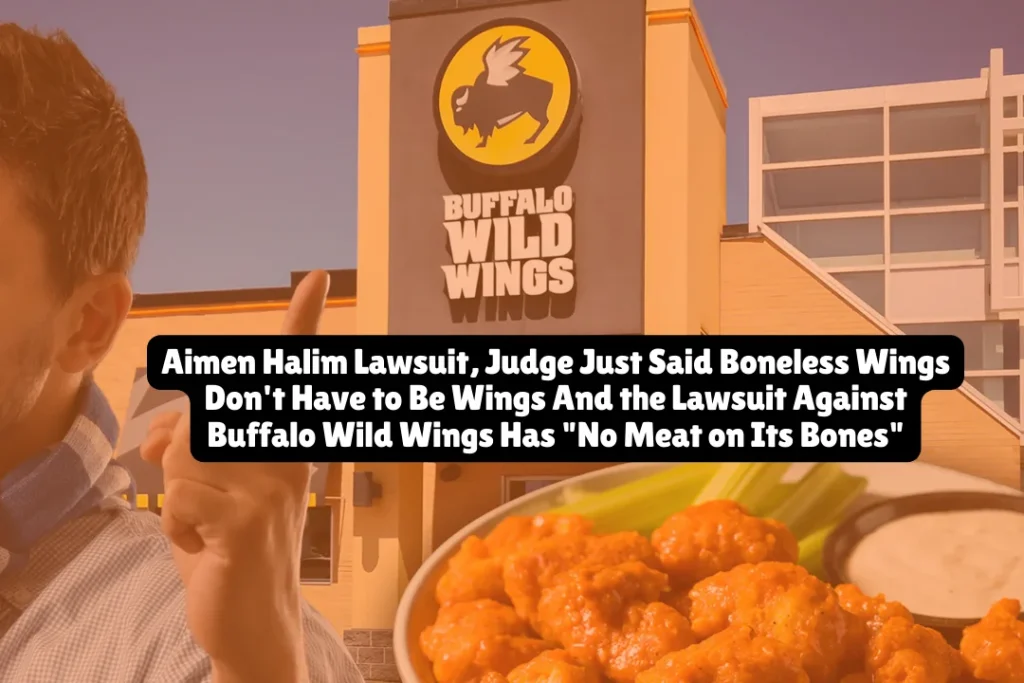
Aimen Halim Lawsuit, Judge Just Said Boneless Wings Don’t Have to Be Wings And the Lawsuit Against Buffalo Wild Wings Has “No Meat on Its Bones”
A federal judge in Chicago dismissed a proposed class action lawsuit on February 17, 2026, that accused Buffalo Wild Wings of deceiving customers by selling “boneless wings” made from chicken breast rather than actual wing meat. The judge ruled that no reasonable consumer is fooled by the name — and delivered his verdict in one of the most pun-filled opinions in recent memory. The case is not completely over, but the plaintiff has a short window to try again.
Case at a Glance
| Detail | Information |
| Case Name | Halim v. Buffalo Wild Wings, Inc., et al. |
| Court | U.S. District Court, Northern District of Illinois |
| Judge | Hon. John Tharp Jr. |
| Filed | 2023 |
| Ruling Date | February 17, 2026 |
| Outcome | Dismissed — complaint fails to allege deception of reasonable consumers |
| Deadline to Refile | March 20, 2026 |
| Settlement | None — no settlement exists |
What This Case Was Actually About
In January 2023, an Illinois man named Aimen Halim walked into his local Buffalo Wild Wings, ordered boneless wings, and — according to the lawsuit — felt deceived when he later learned what was actually on his plate.
Halim alleged that Buffalo Wild Wings misled and defrauded him and other customers over its “boneless” chicken wings menu item. Reasonable customers, Halim said, could believe that they were getting “chicken wings that have simply been deboned, and as such, are comprised entirely of chicken wing meat.”
Halim alleged that the boneless wings are just “slices of chicken breast meat deep-fried like wings,” and that customers would either pay less for the boneless wings or not purchase them at all if they knew what was in the product. Halim said he later regretted buying the item after learning how it was made, which he claimed caused him to suffer “a financial injury as a result of defendants’ false and deceptive conduct.”
The proposed class — the group Halim wanted to represent — was defined as all U.S. consumers who purchased boneless wings from Buffalo Wild Wings within the applicable statute of limitations period. He sought compensatory damages, punitive damages, and an injunction that would force the chain to stop using the term “boneless wings” on its menu. He suggested the product should instead be called something like “chicken poppers.”
What Halim Accused Buffalo Wild Wings of Violating
Halim accused Buffalo Wild Wings of violating the Illinois Consumer Fraud and Deceptive Business Practices Act, breach of express warranty, common law fraud, and unjust enrichment.
These are serious consumer protection claims. The Illinois Consumer Fraud Act in particular is one of the stronger state-level tools consumers have against deceptive marketing — it does not require proof that every consumer was deceived, only that the practice was likely to mislead reasonable people.
The threshold question, then, was whether calling chicken breast “boneless wings” crosses that line. Judge Tharp concluded it does not.
How Buffalo Wild Wings Defended Itself
Buffalo Wild Wings fought back against the claims, arguing in court filings that the Seventh Circuit had recognized that many “literally false statements are not deceptive.”
BWW argued that “reasonable consumers” would not have been misled by the product name, because they would have recognized the true nature of the food products they were ordering and eating.
The chain also pointed out that boneless wings are not a new or niche product. Buffalo Wild Wings had sold them since 2003. The company argued that two decades of widespread cultural familiarity with the product makes it unreasonable to claim a modern consumer would be confused.
What the Judge Said — In His Own Words
Judge Tharp’s February 17 ruling is notable not just for its legal conclusions but for how he delivered them. He wrote the entire opinion laced with deliberate poultry wordplay — a rare move for federal court opinions.
“Halim sued Buffalo Wild Wings over his confusion, but his complaint has no meat on its bones,” Tharp wrote in his ruling. “Despite his best efforts, Halim did not ‘drum’ up enough factual allegations to state a claim.”
On the central legal question — whether reasonable consumers are deceived — Tharp was direct:
“Words can have multiple meanings — indeed, the term ‘buffalo wing’ refers to the type of sauce on the wing, rather than indicating it is made of buffalo meat,” Tharp wrote.
He also used the restaurant’s own menu against Halim’s argument:
“Cauliflower wings are sold at BWW, under the ‘wing’ section of the menu, and are presented as an alternative to chicken wings. If Halim is right, reasonable consumers should think that cauliflower wings are made (at least in part) from wing meat. They don’t, though.”
And on the specific claim that customers expected deboned wing meat:
“A reasonable consumer would not think that BWW’s boneless wings were truly deboned chicken wings, reconstituted into some sort of Franken-wing,” he wrote.
Did Halim Lose Completely? Not Exactly.
This is the detail most news coverage has not fully explained — and it matters for anyone following this case.
While he found Halim had standing to sue because he alleged economic harm, he dismissed the claims for failing to plausibly allege deception.
Standing is the threshold legal requirement to bring a case at all. The fact that Judge Tharp found Halim had standing is actually significant — it means the court accepted that Halim suffered a real economic injury. He paid for something he would not have bought — or would have paid less for — had he known what it was. That is recognized as concrete harm.
What Halim failed to do was the next step: prove that a reasonable consumer would share his confusion. The judge found that the term “boneless wings” is widely understood as a colloquial food product name — not a literal description of the anatomical origin of the meat.
Tharp gave Halim until March 20 to file an amended complaint. Halim’s lawyers told Law & Crime that they do intend to refile.
The Ohio Supreme Court Ruling That Influenced This Decision
Judge Tharp did not write this opinion in a vacuum. He explicitly cited a 2024 Ohio Supreme Court ruling that addressed essentially the same question.
Tharp cited an Ohio Supreme Court ruling from 2024, where the court ruled that “[a] diner reading ‘boneless wings’ on a menu would no more believe that the restaurant was warranting the absence of bones in the items than believe that the items were made from chicken wings, just as a person eating ‘chicken fingers’ would know that he had not been served fingers.”
That analogy — chicken fingers are not made from fingers, chicken nuggets are not nuggets, buffalo wings are not from buffalo — forms the core of the legal reasoning in both the Ohio ruling and Judge Tharp’s opinion. Courts are developing a consistent national framework: food product names that have entered common cultural usage are judged by what ordinary people understand them to mean, not by their literal linguistic content.
What This Ruling Means for Food Labeling Law
This case is part of a broader wave of consumer fraud lawsuits targeting food and beverage labeling. Courts across the country have been asked to draw the line between genuinely deceptive marketing and product names that — while technically inaccurate — are so widely understood that no reasonable person is actually misled.
Tharp noted that “boneless wings are not a niche product for which a consumer would need to do extensive research to figure out the truth.” That reasoning sets a practical standard: the more widely known a food product’s actual composition is, the harder it becomes to argue that its name is deceptive.
The ruling does not give food companies a blank check to mislabel products. It applies specifically to colloquial food names that have developed well-understood consumer meanings over years or decades of widespread use. A company that invented a new product and coined a deceptive name for it today would face a very different legal analysis.
What Happens Next
The case is dismissed, but not permanently closed. Halim has until March 20, 2026 to file an amended complaint with additional factual allegations.
Judge Tharp signaled skepticism: while noting he believed “it is difficult to imagine that Halim can provide additional facts about his experience that would demonstrate that BWW is committing a deceptive act by calling its nuggets ‘boneless wings,'” Tharp still gave him until March 20 to file another version of the complaint and try again.
Halim’s attorneys at Treehouse Law have confirmed they intend to refile. Whether an amended complaint can survive a second motion to dismiss — given the judge’s pointed language about the weakness of the core theory — remains an open question. If Halim files an amended complaint, the court will evaluate it fresh. If he does not file by March 20, the case will close.
There is no settlement, no settlement fund, and no claim form associated with this case. Consumers who purchased Buffalo Wild Wings boneless wings have no action to take at this stage.
Frequently Asked Questions
Did Buffalo Wild Wings win this lawsuit?
The court dismissed the complaint in Buffalo Wild Wings’ favor on February 17, 2026. However, the dismissal is not final — the plaintiff has until March 20, 2026 to file an amended complaint, and his lawyers say they plan to do so.
Are boneless wings actually chicken nuggets?
Judge Tharp described boneless wings in his ruling as “essentially chicken nuggets.” They are made from chicken breast meat, shaped, breaded, and sauced — not from deboned wing meat. That is not disputed. The legal question was whether calling them “wings” is deceptive, and the judge said no.
Can I file a claim or join this lawsuit?
No. There is no settlement, no class certified, and no claim process available. The lawsuit was dismissed and may be refiled in amended form. No consumer action is available at this stage.
What law did Halim claim Buffalo Wild Wings violated?
He alleged violations of the Illinois Consumer Fraud and Deceptive Business Practices Act, breach of express warranty, common law fraud, and unjust enrichment.
Did the judge say Halim had no case at all?
Not entirely. The judge found that Halim did have legal standing — meaning his alleged financial injury was real enough to bring to court. What he failed to prove was that a “reasonable consumer” would share his confusion about what boneless wings contain.
What is the “reasonable consumer” standard?
It is the legal test courts use to evaluate deceptive advertising claims. Rather than asking whether any individual consumer was confused, courts ask whether an ordinary, reasonable person would be misled by the challenged marketing. Judge Tharp found that a reasonable consumer understands that “boneless wings” does not mean deboned wing meat.
Has this issue been decided in other states?
Yes. The Ohio Supreme Court issued a ruling in 2024 reaching essentially the same conclusion — that a diner ordering “boneless wings” does not reasonably expect the absence of bones or the presence of wing meat specifically. Judge Tharp cited that ruling directly.
What does this mean for other food labeling lawsuits?
This ruling adds to a growing body of case law establishing that widely understood colloquial food product names — boneless wings, chicken fingers, chicken nuggets — are judged by their cultural meaning, not their literal text. Courts are increasingly resistant to lawsuits that treat familiar food names as actionable false advertising.
Last Updated: February 18, 2026
Disclaimer: This article is for informational purposes only and does not constitute legal advice. Legal claims and outcomes depend on specific facts and applicable law. For advice regarding a particular situation, consult a qualified attorney.
About the Author

Sarah Klein, JD, is a licensed attorney and legal content strategist with over 12 years of experience across civil, criminal, family, and regulatory law. At All About Lawyer, she covers a wide range of legal topics — from high-profile lawsuits and courtroom stories to state traffic laws and everyday legal questions — all with a focus on accuracy, clarity, and public understanding.
Her writing blends real legal insight with plain-English explanations, helping readers stay informed and legally aware.
Read more about Sarah