
California SB 1218, Illegal Dumpers Could Lose Vehicle Registration Under New Bill Targeting Oakland’s $12M Trash Crisis
California lawmakers want to use the same tool that stops drivers from renewing registration over unpaid parking tickets — and apply it to people who illegally dump trash and never pay the fine.
State Senator Jesse Arreguín introduced SB 1218, a bill that would require the Department of Motor Vehicles to refuse to renew vehicle registrations for individuals who have outstanding fines for illegal dumping. The bill is a direct response to Oakland’s worsening trash crisis, where the city collects only a fraction of the fines it issues. SB 1218 has not yet passed. It is working through the California State Legislature now.
Quick Facts
| Field | Detail |
| Bill Name | California Senate Bill 1218 (SB 1218) |
| Introduced By | State Senator Jesse Arreguín; Assemblymember Mia Bonta |
| Date Introduced | February 2026 |
| Press Conference | March 4, 2026 — Oakland, CA |
| What It Does | Requires DMV to block vehicle registration renewals for unpaid illegal dumping fines |
| Current Status | Proposed — moving through California State Legislature |
| Applies To | California statewide — focused on Oakland enforcement |
| Vote Required | Simple majority |
| Effective Date | TBD — pending passage and governor signature |
Why Oakland Needs This Bill — The Numbers Tell the Story
Oakland has an illegal dumping crisis, and the fines meant to stop it are not working.
In 2024, Oakland had issued nearly 3,000 citations for dumping between 2021 and 2024, totaling roughly $1.3 million in fines. But the city only collected about 11% of the total — $109,000.
It got worse in 2025. The city collected money from just 25 of the 270 individuals who were cited for illegal dumping in 2025. That is a collection rate of less than 10%.
The cleanup cost falls entirely on taxpayers. Oakland cleaned up 15 million pounds of illegally dumped trash last year, costing the city roughly $12 million annually. Meanwhile, the people responsible for much of that trash owe fines they simply never paid.
Illegal dumping disproportionately affects deep East Oakland. Of the citations issued in 2025, over one-third were for incidents in District 7.
What SB 1218 Would Actually Do
The bill’s mechanics are straightforward — and deliberately borrowed from a system that already works.
The DMV already does this with individuals who have unpaid parking tickets and other fines. SB 1218 adds illegal dumping violations to that same list.
This bill would require the DMV to refuse to renew the registration of a vehicle if the registered owner or lessee has been mailed a notice of delinquent illegal dumping violation — the same process already used for unpaid parking penalties. No new agency. No new system. Just an expansion of an existing enforcement tool.
The fines at stake are not small. Fines are currently set at $750 for a first offense, $1,000 for a second, and $1,500 for a third offense and beyond. Under SB 1218, a driver who ignores those fines would find their registration blocked when renewal time comes — forcing a choice between paying what they owe or driving an unregistered vehicle.
“By improving the collection of fines, we can help deter future violations while helping cities recover the cost associated with clean up and code enforcement,” said Senator Arreguín.
What Officials Are Saying
Support for the bill runs from the state Senate to Oakland City Hall.
“For too long, illegal dumpers have treated fines as optional while our neighborhoods pay the price,” Arreguín said. “If you trash our communities, there will be consequences.”
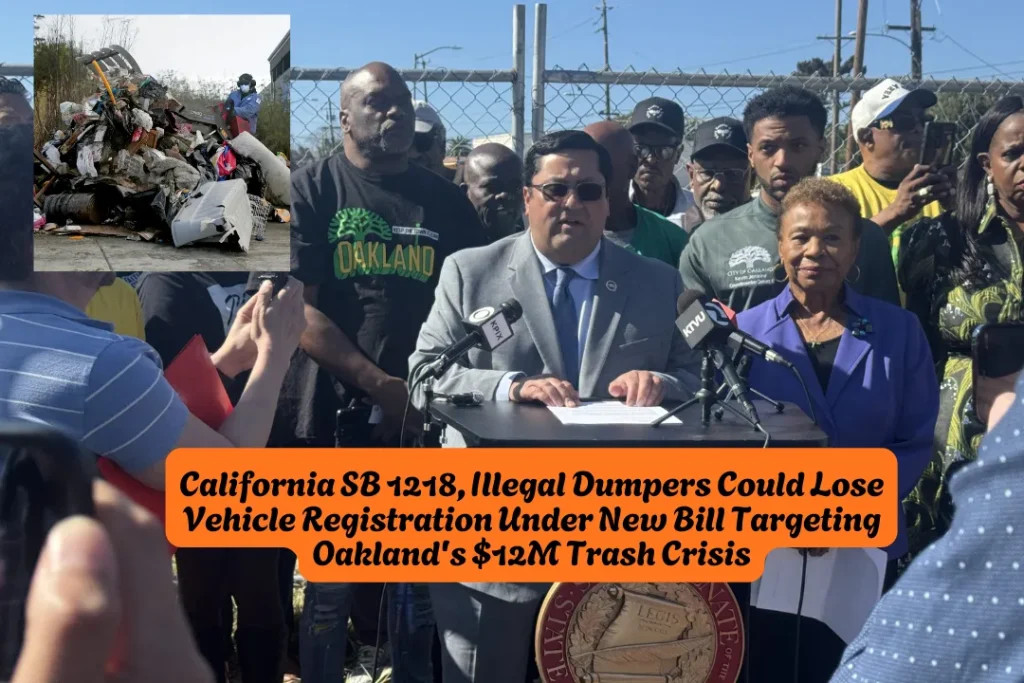
Oakland Mayor Barbara Lee stood alongside Arreguín at the March 4 press conference. “In a city that’s, of course, budget-challenged, we’re still doing everything we can do and will do more,” said Mayor Lee.
City, county, and state leaders joined community organizers at 68th Avenue and Foothill Boulevard to announce the proposal. They acknowledged the problem disproportionately affects lower-income neighborhoods.
District 7 Councilmember Ken Houston, whose district accounts for over one-third of all 2025 dumping citations, backed the bill at the press conference. Houston also called for fines to be raised from $750 to as high as $10,000 for repeat offenders — a separate proposal currently moving through Oakland City Council.
What Critics Are Saying
Not everyone is convinced SB 1218 solves the real problem.
Activist Vincent Williams of the nonprofit Urban Compassion Project criticized SB 1218 by pointing out that the laws already in place to prevent illegal dumping are not being enforced. “Nothing is being done, and there are already laws in place that can hold people accountable,” Williams said.
Resident Laroy Murphy echoed that frustration: “There are cameras on buildings, and no one’s being held accountable.”
The core criticism is this: if Oakland is only collecting fines from 25 out of 270 cited dumpers — many of whom may not be traceable or may dump using unregistered vehicles — a DMV block only works on people who both own registered vehicles and care about keeping them registered. Critics argue the enforcement gap starts much earlier, at the citation and identification stage, before fines are ever issued.
Mayor Lee has promised to crack down on dumping with stricter enforcement and referrals to the Alameda County District Attorney. But there have not been any referrals.
What Laws Are Involved?
California Vehicle Code — Registration Refusal Authority — State law already authorizes the DMV to block registration renewals for various unpaid civil penalties. Existing law requires the DMV to refuse to renew the registration of a vehicle if the registered owner has been mailed a notice of a delinquent parking violation, the processing agency has filed an itemization of unpaid parking penalties, and the owner has not paid. SB 1218 mirrors that exact structure for dumping violations.
California Public Resources Code — Illegal Dumping Provisions — State law already makes illegal dumping an infraction for smaller amounts of waste and a misdemeanor for larger amounts. The fines attached to those violations — $750, $1,000, and $1,500 — are what SB 1218 would allow the DMV to enforce through registration blocks.
How Does This Affect You?
- If you own a vehicle registered in California and receive a citation for illegal dumping — pay the fine. Under SB 1218, unpaid fines would block your DMV registration renewal, the same way unpaid parking tickets do today.
- If you live in Oakland or another California city dealing with dumping blight — this bill is intended to force fine collection that currently sits at under 10%.
- If you operate a business in California with commercial vehicles — the same registration block would apply to any company vehicle registered to a person or entity with an outstanding illegal dumping fine.
- If you are a property owner whose land has been targeted by illegal dumpers — this bill does not create a private right to sue. It is a state enforcement tool, not a civil remedy.
What Happens Next?
SB 1218 now moves through the California State Legislature for committee hearings, votes, and potential amendments. Key steps:
- The bill must pass committee review in the California Senate before reaching a full Senate floor vote.
- If it passes the Senate, it moves to the California State Assembly for the same process.
- If both chambers pass it, it goes to Governor Gavin Newsom for signature or veto.
- If signed, the DMV would need to implement the technical infrastructure to receive illegal dumping fine notifications from cities — a process that would take additional months.
- A realistic effective date, if the bill passes smoothly, would be early 2027.
This page will be updated as the bill advances through the legislature.
Frequently Asked Questions
What is California SB 1218?
SB 1218 is a proposed California law that would require the DMV to refuse to renew the registration of a vehicle if the registered owner has an unpaid illegal dumping fine — applying the same mechanism already used for unpaid parking tickets to illegal dumping violations statewide.
Is SB 1218 already law?
No. Senator Arreguín introduced the bill last week — meaning it was introduced in early March 2026 and is currently working through the California Legislature. It has not passed and has not been signed by the governor. It is not yet in effect.
How much are the fines that could trigger a registration block?
Fines are currently set at $750 for a first offense, $1,000 for a second, and $1,500 for a third offense and beyond. Under SB 1218, any of those unpaid fines could result in a DMV registration block at renewal time.
Does this bill affect the whole state or just Oakland?
The bill is statewide — it would apply to any California city or county that issues illegal dumping citations. However, it is clearly driven by Oakland’s crisis, where only 25 out of 270 people cited for dumping in 2025 paid their fines.
What if I get cited for dumping but I don’t own a car?
The registration block only affects vehicle owners. If a cited individual does not own a registered vehicle in California, SB 1218 provides no additional enforcement mechanism against them. Critics argue this is one of the bill’s core limitations.
Could this law hurt low-income residents unfairly?
That debate is already happening. Supporters argue the law targets people who make a deliberate choice to dump trash illegally. Critics argue many people in the communities hardest hit by dumping are low-income renters who cannot afford the fines — and that blocking registration could cost them their jobs if they need a car to work.
Sources & References
Related Reading on AllAboutLawyer.com: For California workers facing their own enforcement gaps, see our full breakdown of California’s statute of limitations for wage and hour claims — another area where California law sets strict deadlines that many people miss because they don’t know the rules.
Last Updated: March 14, 2026
Disclaimer: This article is for informational purposes only and does not constitute legal advice. SB 1218 is proposed legislation and has not been enacted into law. For advice regarding a particular legal situation, consult a qualified attorney.
About the Author

Sarah Klein, JD, is a licensed attorney and legal content strategist with over 12 years of experience across civil, criminal, family, and regulatory law. At All About Lawyer, she covers a wide range of legal topics — from high-profile lawsuits and courtroom stories to state traffic laws and everyday legal questions — all with a focus on accuracy, clarity, and public understanding.
Her writing blends real legal insight with plain-English explanations, helping readers stay informed and legally aware.
Read more about Sarah