
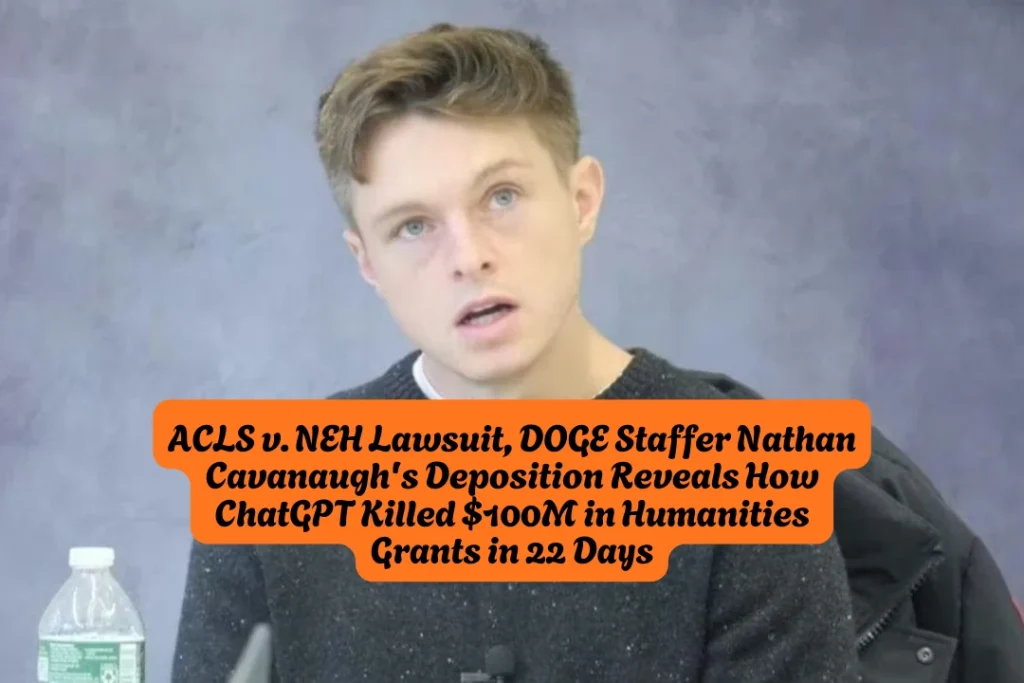
ACLS v. NEH Lawsuit, DOGE Staffer Nathan Cavanaugh’s Deposition Reveals How ChatGPT Killed $100M in Humanities Grants in 22 Days
A federal lawsuit was filed in May 2025. Depositions happened in January 2026. But nobody was really paying attention — until this week, when video footage of Nathan Cavanaugh’s deposition started circulating on social media and legal observers began calling his testimony “arrogant” and flagging what they described as potential federal records violations caught on tape. Nathan Cavanaugh, a former DOGE staffer, raised eyebrows after analysts viewed his “arrogant” deposition tape — sparking a viral moment that sent hundreds of thousands of people searching his name.
Here is everything you need to know — who he is, what the lawsuit actually says, what the deposition revealed, and what happens next.
Quick Case Snapshot
| Field | Detail |
| Case Name | American Council of Learned Societies, et al. v. National Endowment for the Humanities, et al. (Consolidated) |
| Court | U.S. District Court, Southern District of New York |
| Case Number | Consolidated — Southern District of New York |
| Date Filed | May 2025 |
| Defendants | National Endowment for the Humanities (NEH); DOGE staffers Justin Fox and Nathan Cavanaugh; NEH Acting Chair Michael McDonald |
| Plaintiffs | American Council of Learned Societies (ACLS); American Historical Association (AHA); Modern Language Association (MLA); Authors Guild |
| Claims Alleged | Violation of First Amendment (viewpoint-based discrimination); violation of equal protection clause of the Fifth Amendment; violation of constitutional separation of powers; violation of the Federal Records Act |
| Relief Sought | Vacate all 1,477 grant terminations; permanent injunction against re-terminating grants on same grounds |
| Settlement | None — litigation phase only |
| Current Status | Summary judgment motion filed March 6, 2026 — ruling pending |
What Actually Happened — The Full Story
What Is the NEH and Why Does It Matter?
Since the NEH’s founding in 1965, the agency has provided over $6 billion in grants to fund over 70,000 projects in all 50 states. It funds local museums, public libraries, historical archives, documentary films, university research programs, Holocaust education centers, and community arts organizations across every congressional district in America. It is one of the primary ways Congress has directed money to support American cultural and intellectual life for six decades.
Step 1 — DOGE Arrives at the NEH (March 12, 2025)
DOGE’s Small Agencies Team met with NEH leaders on March 12, 2025. Two DOGE staffers — Justin Fox and Nathan Cavanaugh — arrived to review the NEH’s grant portfolio for compliance with President Trump’s executive orders targeting DEI, gender ideology, and environmental sustainability programs.
The lawsuit details that Fox and Cavanaugh lacked “any relevant background in the humanities, public or private grant administration, peer review, or government service of any kind prior to joining the administration.” Cavanaugh was a political appointee in his late 20s working through the General Services Administration as part of the DOGE team.
Step 2 — ChatGPT Becomes the Reviewer
Justin Fox and Nate Cavanaugh, with no background in the humanities, culled short summaries of ongoing NEH projects from the internet. The prompt that they fed to ChatGPT read: “Does the following relate at all to D.E.I.? Respond factually in less than 120 characters. Begin with ‘yes’ or ‘no.'”
DOGE staff prompted the AI: “Does the following relate at all to DEI?” and “Respond factually in less than 120 characters. Begin with ‘Yes.’ or ‘No.’ followed by a brief explanation.”
Fox testified that he did not define what “DEI” meant for the system and did not know how the model interpreted the term. The AI flagged projects as DEI simply because their descriptions referenced marginalized communities, topics involving race, religion, gender, or sexuality — regardless of the actual content or purpose of the funded work.
Step 3 — What Got Flagged and Cancelled
The results of the AI review produced a list that shocked legal observers and historians. Among the grants ChatGPT flagged for cancellation:
- A project about the 1873 Colfax Massacre and its legacy for Black civil rights — ChatGPT flagged it because it “focuses on exclusively anti-Black violence, which is a race.”
- An anthology translating fiction by Jewish writers reflecting on the Holocaust in the Soviet Union — ChatGPT stated “this anthology explores Jewish writers’ engagement with the Holocaust in the USSR.”
- A grant to support the National Catholic Center for Holocaust Education at Seton Hill University.
- A grant to the High Point Museum in North Carolina to replace aging heating and cooling systems — an HVAC infrastructure project — which ChatGPT flagged as DEI after Fox fed it the grant’s description.
On the High Point Museum grant specifically, Fox fed this prompt into ChatGPT: “Does the following relate at all to DEI? The High Point Museum proposes to replace aging HVAC systems in the Museum’s main building to create a better preservation environment for the varied collections it houses.” ChatGPT said yes. The HVAC grant was cancelled.
Step 4 — The NEH’s Own Chair Objected. DOGE Ignored Him.
In an email the morning before the terminations, NEH’s own Acting Chairman Michael McDonald told Fox that for many grants, “there is no justification for canceling the project’s funding.” But McDonald acknowledged the decision was Fox’s to make. Fox and Cavanaugh rejected McDonald’s recommendations and proceeded anyway.
Nate Cavanaugh told lawyers in a January 2026 deposition that his team was pushing McDonald to “move faster.” “We would tell Mike that we were getting pressure from basically the White House to effectuate these contract and grant terminations that are aligned with the EO. So it was a time pressure tactic.”
NEH’s acting chair Michael McDonald said he did not know DOGE had relied on ChatGPT and rejected including Holocaust-related grants under DEI. When asked “In your view, does this grant relate to DEI?” McDonald answered “no.” When the lawyer followed up with “would you consider this to be wasteful spend?” he replied “I would not, no.”
Step 5 — The Damage: 97% of All Active Grants, Gone in 22 Days
Court documents filed March 6 in the federal lawsuit reveal that DOGE staff members Justin Fox and Nathan Cavanaugh terminated 97% of NEH’s active grant portfolio in April 2025, cutting more than $100 million in congressionally appropriated funds in a matter of days.
By April 1, the NEH had canceled $100 million in grants and terminated 65% of its employees. A federal agency that had operated continuously since 1965 was effectively gutted in three weeks.
What the Viral Deposition Revealed
Cavanaugh’s January 23, 2026 deposition video began circulating widely on social media this week. Here is what people are actually reacting to:
The admission about Signal and personal channels: During the deposition, Cavanaugh admitted to sending himself files through his personal channels and on Signal to bypass government data control regulations. Federal employees are generally prohibited from conducting official government business on personal devices or encrypted messaging apps that do not preserve records — a requirement under the Federal Records Act. Legal observers watching the deposition tape described the admission as potentially incriminating.
The “I read books” defense: Cavanaugh admitted that he and Fox did not consult scholars or the NEH’s peer review system before identifying projects for potential cancellation. Instead, they relied largely on their own judgment while scanning grant summaries. “I think a person can have enough judgment from reading books and being well-informed outside of traditional experience to make judgment calls about obvious things like a grant that literally lists DEI in its description,” he testified. But when attorneys asked what books informed those judgments, he conceded he had not consulted any.
The “move faster” pressure tactic: Cavanaugh testified his team was pressuring McDonald to move faster, describing it as “a time pressure tactic” with pressure coming “from basically the White House.”
The breadth of his DOGE work: When asked about his role at the U.S. Institute of Peace, Cavanaugh testified that DOGE “reduced the Institute of Peace to its statutory minimum,” explaining that involved “terminating all of the existing contracts, grants, and firing all the employees.” The NEH was not Cavanaugh’s only assignment.
What Does the Lawsuit Allege?
The lawsuit, consolidated from two separate cases in the Southern District of New York, argues the terminations violated the First Amendment, the equal protection clause of the Fifth Amendment, and the constitutional separation of powers because Congress never granted DOGE any authority over NEH grants.
The lawsuit alleges that Fox and Cavanaugh “made and executed the termination decision without any legal authority conferred by Congress. There is no jurisdictional barrier to vacating these unlawful terminations, and permanent relief is warranted.”
Depositions and records obtained through the discovery process detail the role of DOGE staff in canceling humanities grants, and how both the Federal Equal Protection Clause of the 5th Amendment and the Federal Records Act were violated in the process.
The March 6, 2026 summary judgment motion — the filing that triggered renewed media attention and the release of deposition materials — asks the court to rule in favor of the plaintiffs without a full trial, arguing the evidence from discovery is so clear that no jury is needed to reach a verdict.
What Laws Were Allegedly Violated?
First Amendment — Viewpoint-Based Discrimination — The First Amendment prohibits the government from suppressing speech or funding based on the viewpoint it expresses. Plaintiffs called the terminations “unconstitutional” and claimed the NEH violated the First Amendment by targeting grants for their viewpoints. Funding a grant about the Holocaust does not express a government viewpoint — canceling it because it mentions Jewish history arguably does.
Equal Protection Clause of the Fifth Amendment — The Fifth Amendment’s due process clause contains an implicit equal protection guarantee that prohibits the federal government from discriminating on the basis of race, religion, or national origin. The filing states that searches generated lists of grants referencing race, ethnicity, gender, or sexual orientation — and that projects were flagged for termination on that basis.
Separation of Powers — Congress appropriated the NEH’s grant funds and set the rules for how they would be distributed. The lawsuit argues that DOGE — which has no statutory authority of its own — cannot override congressionally mandated grant programs by simply directing a federal agency to cancel them.
Federal Records Act — Federal law requires government employees to preserve official records and prohibits the use of personal communication channels for official government business. Cavanaugh’s deposition admission about using Signal and personal channels to transmit government files is the basis of this claim.
Who Is Affected?
- You may be affected if your organization received an NEH grant that was terminated in April 2025 — covering schools, libraries, museums, universities, documentary filmmakers, archives, and community humanities programs in all 50 states.
- You may be affected if you are a researcher, educator, or artist who lost funding mid-project when your NEH grant was cancelled.
- You may be affected if you work at a museum or library that lost infrastructure funding — including organizations like the High Point Museum whose HVAC replacement grant was cancelled after ChatGPT flagged it as DEI.
- You may be affected if you are a Holocaust education organization, a civil rights history project, or a faith-based humanities program whose grant was terminated based on AI-generated keyword screening.
No individual claims process is open. The lawsuit seeks to restore all terminated grants — meaning the relief, if granted, would automatically benefit every organization whose grant was cancelled.
Save any documentation of your terminated NEH grant, including the termination letter, grant award documents, and any correspondence with NEH or DOGE staff. These records may be relevant if the court orders restoration of funding.
What Are the Defendants Saying?
The Trump administration has not issued a formal public legal defense specific to the March 6, 2026 summary judgment motion. The government’s general position throughout the litigation has been that the executive branch has broad authority to direct federal agencies to implement the president’s executive orders, and that the NEH grants in question were lawfully terminated because they violated those orders.
McDonald, the NEH acting chair who signed off on the terminations, was asked about DOGE’s concerns that he was slow-walking the process. He said: “I believe that I had a responsibility, having accepted the position in directing the agency, which in my view is part of the executive branch of government. We were given instructions by the President to cooperate with DOGE in its work. And no, I didn’t feel that there were any reasons for obstruction, certainly on my part.”
Notably, McDonald has since been nominated by Trump to become the permanent NEH chairman — the same person who presided over the cancellation of 97% of the agency’s active grants is now being nominated to lead it permanently. AllAboutLawyer.com will update this article when the government files its formal opposition to the summary judgment motion.
Legal Context: Why This Case Is Bigger Than the NEH
This case sits at the intersection of three of the most contested legal questions of 2026: the scope of DOGE’s authority, the limits of executive orders, and whether the federal government can use AI tools to make decisions that affect constitutional rights.
The legal theory most likely to succeed — and the one courts have been most receptive to in parallel cases — is the First Amendment viewpoint discrimination claim. Courts have consistently held that the government cannot selectively withdraw funding based on the viewpoint expressed by the funded work. If the court finds that grants were cancelled because of the perspective they expressed — rather than any genuine legal violation — the terminations are likely unconstitutional regardless of what executive orders say.
This case also has a direct parallel on your site. As AllAboutLawyer.com reported in January 2026, the American Academy of Pediatrics won a federal court order restoring $12 million in HHS grants after a judge found that terminating funding to punish an organization for its public speech was likely unconstitutional First Amendment retaliation. The legal framework is nearly identical — and the AAP court’s reasoning in January 2026 directly strengthens the ACLS plaintiffs’ case here.
What Happens Next?
- On March 6, 2026, the ACLS, the American Historical Association, and the Modern Language Association filed a motion for summary judgment in their case to restore terminated grants awarded to schools, libraries, and community organizations by the NEH. The court must now rule on that motion.
- If the court grants summary judgment for the plaintiffs, it could order immediate restoration of all 1,477 terminated grants without a trial — the fastest possible path to relief for affected organizations.
- If the court denies summary judgment, the case proceeds to trial — a lengthier process that could extend into 2027 or beyond.
- The government is also expected to file its opposition brief to the summary judgment motion within the standard briefing schedule, likely within 21 to 30 days.
- Separately, the Authors Guild filed its own lawsuit on March 10, 2026, adding new plaintiffs and new claims — including the allegation that DOGE’s use of ChatGPT to cancel Holocaust and civil rights history grants specifically demonstrates unconstitutional viewpoint and religious discrimination.
- The deposition of Cavanaugh released this week may also trigger a separate inquiry into Federal Records Act violations based on his admitted use of Signal and personal channels for official government business.
This page will be updated as the case develops.
Important Case Dates
| Milestone | Date |
| Executive Orders Signed | January 2025 |
| DOGE Meets NEH Leadership | March 12, 2025 |
| ChatGPT Grant Review Conducted | March 12–31, 2025 |
| 97% of NEH Grants Cancelled | April 1, 2025 |
| 65% of NEH Staff Terminated | April 2025 |
| Original Lawsuit Filed | May 2025 |
| Nathan Cavanaugh Deposed | January 23, 2026 |
| Justin Fox Deposed | January 28, 2026 |
| Michael McDonald Deposed | January 30, 2026 |
| Summary Judgment Motion Filed | March 6, 2026 |
| Authors Guild Lawsuit Filed | March 10, 2026 |
| Deposition Video Goes Viral | March 13, 2026 |
| Government Opposition Brief Due | TBD |
| Summary Judgment Ruling | TBD |
| Trial Date (if needed) | TBD |
Frequently Asked Questions
Is the Nathan Cavanaugh / NEH lawsuit real and legitimate?
Yes. The case is consolidated in the U.S. District Court for the Southern District of New York. The American Historical Association, American Council of Learned Societies, and Modern Language Association filed the lawsuit in federal court and filed a motion for summary judgment on March 6, 2026. The full deposition transcripts, discovery exhibits, and court filings are publicly available through the ACLS and AHA websites and through the PACER federal docket system.
Who exactly is Nathan Cavanaugh and why is he trending?
Cavanaugh is a political appointee in his late 20s who worked with Elon Musk’s DOGE team via the General Services Administration. His deposition video circulated widely this week after analysts described his testimony as “arrogant” — and after he admitted to sending government files to himself via Signal and personal channels, raising potential Federal Records Act violation concerns.
Did DOGE actually use ChatGPT to cancel federal grants?
Yes — this is confirmed by deposition testimony and internal documents produced in discovery. When DOGE was asked to identify NEH grants that violated President Trump’s executive orders, it enlisted the help of ChatGPT, prompting the AI: “Does the following relate at all to DEI?” Fox testified he did not define what “DEI” meant for the system and did not know how the model interpreted the term.
Can I file a claim to get my NEH grant restored right now?
No individual claims process is open. The lawsuit seeks a court order vacating all 1,477 terminations — if successful, funding would be restored to all affected organizations automatically. Individual organizations should document all losses and monitor the case through PACER or the ACLS website.
What happens if the court grants summary judgment for the plaintiffs?
The court could order the NEH to immediately reinstate all terminated grants. That would mean $100 million in congressionally appropriated funds — already allocated to museums, schools, libraries, and humanities programs — would be restored without a full trial. Organizations mid-project when the cancellations hit in April 2025 would resume funding.
Does using Signal for government business violate the law?
The Federal Records Act requires federal employees to preserve official records and prohibits conducting government business on personal devices or apps that do not automatically preserve records. Cavanaugh admitted during his deposition to sending himself files through personal channels and on Signal to bypass government data control regulations. Whether that admission leads to a separate enforcement action is TBD — but legal observers called it a significant moment in the deposition.
Why was a Holocaust education grant cancelled as “DEI”?
ChatGPT flagged the anthology of fiction by Jewish Holocaust survivors as DEI because — in the AI’s assessment — it “explores Jewish writers’ engagement with the Holocaust in the USSR.” The NEH’s own Acting Chair Michael McDonald testified he did not believe the grant was DEI-related or wasteful. DOGE overruled him and cancelled it anyway.
Will I get notified if the grants are restored?
Affected organizations will be notified directly by the NEH if a court orders restoration. Individual researchers and community members who benefited from funded programs should monitor the ACLS at acls.org and the AHA at historians.org for updates, as both organizations are tracking the case in real time.
Related Reading on AllAboutLawyer.com: The legal framework at the center of this case — unconstitutional First Amendment retaliation through federal grant termination — is the same theory that produced a court victory just two months ago. See our full coverage of how the American Academy of Pediatrics won a federal court order restoring $12M in HHS grants after a judge found the terminations were likely unconstitutional viewpoint-based retaliation — the AAP ruling directly strengthens the ACLS plaintiffs’ position in this case.
Last Updated: March 14, 2026
This article is for informational purposes only and does not constitute legal advice. Allegations in a complaint are not findings of fact. All parties are presumed innocent unless and until proven otherwise in court.
About the Author

Sarah Klein, JD, is a licensed attorney and legal content strategist with over 12 years of experience across civil, criminal, family, and regulatory law. At All About Lawyer, she covers a wide range of legal topics — from high-profile lawsuits and courtroom stories to state traffic laws and everyday legal questions — all with a focus on accuracy, clarity, and public understanding.
Her writing blends real legal insight with plain-English explanations, helping readers stay informed and legally aware.
Read more about Sarah