
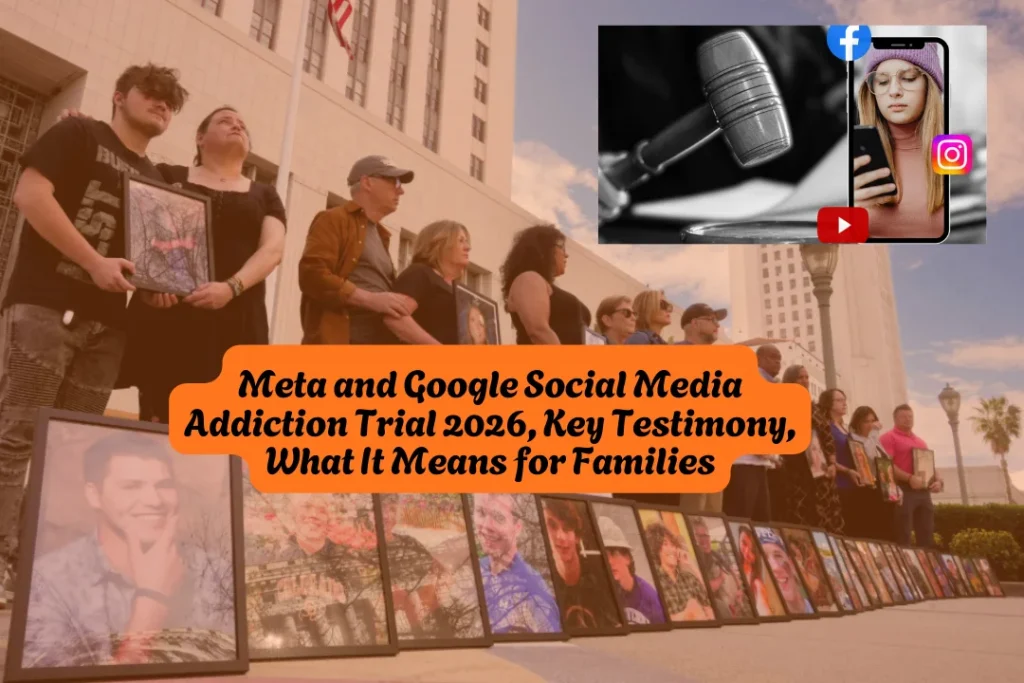
Meta and Google Social Media Addiction Trial 2026, Key Testimony, What It Means for Families
A trial underway at Los Angeles Superior Court is examining whether Meta’s Instagram and Google’s YouTube deliberately designed their platforms to be addictive and harmful to young people. The case centers on K.G.M., a 20-year-old California woman who says she began using YouTube at age 6 and Instagram at age 9, and that her compulsive use of the platforms worsened her depression and suicidal thoughts.
The jury’s verdict in this bellwether case could shape the outcome of approximately 1,600 other pending cases filed by families and school districts across the United States.
Quick Facts
| Field | Detail |
| Case Name | K.G.M. v. Meta Platforms, Inc., et al., Case No. 23SMCV03371 |
| Court | Los Angeles County Superior Court, Los Angeles, California |
| Defendants | Meta Platforms, Inc. (Instagram); Google LLC (YouTube) |
| Plaintiff | K.G.M. (“Kaley”), a 20-year-old California woman |
| Trial Began | February 3, 2026 |
| Expected Duration | Six weeks |
| Legal Theory | Product liability — platforms as defective products engineered to addict young users |
| Prior Settlements | TikTok and Snap settled before trial (terms undisclosed) |
| Verdict | Pending — trial ongoing as of March 11, 2026 |
| Stakes | Outcome could influence 1,600+ coordinated pending cases nationwide |
Current Trial Status
- As of early March 2026, the trial has entered its defense phase. Meta’s lawyers have indicated they plan to call K.G.M.’s therapists as witnesses to argue that her psychological challenges stemmed from family turmoil and school life rather than platform design.
- During cross-examination of plaintiff K.G.M., defense counsel focused heavily on other potential causes of her mental health struggles, including family conflict, allegations of abuse, estrangement from her father, academic difficulties, and peer bullying.
- The Social Media Addiction MDL in federal court has also entered a critical phase, with Judge Rogers setting the first two bellwether trials for June 15 and August 6, 2026 — dates that will significantly increase pressure on defendants in the hundreds of coordinated federal cases.
What Is the Social Media Addiction Trial About?
The trial questions whether social media giants deliberately designed their platforms to be addictive to children. Plaintiff K.G.M.’s lawsuit claims she began using social media young — YouTube at age 6 and Instagram at age 9 — and that after becoming dependent on the platforms, her body image issues, depression, and suicidal thoughts worsened.
The plaintiff’s lawyers found a way around the federal legal shield that has long protected Silicon Valley by treating social media apps as unsafe products — viewing Instagram, YouTube, and other platforms as defective under product liability law. The argument is that tech companies deliberately designed social media sites as harmful and dismissed internal warnings that the services could be problematic for teenagers.
TikTok and Snapchat, originally named as defendants in K.G.M.’s case, reached undisclosed settlement agreements with the plaintiff shortly before the trial began. The terms of those settlements have not been publicly disclosed. Meta and Google remain as the two defendants taking the case to a jury verdict. The case is one of three bellwether proceedings selected by the court — a legal strategy that uses early test verdicts to guide settlement negotiations across thousands of similar lawsuits.
Key Expert Testimony: What Witnesses Said
Dr. Anna Lembke — Stanford Psychiatrist (Plaintiff’s Expert)
Dr. Anna Lembke, medical director of Stanford University’s addiction medicine program and the author of the bestselling book Dopamine Nation, served as the first witness called by the plaintiff. She walked jurors through what she described as the four “C’s” of addiction: loss of control, cravings, compulsions, and consequences.
Lembke testified that after reviewing thousands of pages of internal documents and the companies’ own research, she determined that the design features of social media are addictive. She described the notification tool as a potent feature that triggers cravings to return to the platform, and noted that the 24-hour time limit on Instagram Stories creates a fear of missing out that compels users to check the platform more frequently.
Lembke also testified that approximately 40% of patients at Stanford’s adolescent recovery clinic — which historically treats mostly alcohol and drug abuse — now present with social media addiction. She added that individuals would rarely self-identify a social media addiction and would require a skilled therapist to diagnose it.
Lembke walked jurors through what she described as an internal Meta document, purportedly dated October 29, 2020, that separated users with existing vulnerabilities into four groups: adolescents, females, people with mental health challenges, and those from low socioeconomic backgrounds — illustrating what she characterized as a bidirectional feedback loop recognized in addiction medicine.
Mark Zuckerberg — Meta CEO
Meta CEO Mark Zuckerberg testified on February 18, 2026 — the first time he had ever testified before a jury on claims related to social media harming children’s mental health. He said he believed he had navigated the safety of young users “in a reasonable way” and denied that Meta seeks to make Instagram addictive.
During questioning by plaintiff’s attorney Mark Lanier, Zuckerberg said he still agrees with a prior congressional statement that the existing body of scientific work has not proved that social media causes mental health harms in young people.
Lanier also questioned Zuckerberg extensively on age-verification policies, displaying an internal Meta email from 2015 estimating that 4 million children under 13 were using Instagram — approximately 30% of U.S. children ages 10 to 12. Zuckerberg said the company removes identified underage users and notes age requirements during sign-up.
Lanier pressed Zuckerberg about Meta’s decision to allow beauty filters that manipulated facial appearance after 18 internal experts warned the filters were harmful to teenage girls and could contribute to body dysmorphia. Zuckerberg and Instagram chief Adam Mosseri reversed a temporary ban and allowed the filters to remain on the platform.
Adam Mosseri — Head of Instagram
Instagram chief Adam Mosseri testified that he believes social media use — even 16 hours a day of scrolling by a teen — can be considered “problematic,” but not “clinically addictive.” He argued it is “important to differentiate between clinical addiction and problematic use,” and said he believes protecting minors in the long run is good for the business.
K.G.M. (“Kaley”) — Plaintiff
K.G.M., now 20, testified that using Instagram and YouTube as a child fueled her depression and anxiety and led her to withdraw from her family. She told jurors the platforms “really affected my self-worth” and that they made her give up hobbies, prevented her from making friends, and caused her to constantly compare herself to others.
She also described using Instagram’s beauty filters, which she says contributed to body dysmorphia — a struggle she said still leads her to spend three to four hours on her appearance each morning. She said autoplay on YouTube repeatedly kept her on the platform far longer than she intended.
During cross-examination, defense counsel for Meta focused heavily on contradictions between K.G.M.’s live testimony and statements she made in her 2025 deposition on approximately 20 separate occasions. Meta’s defense team argued her mental health challenges originated from a turbulent home environment rather than social media use.
The Central Legal Debate: Is Social Media Addiction Real?
Dr. Anna Lembke defines addiction as “the continued compulsive use of a substance or behavior despite harm to self or others.” She testified that what makes social media platforms particularly addictive is the “24/7, really limitless, frictionless access” users have to them.
However, social media addiction is not currently recognized as an official disorder in the Diagnostic and Statistical Manual of Mental Disorders (DSM-5), which is the standard reference psychiatrists and mental health practitioners use to assess and treat patients. Some researchers question whether “addiction” is the appropriate term to describe heavy social media use, arguing that identifiable symptoms including strong, uncontrollable urges and withdrawal symptoms must be present.
A 2024 article published in Cureus found that social media addiction is marked by excessive, compulsive use including cravings and withdrawal-like symptoms that interfere with daily life. The authors concluded these characteristics resemble those of gambling disorder, since both involve similar neurological reward pathways related to dopamine.
Meta and other tech firms have argued there is no conclusive evidence linking social media to addiction or mental health problems — language that some lawyers representing plaintiffs say sounds familiar to those who previously litigated cases against tobacco companies.
What the “Bellwether” Structure Means for Families
The jury’s verdict in the K.G.M. case will not be legally binding on the 1,600 other pending cases, but the outcome will significantly influence settlement talks and legal strategy across all of those proceedings.
If the jury sides with K.G.M., the tech companies could face damages to be determined by the jury and could be forced to change the designs of their platforms. Multiple losses for the companies could put them on the hook for substantial damages and accelerate settlement negotiations across the coordinated cases.
In past mass torts such as Roundup, opioids, and 3M earplugs, the approach of bellwether trials and early plaintiff wins significantly accelerated global settlement negotiations. With summary judgment denied on key claims and parallel state court trials already producing pre-verdict settlements, the pressure on social media companies to evaluate resolution options is increasing.
Families who believe their children were harmed by social media platforms may still have legal options. Because this is an individual personal injury trial — not a consumer class action settlement — there is no claim form to file. Families seeking to join the broader litigation should consult a licensed attorney who specializes in social media addiction cases. You can read about the TikTok pre-trial settlement for background on how TikTok resolved its portion of these cases before trial began, and review the broader Instagram class action lawsuit for a full picture of the coordinated litigation landscape.
Frequently Asked Questions
What is the social media addiction trial about?
The trial examines whether Meta and Google deliberately designed Instagram and YouTube to be addictive to children. Plaintiff K.G.M.’s lawsuit argues the platforms are defective products under product liability law because their features — including infinite scroll, autoplay, beauty filters, and push notifications — were engineered to maximize engagement at the expense of young users’ mental health.
Who is the plaintiff in the Meta and Google trial?
The plaintiff is K.G.M., a 20-year-old California woman referred to in court as “Kaley.” She says she started compulsively using YouTube when she was 6 years old and began scrolling on Instagram at age 9, and that her use of the platforms worsened her depression and suicidal thoughts.
Has a verdict been reached in the social media addiction trial?
No verdict has been reached as of March 11, 2026. The trial is in its defense phase, with Meta’s legal team calling witnesses to argue that K.G.M.’s mental health challenges stemmed from difficult family and personal circumstances rather than platform design. The trial is expected to conclude in mid-March 2026.
Did TikTok and Snap settle the social media addiction case?
Yes. TikTok and Snapchat, originally named as defendants in K.G.M.’s case, both reached undisclosed settlement agreements with the plaintiff shortly before the trial began. The terms of those settlements have not been publicly disclosed. Meta and Google are the two remaining defendants.
What is a bellwether trial and why does it matter?
A bellwether trial is a test case chosen to go first in a group of similar lawsuits. Its outcome does not legally bind the other cases, but it powerfully influences how attorneys on both sides assess the strength of their positions and whether to settle or fight. The verdict in K.G.M.’s case could shape the outcome of approximately 1,600 other pending social media addiction cases filed by families and school districts.
Can I file a claim if my child was harmed by social media?
This trial is an individual personal injury lawsuit — not a consumer class action with a claim form. Families who believe their children suffered harm from social media addiction should consult a licensed attorney who handles social media personal injury cases. Because TikTok settled before trial and Meta and Google are still in litigation, no open settlement fund currently exists for new claimants.
What evidence did experts present about social media harming children?
Internal documents entered into evidence revealed that Instagram had over 4 million users under age 13 as of 2015 — representing roughly 30% of all 10-to-12-year-olds in the U.S. at the time. Internal documents also showed Meta set goals to grow average daily usage from 40 minutes in 2023 to 46 minutes by 2026. Expert witnesses testified that these metrics reflect product decisions that prioritized engagement growth over user wellbeing.
How does Section 230 affect these lawsuits?
Section 230, a provision of the Communications Act of 1934, historically shielded internet companies from liability for content users post on their platforms. Plaintiff’s attorneys sidestepped this protection by focusing on product design claims — arguing that Meta and Google should be held liable not for what users posted, but for the features they deliberately built into their platforms to maximize addictive engagement.
Sources & References
- CNN — Zuckerberg Testifies, February 18, 2026: cnn.com
- NPR — Zuckerberg Grilled on Teens and Tweens, February 18, 2026: npr.org
- NBC News — Plaintiff K.G.M. Testifies, February 26, 2026: nbcnews.com
- Rolling Stone — Expert Testimony, Dr. Anna Lembke, February 2026: rollingstone.com
- Mercury News — Meta, Google Pivot to Accuser’s History, March 10, 2026: mercurynews.com
- Fox Business — Stanford Psychiatrist Testimony, February 2026: foxbusiness.com
Last Updated: March 11, 2026
Disclaimer: This article is for informational purposes only and does not constitute legal advice. Legal claims and outcomes depend on specific facts and applicable law. For advice regarding a particular situation, consult a qualified attorney.
About the Author

Sarah Klein, JD, is a licensed attorney and legal content strategist with over 12 years of experience across civil, criminal, family, and regulatory law. At All About Lawyer, she covers a wide range of legal topics — from high-profile lawsuits and courtroom stories to state traffic laws and everyday legal questions — all with a focus on accuracy, clarity, and public understanding.
Her writing blends real legal insight with plain-English explanations, helping readers stay informed and legally aware.
Read more about Sarah