
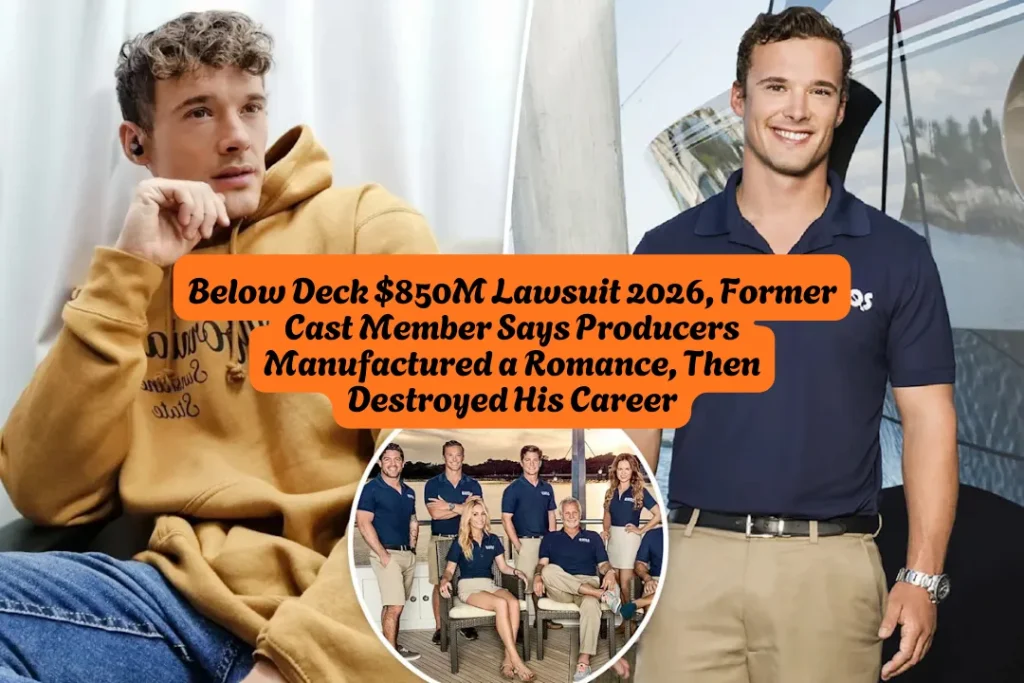
Below Deck $850M Lawsuit 2026, Former Cast Member Says Producers Manufactured a Romance, Then Destroyed His Career
Emile Kotze — a South African deckhand who appeared on Below Deck Season 3 in 2015 at age 23 — is suing NBCUniversal, Bravo Media, and production company 51 Minds Entertainment for up to $850 million over allegations of sexual harassment, manipulation, defamatory editing, and a decade-long cover-up. Kotze claims he was “sexually harassed, manipulated, and subjected to degrading treatment” during and after filming Season 3, and that the network engaged in a “coordinated campaign of exploitation, harassment and deceit” that effectively destroyed his professional yachting career.
NBCUniversal has denied all allegations and is fighting to have the case dismissed. As of March 2026, the lawsuit is active in federal court in New York.
Quick Facts
- Case: Emile Kotze v. NBCUniversal et al. | Case No. 1:2025cv04703
- Court: US District Court, Southern District of New York
- Filed: June 2, 2025 — amended October 2025
- Defendants: NBCUniversal, Bravo Media LLC, 51 Minds Entertainment
- Damages sought: Between $633 million and $850 million
- NBC’s motion to dismiss: Filed November 2025 — denied January 3, 2026
- Current status: Active — discovery and motions stage
- Kotze’s representation: Pro se — representing himself
- NBC’s response: Denied all allegations — fighting dismissal
What Emile Kotze Says Happened on Set
Kotze was 23 years old when he joined Below Deck Season 3 as a deckhand in 2015. He says he was told the show was a “documentary-style” series that followed a crew working abroad and believed it would help his career. What he says he got instead was a deliberately manufactured environment designed entirely to create televised drama at his expense.
According to the complaint filed in October 2025, Kotze claims the production team deliberately orchestrated situations to boost television ratings at his expense — arranging for him and castmate Raquel “Rocky” Dakota to work closely together, including scheduling night shifts where they were alone, to manufacture flirtatious interactions.
He alleges producers pressured him into a romance with his co-star Raquel “Rocky” Dakota despite him expressing “hesitance” and claims they “plied” him with alcohol to encourage him to make a move on her — and even coached him on what to say, including directing him to use a cheesy pickup line on camera that he would never normally say.
When the season aired, Kotze says the editing made things worse. He argues the final edit of the season created a misleading and defamatory image, depicting him as immature, incompetent, and sexually aggressive — and that portrayal had lasting consequences in his professional life, effectively blacklisting him from the yachting industry.
Kotze is seeking $123 million for lost future earnings, no less than $10 million for emotional distress, and $500 million in punitive damages. He also asked the court to demand that the network remove or delete any intimate images of him from all platforms and stop future streaming of Season 3 episodes containing defamatory content — or add a disclaimer clarifying that his portrayal was manipulated.
Kotze says he suffers from diagnosed PTSD, anxiety, and depression stemming from his experiences on the show.
Why He Waited a Decade to Sue
This is the question most people ask first — and it is also the centerpiece of NBCUniversal’s legal defense.
Kotze said in his second amended complaint that he wanted “to finally expose the truth, obtain justice for himself, and set a precedent that such exploitative conduct has legal consequences.” He cites “new evidence and recent developments” as reasons for the timing — a reference to the broader reality TV accountability movement gaining momentum in 2024 and 2025.
Kotze is also trying to use a specific federal law to get around the normal statute of limitations — the Ending Forced Arbitration of Sexual Assault and Sexual Harassment Act of 2021, which allows individuals who may have been victims of sexual assault or harassment to choose to pursue their claims in court rather than being bound by a mandatory arbitration agreement. Reality TV contracts almost universally include arbitration clauses that keep disputes private — this law is his tool for getting into public court instead.
What NBCUniversal Is Arguing
NBCUniversal is not taking this quietly. The network filed a motion to dismiss in November 2025 with three main arguments:
The statute of limitations. The network argues the lawsuit was filed roughly 10 years after Season 3 first aired and is time-barred — the legal window to bring these claims has long closed.
First Amendment protection. NBCUniversal invokes the First Amendment, arguing that editing and presentation of reality television are protected creative expression under the US Constitution — and that forcing a network to remove a television program from distribution would constitute an unconstitutional “prior restraint” on speech.
Insufficient evidence. The company claims Kotze’s complaint contains vague allegations and limited factual support — especially given the enormous damages he is seeking.
Despite all three arguments, NBC’s motion to dismiss the first amended complaint was denied by the judge on January 3, 2026 — meaning the case moves forward and Kotze gets his day in court.
The Unusual Detail — He Is Representing Himself
One unusual aspect of the case is that Kotze is representing himself — a legal status known as appearing pro se. Self-representation is rare in cases involving hundreds of millions of dollars and complex media law issues. NBCUniversal, by contrast, is represented by experienced corporate legal teams.
Courts across the country grant pro se litigants some degree of leeway in how their filings are interpreted — but that does not level the playing field in a case this complex. A judge has already denied multiple motions Kotze filed, writing that he had “filed eight motions essentially seeking the same relief” with “no new facts or intervening change of law” and warned that the court may limit his ability to file further duplicative motions.
Legal observers have noted that without professional counsel, Kotze faces an extremely steep climb even if his underlying allegations have merit.
The Bigger Case Running Alongside This One
The Kotze lawsuit is not the only active Below Deck case in 2026.
A judge denied a motion by NBCUniversal, Bravo Media, and Mountain View Productions to force into arbitration the claims of former Below Deck: Sailing Yacht camera operator Grey Duddleston and hair and makeup artist Samantha Suarez — who filed a lawsuit in March 2025 against NBCUniversal, Bravo, and cast member Gary King alleging sexual battery, a hostile work environment, retaliation, and failure to prevent discrimination.
The judge ruled the studios could not compel arbitration due to the Ending Forced Arbitration of Sexual Assault and Sexual Harassment Act of 2021 — the same law Kotze is relying on.
Two separate Below Deck lawsuits. Same law. Same network. Both moving forward in 2026.
Part of a Larger Reality TV Reckoning
Kotze’s lawsuit comes amid a broader wave of criticism from former reality television personalities. Several former Bravo stars — including Bethenny Frankel and Leah McSweeney — have publicly questioned the industry’s handling of mental health, contracts, and workplace protections.
The reality TV industry has long operated under a system where broad contracts, mandatory arbitration, and powerful editing rights gave networks near-total control over how cast members were portrayed — and near-total protection from accountability when things went wrong.
Legal analysts note that even before any ruling, lawsuits of this magnitude can influence how productions think about on-set safeguards, participant care, and complaint mechanisms — especially when allegations are framed as systemic failures rather than isolated incidents.
Your site has already covered the parallel Leah McSweeney case in depth. Our breakdown of the Leah McSweeney Bravo lawsuit moving to trial in 2026 explains the key ruling that rejected Bravo’s First Amendment defense — the same defense NBCUniversal is now trying to use against Kotze. And our coverage of the Marciano Brunette defamation lawsuit against reality TV producers covers another 2025 case raising the same core question: how much legal protection do reality TV production decisions actually have under the First Amendment?
Key Legal Terms Explained
Pro Se Representation: When a person represents themselves in court without an attorney. Judges allow some flexibility in interpreting pro se filings but do not give legal advice or help build the case.
Motion to Dismiss: A request by the defendant asking the court to throw out the case before it goes to trial — usually arguing the complaint fails legally on its face. NBC’s motion was denied in January 2026.
Statute of Limitations: The legal deadline for filing a lawsuit after an alleged wrong occurred. NBC’s primary defense is that Kotze waited too long — roughly a decade after Season 3 aired.
Ending Forced Arbitration of Sexual Assault and Sexual Harassment Act (2021): A federal law that allows people claiming sexual assault or harassment to bypass mandatory arbitration clauses in contracts and sue in public court instead.
Prior Restraint: A court order blocking speech or publication before it occurs — one of the most disfavored actions in First Amendment law. NBCUniversal argues that ordering removal of Season 3 from streaming would constitute prior restraint.
Defamatory Editing: The legal theory that selectively editing footage to portray someone in a false and damaging light can constitute defamation — a theory at the core of Kotze’s lawsuit.
This article is for informational purposes only and does not constitute legal advice. This article will be updated as the case develops. As of March 2026, the case remains in federal court in the Southern District of New York.
Sources: Kotze v. NBCUniversal et al., Case No. 1:2025cv04703 (S.D.N.Y.) | TMZ, March 5, 2026 | People Magazine, March 6, 2026 | Deadline Hollywood, February 2, 2026 | RealityBlurred.com, March 6, 2026 | AceShowbiz, March 7, 2026
About the Author

Sarah Klein, JD, is a licensed attorney and legal content strategist with over 12 years of experience across civil, criminal, family, and regulatory law. At All About Lawyer, she covers a wide range of legal topics — from high-profile lawsuits and courtroom stories to state traffic laws and everyday legal questions — all with a focus on accuracy, clarity, and public understanding.
Her writing blends real legal insight with plain-English explanations, helping readers stay informed and legally aware.
Read more about Sarah