
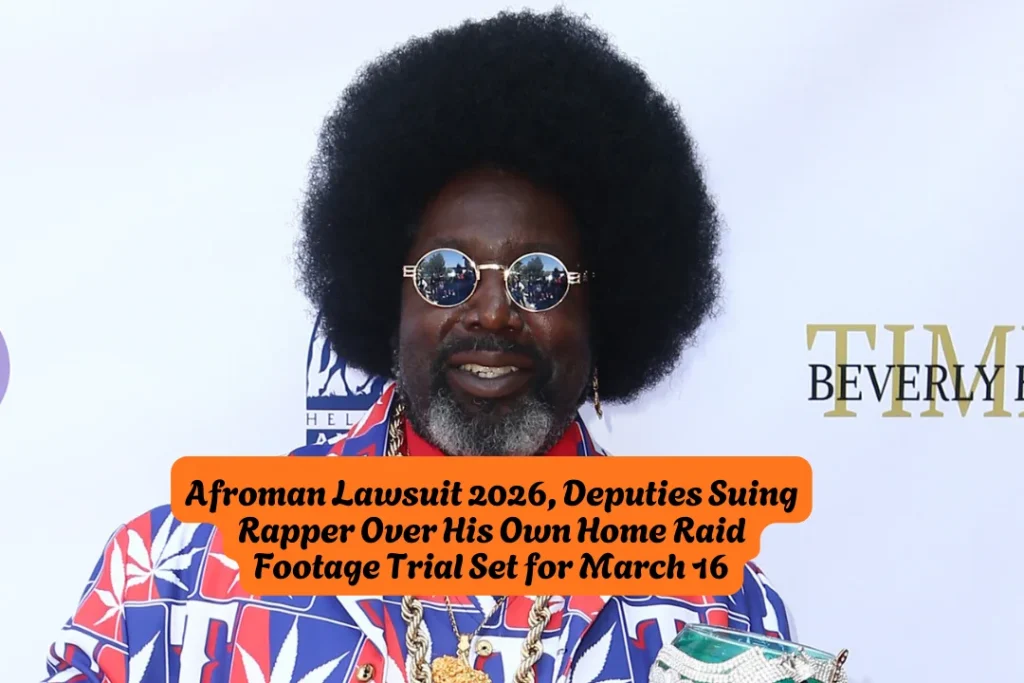
Afroman Lawsuit 2026, Deputies Suing Rapper Over His Own Home Raid Footage Trial Set for March 16
Seven Adams County sheriff’s deputies are suing rapper Afroman — real name Joseph Foreman — for turning footage of a 2022 police raid on his home into viral music videos and merchandise. The trial is scheduled to begin March 16, 2026 in Adams County, Ohio. The deputies sued Afroman over a music video he made using security footage from a 2022 raid on his home, arguing their likenesses were used without permission and subjected them to ridicule and public attention.
Afroman says it is a straightforward free speech issue — he used his own footage, on his own property, to criticize police officers who searched his home and found nothing. The case has become one of the most closely watched First Amendment trials of 2026.
Quick Facts
- Case: Cooley et al. v. Foreman AKA Afroman
- Court: Adams County Court of Common Pleas, Ohio
- Plaintiffs: Seven Adams County Sheriff’s Office members — four deputies, two sergeants, one detective
- Defendant: Joseph Edgar Foreman (Afroman), his recording firm, and a Texas-based media distribution company
- Trial date: March 16, 2026
- What deputies are claiming: Invasion of privacy, false light, emotional distress, unauthorized commercial use of their likenesses
- What Afroman is arguing: First Amendment free speech — the footage is his, the criticism is protected
- Afroman’s countersuit status: Dismissed by Judge Jonathan P. Hein in February 2026 without a hearing
- ACLU involvement: Filed amicus brief supporting Afroman’s First Amendment defense
What Happened the Night of the Raid
In August 2022, Adams County deputies showed up at Afroman’s house with a search warrant connected to an investigation into possible drug possession and trafficking, plus allegations that he kept women locked in his basement. The warrant claimed a confidential informant had seen large amounts of cash and marijuana on the property.
The raid was dramatic. The footage shows Afroman’s front door being smashed in, officers combing his home with weapons drawn, and officers searching through his clothing and personal belongings.
None of the allegations held up. No kidnapping victims were found. No charges were ever filed against Afroman.
Deputies seized thousands of dollars in cash, which was later returned, but Afroman said about $400 was never recovered. He also said the raid left significant damage throughout his home and that the Adams County Sheriff’s Office told him it was not responsible for paying for repairs.
The rapper was furious. And being a musician, he did what musicians do — he made songs about it.
The Music Videos That Started It All
Afroman’s wife recorded the raid on her phone. Security cameras also captured the entire search. Using that footage, Afroman created a series of music videos for his album titled Lemon Pound Cake — named after a moment during the raid when a deputy paused, gun drawn, to look at a lemon pound cake sitting on the rapper’s kitchen counter.
The deputies are suing over Afroman’s use of their images on Instagram, on T-shirts, and in music videos. They allege the rapper used their image and likeness without permission, causing the officers to suffer “humiliation, ridicule, mental distress, embarrassment and loss of reputation.”
The videos went viral. The merchandise sold widely. The deputies demanded Afroman hand over all profits from the music and merchandise.
Afroman’s reaction to being sued by the officers he was criticizing: “I was thinking, these big bad cops are being beat up and bullied by those little corny rap songs I made about them. I’m like, ‘Oh my god, are you letting me know that my raps are working on you?'”
The Legal Claims — What Both Sides Are Arguing
What the deputies claim:
The officers filed four main legal claims against Afroman:
Invasion of privacy — false light. The deputies argue Afroman portrayed them in a false and highly offensive way that a reasonable person would find objectionable. For this claim to succeed, they must prove Afroman knew his portrayal was false or acted with reckless disregard for the truth.
Invasion of privacy — misappropriation of likeness. The officers argue Afroman used their faces and identities for commercial gain — selling merchandise and generating music revenue — without their consent.
Intentional infliction of emotional distress. The deputies claim Afroman’s actions were so extreme and outrageous that they caused severe emotional harm.
Civil conspiracy. The suit names Afroman’s recording firm and a Texas-based media distribution company as co-defendants, alleging they acted together to profit from the unauthorized use.
What Afroman argues:
Afroman’s legal team and the ACLU argue the lawsuit is a classic SLAPP suit — a Strategic Lawsuit Against Public Participation — designed to silence criticism of public officials rather than address any genuine legal wrong.
The ACLU’s brief explains that Afroman’s music videos are not tortious conduct but protected speech, highlighting the importance of the First Amendment’s strong protections for criticism of government actors, including police officers, which acts as a check against the government and is vital to the health of a democracy.
The core First Amendment argument is powerful: when officers execute their duties in public or on someone’s property, their faces and actions become part of the public record. Afroman used his own security footage, on his own property, to criticize government officials performing their official duties.
Why the Deputies Face an Uphill Legal Battle
Legal experts who have analyzed this case are largely skeptical that the deputies will prevail — for several reasons.
The false light problem. To win on the false light invasion of privacy claim, the officers must prove Afroman knew he was portraying them falsely or acted with reckless disregard for the truth. The complaint does not identify any specific statements that placed officers in a false light. Afroman’s use of their images is infused with artistic expression, parody, and social commentary.
The misappropriation problem. For a right of publicity claim to succeed, the plaintiff’s likeness must have independent commercial value — like a celebrity’s face on a product. The court may decide that the artistic expression and social commentary are what give the merchandise value, not the officers’ distinctive appearances.
The Streisand Effect. Legal observers have noted the lawsuit simply brought far greater attention to the videos than they would have otherwise received — a phenomenon known as the Streisand Effect, where attempting to suppress information causes it to spread more widely. The officers’ decision to sue Afroman made the music videos significantly more famous than they would have been without the lawsuit.
Afroman’s Countersuit Was Dismissed — And He Is Not Happy About It
Afroman did not take the deputies’ lawsuit lying down. He filed his own countersuit seeking damages for the destruction of his home during the raid, challenging how the search was conducted and how authorities handled the aftermath.
In February 2026, Judge Jonathan P. Hein dismissed all of Afroman’s claims without a hearing. Afroman publicly criticized the dismissal, saying: “I don’t like that they dismissed all of my claims with a click of a button in some little office somewhere without a hearing.”
The dismissal means the March 16 trial focuses entirely on the deputies’ claims against Afroman — not on what happened to his home or his missing $400.
What This Trial Could Mean for Free Speech
This case matters well beyond one rapper and a few Ohio deputies. The March 2026 trial will test where Ohio law draws the line between officers’ likeness and privacy claims and First Amendment protections for political and artistic speech.
The outcome could set precedent for several important questions:
Can police officers sue someone for criticizing them using footage of their own public conduct? If the answer is yes, it opens the door for law enforcement to use civil litigation as a tool to suppress criticism — something courts have historically been deeply reluctant to allow.
Does commercial use of protest art strip it of First Amendment protection? Afroman made money from his videos and merchandise. The deputies argue that commercial element changes the legal picture. Afroman’s side argues that artists have always been able to profit from political commentary.
What counts as a SLAPP suit? Ohio has anti-SLAPP protections, but they are weaker than those in states like California. If Afroman prevails and the court finds this was a retaliatory lawsuit, it could push Ohio lawmakers to strengthen those protections.
The ACLU’s involvement signals how seriously civil liberties advocates are watching this case. The organization argues the lawsuit sought to silence criticism in violation of the First Amendment — and that there is nothing the First Amendment protects more strongly than criticism of public officials on matters of public concern.
For context on how courts handle civil rights cases involving police conduct and accountability, our coverage of the Micah Washington $20M federal civil rights lawsuit examines another active 2026 case testing the limits of police accountability in federal court. And our breakdown of the James Hodges wrongful arrest lawsuit covers how courts have handled cases where police conduct during arrests led to significant legal consequences.
Key Legal Terms Explained
SLAPP Suit (Strategic Lawsuit Against Public Participation): A lawsuit filed not to win in court but to silence criticism by burdening the defendant with legal costs and stress. Courts in many states can dismiss SLAPP suits early and award attorney fees to defendants.
False Light Invasion of Privacy: A claim that someone portrayed you in a misleading way that a reasonable person would find highly offensive. Requires proof the defendant knew the portrayal was false or acted recklessly.
Right of Publicity / Misappropriation of Likeness: A legal right protecting individuals from having their name, image, or likeness used commercially without consent. Typically stronger for celebrities whose identities have independent commercial value.
First Amendment: The constitutional protection for freedom of speech and expression — including artistic works, satire, parody, and criticism of government officials. Public officials face a higher burden when suing over speech about their official conduct.
Amicus Brief: A legal document filed by a party not directly involved in a case — here, the ACLU — to offer the court relevant legal arguments or perspectives.
This article is for informational purposes only and does not constitute legal advice. This article will be updated as the trial proceeds — the next key date is March 16, 2026.
Sources: Cooley et al. v. Foreman AKA Afroman, Adams County Court of Common Pleas, Ohio | FOX19 Now, March 4–5, 2026 | AllHipHop, March 5, 2026 | ACLU amicus brief, April 2023 | Foundation for Individual Rights and Expression (FIRE) analysis | Prism News, March 7, 2026
About the Author

Sarah Klein, JD, is a licensed attorney and legal content strategist with over 12 years of experience across civil, criminal, family, and regulatory law. At All About Lawyer, she covers a wide range of legal topics — from high-profile lawsuits and courtroom stories to state traffic laws and everyday legal questions — all with a focus on accuracy, clarity, and public understanding.
Her writing blends real legal insight with plain-English explanations, helping readers stay informed and legally aware.
Read more about Sarah