
Justin Timberlake DWI Lawsuit 2026, Judge Blocks Bodycam Release, Here Is the Full Story and What Happens Next
Justin Timberlake is back in court — not over a new arrest, but over eight hours of police bodycam footage from his June 2024 DWI arrest that he does not want the public to see. On March 2, 2026, Timberlake’s attorney Edward Burke Jr. filed a lawsuit against the Village of Sag Harbor and its police department, seeking to prevent the public release of roughly eight hours of police body camera footage connected to the singer’s June 18, 2024 arrest.
A judge approved a temporary restraining order on March 5, 2026, preventing the police department from releasing the footage for now. The Village of Sag Harbor now has until April 9, 2026 to respond — and this case is far from over.
Quick Facts — Current Status
- Lawsuit filed: March 2, 2026 — Suffolk County Supreme Court, New York
- Case type: Article 78 Proceeding — petition to block public records release
- Defendants: Village of Sag Harbor, Sag Harbor Village Police Department, Chief of Police Robert Drake
- What Timberlake wants: Full block or maximum redaction of eight hours of bodycam footage
- Current status: Temporary Restraining Order granted March 5, 2026 — footage blocked for now
- Next deadline: Village of Sag Harbor must respond by April 9, 2026
- Judge: Acting Suffolk County Supreme Court Justice Joseph Farneti
- Original arrest: June 18, 2024 — Sag Harbor, New York
- Criminal case outcome: Plea deal September 2024 — reduced to non-criminal traffic violation
What Happened the Night of the Arrest
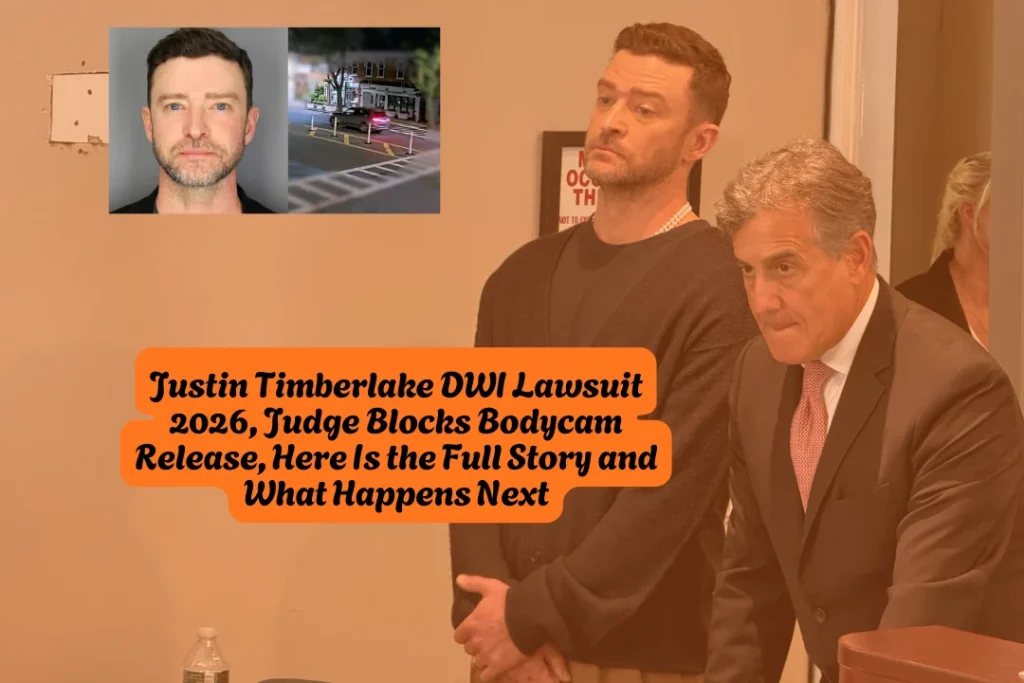
Police stopped Timberlake shortly after midnight on June 18, 2024, in the Hamptons village after observing his vehicle allegedly run a stop sign and drift out of its lane.
Timberlake told arresting officers he had drunk one martini. He was then taken to police headquarters for processing where he refused multiple times to take a chemical test. He was held overnight and arraigned the following morning.
The arresting officer reported that his eyes were bloodshot and glassy and that he performed poorly on a field sobriety test. Timberlake served nine hours in jail following his arrest.
The arrest made global headlines. His mugshot circulated across social media within hours. The detail that he allegedly told officers the arrest would “ruin” his world tour became one of the most widely shared lines of that summer.
How the Criminal Case Was Resolved in 2024
In September 2024, Timberlake reached a plea agreement. He pleaded guilty to a lesser offense — driving while ability impaired — a non-criminal traffic violation significantly less serious than the original DWI misdemeanor charge.
Under the plea deal Timberlake:
- Paid a $500 fine
- Completed 25 to 40 hours of community service
- Accepted a 90-day suspension of his New York driver’s license
- Recorded a public safety announcement warning against impaired driving
Outside court, Timberlake told reporters: “Even if you had one drink, don’t get behind the wheel of a car. There are so many alternatives. This is a mistake that I made, but I am hoping that whoever is watching and listening right now can learn from this mistake.”
Most people assumed that was the end of it. It was not.
Why the Bodycam Footage Became a New Legal Issue in 2026
After the criminal case closed, multiple media organizations — including NBC News and the Associated Press — filed Freedom of Information Law requests with the Sag Harbor Village Police Department seeking access to the bodycam footage from the arrest night.
The police department notified Timberlake’s legal counsel on March 1, 2026 of its intention to release the footage with limited redactions for medical information and for the security layout of the police complex.
Timberlake’s team moved within hours. The very next day, March 2, 2026, they filed a lawsuit in Suffolk County Supreme Court to stop the release entirely.
What Timberlake’s Lawyers Are Arguing
The complaint alleges that the police department’s intention to release police body camera footage constitutes an unwarranted invasion of personal privacy and would cause severe and irreparable harm to the singer’s personal and professional reputation.
Timberlake’s attorneys argue the video shows personally identifiable information and private details that are not relevant to any law enforcement action of public concern, stating: “The harm from public exposure — stigma, harassment, reputational injury, and the permanent loss of privacy — is immediate and irreparable.”
Specifically, his legal team argues:
The footage covers eight continuous hours — far beyond the arrest itself. Burke stated: “The bodycam footage captures approximately eight hours of continuous recording and encroaches upon areas of Petitioner’s life and emotional state that have no relevance at all to Petitioner’s arrest.”
It captures other private individuals. The lawsuit argues bystanders captured in the footage also have legitimate privacy interests that would be violated by release.
It contains medical details. The footage allegedly includes personal health information that falls outside what New York’s Freedom of Information Law requires to be made public.
What Sag Harbor and the Media Are Arguing
The village’s attorney Vincent Toomey has argued the opposite position — that New York’s public records laws generally require materials like this to be made available, particularly when they document interactions between police and members of the public.
Sag Harbor Mayor Thomas Gardella said the village is trying to balance transparency with privacy concerns as negotiations between both sides continue.
The media organizations that filed FOIL requests argue that bodycam footage from a DWI arrest — involving a public figure, on a public road, resulting in criminal charges — is exactly the kind of government record the public has a right to see. The press freedom argument here is significant: if courts allow celebrities to block arrest footage simply because release would embarrass them, it sets a precedent that could apply to politicians, executives, and other public figures seeking to suppress legitimate public records.
Where the Case Stands Right Now — March 2026
Suffolk County Judge Joseph Farneti approved a temporary restraining order on March 5, 2026, preventing the police department from releasing the footage while the legal dispute works its way through the courts. The Village of Sag Harbor has been given until April 9, 2026 to submit documents supporting its position to release the footage.
A temporary restraining order is exactly what it sounds like — temporary. It does not mean Timberlake has won. It means the judge decided the situation needed more time before a final decision, and that releasing footage while the case is pending could cause harm that cannot be undone.
After April 9, the court will review both sides’ arguments and decide whether to:
- Grant a preliminary injunction blocking release while the full case proceeds
- Deny the injunction and allow the village to release the footage
- Order a private review of the footage and redact specific portions before release
The Bigger Legal Question This Case Raises
This case goes well beyond Justin Timberlake. The legal dispute highlights a broader question that frequently arises when high-profile individuals interact with the criminal justice system: should celebrities receive additional privacy protections when police records are requested under freedom of information laws?
Under New York’s Freedom of Information Law, government records are presumed public unless a specific exemption applies. Those exemptions include unwarranted invasions of personal privacy, interference with law enforcement investigations, and certain medical information. Timberlake’s team is arguing multiple exemptions apply here.
The counter-argument is equally important: DWI is a public safety issue. When police stop someone for drunk driving — regardless of how famous they are — the public has a legitimate interest in how that stop was handled, whether proper procedures were followed, and what the encounter looked like. Bodycam footage serves exactly that accountability function.
The outcome could set precedent for balancing celebrity privacy against public transparency in high-profile cases — potentially reshaping how bodycam footage is handled in future celebrity arrests across the nation.
What the DWI Charge Actually Meant Legally
Many people are confused about the difference between the original DWI charge and what Timberlake ultimately pleaded guilty to. Here is the distinction in plain English.
Driving While Intoxicated (DWI) in New York is a misdemeanor criminal charge that applies when a driver’s blood alcohol content is 0.08% or higher, or when an officer determines impairment based on observed behavior and sobriety tests. A DWI conviction creates a permanent criminal record.
Driving While Ability Impaired (DWAI) is a lesser offense — a non-criminal traffic violation in New York. It carries lower fines, no criminal record, and significantly less stigma. It is often offered as a plea reduction when the evidence of full intoxication is debatable or when the defendant has no prior record.
Timberlake refused multiple times to take a chemical test during his arrest. In New York, refusing a breathalyzer results in automatic license suspension but also means there is no BAC reading on record — which can affect plea negotiations. Our guide on what happens when you get a DUI in California covers how plea reductions work in DUI cases across different states and what factors typically drive prosecutors to offer lesser charges. And if you have ever wondered what a DWI arrest actually looks like step by step from stop to arraignment, our breakdown of the Rusty Moore DWI federal lawsuit in Minnesota walks through that exact process in detail — including what rights you have at each stage.
Key Legal Terms Explained
Article 78 Proceeding: A special type of New York court proceeding used to challenge actions by government agencies or officials — in this case, challenging the police department’s decision to release public records.
Freedom of Information Law (FOIL): New York’s public records law, similar to the federal Freedom of Information Act, that gives the public the right to access government records unless a specific exemption applies.
Temporary Restraining Order (TRO): A short-term court order that stops a specific action — here, the release of the footage — while the court takes more time to hear full arguments from both sides. A TRO is not a final ruling.
Preliminary Injunction: A longer-term court order that would block the footage release while the full legal case is litigated. The April 9 hearing will address whether this should be granted.
DWAI (Driving While Ability Impaired): A non-criminal traffic violation in New York — less serious than DWI, carries no criminal record. This is what Timberlake ultimately pleaded guilty to in September 2024.
This article is for informational purposes only and does not constitute legal advice. This article will be updated as the case develops — next key date is April 9, 2026.
Sources: Timberlake v. Village of Sag Harbor, Suffolk County Supreme Court, filed March 2, 2026 | Variety, March 6, 2026 | NBC News, March 3, 2026 | Newsweek, March 3, 2026 | Long Island Guide, March 7–8, 2026
About the Author

Sarah Klein, JD, is a licensed attorney and legal content strategist with over 12 years of experience across civil, criminal, family, and regulatory law. At All About Lawyer, she covers a wide range of legal topics — from high-profile lawsuits and courtroom stories to state traffic laws and everyday legal questions — all with a focus on accuracy, clarity, and public understanding.
Her writing blends real legal insight with plain-English explanations, helping readers stay informed and legally aware.
Read more about Sarah