
IVC Filter lawsuit, Your IVC Filter Broke Inside You, And the Company Knew. Here’s Where the Lawsuit Stands in 2026
The One Thing You Need to Understand First
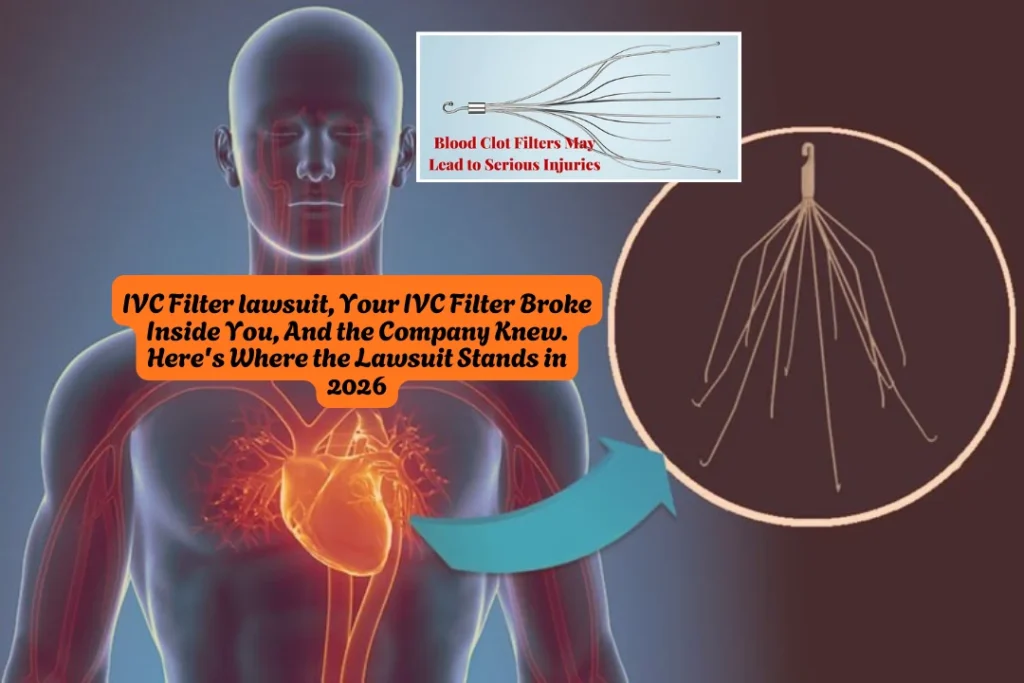
An IVC filter is a small metal device — it resembles a small metal spider — implanted inside the large vein that carries blood from your lower body to your heart. It was supposed to catch blood clots before they reached your lungs and killed you.
For thousands of patients, it did the opposite. The filter broke apart. Pieces migrated to the heart, the lungs, and other organs. It perforated blood vessel walls. It tilted and punctured the aorta. In some cases it caused the very pulmonary embolism it was supposed to prevent.
Juries in IVC filter lawsuits have awarded patients more than $41 million since March 2018. One jury awarded $33.7 million in a single case. The two biggest manufacturers — C.R. Bard and Cook Medical — have been fighting these cases in court for over a decade.
Here is where everything stands right now.
What Is an IVC Filter and Why Were They Implanted?
The inferior vena cava is a major vein in the circulatory system that carries blood from the legs and lower torso to the heart. An IVC filter is a blood filtering device used when a patient is in danger of forming a blood clot that could travel to the lungs and turn into a dangerous, life-threatening pulmonary embolism. IVC filter placement has been employed in patients who have undergone trauma, bariatric surgery, hip and knee replacement surgery, or have been otherwise unable to tolerate blood thinning medications.
They were sold as a safety net. A backup plan. For patients who could not take blood thinners, this tiny metal cage was supposed to be a lifesaver.
The problem nobody told patients: in 2010, the FDA issued a communication advocating for the removal of IVC filters when no longer necessary, optimally 29 to 54 days after the original procedure. In 2014, the FDA updated their communication, reemphasizing the importance of removing IVC filters in the appropriate time frame.
Most patients were never told any of this. Many had no idea their filters were supposed to come out. And the longer a filter stays in, the more likely it is to fail.
What These Devices Are Doing to People’s Bodies
Recent lawsuits allege that IVC filters have broken or migrated after being implanted, severely damaging blood vessels and organs, and in some cases causing death.
The specific ways these devices fail include:
Filter Fracture — the device breaks apart, causing fragments to travel throughout the body. In some cases those fragments reach the heart or lungs.
Migration — the whole device or pieces of it migrate from original placement to other parts of the body. A filter that starts in the vena cava can end up embedded in the wall of the heart.
Organ Perforation — sharp filter parts can puncture the vena cava, heart, lungs or other organs. The firefighter Jeff Pavlock had his filter tilt and perforate both his aorta and his duodenum — requiring two additional surgeries that still could not remove the device.
Impossible Removal — more than 7% of patients required two or more removal attempts. Some filters become permanently embedded and are simply too dangerous to remove. Those patients live indefinitely with a broken, potentially lethal device inside them.
Increased Clotting Risk — in a cruel irony, some filters paradoxically increase the risk of deep venous thrombosis — the exact problem they were designed to prevent.
The Two Companies at the Center of It All
C.R. Bard — Settled and Closed
As of February 2026, inferior vena cava filter multidistrict litigation against C.R. Bard was no longer open following confidential settlements.
Bard has negotiated confidential individual settlements and a global settlement with more than 8,000 plaintiffs. The exact amounts are sealed — which tells you a great deal about how much they were willing to pay to keep those numbers quiet.
While the Bard MDL has been closed, lawyers continue to accept individual cases. Individual cases are still being filed against Bard in state courts. So if you had a Bard filter, your window has not necessarily closed — but it is narrowing fast.
The Bard filters most commonly named in lawsuits include the Bard Recovery, Bard G2, Bard Eclipse, and Bard Denali.
Cook Medical — Still Fighting in Court
This is where the most active litigation in 2026 is happening.
As of February 2026, 6,873 cases against Cook Medical are pending in MDL 2570 before Senior Judge Richard L. Young of the U.S. District Court for the Southern District of Indiana. A total of 11,464 lawsuits have been filed in the MDL.
Unlike Bard, Cook Medical has not reached any notable or global settlements in IVC filter lawsuits, choosing instead to proceed to trial. That is a deliberate strategy. Fighting in court — even losing some cases — is cheaper for Cook than writing one giant check that resolves everything.
But that strategy is showing cracks. Cook lost two bellwether trials: juries awarded $3 million to Tonya Brand and $1.2 million to Jeff Pavlock. And now, for the first time in the history of this litigation, serious settlement talks are underway.
The Settlement Update You Actually Came Here For
Here is what is happening right now — step by step.
In October 2025, court documents showed that both sides have “reached agreement on the major terms and conditions of settlement” for some of the cases in the MDL. This is significant. It is the first time Cook has acknowledged agreeing to settlement terms for any portion of this case.
But read that carefully: it covers some cases, not all 6,873. Not a global settlement. Not a check in the mail for everyone.
In December 2025, talks of resolving some of the Cook IVC filter lawsuits continued. A schedule was set for January 2026 that includes settlement negotiations for numerous batches of cases.
As of February 2026, the Cook IVC track to settlement negotiations is looking promising, with multiple settlement conferences slated for 2026. However, a global settlement has not yet been agreed to.
In 2025, Magistrate Judge Tim A. Baker was assigned as a settlement mediator. These are confidential procedures in which each plaintiff has their case evaluated individually. While plaintiffs do not appear before Judge Baker personally, their attorney discusses the specific facts of the case — including a long list of all personal injuries past, present, and future, and any financial losses.
In plain English: your case gets a number. The mediator tells Cook what your injuries are worth. Cook either agrees or disagrees. Then negotiations happen behind closed doors.
The Injury Tier System: What Category Is Your Case?
This is the detail most articles skip entirely — and it directly determines how much money you may receive.
IVC filters fail in different ways and cause different injuries. The form used in the MDL has seven categories, ranging from “product-in-place” to wrongful death injuries. Medical records are attached to the form.
The two surgery types matter enormously for settlement value:
Open Surgery — surgeons open your stomach or chest area to remove the filter in a complicated procedure that leaves a scar. These cases may be the highest settlement category.
Percutaneous Removal — an interventional radiologist enters a leg or neck vein with a catheter to retrieve the filter. If the filter is stuck, the patient is rescheduled for open removal. The perc removal may get most of the filter out but fractured pieces may not be retrievable.
If pieces of your filter remain inside you permanently — because they are too dangerous to remove — that is a separate and significant category of harm on its own.
What Are IVC Filter Lawsuits Actually Paying?
Based on mass tort litigation, settlements may average between $100,000 and $500,000 for significant injury cases. According to legal sources, the average settlement amount for IVC lawsuits ranges from $100,000 to $750,000.
While every case is unique, IVC filter claims typically result in settlements ranging from $200,000 to $750,000 depending on the severity of injuries and specific circumstances.
The outliers tell the real story of what these cases can be worth at trial:
| Case | Filter | Verdict | Year |
| Tracy Reed-Brown v. Rex/Argon | Option Filter | $33.7 million | 2019 |
| Tonya Brand v. Cook Medical | Celect Filter | $3 million | 2019 |
| Sherr-Una Booker v. C.R. Bard | G-2 Filter | $3.6 million | 2018 |
| Shanequeia Wright v. C.R. Bard | Recovery Filter | $2.55 million | 2021 |
| Jeff Pavlock v. Cook Medical | Celect Filter | $1.2 million | 2018 |
| Justin Peterson v. Bard | Eclipse Filter | $926,000 | 2021 |
These are not flukes. These are six separate juries in six separate states all arriving at the same conclusion: these companies failed their patients.
The Angle Nobody Is Writing About: The FDA Warned Them and They Kept Selling
In 2010 and 2014, the FDA issued warnings about the risk of IVC filter complications, indicating it had received hundreds of adverse event reports since 2005. There was indication of a very high failure rate with IVC filter placement. Parts of the filter were breaking off and perforating patients’ veins, or migrating to the heart, lungs, and other vital organs.
The FDA did not just send a quiet memo. In July 2015, the FDA issued a formal warning letter to C.R. Bard concerning violations found at two Bard facilities.
And yet: recent medical research has raised concerns about the use of IVC filters, as there is no demonstrable decrease in mortality with their use.
Read that again. The device that broke inside thousands of people, caused organ perforations, migrated to hearts and lungs, and required emergency surgeries — has no proven mortality benefit. The FDA knew. The companies knew. And they kept implanting them.
That is the foundation of every lawsuit in this litigation — not just a product defect, but a documented failure to warn patients and doctors about risks the manufacturers had already been told about by their own government regulator.
Quick Reference: IVC Filter Lawsuit Status (March 2026)
| Manufacturer | MDL Status | Settlement Status |
| C.R. Bard | MDL closed July 2024 | Global settlement completed — confidential |
| Cook Medical | 6,873 active cases pending | Partial settlements underway; no global deal yet |
| Boston Scientific | Individual cases only | Mostly proceeding to trial |
| Rex / Argon | MDL closed | Settled — $33.7M verdict stands |
| Cordis | Individual cases | Ongoing |
Can You Still File an IVC Filter Lawsuit?
Possibly — but time is the biggest threat to your claim right now.
Time limits for filing an IVC filter lawsuit vary by state but typically range from 1 to 3 years from the date when complications were discovered. The clock does not start when the filter was implanted — it starts when you discovered, or reasonably should have discovered, that the filter caused your injury.
You may be eligible to file a lawsuit if your IVC filter fractured, if the whole device or pieces of it migrated, if it perforated your organs or tissue, or if removal of the filter caused complications. The families of patients who died from these issues may also be eligible.
A recall is not necessary to file a lawsuit for damage or injury. You do not need to have a recalled filter. Any IVC filter that failed and caused injury is potentially the basis for a claim.
Most IVC filter attorneys work on a contingency fee basis, meaning there are no upfront costs. Attorneys only receive payment if you receive compensation.
What This Means for Legal Professionals
The IVC filter litigation is entering its most consequential phase for practitioners to watch — specifically the Cook Medical MDL.
The shift from a “fight everything” strategy to partial settlement negotiations marks a genuine inflection point. Judge Young has encouraged settlement discussions and the assignment of Magistrate Judge Tim A. Baker as settlement mediator signals that the court is actively pushing toward resolution.
The seven-category injury tier framework is also worth studying as a model. Unlike the Camp Lejeune Elective Option — which drew criticism for its rigid eligibility criteria and low per-person payouts — the Cook MDL’s individualized mediation approach gives each plaintiff’s specific injury history genuine weight. Whether that translates to fair compensation at scale remains to be seen.
For attorneys currently representing plaintiffs: the Gunther Tulip bellwether trials now being scheduled by Judge Young are the next critical data point. Two Celect filter bellwether trials returned plaintiff verdicts. Judge Young is now setting test trials for the Gunther Tulip — Cook’s first IVC filter put on the market. Those outcomes will define settlement leverage for the remaining 6,873 cases.
Related Reading on AllAboutLawyer.com
For more on defective medical device litigation and how mass tort cases actually get resolved:
- Truvada Lawsuit 2026 — Gilead Knew About a Safer Drug and Waited — how pharmaceutical companies delay safer products for profit
- Camp Lejeune Lawsuit 2026: 409K Claims Stuck — What Veterans Must Know — the anatomy of a mass tort that the government is fighting from both sides
- Ask a Lawyer — Get Legal Answers Fast — speak to a qualified attorney about your IVC filter claim today
Published: March 7, 2026
This article is for general informational purposes only and does not constitute legal advice. IVC filter litigation is actively evolving. Statute of limitations deadlines vary by state and are strictly enforced. If you believe you have a claim, consult a licensed product liability attorney as soon as possible.
About the Author

Sarah Klein, JD, is a licensed attorney and legal content strategist with over 12 years of experience across civil, criminal, family, and regulatory law. At All About Lawyer, she covers a wide range of legal topics — from high-profile lawsuits and courtroom stories to state traffic laws and everyday legal questions — all with a focus on accuracy, clarity, and public understanding.
Her writing blends real legal insight with plain-English explanations, helping readers stay informed and legally aware.
Read more about Sarah