
Truvada Lawsuit, Gilead Knew About a Safer HIV Drug And waited. Now 26,000+ People Are Suing Over Truvada
The Story Nobody Tells You Plainly
A drug company had a safer version of their HIV medication sitting in their lab. They knew it was safer. Then they chose — deliberately, documented, in writing — to put it back on the shelf for over a decade while continuing to sell the more dangerous version to HIV patients around the world.
That is what the Truvada lawsuit is actually about.
Not just bad side effects. Not just a failure to warn. But a calculated corporate decision to let patients absorb preventable kidney damage and bone loss because switching to the safer drug would have cost Gilead Sciences billions in patent revenue.
More than 26,000 people are now suing. A California Supreme Court ruling that could define pharmaceutical liability for a generation is expected in 2026. And the $40 million Gilead already paid? It works out to roughly $12,500 per person — for patients who lost kidneys, needed hip replacements, and developed permanent osteoporosis.
Here is everything you need to know.
What Is Truvada and Who Took It?
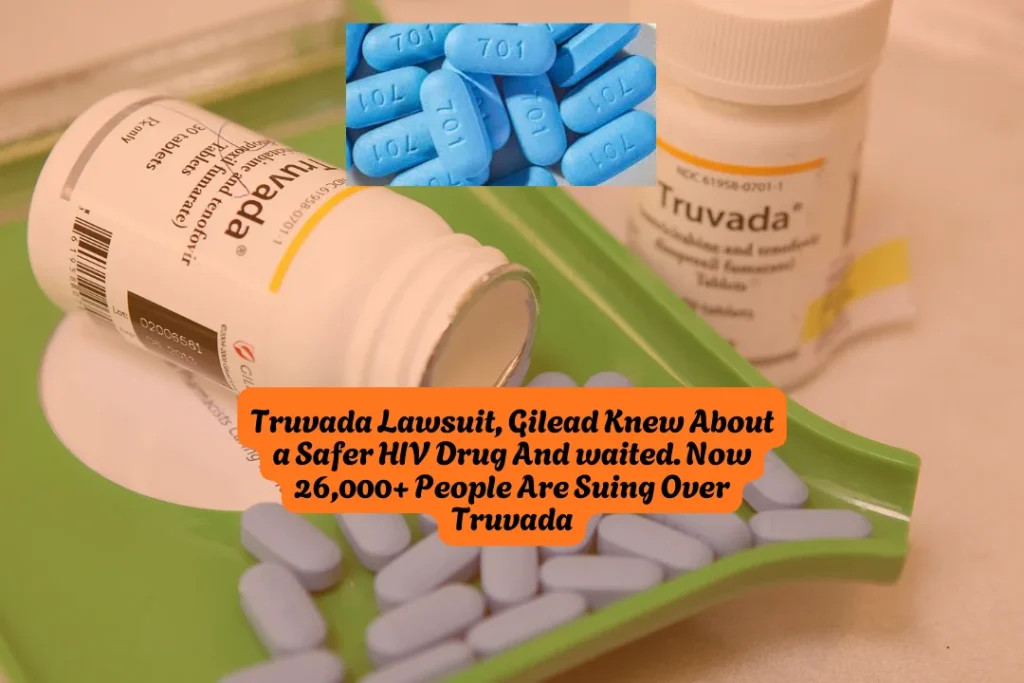
Truvada is one of five drugs manufactured and sold by Gilead Sciences that use tenofovir disoproxil fumarate (TDF) to prevent and treat HIV. Over the past two decades, countless patients have used the drug for the treatment and prevention of HIV.
It launched in 2004 as a genuine breakthrough — one of the first effective once-a-day HIV treatments. In 2012, the FDA approved it for PrEP (pre-exposure prophylaxis), meaning HIV-negative people with high exposure risk could take it daily to prevent infection.
For millions of people, Truvada was not just a drug. It was a lifeline.
The other TDF drugs caught up in the same litigation include Viread, Atripla, Complera, and Stribild — all made by Gilead, all containing the same ingredient at the center of this case.
What Is TDF Doing to People’s Bodies?
The most significant health issues reported are kidney complications — Truvada has been linked to severe kidney problems, including acute kidney injury, renal impairment, and Fanconi syndrome — and bone density loss. Patients using Truvada have reported osteopenia, osteoporosis, and fractures. The drug’s impact on bones can lead to a significant reduction in bone mineral density, making them more brittle.
One study published in 2012 found the risk for chronic kidney disease increased by 33 percent each year someone was taking a drug with TDF. The study was done by researchers from the University of California, San Francisco, and focused on 10,000 people infected with the HIV virus. Patients who discontinued using the drug were still at increased risk for kidney disease between six months to a year after stopping.
These are not minor side effects. People lost kidney function permanently. People in their twenties and thirties needed hip replacements. Louisiana resident Christopher Pierot was 26 when he started taking Truvada. By age thirty, he underwent painful hip replacement surgery because of severe bone necrosis and bone loss.
The Core Allegation: Gilead Had a Safer Drug and Sat On It
This is the heart of the lawsuit — and it is factually the most explosive part of the story.
As early as 2001, Gilead knew that side effects of TDF HIV drugs could be highly toxic to kidneys and bones, but inadequate warnings were provided to users and the medical community. The drug maker also knew about a safer alternative by 2004, but stopped development of TAF drugs, since they would negatively impact the lucrative sales of Truvada, Viread and the other TDF drugs.
The safer drug is called tenofovir alafenamide fumarate — TAF. In 2004, Gilead paused work on TAF.
Why? At that particular time, the company was already generating billions in revenue from Viread and, later, Truvada. Moreover, Viread and Truvada were under patent protection for another decade. If Gilead had immediately released the newer, safer TAF, it would have killed the marketability of their existing TDF drugs like Viread and Truvada. This would have effectively ended ten years of patent-protected revenues for these drugs, so Gilead purposefully withheld the release of TAF.
It gets more calculated. When generic versions of the earlier drugs were approaching the market, the manufacturer obtained approval for TAF drugs, which will not face generic equivalents until at least 2032.
So the timeline looks like this: sell TDF for maximum patent life, let it go generic, then release the safer TAF drug with a fresh patent. Patients take more damage in the middle. Gilead makes money on both ends.
Gilead’s own president made a 2011 statement to investors that TAF would be a “kinder, gentler” version of TDF. The company’s own president. Talking to investors. In 2011. Seven years after they shelved the safer version.
What Gilead Says in Its Defense
To be fair, this is not a one-sided story. Gilead disputes the allegations vigorously.
Gilead stopped TAF development because it had not distinguished itself from TDF, which had already been on the market for years and had a proven safety and effectiveness profile. Gilead instead focused its resources on developing combination medicines containing TDF so that people living with HIV could take a single, once-a-day pill rather than the complex and complicated cocktail of numerous different medicines they had previously been required to take.
The evidence shows that the long-term safety of TAF was unknown and impossible to predict in 2004, when Gilead stopped TAF development in favor of further developing TDF-based medications. Gilead started looking into TAF again in 2010, and, after five years of additional research and development and clinical trials, received FDA approval to market TAF-based medicines in 2015.
Gilead also argues that if the California Supreme Court affirms the lower court’s decision, the new liability rule could undermine the way in which companies develop new products and discourage them from looking for ways to improve existing products.
This is not a frivolous argument. It raises a real question: should a pharmaceutical company be legally liable for not bringing a better drug to market faster, even if the drug they were selling was FDA-approved and properly labeled? That is exactly what the California Supreme Court is now deciding.
The $40 Million Settlement: Fast Money, Insulting Math
On June 11, 2024, Gilead Sciences agreed to a $40 million Truvada settlement, resolving around 2,600 claims by patients who alleged they developed kidney and bone diseases while taking the drug.
The one-time payment of $40 million is meant to “avoid the cost and distraction of litigating these cases” and is “in no way” an admission of wrongdoing or liability, the company said.
The HIV lawsuit settlements payout per person currently averages $12,500 for the ~2,600 federal cases.
That is $12,500. For permanent kidney damage. For hip replacements at age thirty. For a lifetime of medical monitoring and ongoing bone deterioration.
Most lawyers believe Gilead will eventually pay far more — especially if California plaintiffs start winning in court. The federal settlement was for the smaller, easier-to-resolve cases. The 24,000+ cases still active in California state court are where the real money — and the real legal fight — is happening.
The California Supreme Court Ruling That Could Change Everything
This is the single most important development in 2026, and almost no general-audience coverage explains it clearly.
The California Supreme Court has agreed to review an appellate court’s decision that Gilead Sciences Inc. must face allegations it delayed releasing a safer HIV drug to maximize profits from an older drug.
The legal question is genuinely novel. Although the plaintiffs sought compensation for their injuries allegedly caused by their use of TDF, they did not try to prove that TDF was defective. Instead, plaintiffs pursued an ordinary negligence claim, arguing that Gilead deferred development of TAF to enlarge its profits.
In plain English: plaintiffs are not saying Truvada was broken. They are saying Gilead had something better, knew it was better, and chose not to release it for money. That should be negligence.
Justice Jeremy Goldman wrote for a unanimous three-judge panel of the appellate court and ruled that if TAF was delayed “solely to maximize Gilead’s profits,” it could amount to negligence on the company’s part.
Briefing is underway, with plaintiffs’ response due in November and Gilead’s reply expected by January 2026. Oral argument will likely be scheduled sometime in the first half of 2026. A decision from the Court is typically issued within 90 days after oral argument.
If the California Supreme Court sides with plaintiffs, it will be the first time a U.S. court has held a drug company liable not for making a bad drug — but for not releasing a better one fast enough. The implications go far beyond Truvada.
Where All the Cases Stand Right Now (March 2026)
| Court / Venue | Status |
| California Federal Court (~2,600 cases) | $40M settlement reached; ~$12,500 per person |
| California State Court (~24,000 cases) | Active; awaiting California Supreme Court ruling |
| California Supreme Court | Oral argument expected H1 2026; decision within 90 days after |
| Bellwether Trials (CA State) | Scheduled for late 2025 into early 2026 |
| New cases being accepted | Yes — lawyers still taking cases as of March 2026 |
| Total plaintiffs | 26,000+ |
Who Can Still File a Truvada Lawsuit?
You may still be eligible if:
- You took one of these Gilead HIV drugs: Truvada, Atripla, Complera, Stribild, or Viread
- You experienced kidney damage, kidney failure, bone density loss, osteoporosis, or fractures
- The duration between consumption of the drug and the onset of side effects can be crucial in establishing a direct link — having medical documentation that validates the injuries and correlates them with consumption of Truvada can strengthen a potential claim
- If you were not adequately informed about the potential risks associated with Truvada or were unaware of the alleged safer alternatives, this could play a role in your eligibility
Critical warning on timing: For Truvada lawsuits, the statute of limitations depends on the state you live in. If you miss the deadline for filing, you won’t have the opportunity to do so again. If you think you have a claim, the time to act is now — not after the California Supreme Court rules.
What Damages Can You Recover?
You could recover economic damages — reimbursement for any actual costs incurred from your illness, including medical bills, future expected medical costs, and lost income — as well as non-economic damages when an individual suffers a major injury or devastating and permanent medical condition due to a defective drug.
Severe injuries like kidney failure could net millions at trial. The $12,500 federal average is a floor, not a ceiling — and represents the least severe, most straightforward cases.
What This Means for Legal Professionals
The Truvada litigation is reshaping pharmaceutical product liability law in two ways simultaneously.
The TAF negligence theory — holding a manufacturer liable for not releasing a safer drug, without proving the existing drug was defective — is an entirely novel legal standard. Under traditional tort principles, if a manufacturer makes a prescription medication that is free from defects in its design, manufacture, and labeling, it should not be held liable for causing any warned-about side effects. The California appellate court departed from that entirely. If the Supreme Court affirms it, every pharmaceutical company in the country faces a new category of liability exposure.
The PrEP plaintiff category is also expanding. There is increasing attention to cases involving long-term PrEP use, with plaintiffs arguing that consistent daily dosing for prevention purposes resulted in prolonged exposure and greater risk of cumulative kidney and bone harm. This is legally distinct from HIV treatment patients and may require different damages framing.
The key factors to watch will be expert admissibility rulings, bellwether trial scheduling, and how courts interpret Gilead’s alleged delay of TAF — issues that will significantly influence potential settlement discussions and the future scale of the lawsuits.
Related Reading on AllAboutLawyer.com
For more on pharmaceutical litigation, mass tort cases, and how to understand your legal rights against large corporations:
- Camp Lejeune Lawsuit 2026: 409K Claims Stuck, What Veterans Must Know — how the government uses delays to minimize mass tort payouts
- Progressive Insurance Lawsuit — Stacked Coverage Settlement — what corporations do when they owe people money
- Ask a Lawyer — Get Legal Answers Fast — talk to a qualified attorney about your Truvada claim today
This article is for general informational purposes only and does not constitute legal advice. Truvada litigation is actively evolving. Statute of limitations deadlines vary by state. If you believe you have a claim, consult a licensed pharmaceutical injury attorney as soon as possible.
About the Author

Sarah Klein, JD, is a licensed attorney and legal content strategist with over 12 years of experience across civil, criminal, family, and regulatory law. At All About Lawyer, she covers a wide range of legal topics — from high-profile lawsuits and courtroom stories to state traffic laws and everyday legal questions — all with a focus on accuracy, clarity, and public understanding.
Her writing blends real legal insight with plain-English explanations, helping readers stay informed and legally aware.
Read more about Sarah