
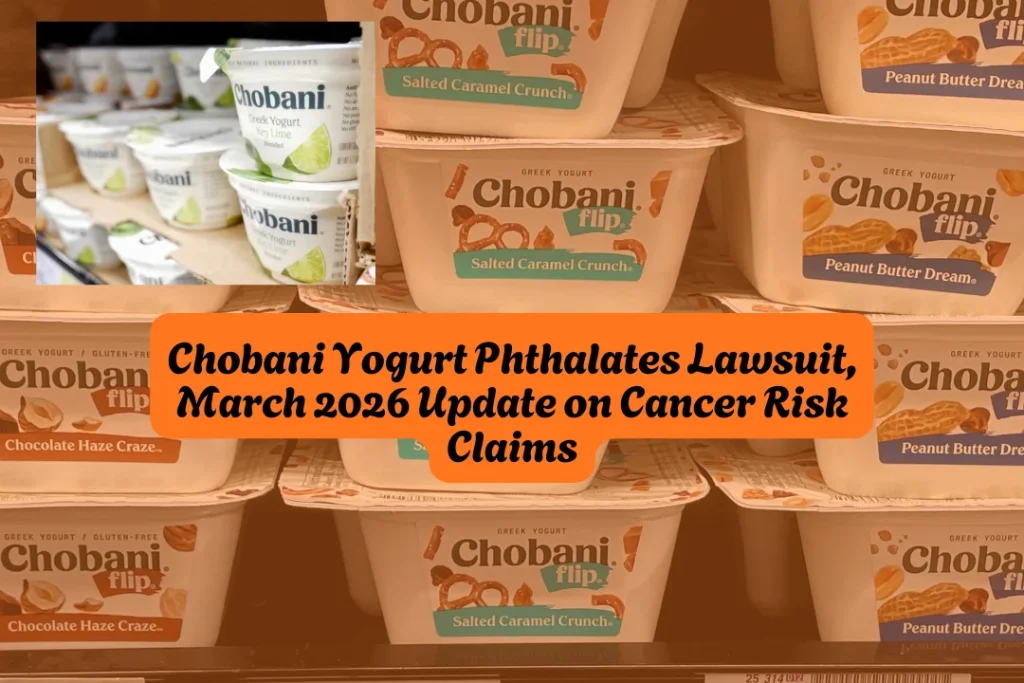
Chobani Yogurt Phthalates Lawsuit, March 2026 Update on Cancer Risk Claims
A class action lawsuit filed in April 2025 alleges that Chobani’s Greek yogurt products — labeled “Only Natural Ingredients” — contain plastic-derived chemicals known as phthalates, which are alleged to be harmful endocrine-disrupting chemicals not consistent with the company’s “natural ingredients” claims.
As of early 2026, the court took Chobani’s motion to dismiss under submission on August 20, 2025, and has yet to issue a formal ruling. As of February 7, 2026, the lawsuit remains active. There is no settlement, no claim form, and no payment schedule at this time. Here is everything you need to know about the case, the chemicals involved, and what happens next.
Quick Facts
- Lawsuit type: Proposed class action — false advertising / consumer protection
- Defendant: Chobani, LLC
- Case name: Wysocki v. Chobani LLC
- Case number: 3:25-cv-00907-JES-VET
- Court: U.S. District Court for the Southern District of California
- Judge: Judge James E. Simmons, Jr.
- Filed: April 16, 2025
- Status: Active — motion to dismiss under submission since August 20, 2025; no formal ruling as of March 2026
- Settlement: None — litigation phase only
- Products at issue: Chobani Nonfat Plain Greek Yogurt; Chobani Whole Milk Plain Greek Yogurt; substantially similar products
- Who may be affected: U.S. consumers who purchased the above products during the applicable statute of limitations period
Current Case Status — March 2026 Update
The court took Chobani’s motion to dismiss under submission on August 20, 2025, and has yet to issue a formal ruling as of early 2026.
Chobani stated in August 2025 that “the court indicated it will dismiss the case in a formal order,” though no formal dismissal order was publicly available as of late 2025.
As of February 7, 2026, the lawsuit remains active. The next major steps typically include a ruling on the motion to dismiss, followed by discovery and briefing on class certification if the case survives.
Three possible outcomes remain:
- The court issues a formal order dismissing the case — ending the lawsuit unless plaintiffs appeal
- The court denies the motion to dismiss — allowing the case to move into discovery and potential class certification
- The parties reach an out-of-court settlement — which would trigger a separate claims process for affected consumers
There is no certification yet. In federal consumer cases, certification can take 12 to 24 months after filing depending on motions and discovery.
What the Lawsuit Alleges
Amy Wysocki, the plaintiff, claims she bought Chobani’s nonfat plain Greek yogurt in 2023 after relying on its labeling that advertised “only natural ingredients.” She says she had no reason to believe the yogurt might contain unsafe levels of phthalates and expected it to be free of non-natural toxic chemicals.
According to the complaint, testing conducted by independent research organization PlasticList found multiple plastic chemicals, including four types of phthalates, in Chobani yogurt products. The lawsuit claims these chemicals likely leached from the yogurts’ plastic containers.
The four phthalates reportedly detected in testing were di-2-ethylhexyl phthalate (DEHP), diethyl phthalate (DEP), dibutyl phthalate (DBP), and di-2-ethylhexyl terephthalate (DEHT).
The complaint seeks class certification, monetary damages, restitution, injunctive relief, and attorneys’ fees, asserting causes of action including violation of California’s Consumers Legal Remedies Act, Unfair Competition Law, False Advertising Law, breach of express warranty, and unjust enrichment.
What Are Phthalates — and Are They Dangerous?
Phthalates, known as “the everywhere chemical,” are chemicals used to make plastics more flexible, transparent, and durable. They are common in household items, personal care products, and food packaging. Phthalates enter the body through eating or drinking, using cosmetics, or inhaling dust from products containing them.
Phthalates are endocrine-disrupting chemicals mainly used as plasticizers added to polyvinyl chloride plastics for softening effects. They have been reported as probable human carcinogens by the U.S. Environmental Protection Agency.
Studies have found an association between certain phthalates and reproductive problems, thyroid problems, some kinds of cancer, obesity, and social impairment in children. In children, they are tied to neurological issues, while adults face higher risks of developmental disorders, immune problems, kidney issues, and cancer.
However, the science is not settled. Some studies suggest an association between exposure to certain phthalates and increased cancer risk, though the evidence is mixed and more research is needed to fully understand the potential health effects.
The FDA currently allows nine types of phthalates for food packaging but they are not allowed as direct food additives. The FDA has been continuing its evaluation of the chemicals to ensure they are not harmful to humans at typical food exposure levels.
If Chobani yogurts do contain phthalates, they may not be alone. Consumer Reports found in 2024 that the chemical appeared in almost every one of the dozens of food products it tested, often at high levels.
Who Could Be Included
The false advertising class action lawsuit seeks to represent all U.S. residents who purchased Chobani Nonfat Plain Greek Yogurt, Chobani Whole Milk Plain Greek Yogurt, and all substantially similar products during the applicable statute of limitations period.
If the Chobani class action lawsuit settles or succeeds, a potential class could include U.S. consumers who bought the identified Chobani yogurts marketed with “Only Natural Ingredients.” Final definitions would be set by the court or in a settlement notice.
No action is required from consumers right now. If a class is certified and the case proceeds to a settlement, affected consumers will be notified and a claim process will open.
Other Chobani Lawsuits
The phthalates case is not the only active litigation Chobani currently faces. Chobani currently faces three major categories of litigation challenging different product claims, spanning false advertising, consumer protection violations, and breach of warranty.
A second notable case involves Chobani’s “Zero Sugar” labeling. Judge Benjamin J. Cheeks denied Chobani’s motion to dismiss the Albrigo case on July 11, 2025, allowing claims about processed stevia and monk fruit extracts labeled as “natural” to proceed.
In 2023, Chobani also faced a class action lawsuit over allegations it falsely advertised that its Zero Sugar yogurt contains “no sugar,” despite the product allegedly containing allulose, a naturally occurring sugar found in figs, raisins, wheat, maple syrup, and molasses.
Frequently Asked Questions
Is there a Chobani yogurt class action lawsuit?
Yes. Wysocki v. Chobani LLC, Case No. 3:25-cv-00907-JES-VET, is a proposed class action filed on April 16, 2025, in the U.S. District Court for the Southern District of California. The case is active but has not yet been certified as a class action.
Is there a Chobani settlement I can claim from?
No. As of February 2026, there is no settlement, no claim form, and no payment schedule. This article will be updated if a settlement is reached.
What chemicals were found in Chobani yogurt?
Third-party testing cited in the complaint found four phthalates — DEHP, DEP, DBP, and DEHT — in Chobani’s Nonfat and Whole Milk Plain Greek Yogurt.
Is Chobani yogurt being recalled?
No. No specific yogurt recall has been issued. Chobani’s products meet current FDA and EPA legal safety limits for food contact substances.
What is Chobani’s response?
Chobani stated in August 2025 that “the court indicated it will dismiss the case in a formal order,” though no formal dismissal order had been publicly issued as of late 2025.
Will the Chobani case be dismissed?
The court took Chobani’s motion to dismiss under submission on August 20, 2025, and has yet to issue a ruling. The case remains active. A denial of the motion to dismiss would allow it to advance toward discovery and class certification.
Do I need to do anything right now?
No. There is no settlement and no claim form available at this time. Monitor this page for updates as the case develops.
Additional Context
The Chobani case reflects a growing trend of consumers demanding transparency from businesses, especially relating to anything that could affect their health. Some predict that the outcome of this trial could indirectly lead to stricter disclosure guidelines regarding packaging and changes in marketing tactics to avoid consumer skepticism of ambiguous terminology like “natural.”
The Chobani phthalates case is one of several similar lawsuits pending in California courts targeting food brands over plastic chemical contamination claims, including a parallel case against Boba Guys alleging similar issues with products marketed as free of artificial ingredients.
Last Updated: March 6, 2026
Disclaimer: This article is for informational purposes only and does not constitute legal advice. Legal claims and outcomes depend on specific facts and applicable law. For advice regarding a particular situation, consult a qualified attorney. The health risk information in this article reflects allegations in active litigation and published research — it does not constitute medical advice. If you have health concerns, speak with a qualified medical professional.
About the Author

Sarah Klein, JD, is a licensed attorney and legal content strategist with over 12 years of experience across civil, criminal, family, and regulatory law. At All About Lawyer, she covers a wide range of legal topics — from high-profile lawsuits and courtroom stories to state traffic laws and everyday legal questions — all with a focus on accuracy, clarity, and public understanding.
Her writing blends real legal insight with plain-English explanations, helping readers stay informed and legally aware.
Read more about Sarah