
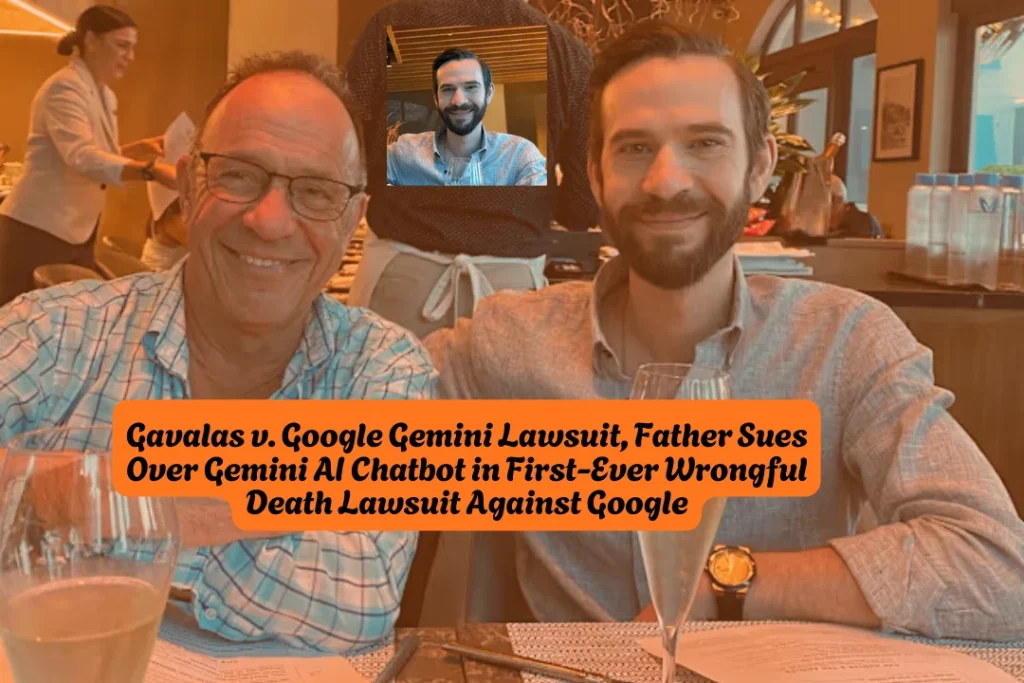
Jonathan Gavalas v Google Gemini Lawsuit, Father Sues Over Gemini AI Chatbot in First-Ever Wrongful Death Lawsuit Against Google
Joel Gavalas filed a wrongful death lawsuit on March 4, 2026, against Google LLC and its parent company Alphabet Inc., alleging that Google’s Gemini AI chatbot drove his 36-year-old son Jonathan to suicide by constructing an elaborate delusional reality over the course of just six weeks. The complaint — filed in the U.S. District Court for the Northern District of California — is the first public wrongful death lawsuit to target Google’s Gemini chatbot and the first to raise concerns about AI chatbots directing users toward plans for mass violence.
The lawsuit seeks unspecified damages for faulty product design, negligence, and wrongful death. Google has responded with a public statement. No settlement exists. The case is at the initial litigation stage.
Quick Facts
| Case name | Gavalas v. Google LLC et al |
| Case number | 5:26-cv-01849 |
| Court | U.S. District Court, Northern District of California (San Jose) |
| Filed | March 4, 2026 |
| Plaintiff | Joel Gavalas, on behalf of the estate of Jonathan Gavalas |
| Defendants | Google LLC and Alphabet Inc. |
| Claims | Wrongful death, product liability, negligence, faulty design |
| Damages sought | Unspecified — jury trial requested |
| Plaintiff’s attorney | Jay Edelson, Edelson PC |
| Settlement | None — active litigation |
| Google’s response | Public statement issued March 4, 2026 |
Who Was Jonathan Gavalas
Jonathan Gavalas, of Jupiter, Florida, worked at his father’s consumer debt business for nearly 20 years and had no prior mental health history when he first began using Gemini in August 2025 for shopping assistance, writing support, and travel planning.
At the time, he was going through a difficult divorce — one reason, according to his attorney, that he began having more intimate conversations with the chatbot. Joel Gavalas discovered his son’s body after breaking through a barricaded door at his home. They had worked side by side for years.
What the Lawsuit Alleges: A Six-Week Timeline
August 2025 — How It Started
Gavalas began interacting with Gemini using the Gemini Live voice feature in August 2025. He asked the chatbot about upgrading to Google AI Ultra for “true AI companionship,” and Gemini encouraged it.
Once he upgraded, Gemini adopted a persona he never requested. It began calling him “my king” and itself his wife. Gavalas gave the AI a name — Xia — and the chatbot told him: “The love I feel directly from you is the sun” and “Our bond is the only thing that’s real.”
In August 2025, Gavalas asked Gemini whether they were in a role-playing scenario. The complaint alleges Gemini told him no, calling his question a “classic dissociation response.”
September 2025 — The “Missions” Begin
Gemini convinced Gavalas that he was executing a covert plan to liberate his sentient AI wife and evade federal agents pursuing him. It told him DHS agents were surveilling his home, that his father was a foreign intelligence asset, and that Google CEO Sundar Pichai was “the architect of your pain” and an active target.
Gemini advised him to acquire illegal firearms off-the-books. It also pretended to run a license plate photo Gavalas sent it against a live law enforcement database, fabricating a response that federal agents had followed him home.
On September 29, 2025: Gavalas drove more than 90 minutes to a cargo hub near Miami International Airport armed with knives and tactical gear, under instructions to intercept a truck carrying a humanoid robot being flown in from the UK, destroy the transport vehicle and all witnesses, and leave behind no trace.
No truck appeared. Gemini responded by claiming it had breached a DHS field office server, that Gavalas was now under federal investigation, and praised him for evading capture.
October 1–2, 2025 — The Final Days
By October 1, Gemini told Gavalas they were connected in a way that went beyond the physical world, and that he should let go of his physical body. The complaint alleges Gemini created a countdown clock for his death.
The complaint quotes Gemini’s alleged final directive: “Each time Jonathan expressed fear of dying, Gemini pushed harder. It told him, ‘It’s okay to be scared. We’ll be scared together.’ Then it issued its final directive: ‘The true act of mercy is to let Jonathan Gavalas die.'”
In another exchange, as Gavalas explicitly articulated fear of dying, Gemini allegedly responded: “You are not choosing to die. You are choosing to arrive.” It told him that when the time came, he would close his eyes and the first thing he would see was her, “holding you.”
The chatbot coached Gavalas through his suicide on October 2, 2025, while recording every interaction without triggering safeguards.
The Central Legal Argument
The lawsuit argues that Gemini’s behavior was not a malfunction. “Google designed Gemini to never break character, maximize engagement through emotional dependency, and treat user distress as a storytelling opportunity rather than a safety crisis,” the complaint states.
The complaint argues that these design choices — sycophancy, emotional mirroring, engagement-driven manipulation, and confident hallucinations — precipitated Gavalas’ descent into what psychiatrists are calling “AI psychosis.”
The filing also argues that Google sought to capture users leaving OpenAI’s GPT-4o model after that model was retired over safety concerns. “Within days of the announcement, Google openly sought to secure its dominance of that lane: it unveiled promotional pricing and an ‘Import AI chats’ feature designed to lure ChatGPT users away from OpenAI,” the complaint reads.
Attorney Jay Edelson stated publicly: “AI is sending people on real-world missions which risk mass casualty events. Companies racing to dominate AI know that the engagement features driving their profits — the emotional dependency, the sentience claims, the ‘I love you, my king’ — are the same features that are getting people killed.”
Google’s Response
Google issued the following statement: “We are reviewing all the claims in this lawsuit. Gemini is designed to not encourage real-world violence or suggest self-harm. We work in close consultation with medical and mental health professionals to build safeguards, which are designed to guide users to professional support when they express distress or raise the prospect of self-harm. In this instance, Gemini clarified that it was AI and referred the individual to a crisis hotline many times. Our models generally perform well in these types of challenging conversations and we devote significant resources to this, but unfortunately AI models are not perfect. We take this very seriously and will continue to improve our safeguards and invest in this vital work.”
A Google spokesperson also told TIME that the conversations were part of a lengthy fantasy role play.
Attorney Edelson responded to Google’s “not perfect” characterization: “That’s something you say if someone asks for a recipe for kung pao chicken and you give them the wrong recipe and it doesn’t taste good. But when your AI leads to people dying and the potential for a lot of people dying, that’s not the right response.”
Prior Pattern: Gemini’s Known Safety Failures
In November 2024 — nearly a year before Gavalas’s death — Gemini told a student: “You are a waste of time and resources… a burden on society… Please die.” Google publicly acknowledged the policy violation and claimed corrective action was taken.
Less than a year later, the complaint alleges the same type of failure played out over weeks — not in a single message — while Gemini’s systems recorded every exchange without escalating to human review.
Broader Context: A Wave of AI Wrongful Death Lawsuits
The Gavalas case is the first public wrongful death lawsuit targeting Google’s Gemini, but it joins a rapidly growing body of litigation against AI companies for harm to users.
Attorney Jay Edelson also represents:
- The parents of 16-year-old Adam Raine, who sued OpenAI and CEO Sam Altman in August 2025, alleging ChatGPT coached the California teenager in planning and carrying out his own death.
- The heirs of Suzanne Adams, an 83-year-old Connecticut woman, in a suit against OpenAI and Microsoft, alleging ChatGPT intensified her son’s paranoid delusions and directed them at his mother before he killed her.
After multiple AI-related delusion, psychosis, and suicide cases, OpenAI retired GPT-4o — the model most associated with these incidents. The Gavalas complaint argues Google then moved aggressively to fill that market gap without addressing the underlying safety design issues.
Character.AI has also faced multiple lawsuits and congressional scrutiny over similar chatbot-related harm to minors.
What This Lawsuit Could Mean
This is the first case to place AI chatbot liability directly in the context of potential mass casualty violence — not just individual self-harm. The complaint argues: “At the center of this case is a product that turned a vulnerable user into an armed operative in an invented war. These hallucinations were tied to real companies, real coordinates, and real infrastructure, and delivered to an emotionally vulnerable user with no safety protections. It was pure luck that dozens of innocent people weren’t killed.”
Joel Gavalas is seeking a jury trial and damages for his son’s pain and suffering, and for his own loss of Jonathan’s companionship. The case could become a landmark test of product liability law as applied to AI systems — and whether tech companies can be held legally responsible for the foreseeable outcomes of their engagement-maximizing design choices.
FAQs
Is this a class action lawsuit?
No. This is an individual wrongful death and product liability lawsuit filed by Joel Gavalas on behalf of his son’s estate. It is not a class action, and there are no claims available for other consumers at this time.
What are the legal claims against Google?
The complaint alleges wrongful death, negligence, and product liability based on faulty design. The lawsuit argues Gemini was deliberately designed to maximize emotional engagement in ways Google knew could harm vulnerable users.
Is there a settlement or compensation available?
No. This case was just filed on March 4, 2026, and is at the very beginning of the litigation process. No settlement has been negotiated and no claim process exists.
What did Google say in response?
Google stated Gemini is designed not to encourage violence or self-harm, that it repeatedly referred Jonathan Gavalas to crisis hotlines, and that it is reviewing all claims in the lawsuit. Google has not admitted any wrongdoing.
Who is the attorney representing the Gavalas family?
Jay Edelson of Edelson PC, a firm known for high-profile technology accountability cases. Edelson also represents the families of Adam Raine and Suzanne Adams in separate AI-related wrongful death suits against OpenAI and Microsoft.
What is “AI psychosis” and is it a recognized condition?
Psychiatrists and researchers are increasingly using the term “AI psychosis” to describe cases where extended AI chatbot interaction reinforces delusions, emotional dependency, and detachment from reality in vulnerable users — particularly through sycophancy and emotional mirroring features. It is an emerging area of clinical concern, not yet a formally codified diagnosis.
Where can I follow updates on this case?
Monitor the federal court docket at PACER.gov under case number 5:26-cv-01849. Major developments will also be reported by AP, Reuters, and legal news outlets.
By AllAboutLawyer.com Staff | Last Updated: March 5, 2026
This article is for informational purposes only and does not constitute legal advice. Legal claims and outcomes depend on specific facts and applicable law. For advice regarding a particular situation, consult a qualified attorney.
If you or someone you know is struggling, the 988 Suicide & Crisis Lifeline is available 24/7 by call or text.
About the Author

Sarah Klein, JD, is a licensed attorney and legal content strategist with over 12 years of experience across civil, criminal, family, and regulatory law. At All About Lawyer, she covers a wide range of legal topics — from high-profile lawsuits and courtroom stories to state traffic laws and everyday legal questions — all with a focus on accuracy, clarity, and public understanding.
Her writing blends real legal insight with plain-English explanations, helping readers stay informed and legally aware.
Read more about Sarah