
How to Spot Fake Class Action Settlement Notices? Complete Consumer Guide
A letter arrives in your mailbox — or an email hits your inbox — telling you that you’re entitled to hundreds or even thousands of dollars from a class action settlement. It looks official. It has case numbers, legal language, and a link to file your claim. But is it real?
According to the Federal Trade Commission (FTC), only 4 percent of people who receive class action settlement notices ever file claims. One major reason: millions of Americans assume the notice is a scam and throw it away. Sometimes they’re right to be skeptical. But often, they’re walking away from real money they are legally owed.
Fake class action settlement notices are a growing threat. Red flags include requests for your Social Security number or bank account, upfront “processing fees,” vague case details, and unusually large payout claims.
This guide explains exactly how to tell the difference between a real settlement notice and a scam — and what to do in either case
Why Scammers Target Class Action Recipients
Fake settlement notices aren’t random. They’re deliberately engineered to exploit a moment when you’re already primed to believe you might be owed money.
When a major company gets hit with a class action, fake “notice” emails follow within days — addressed to real people, referencing real company names, with fake settlement websites designed to steal your data. Scammers read the same headlines you do.
The BBB has warned that these scams are specifically designed to target people who already know about real settlements, which makes them harder to spot.
The Camp Lejeune Justice Act is perhaps the most documented example of this pattern. Marketing agencies and law firms spent over $40 million advertising that lawsuit, and scammers quickly jumped on board, hoping the media attention would make it easier to trick people — especially military personnel — into falling for common scam tactics.
The BBB documented that scammers sent fake phishing emails that looked like legitimate settlement notices. When individuals clicked the link, their devices became infected with malware that stole their personal information for use in identity theft crimes. In other cases, scammers told victims they had to pay an administrative fee to file their case, then continued asking for more fees before disappearing with the victims’ information and money.
8 Red Flags That Signal a Fake Settlement Notice
1. It Asks for Upfront Fees
This is the single most reliable indicator of a scam. You never pay to file a class action settlement claim. Ever. The attorneys handling class actions are paid from the settlement fund itself — typically 25–33% of the total award — after the court approves their fees.
Any “processing fee,” “administrative fee,” or “filing cost” charged upfront is a scam. Report it immediately.
2. It Requests Your Full Social Security Number
Real settlement claims may ask for the last four digits of your SSN in specific circumstances — such as data breach settlements where SSN exposure is the basis of the claim — but no legitimate claims administrator needs your full nine-digit SSN. If a notice asks for your complete Social Security number to “verify your eligibility,” stop immediately.
3. It Asks for Bank Account or Credit Card Details Before a Settlement Exists
Attempts to gather your bank details before a class action settles are likely a scam. Once there is a settlement, the plaintiffs’ attorneys may offer direct deposit to receive your compensation — but that comes only after court approval, not before.
4. The Notice Is Vague or Missing Key Details
Real notices include detailed information about the lawsuit, clearly identify who is affected, provide instructions on how to submit claims, and list proper contact information. Red flags include vague information about the case, poor grammar and spelling, missing contact information, and the absence of an official website.
A legitimate settlement notice will always include:
- The full case name and case number
- The court where it was filed
- The name of the settlement administrator
- Specific eligibility criteria explaining why you are included
- A clear deadline for filing
5. It Promises an Unusually Large or Immediate Payout
Most notices do not show settlement amounts. Large payout sums are a scam signal. Class action payouts are typically modest — often ranging from a few dollars to a few hundred dollars per individual claimant — because the total settlement fund is divided among potentially thousands or millions of class members.
Settlements take time, so any offer of a quick payout is likely a scam. Even when a settlement is legitimate and court-approved, payments typically take months to distribute.
6. The Link Doesn’t Match a Verifiable Domain
Instead of visiting the firm’s website — which could be fake — search for the company with the words “lawsuit” or “settlement” and the year. Look for news articles from reputable agencies, as well as the law firm’s independently verified online presence.
Legitimate settlements appear on court dockets and are covered by reputable news outlets. Real settlements have court case numbers, named attorneys, and settlement websites hosted at official domains.
7. You Weren’t a Customer or Patient of the Company Mentioned
If you received the notice by email, text, or social media and you weren’t aware of any problem or case involving that company, treat it with extra caution. Scammers often send mass blast emails referencing well-known companies with no way of knowing whether you were actually a customer.
8. The Notice Arrived via Text Message or Social Media
Legitimate class action settlement administrators use postal mail and, in some cases, email — but they do not initiate contact via text message, social media, or unsolicited phone calls. Be alert for suspicious links that don’t appear to come from a law firm or court, and for promises of a significant or fast payout.
What a Legitimate Settlement Notice Looks Like
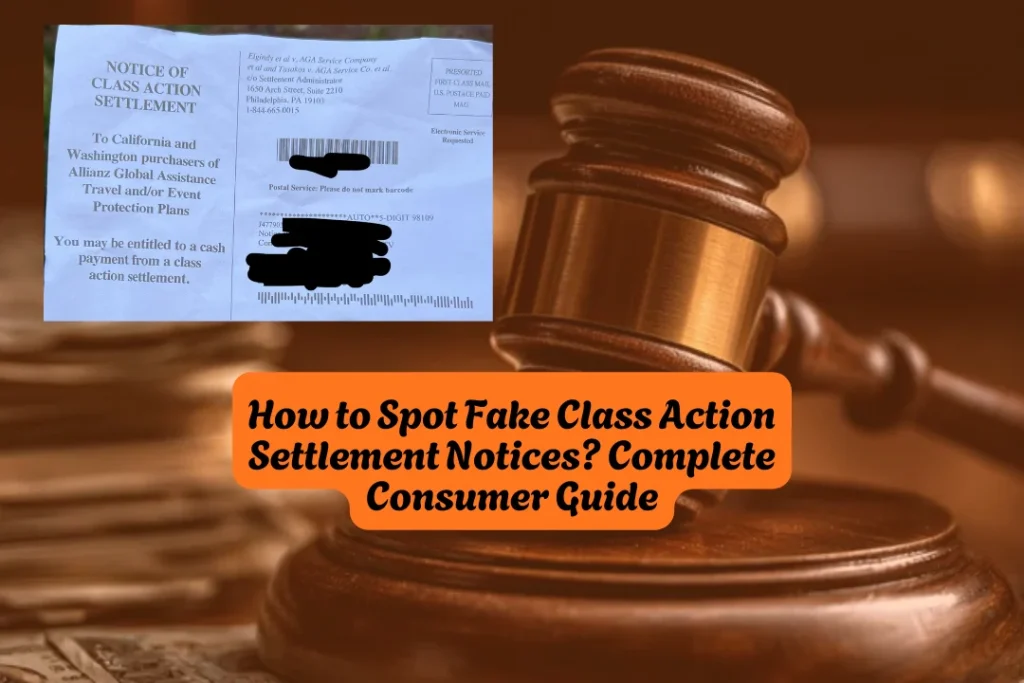
Understanding the anatomy of a real notice makes fakes far easier to spot. According to guidance from the BBB, FTC, and consumer protection attorneys, a genuine class action settlement notice will:
- Name the specific defendant (the company or organization being sued) and explain what they allegedly did wrong
- Include a court-assigned case number and the name of the federal or state court
- Clearly explain why you are included — you bought a specific product, used a certain service, or were affected by a specific incident
- Identify the named plaintiff attorneys with verifiable contact information
- Direct you to an official settlement website registered at a recognizable domain
- Provide a specific claim deadline, opt-out deadline, and objection deadline
- Ask only for name, address, email, and sometimes proof of purchase — nothing more to establish initial eligibility
- Offer multiple ways to file — online, by mail, or by phone through the settlement administrator
Genuine settlement notices will include a case name and website, and you should always verify independently rather than clicking a link in an unsolicited email or text.
How to Verify Any Class Action Notice in 5 Steps
Step 1: Search Independently — Never Click the Link
Don’t click the link in the notice. Instead, search for “[Company Name] class action settlement” and see what comes up. Open a new browser window and type the search yourself. If the settlement is real, it will appear in coverage from outlets like Reuters, the Associated Press, or legal news sites.
Step 2: Cross-Check on Trusted Settlement Databases
Three reliable sources are: ClassAction.org — a comprehensive database of open settlements; TopClassActions.com — active settlements with filing deadlines; and ftc.gov/enforcement/refunds — FTC-administered refunds and settlements.
These databases are free and regularly updated. If the settlement in your notice doesn’t appear in any of these places, that is a serious warning sign.
Step 3: Look Up the Case on PACER or Your State Court System
Every federal class action settlement must be filed in federal court and is publicly accessible. Visit pacer.gov to search federal civil court records. You can also use the search function on your state’s attorney general and federal court websites to verify the existence of the case.
Step 4: Verify the Law Firm Independently
Look up the law firm and make sure it’s legitimate. Call them directly — don’t just rely on a postcard you get in the mail. Search the firm’s name in your state bar association’s attorney lookup directory. Every licensed law firm in the U.S. is listed with the state bar where it practices.
Step 5: Check the Settlement Website URL Carefully
Scammers create lookalike websites with subtle URL variations — for example, “equifax-settlement-claims.com” instead of the official “equifaxbreachsettlement.com.” The URL may appear slightly different from the one referenced in verified news articles or on the official court record. Always navigate to the settlement website by typing the URL yourself after verifying it through independent sources.
Real-World Example: The Camp Lejeune Scam
The Camp Lejeune water contamination case is a stark reminder of how quickly and aggressively scammers move once a high-profile case enters the news.
The BBB documented that victims received emails or phone calls informing them they could claim settlements ranging from a few thousand to several million dollars. Following those instructions resulted in downloading malware, surrendering personal identifying information, or paying “filing fees” that never ended.
The scam was not limited to actual veterans. One person reported receiving a call claiming $5,000,000 in compensation was available for their deceased brother who had served in the military years earlier.
This case illustrates a critical rule: the existence of a real, widely publicized class action lawsuit does not make any individual notice about that lawsuit legitimate. Criminals involved in fake class actions count on people connecting news events to the notices they receive and falling for their scams.
What to Do If You Fall for a Fake Notice
If you realize you’ve provided personal information or money to a fraudulent settlement scheme, act immediately:
If you gave bank account or financial information: Call your bank right away and request an account freeze or new account numbers. Ask about reversing any recent transactions.
If you gave your Social Security number: Visit IdentityTheft.gov for complete recovery steps. Place a free credit freeze at all three major bureaus — Equifax, Experian, and TransUnion — to prevent new accounts from being opened in your name.
If you clicked a link or downloaded an attachment: Run a full security scan on your device immediately. Change all passwords, especially for email, banking, and any accounts that use your SSN or financial data.
Report the scam: Notify the Federal Trade Commission at ReportFraud.ftc.gov. Taking action may protect other potential victims from falling prey to the same scammers. Also report to your state attorney general’s consumer protection office and the BBB’s Scam Tracker at bbb.org/ScamTracker.
Should You Respond to Legitimate Settlement Notices?
Yes — and the stakes of ignoring real notices are higher than most people realize.
If you can confirm a notice’s legitimacy, there’s no reason not to respond. Whether you do nothing or file a claim, your rights to bring a future claim are the same — you lose them either way. So you may as well file and receive whatever compensation is available.
When people don’t participate in a class action, they’re opted in by default — which means the defendant’s liability is erased, but the consumer isn’t getting paid for it.
The financial stakes are real. Recent settlements have included AT&T’s $177 million data breach settlement, Neiman Marcus’s $3.5 million payout, and Panera Bread’s $2.5 million settlement — all of which had millions of potentially eligible claimants. Only 4 percent of eligible individuals typically file claims, meaning the vast majority of people forfeit real money because they’re unsure whether the notice is genuine.
Quick Reference: Real vs. Fake Settlement Notices
| Feature | Legitimate Notice | Scam Notice |
| Upfront fees | Never required | Often requested |
| Full SSN required | No (last 4 digits only, rarely) | Yes — a major red flag |
| Bank account info | Only after settlement approval | Requested immediately |
| Case number | Always present | Missing or vague |
| Law firm verifiable | Yes, in state bar records | Cannot be independently verified |
| Payout amount | Usually modest; often not specified | Promises large or immediate sums |
| Filing deadline | Specific court-approved date | Vague or urgency-driven |
| Verification | Appears in court records and news | Cannot be found in any database |
| Contact method | Mail; sometimes email | Text, social media, cold calls |
Frequently Asked Questions
Q: Is a class action settlement notice in my mail likely real or a scam?
Most mailed settlement notices are legitimate — scammers more commonly operate via email and text. However, physical mail scams exist too. Always verify through independent sources before responding or providing any personal information.
Q: A settlement notice asks for my driver’s license number. Is that normal?
Scam signs include asking for Social Security, bank account, and driver’s license information. Legitimate administrators may need your email or address to send payment, but nothing more beyond basic identification.
Q: I received a notice about a company I’ve never heard of. What should I do?
Do not respond until you verify the case independently. Search the company name and “class action settlement” to see if it appears in reputable news coverage or on ClassAction.org. If you have no connection to the company or incident described, the notice may have been sent in error or may be fraudulent.
Q: What if the notice looks exactly like the real company’s branding?
Scammers are now sophisticated enough to know that consumers are savvy about class actions. The tell is always the ask — for money, or for information no legitimate settlement needs. No amount of official-looking branding changes the fact that filing a claim is always free.
Q: Can I get a bigger payout by filing an individual lawsuit instead of a class action?
Consumers can opt out of a class action and file their own suit, usually in small claims court. Consumers who sued Equifax individually over the 2017 data breach received larger individual verdicts than plaintiffs in the class action — though individual suits require more time and effort.
Q: Where do I report a fake settlement notice?
Report to the FTC at ReportFraud.ftc.gov, the BBB at bbb.org/ScamTracker, and your state attorney general’s consumer protection office. Reporting helps investigators track patterns and warn other potential victims.
Q: How long does it take to receive a real class action payment after filing?
Real settlement payments can take anywhere from several months to over a year after a claim deadline closes, as the court must grant final approval, claims must be processed, and funds must be distributed. Any notice promising payment within days or weeks of filing is almost certainly a scam.
Last Updated: March 5, 2026
This article is for informational purposes only and does not constitute legal advice. Legal outcomes depend on specific facts and applicable law. Readers should consult a qualified attorney for advice regarding their individual circumstances.
About the Author

Sarah Klein, JD, is a licensed attorney and legal content strategist with over 12 years of experience across civil, criminal, family, and regulatory law. At All About Lawyer, she covers a wide range of legal topics — from high-profile lawsuits and courtroom stories to state traffic laws and everyday legal questions — all with a focus on accuracy, clarity, and public understanding.
Her writing blends real legal insight with plain-English explanations, helping readers stay informed and legally aware.
Read more about Sarah