
Trump Law Firms 2026, Executive Orders, $1 Billion Pro Bono Deals, Constitutional Lawsuits, and What Happens Next in Trump vs. Big Law
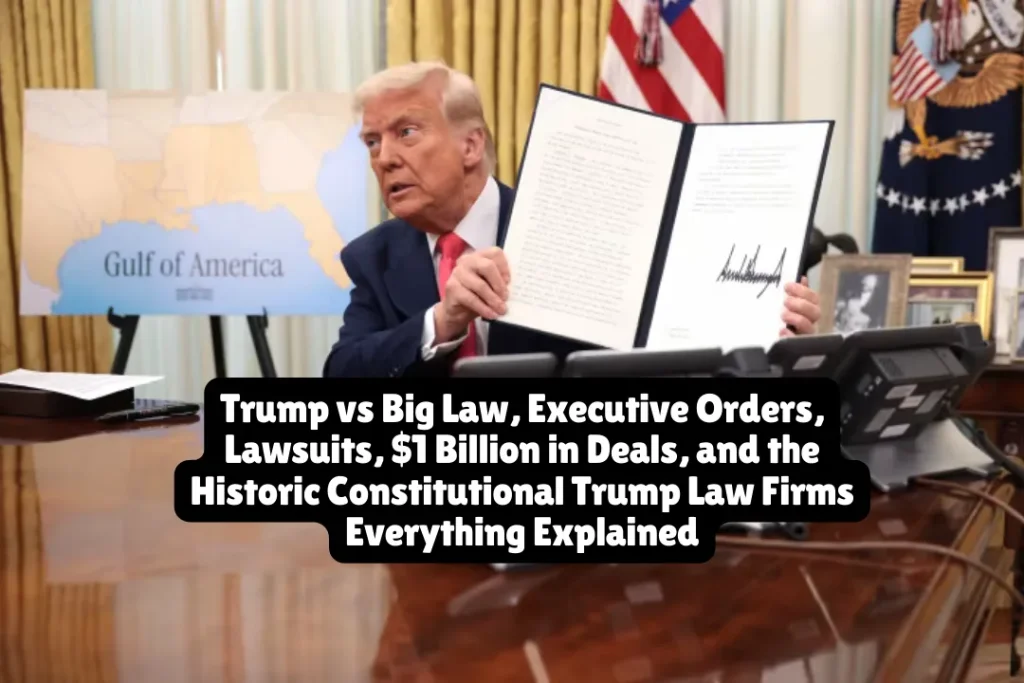
President Donald Trump’s campaign against major American law firms is one of the most consequential — and contested — legal stories of 2025–2026. Starting in March 2025, Trump signed a series of executive orders targeting prominent law firms he viewed as political enemies, stripping their lawyers of security clearances, cutting government contracts, and banning them from federal buildings.
Four firms fought back in court and won. Others cut deals worth nearly $1 billion in free legal services to avoid White House punishment. And on March 3, 2026, the DOJ filed to drop its appeals — then reversed course hours later in a dramatic about-face that left the legal industry stunned. This article covers every aspect of the story from beginning to present.
The Complete Timeline: How It Started and Where It Stands Today
March 2025 — The Executive Orders Begin
On March 6, 2025, Trump issued Executive Order 14230 titled “Addressing Risks from Perkins Coie LLP.” The order suspended security clearances for the firm’s employees, restricted their access to federal buildings, directed agencies to review and potentially terminate contracts with the firm, and ordered the government not to hire attorneys from the firm.
Trump’s central complaint was Perkins Coie’s representation of Hillary Clinton during the 2016 presidential campaign and its hiring of Fusion GPS, which produced the so-called “Steele Dossier.”
More orders followed in rapid succession:
- March 14, 2025: Trump issued Executive Order 14237 targeting Paul Weiss, citing a former attorney who investigated Trump as a Manhattan DA prosecutor and pro bono work against January 6 defendants.
- March 25, 2025: Trump issued an order against Jenner & Block, citing its hiring of Andrew Weissmann after he worked on Special Counsel Robert Mueller’s investigation.
- March 27, 2025: Trump targeted WilmerHale, citing its connections to Mueller, who worked at the firm both before and after his special counsel role.
Each order imposed the same set of sanctions: suspension of security clearances, restrictions on access to federal buildings, direction to review and terminate government contracts, and instructions to federal agencies not to hire the firms’ employees.
The Firms: Two Very Different Responses
Group 1 — The Firms That Fought Back
Four firms refused to cut deals and went directly to federal court.
Perkins Coie was the first to sue. Perkins Coie sued to block the portion of the order barring its attorneys from certain federal buildings and requiring government contractors to disclose their business with the firm, and was successful in getting a temporary injunction.
On May 2, 2025, U.S. District Judge Beryl Howell issued a permanent injunction, characterizing the executive order as “an unprecedented attack” on the legal system and ruling that it “violates the Constitution and is thus null and void.”
WilmerHale and Jenner & Block filed suit shortly after. In late May, both won permanent injunctions from separate federal judges, which ruled that the executive orders were unconstitutional.
Susman Godfrey — targeted because it represented Dominion Voting Systems in its defamation lawsuit against Fox News — also sued and won. In ruling for Susman Godfrey, a judge found that the government “sought to use its immense power to dictate the positions that law firms may or may not take,” which threatened the foundation of legal representation in the U.S. Judge Loren AliKhan said the executive order was the result of a “personal vendetta.”
In total, four different federal judges ruled independently that Trump’s executive orders against these firms were unconstitutional. A May ruling from Judge Beryl Howell called the executive order against Perkins Coie “an unprecedented attack” on the U.S. judicial system.
Related article: Paul Weiss and Trump Administration Agreement: Executive Order, $40 Million Pro Bono Commitment, and Leadership Changes Explained
Group 2 — The Firms That Cut Deals (“The Capitulating Firms”)
Other national law firms under threat of similar executive orders cut deals with the administration and changed their approach, especially by shifting the political leanings in the pro bono work they were willing to do, from liberal causes to more conservative ones. Several prominent firms, including Paul Weiss and Kirkland & Ellis, became known as “the capitulating firms” across the industry.
Here is every confirmed deal, with amounts:
| Firm | Deal Amount | Notes |
| Paul Weiss | $40 million | First deal struck; executive order rescinded |
| Skadden Arps | $100 million | No EO had been issued; preemptive deal |
| Willkie Farr & Gallagher | $100 million | Preemptive deal |
| Milbank | $100 million | Preemptive deal |
| Kirkland & Ellis | $125 million | Preemptive deal |
| Latham & Watkins | $125 million | Preemptive deal |
| A&O Shearman | $125 million | Preemptive deal |
| Simpson Thacher & Bartlett | $125 million | Preemptive deal |
| Cadwalader, Wickersham & Taft | $100 million | Preemptive deal |
| Total | ~$940 million | Nearly $1 billion in pro bono pledges |
At least seven other firms agreed to provide tens of millions of dollars in pro bono work to the Trump administration, despite there being no executive orders issued against those firms — the threat of one was enough to bring them to the bargaining table.
What the “Deals” Actually Require — And Why Critics Call Them Coercion
The deals are not traditional settlements. They require firms to provide free legal services to causes the Trump administration supports — a requirement critics describe as legally and ethically unprecedented.
Veteran lawyers reached a curious conclusion about these deals: they do not appear to be legally valid.
President Trump essentially intimated that these agreements are intended to create a chilling effect on litigation against executive actions, stating on April 8, 2025, that firms had given him over $340 million in total commitments for pro bono work, classifying them as “damages” for prior conduct.
“Pro bono was never for the United States government or for a billionaire president,” one legal ethics expert said. “That’s a little obscene, right? Pro bono is for those who are under attack, not the attack dog.”
Democratic senators including Richard Blumenthal, Adam Schiff, and Rep. Jamie Raskin wrote to firms including Paul Weiss demanding information about the scope of the deals. “Paul Weiss’s work for the Commerce Department clearly falls outside of the scope of the deal you previously described — suggesting that the Administration’s coercion of your law firm may be ongoing and escalating,” the lawmakers wrote.
Resignations and Internal Fallout
Multiple lawyers resigned from firms that made deals with Trump. Steven Banks, pro bono practice leader at Paul Weiss, left the firm, saying he wanted to wage a fight for “the things that I have believed in.”
In February 2026, the revelation of Brad Karp’s personal relationship with convicted sex offender Jeffrey Epstein was followed by Karp’s resignation as chair of Paul Weiss.
The Constitutional Questions Explained
What exactly did the courts find unconstitutional? The rulings centered on three core constitutional protections.
First Amendment — Free Speech and Association
The courts found that Trump’s executive orders punished law firms for the clients they chose to represent and the legal positions they took — all protected First Amendment activity. As one judge wrote, the orders sent the message that “lawyers must stick to the party line, or else.”
The right to choose your own legal counsel — and for lawyers to take on clients without fear of government retaliation — is foundational to the U.S. adversarial legal system. As stated from the outset by WilmerHale: “Our challenge to the unlawful Executive Order was about defending our clients’ constitutional right to retain the counsel of their choosing and defending the rule of law.”
Understanding your First Amendment rights and how courts apply them is essential context for understanding why all four judges ruled against the administration in these cases.
Fifth Amendment — Due Process
The orders also raised due process concerns. Firms were sanctioned based on past conduct — clients they had represented, lawyers they had employed — without any hearing, notice, or opportunity to respond before sanctions were imposed.
Separation of Powers
The orders attempted to use presidential power to punish private businesses for legal work conducted in the courts — a branch of government independent from the executive. Courts found this crossed a line that the Constitution does not permit the president to cross.
The ABA Sues
On June 16, 2025, the American Bar Association sued the Trump administration, describing the executive orders as part of a policy intended “to intimidate and coerce law firms and lawyers to refrain from challenging the President or his Administration in court, or from even speaking publicly in support of policies or causes that the President does not like.” The ABA is represented in the suit by Susman Godfrey — one of the targeted firms that fought back.
Individual Lawyers Targeted
Beyond the firms, Trump also targeted individual attorneys directly.
On March 21, 2025, Trump issued a presidential memorandum revoking the security clearances of 14 individuals, including attorneys Alvin Bragg, Norman Eisen, Letitia James, Lisa Monaco, Andrew Weissmann, and Mark Zaid. Zaid, who has represented whistleblowers in both Republican and Democratic administrations, filed suit challenging the constitutionality of the memorandum.
At Covington & Burling, a lawyer who worked on former Special Counsel Jack Smith’s two prosecutions of Trump had his security clearance targeted. Covington responded by affirming it would continue to represent Jack Smith despite the action against the firm.
EEOC Investigations Into DEI Practices
The campaign against law firms extended beyond executive orders.
The Equal Employment Opportunity Commission sent letters on March 17, 2025, to twenty law firms, demanding information about their employment practices and telling them they were being investigated in relation to their diversity, equity, and inclusion (DEI) practices.
The firms that received letters include A&O Shearman, Debevoise & Plimpton, Cooley, Freshfields, Goodwin Procter, Hogan Lovells, Kirkland & Ellis, Latham & Watkins, McDermott Will & Emery, Milbank, Morgan Lewis, Morrison & Foerster, Perkins Coie, Reed Smith, Ropes & Gray, Sidley Austin, Simpson Thacher & Bartlett, Skadden, White & Case, and WilmerHale.
Three law students filed suit against the EEOC on April 15, 2025, alleging it had exceeded its authority when it demanded information about firms’ employment practices and that the release of their application information would constitute a breach of privacy.
March 3, 2026 — The DOJ’s Dramatic Reversal
This is the most recent and most confusing development in the entire saga.
What happened first: The Trump administration said it would be voluntarily dismissing appeals of lower court decisions that struck down the executive orders as unconstitutional. The motion to end the cases was signed by Associate Attorney General Stanley Woodward.
What happened hours later: The Justice Department walked back its move to end its appeals of the lower court decisions — just hours after saying it would drop its defense of the directives. The Justice Department informed the U.S. appeals court in Washington, D.C., on Tuesday that it is now seeking to withdraw its request to voluntarily dismiss the appeals.
Lawyers for the four firms oppose the move, calling it an “unexplained about-face.” The Justice Department said that regardless of the firms’ position, it is its “prerogative” to pursue the appeal.
Susman Godfrey stated: “Yesterday evening, the Administration told the Court that it gave up and wouldn’t even try to defend its unconstitutional executive orders. This morning, it reversed course. No explanation was given.”
As of the publication date of this article, the DOJ’s reversal remains unexplained and the cases remain pending before the U.S. Court of Appeals for the D.C. Circuit.
What Happens Next
Several threads remain unresolved:
- D.C. Circuit appeals: The four cases against Perkins Coie, WilmerHale, Jenner & Block, and Susman Godfrey remain pending in the appellate court following the DOJ’s reversal on March 3, 2026
- ABA lawsuit: The American Bar Association’s suit against the Trump administration over the executive orders continues
- Mark Zaid’s individual lawsuit: The whistleblower attorney’s challenge to the security clearance revocation remains active
- Pro bono deal compliance: Congressional Democrats continue investigating the scope and legality of the ~$1 billion in deal commitments from the nine firms that settled
- Cadwalader merger: Cadwalader announced plans to merge with Hogan Lovells, raising questions about how much — if any — of their Trump deal commitment will transfer to the new combined firm
Why This Matters: Broader Implications for the Legal System
The Trump law firm campaign has implications that extend far beyond the specific firms involved.
Access to counsel: When law firms fear government retaliation for representing certain clients, individuals and organizations who most need legal representation — those challenging government action — may find it harder to obtain counsel.
Chilling effect on litigation: Trump classified the pro bono deal commitments as “damages” for prior conduct, suggesting the agreements are intended to deter future litigation against his administration.
Rule of law: By targeting firms based on the clients they represented, the orders represented a direct challenge to the country’s adversarial system of justice — the principle that every party, regardless of how unpopular, is entitled to legal representation.
Precedent: All four permanent injunctions issued by federal judges represent some of the strongest judicial language in recent memory defending the independence of the legal profession from executive branch retaliation.
Frequently Asked Questions
Why did Trump target these law firms?
Each of the firms Trump targeted had one thing in common: well-known work in Washington, especially in litigation that was adverse to Trump personally or politically. Perkins Coie represented Hillary Clinton; WilmerHale employed Robert Mueller; Jenner & Block hired Andrew Weissmann; Susman Godfrey represented Dominion Voting Systems against Fox News.
What did the executive orders actually do to the firms?
The executive orders sought to cut security clearances for the firms’ lawyers, directed federal agencies to review contracts with the firms’ clients, and restricted their lawyers’ access to federal buildings and government officials. For firms that rely on government work or need security clearances, these measures posed an existential threat.
Which firms fought back and won?
Jenner & Block, Perkins Coie, Susman Godfrey, and WilmerHale each sued the Trump administration. Between May and June 2025, judges struck down the executive orders against them, ruling that the measures violated free speech rights and other constitutional protections.
Which firms made deals with Trump — and for how much?
Nine firms struck deals amounting to nearly $1 billion in pro bono commitments: Paul Weiss ($40M), Willkie Farr & Gallagher ($100M), Milbank ($100M), Skadden Arps ($100M), Cadwalader ($100M), Kirkland & Ellis ($125M), A&O Shearman ($125M), Latham & Watkins ($125M), and Simpson Thacher & Bartlett ($125M).
Are the deals legally binding?
Veteran lawyers have reached the curious conclusion that the deals do not appear to be legally valid. The terms are murky, enforcement mechanisms are unclear, and congressional Democrats continue to seek information about what work firms are actually performing under the agreements.
What happened on March 3, 2026?
The DOJ filed to dismiss its appeals of the four lower court rulings finding the executive orders unconstitutional — then reversed course hours later without explanation, calling it the government’s “prerogative” to continue the appeals. The four firms called it an “unexplained about-face.” The cases remain pending before the D.C. Circuit.
Could the Supreme Court hear this case?
If the D.C. Circuit rules on the appeals, the losing party could petition the Supreme Court for review. Given the fundamental constitutional questions involved — presidential power to punish lawyers for representing political opponents — legal scholars consider this a strong candidate for Supreme Court consideration if it reaches that stage.
Last Updated: March 4, 2026. This article is for informational purposes only and does not constitute legal advice. Allegations in filings are not findings of fact. All parties are presumed innocent unless and until proven otherwise in court.
About the Author

Sarah Klein, JD, is a licensed attorney and legal content strategist with over 12 years of experience across civil, criminal, family, and regulatory law. At All About Lawyer, she covers a wide range of legal topics — from high-profile lawsuits and courtroom stories to state traffic laws and everyday legal questions — all with a focus on accuracy, clarity, and public understanding.
Her writing blends real legal insight with plain-English explanations, helping readers stay informed and legally aware.
Read more about Sarah