
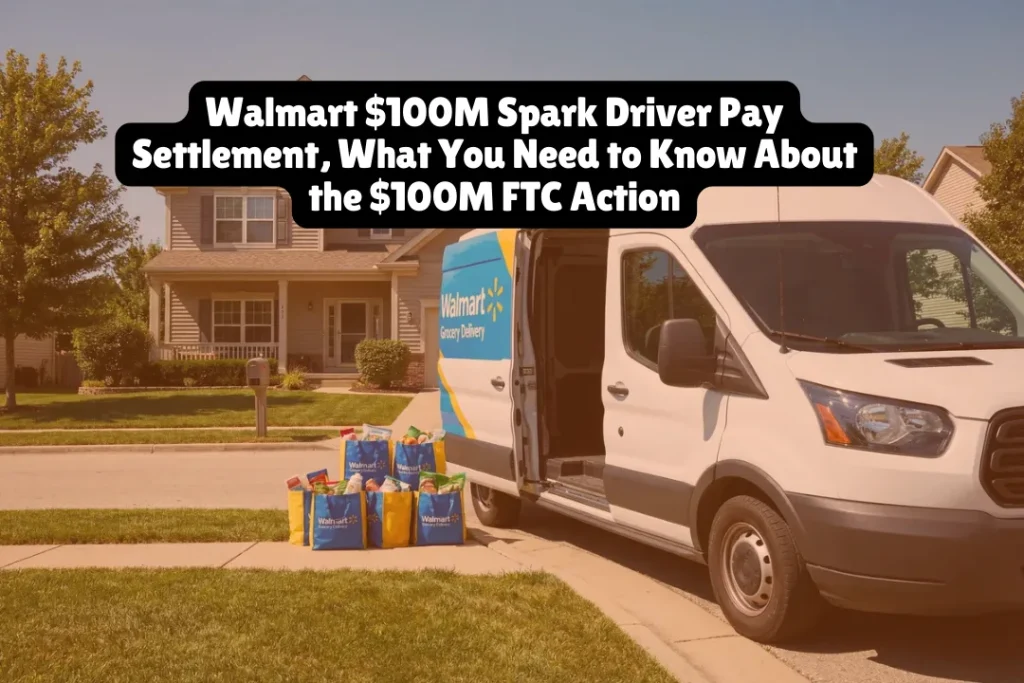
Walmart $100M Spark Driver Pay Settlement, What You Need to Know About the $100M FTC Action
Walmart has agreed to a $100 million settlement resolving allegations brought by the Federal Trade Commission and 11 state attorneys general that the company deceived gig drivers in its Spark Driver delivery program about their base pay, tips, and incentive earnings. The FTC filed its complaint in federal court in California on February 26, 2026. Eligible Spark drivers who experienced underpayment between January 1, 2021, and February 26, 2026, may receive compensation — and do not need to submit a claim form to get paid.
Quick Facts
| Detail | Information |
| Defendant | Walmart Inc. |
| Allegations | Deceptive earnings claims — misrepresented base pay, tips, and incentive pay to Spark drivers |
| Settlement Status | Final judgment entered February 26, 2026 |
| Who May Be Affected | Spark drivers nationwide who lost pay due to deceptive representations (Jan. 1, 2021 – Feb. 26, 2026) |
| Total Settlement Amount | $100,000,000 |
| Claim Deadline | No claim form required — payments are issued automatically |
| Official Source | FTC Press Release |
Current Status and What Happens Next
The settlement reached final judgment on February 26, 2026. This is not a pending or preliminary settlement — it is done. Walmart has already begun issuing direct payments to affected drivers, and the FTC will distribute additional funds from a separate $16.17 million settlement fund to drivers whose recorded pay did not match the amounts shown in their initial offer cards.
Walmart is also required to file annual compliance reports with the FTC for the next 10 years. The $10 million paid to the FTC will be used to issue refunds to consumers — customers who paid tips they were told would go entirely to drivers but did not. Drivers in participating states will receive additional amounts from the $11 million paid to state attorneys general.
For consumers seeking a refund of tips: Monitor the FTC’s official refund program page at ftc.gov/enforcement/refunds for updates on the consumer distribution.
What the Lawsuit Alleges
The FTC and 11 states alleged that Walmart engaged in four specific deceptive practices targeting Spark drivers through the app starting at least in 2021.
Tip misrepresentation on individual orders. Walmart displayed a tip amount to drivers before they accepted a delivery offer, but did not tell drivers the tip had not been preauthorized by the customer. If the customer’s payment failed or was declined, the driver received no tip — even though the offer card showed one.
Split-tip deception on divided orders. When a single customer’s order was split between multiple drivers, Walmart showed each driver the full tip amount. In reality, the tip was divided among all drivers who handled parts of the order, so each received only a fraction of what was displayed.
Base pay and tip reductions on batched orders. Walmart sometimes removed individual stops from “batched” deliveries — orders involving multiple customer drop-offs during one trip — after drivers accepted the offer. When it did, Walmart reduced the base pay or tips without clearly notifying drivers. In many cases, drivers only learned of the reduction after completing the delivery.
Undisclosed incentive conditions. Walmart offered extra incentive pay for completing a set number of deliveries, finishing within certain timeframes, or referring new drivers. The FTC alleged Walmart failed to disclose all the conditions required to earn those incentives and denied payments to drivers who believed they had met the terms. For example, drivers who referred new drivers often did not receive promised referral bonuses.
The complaint states that Walmart was aware of these issues almost immediately after the Spark program launched in 2018 but did not address them. Nearly one million drivers made more than 272 million deliveries through the program, and the FTC alleges the practices caused drivers to collectively lose tens of millions of dollars they were owed.
Who Could Be Eligible
You may be eligible to receive a payment from this settlement if all of the following apply to you:
- You worked as a Spark Driver in the United States, the District of Columbia, or a U.S. territory
- You accepted one or more delivery offers through the Spark Driver app between January 1, 2021, and February 26, 2026
- You were shown a base pay amount, tip, or incentive in the app that was not paid as displayed
Specific examples of qualifying situations include: receiving a smaller tip than shown on the offer card, having a tip split without notification, having base pay reduced after accepting a batched order without clear explanation, or not receiving an incentive payment you completed the requirements for.
This is a nationwide settlement. You do not need to live in one of the 11 participating states (Arizona, California, Colorado, Illinois, Michigan, North Carolina, Oklahoma, Pennsylvania, South Carolina, Utah, or Wisconsin) to receive a payment as a driver. The geographic restriction for the state-level payments applies to how those specific state funds are distributed — the core driver compensation fund covers all U.S.-based Spark drivers.
Walmart customers who paid tips through the Spark app that did not reach drivers may also receive refunds from the $10 million consumer fund administered by the FTC.
Settlement Details
The $100 million total settlement breaks down as follows:
Up to $79 million is earmarked directly for Spark drivers. Walmart has already begun issuing a portion of this directly to drivers based on its own payment records. The remaining balance will be distributed through an FTC-administered $16,175,302 settlement fund to drivers whose recorded earnings did not match the offer amounts shown to them.
$10 million goes to the FTC to issue refunds to customers who paid tips they were told would go entirely to drivers.
$11 million is divided among the 11 participating states as civil penalties. Individual state amounts include approximately $2 million for North Carolina, $1.4 million for Pennsylvania, $890,000 for Michigan, and $567,810 for Utah.
No claim form is required for drivers. Payments to drivers are being calculated based on Walmart’s internal records of what drivers were shown versus what they were actually paid. Drivers do not need to submit any paperwork to receive their share of the settlement.
Behavioral requirements going forward. As part of the settlement, Walmart must implement an earnings verification program, is prohibited from modifying an accepted offer’s base pay or tips except in limited circumstances (such as customer cancellation), and is banned from misrepresenting earnings in future driver offers.
Prior Related Cases and Industry Context
The Walmart Spark settlement is part of a broader pattern of regulatory action targeting gig platform pay transparency. In New York City, both DoorDash and Uber Eats faced municipal enforcement requiring changes to tipping practices after city law established a mandatory minimum wage for delivery workers. Instacart also raised delivery fees in New York to comply with similar worker pay standards. The FTC’s action against Walmart is the first major federal enforcement of its kind in the gig delivery space and was brought under the FTC’s Labor Task Force, launched in February 2025 specifically to address deceptive and unfair practices in labor markets.
Prior to this settlement, Walmart had not faced a comparable federal enforcement action for driver pay practices. However, the gig economy broadly has faced increasing scrutiny over how platforms present earnings to workers who rely on upfront pay estimates to decide whether to accept jobs. The FTC’s action reflects the legal principle that workers making independent contractor decisions based on platform earnings disclosures deserve the same consumer protections as retail buyers.
Frequently Asked Questions
What is the Walmart Spark settlement about?
Walmart agreed to a $100 million settlement on February 26, 2026, resolving FTC and multistate allegations that it misled Spark delivery drivers about how much they would earn in base pay, tips, and incentive pay. The settlement also addresses Walmart deceiving customers about whether 100% of tips went to drivers.
What exactly did Walmart allegedly do wrong?
The FTC alleged four main practices: showing drivers tip amounts that hadn’t been preauthorized by customers; displaying the full tip to each driver when a tip was being split across multiple drivers; reducing base pay or tips after a driver accepted a batched order without clear notice; and denying incentive payments without disclosing all the conditions drivers had to meet.
Is this a class action lawsuit?
This is a regulatory enforcement action brought by the FTC and 11 state attorneys general — not a private class action lawsuit filed by drivers themselves. The settlement achieves similar results for drivers, with direct payments distributed based on Walmart’s own records, but it was initiated by government agencies under the FTC Act and state consumer protection laws.
Who may be eligible for a payment?
Any Spark driver in the United States who accepted delivery offers between January 1, 2021, and February 26, 2026, and received less pay, tips, or incentives than the amounts displayed in the app may be eligible. This applies nationwide, not just in the 11 states that joined the complaint.
Do I need to file a claim form to get paid?
No. Drivers do not need to submit a claim form. Payments are being calculated automatically based on Walmart’s internal records of discrepancies between offered and actual pay. Walmart has already begun issuing some payments directly, and the FTC will administer an additional $16.17 million driver fund.
How much will each driver receive?
Individual payment amounts depend on how much each driver was underpaid. Payments are calculated based on the gap between what the app showed and what was actually paid — for example, a driver shown a $10 tip who received $7 may receive a $3 payment, and a driver denied a $50 referral incentive may receive the full $50.
What about customers who paid tips that didn’t reach drivers?
Walmart customers may receive refunds from a separate $10 million consumer fund administered by the FTC. Monitor ftc.gov/enforcement/refunds for updates on when and how that distribution will be processed.
Where can I find the official information?
The official FTC press release is available at ftc.gov. Your state attorney general’s website may also have information specific to drivers in your state.
Additional Context, What This Settlement Means for Gig Workers
The FTC’s action against Walmart signals that federal regulators view gig workers’ decisions to accept or reject job offers as consumer decisions deserving legal protection. Because independent contractors like Spark drivers accept work based on the earnings information a platform shows them, the FTC treated misleading that information as a deceptive practice under the same laws that protect retail consumers.
The 10-year compliance monitoring requirement — requiring Walmart to report annually to the FTC — is among the longer oversight periods in gig economy settlements and suggests regulators view systematic pay transparency as an ongoing concern rather than a one-time fix.
If you believe you were underpaid as a Spark driver and have not received payment within a reasonable period, you can report a concern directly to the FTC at ReportFraud.ftc.gov.
Last Updated: March 1, 2026
This article is for informational purposes only and does not constitute legal advice. Legal claims and outcomes depend on specific facts and applicable law. For advice regarding a particular situation, consult a qualified attorney.
About the Author

Sarah Klein, JD, is a licensed attorney and legal content strategist with over 12 years of experience across civil, criminal, family, and regulatory law. At All About Lawyer, she covers a wide range of legal topics — from high-profile lawsuits and courtroom stories to state traffic laws and everyday legal questions — all with a focus on accuracy, clarity, and public understanding.
Her writing blends real legal insight with plain-English explanations, helping readers stay informed and legally aware.
Read more about Sarah