
Walgreens Class Action Over ‘Dishwasher Safe’ Cutlery, 2026 Update
A California consumer’s class action against Walgreens over “dishwasher safe” plastic cutlery that melted in her dishwasher survived a motion to dismiss in February 2026. The case — Simpson v. Walgreen Co., et al., Case No. 1:23-cv-16465 — is now in active litigation in the Northern District of Illinois, with class certification still ahead.
What the Walgreens Cutlery Class Action Is About
Walgreens consumer Bridget Simpson filed the class action lawsuit in December 2023 against Walgreens and the manufacturers and distributors of its plastic cutlery, Sumter Easy Home LLC and Ningbo (USA) Home-Link Plastic Product Mfg. Ltd.
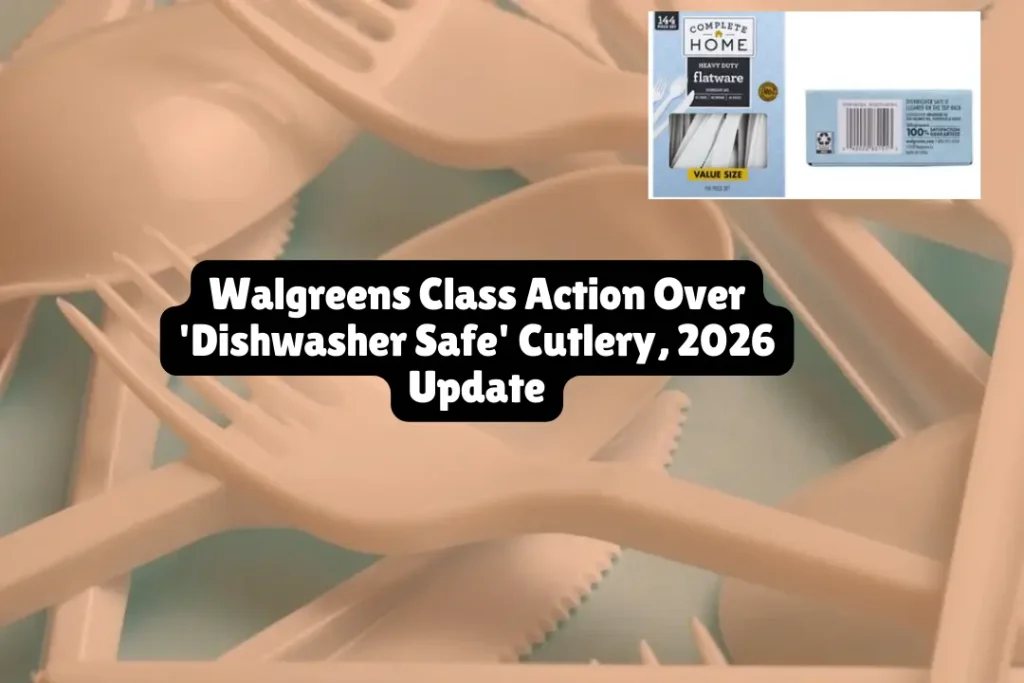
Simpson said the Walgreens Complete Home Heavy Duty plastic cutlery packaging was labeled “HEAVY DUTY” and “DISHWASHER SAFE” in all caps on the front and back. However, on the bottom of the box, a disclaimer read: “Dishwasher safe if cleaned on the top rack.” The problem? A dishwasher’s standard cutlery basket sits on the lower rack — not the top. When Simpson put the cutlery there, it melted into her appliance.
Simpson argued Walgreens failed to abide by an industry standard to clearly delineate that something can only be safely washed on a top rack. She argues she would not have purchased the product, or would have paid less for it, had she known the full-dishwasher-safe claim was false. This is the core of the consumer protection litigation — that a front-label promise cannot be quietly contradicted by fine print buried on the bottom of the box.
What the February 2026 Ruling Actually Said — and What Competitors Missed
U.S. District Judge Franklin U. Valderrama granted in part and denied in part Walgreens’ motion to dismiss. Valderrama determined Simpson plausibly alleged that a reasonable consumer would be misled by the plastic cutlery’s packaging into believing it was safe to wash anywhere in the dishwasher. He also determined Simpson’s class action lawsuit sufficiently alleged Walgreens’ cutlery packaging contained a false statement and that she relied on it when purchasing the product.
The case citation competitors have missed: Simpson v. Walgreen, 2026 WL 413565 (N.D. Ill. 2026). This is the February 17, 2026 opinion published in West’s Federal Supplement system — a specific docket reference absent from most news coverage.
The judge did agree with the defendants that Simpson failed to comply with California’s Consumer Legal Remedies Act requirement to give companies 30 days of notice before naming them as defendants. Valderrama dismissed those CLRA claims without prejudice, giving Simpson at least 30 days to provide proper notice and refile. The case will proceed with claims for common law fraud, unjust enrichment, intentional misrepresentation, and negligent misrepresentation. The breach of implied warranty and injunctive relief claims were also dismissed without prejudice.
That “without prejudice” status matters: Simpson can revive the CLRA, False Advertising Law, and Unfair Competition Law claims — which carry statutory damages — once she serves proper 30-day notice on Walgreens.
Who Is Potentially Eligible to Join This Lawsuit
This is a proposed class action — meaning class certification has not yet occurred. Until the court certifies a class, there is no formal mechanism to “join” the lawsuit. However, consumers who may fall within the proposed class should track the case closely.
Based on the complaint, potential class members include consumers who purchased Walgreens Complete Home Heavy Duty plastic cutlery, relied on the “dishwasher safe” label, and suffered harm — such as a melted product or economic loss from paying a premium for a product that did not perform as advertised. The proposed class appears to include California purchasers and potentially a nationwide subclass.
You do not need to retain a lawyer to monitor a class action. However, anyone with a documented injury — such as property damage from melted plastic — may wish to consult lead counsel or a consumer protection attorney to evaluate their individual rights before class certification occurs.
Hidden Risks and What the Dismissed Claims Could Mean for You
The CLRA and California’s False Advertising Law are significant because they allow for statutory damages — set amounts per violation — and attorney’s fees, making them highly valuable tools in consumer protection litigation. Their dismissal without prejudice is procedural, not substantive. Once proper 30-day notice is served, those claims can return to the case.
If Simpson refiles the CLRA claims and they survive, the class could seek restitution of the purchase price for every California consumer who bought the product under the same misrepresentation. That scope is what makes class certification the next critical milestone in this case.
The injunctive relief dismissal is also notable. The judge determined Simpson’s argument for injunctive relief falls short because she has not shown a likelihood of being misled again in the future. This is a common threshold in federal court — plaintiffs must show future harm risk to seek injunctions, not just past harm.
Action Checklist for Affected Consumers
Step 1 — Document your purchase. If you bought Walgreens Complete Home Heavy Duty plastic cutlery and experienced melting or damage, save any receipts, the original packaging (especially the bottom disclaimer), and photos of the damage.
Step 2 — Do not file a claim yet. There is no settlement, no settlement administrator, and no active claims process. Anyone advertising a claim form for this specific lawsuit as of February 2026 is not accurately representing the case status.
Step 3 — Monitor the docket. The case docket — Case No. 1:23-cv-16465, Northern District of Illinois — is publicly accessible through the PACER system at pacer.uscourts.gov. Key upcoming milestones include Simpson’s refiling of CLRA claims (expected within 30 days of the February 2026 ruling) and, eventually, a motion for class certification.
Step 4 — Watch for a class notice. If and when the court certifies a class, potential class members will receive official notice — typically by mail or email — explaining how to participate or opt out. That notice is the official trigger to act.
Frequently Asked Questions
Has the Walgreens cutlery class action been settled?
No. As of February 28, 2026, there is no settlement in Simpson v. Walgreen Co. The case survived a motion to dismiss and is in active litigation. No settlement administrator has been appointed and no claim form exists for this lawsuit.
What claims survived the motion to dismiss? Common law fraud, unjust enrichment, intentional misrepresentation, and negligent misrepresentation survived and are proceeding. California statutory claims under the CLRA, False Advertising Law, and Unfair Competition Law were dismissed without prejudice and may be refiled after proper notice.
Who are the defendants in this case?
The defendants are Walgreen Co., Sumter Easy Home LLC, and Ningbo (USA) Home-Link Plastic Product Mfg. Ltd. — the retailer, distributor, and manufacturer of the cutlery.
What is class certification and why does it matter here?
Class certification is when a court officially approves a lawsuit to proceed on behalf of a group of people rather than just one plaintiff. It has not happened yet in this case. Until class certification is granted, Simpson represents only herself, and no broader class exists.
Could this case result in a settlement?
Many consumer protection litigation cases settle before or after class certification. However, no settlement discussions have been publicly disclosed in this case. Any settlement would need court approval, and class members would receive notice before being bound by it.
What should I do if my Walgreens plastic cutlery melted?
Document the incident with photos and preserve the packaging. You do not need to take any formal legal action at this stage. If a class is certified, you will receive notice. If you believe you have individual property damage beyond the cost of the cutlery itself, consult a consumer protection attorney.
How is this different from other Walgreens class actions?
This case is specifically about the “dishwasher safe” misrepresentation on Complete Home Heavy Duty plastic cutlery — not the separate Walgreens Savings Club settlement (Russo et al. v. Walgreen Co., No. 1:17-cv-02246) or the Walgreens Boots Alliance securities class action. Each case has separate eligibility requirements and procedures.
Last Updated: February 28, 2026
This article is for informational purposes only and does not constitute legal advice. Class action status, eligibility, and outcomes depend on specific facts and applicable law. For questions about this case, consult the official court docket at pacer.uscourts.gov or a qualified attorney. No claim form exists for this lawsuit as of the publication date.
Stay informed, stay protected. — AllAboutLawyer.com
About the Author

Sarah Klein, JD, is a licensed attorney and legal content strategist with over 12 years of experience across civil, criminal, family, and regulatory law. At All About Lawyer, she covers a wide range of legal topics — from high-profile lawsuits and courtroom stories to state traffic laws and everyday legal questions — all with a focus on accuracy, clarity, and public understanding.
Her writing blends real legal insight with plain-English explanations, helping readers stay informed and legally aware.
Read more about Sarah