
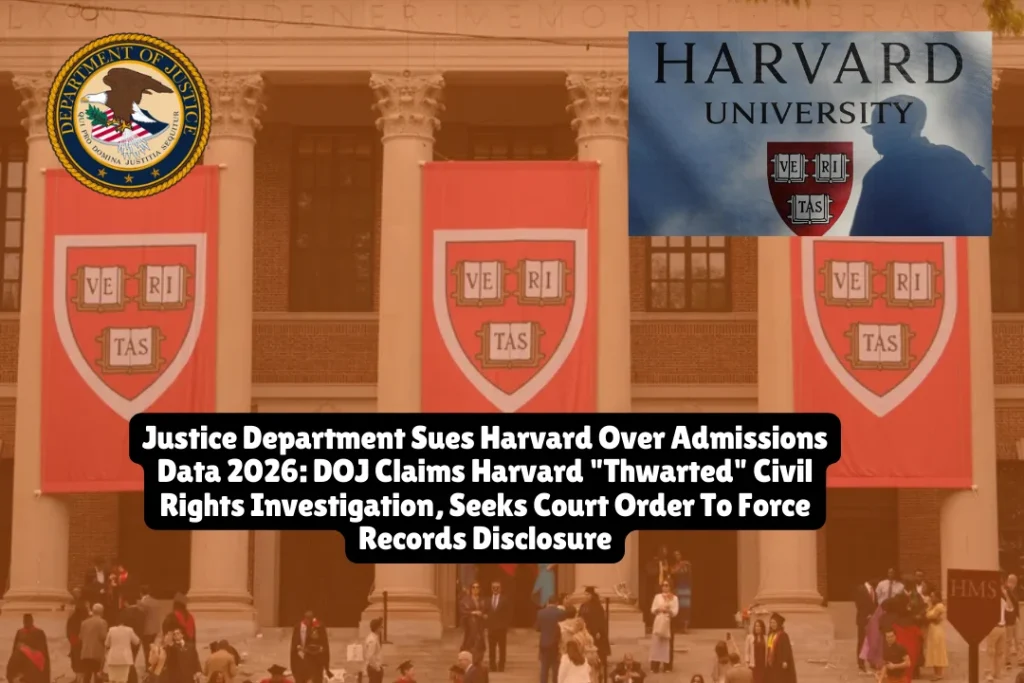
Justice Department Sues Harvard Over Admissions Data 2026, DOJ Claims Harvard “Thwarted” Civil Rights Investigation, Seeks Court Order To Force Records Disclosure
The U.S. Department of Justice sued Harvard on Friday, seeking a court order requiring the University to turn over admissions records requested as part of a federal civil rights review. Filed February 13, 2026, the lawsuit alleges Harvard provided only “aggregated data and publicly available information” instead of the detailed applicant-level records DOJ demanded in April 2025 to investigate whether the university continues using race in admissions after the 2023 Supreme Court ban.
The Justice Department said Harvard has “thwarted” efforts to investigate potential discrimination, marking the latest escalation in an unprecedented federal standoff with America’s oldest university.
What Is The DOJ Suing Harvard For?
The Justice Department opened a compliance review into Harvard’s admissions practices last April on the same day the White House issued a series of sweeping demands aligned with Trump’s priorities. DOJ demanded five years of admissions data including applicants’ grades, test scores, essays, extracurricular activities, admission decisions, and racial/ethnic information for undergraduate, medical, and law school applicants.
The April 25, 2025 deadline passed without Harvard providing the requested data. The lawsuit alleges that Harvard repeatedly slow-walked the pace of production and refused to produce pertinent data and documents requested by the DOJ, including individualized applicant admissions data, admissions policies, and correspondence related to race; ethnicity; diversity, equity, and inclusion.
Harvard’s Defense: “Retaliatory Actions”
Harvard spokesperson Jason A. Newton wrote in a statement that Harvard had engaged in “good faith” with the federal government and categorized the complaint as another attempt to punish Harvard for pushing back against the White House’s demands.
“The University will continue to defend itself against these retaliatory actions which have been initiated simply because Harvard refused to surrender its independence or relinquish its constitutional rights in response to unlawful government overreach,” Newton stated.
Similar to concerns in other federal investigations like the Supreme Court Ends Harvard Affirmative Action, Sparks Federal Investigation into Legacy Admissions, Harvard argues the government is using civil rights enforcement as political leverage.
What Data Does DOJ Want?
It asked for a trove of data including applicants’ grades, test scores, essays, extracurricular activities and admissions outcomes, along with their race and ethnicity. The scope includes undergraduate admissions plus Harvard Medical School and Harvard Law School.
Justice Department officials said they need the data to determine whether Harvard has continued considering applicants’ race in admissions decisions despite the 2023 Supreme Court ruling in Students for Fair Admissions v. Harvard that banned affirmative action.
Harmeet Dhillon, who leads the department’s Civil Rights Division, said Harvard’s refusal is a red flag. “If Harvard has stopped discriminating, it should happily share the data necessary to prove it,” Dhillon said.
What Harvard Has Changed Post-Affirmative Action
Among those changes, Harvard barred alumni interviewers from referencing an applicant’s race in written evaluations and instructed them to avoid mentioning students’ languages, religious practices, and involvement in race-based organizations.
The University also delayed releasing admissions data for the Class of 2029 until next fall, citing the Supreme Court decision. The only reference point — demographic data for the Class of 2028 — appears to show a four percent drop in enrolled Black students.
The Broader Trump-Harvard Conflict
This lawsuit represents one piece of an ongoing federal pressure campaign. In May, Secretary of Education Linda McMahon followed through on that threat in Harvard’s case, cutting off grants to Harvard and accusing the University of “ugly racism” in its admissions practices.
Trump’s dispute with Harvard had appeared to be winding down last summer after the president repeatedly said they were finalizing a deal to restore Harvard’s federal funding. The deal never materialized, and Trump rekindled the conflict this month when he said Harvard must pay $1 billion as part of any deal, double what he previously demanded.
Legal Claims And Potential Outcomes
The suit alleges that Harvard — a recipient of DOJ funding — violated Title VI by failing to comply with the DOJ’s request for sufficient document production for compliance review. Title VI prohibits discrimination based on race, color, or national origin in programs receiving federal financial assistance.
The lawsuit seeks only to compel Harvard to produce documents related to any consideration of race in admissions and does not accuse Harvard of racial discrimination at this stage.
If DOJ prevails, Harvard must produce the requested records. If the investigation finds evidence of continued race-based admissions, separate enforcement actions could follow, including federal funding cuts or referral to other agencies.
What This Means For Applicants
The lawsuit doesn’t directly affect current applications or admission decisions. However, the outcome could reshape how Harvard and other universities document and justify their admissions processes.
The White House is separately pressing universities across the U.S. to providing similar data to determine whether they have continued to factor race into admissions decisions.
FAQs
What is the Justice Department suing Harvard for?
The DOJ seeks a court order forcing Harvard to turn over five years of detailed admissions data to investigate whether the university continues considering race in admissions after the 2023 Supreme Court ban on affirmative action.
When was this lawsuit filed?
February 13, 2026, in federal court in Massachusetts.
What data does DOJ want?
Applicant grades, test scores, essays, extracurricular activities, admission outcomes, race/ethnicity information for undergraduate, medical, and law school applicants from 2020-2025.
Why does DOJ think Harvard is still using race?
Harvard’s refusal to provide detailed data and delayed release of demographic statistics for incoming classes raise questions about continued race-conscious admissions practices.
How does this affect current applicants?
It doesn’t directly impact applications or decisions, but could lead to changes in how Harvard evaluates applicants if the investigation finds violations.
Is Harvard violating the law?
The lawsuit alleges Harvard violated Title VI by refusing to comply with federal data requests. It doesn’t yet allege racial discrimination in admissions.
What happens next?
Harvard will respond to the lawsuit. The court will decide whether to order Harvard to produce the records. If produced, DOJ will analyze the data for evidence of continued race-based admissions.
Last Updated: February 14, 2026
Disclaimer: This article provides general information about ongoing federal litigation and is not legal advice.
What To Do: Applicants should continue following Harvard’s published admissions process. The lawsuit addresses institutional compliance, not individual applications.
Stay informed, stay protected. — AllAboutLawyer.com
About the Author

Sarah Klein, JD, is a licensed attorney and legal content strategist with over 12 years of experience across civil, criminal, family, and regulatory law. At All About Lawyer, she covers a wide range of legal topics — from high-profile lawsuits and courtroom stories to state traffic laws and everyday legal questions — all with a focus on accuracy, clarity, and public understanding.
Her writing blends real legal insight with plain-English explanations, helping readers stay informed and legally aware.
Read more about Sarah