
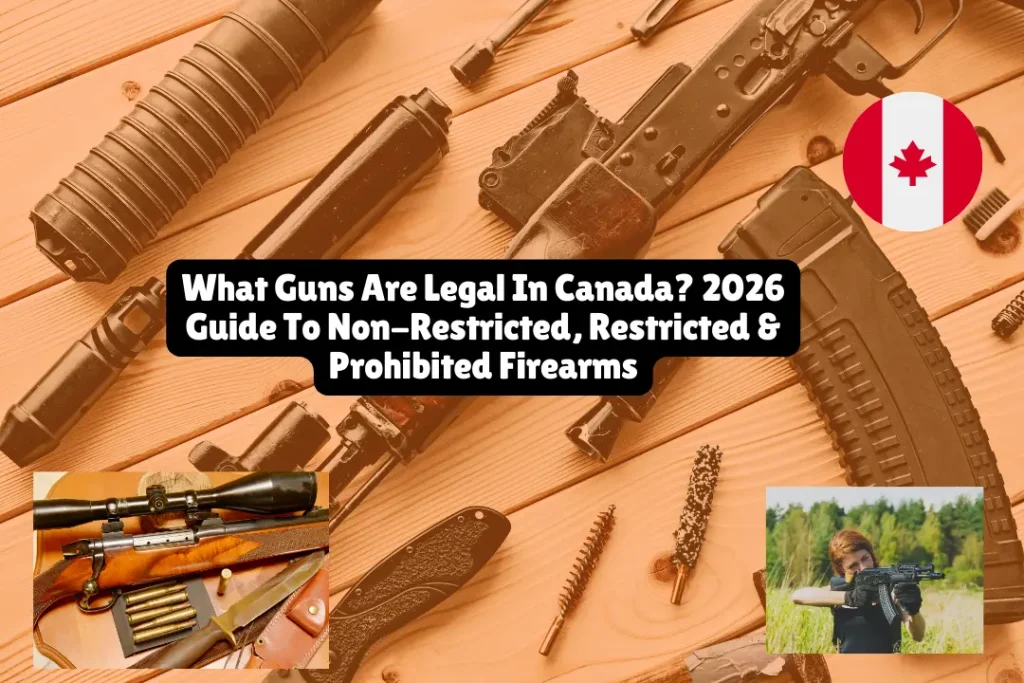
What Guns Are Legal In Canada? 2026 Guide To Non-Restricted, Restricted & Prohibited Firearms
Most hunting rifles, shotguns, and bolt-action firearms are legal in Canada under the non-restricted classification, while handguns and certain semi-automatic rifles require restricted licensing. However, over 2,500 assault-style firearms including AR-15s, AK-47s, and variants are completely prohibited for civilian ownership as of January 2026.
The Three-Tier Canadian Firearms Classification System
Canada categorizes firearms into three main classes: non-restricted, restricted, and prohibited. Each class determines what license you need and where you can legally use the firearm.
Non-Restricted Firearms: What Most Canadians Can Own
Non-restricted firearms include common rifles like the Remington 700 or Ruger Mini-14, and shotguns such as the Mossberg 500 or Winchester Model 12. These require only a basic Possession and Acquisition License (PAL).
Non-restricted firearms meet specific minimum requirements: rifle barrels must be at least 470mm (18.5 inches) long with an overall firearm length of at least 660mm (26 inches). Shotguns must have barrels at least 457mm (18 inches) long.
Popular legal non-restricted firearms include:
Bolt-Action Rifles: Tikka T3x, Savage Axis, Remington Model 700, Ruger American Rifle, Browning X-Bolt. These rifles are ideal for hunting and target shooting.
Semi-Automatic Rifles (Non-Prohibited): Ruger 10/22 (.22 caliber), SKS rifles (certain models), and other semi-automatics not on the prohibited list.
Shotguns: Benelli Super Black Eagle, Remington 870, Mossberg 500, Winchester SXP, Browning BPS. These work for hunting, sport shooting, and clay target sports.
No registration is required for non-restricted firearms, but you must have a valid PAL to purchase or possess them.
Restricted Firearms: Handguns And Certain Semi-Automatics
Restricted firearms require an RPAL (Restricted Possession and Acquisition License), gun club membership, or professional carry authorization. This category primarily includes handguns with barrels over 105mm and specific semi-automatic rifles.
Since the national handgun freeze took effect in October 2022, civilians can no longer acquire new handguns. If you owned handguns before the freeze, you can keep them but cannot sell or transfer them to other individuals.
Restricted firearms must be registered with the Canadian Firearms Registry and require Authorization to Transport (ATT) for any movement between locations. You can only use restricted firearms at approved shooting ranges—hunting with handguns or restricted rifles is prohibited.
Related article: Is Open Carry Legal In Canada? No For Handguns—Here’s What The Law Actually Allows In 2026
Prohibited Firearms: What You Cannot Own
Over 2,500 makes and models of assault-style firearms have been banned since May 2020, including AR-15, AR-10, M16, and M4 pattern firearms. The prohibition also includes upper receivers of these firearms classified as prohibited devices.
Prohibited firearms include:
- Fully automatic weapons (machine guns)
- Converted automatic firearms
- Handguns with barrels of 105mm or less
- Handguns chambered for .25 or .32 caliber ammunition
- Sawed-off rifles and shotguns
- Over 2,500 specific assault-style firearms banned by name
Individual firearm owners must safely dispose of or permanently deactivate their assault-style firearms before the amnesty period ends on October 30, 2026, or risk criminal liability for illegal possession.
Critical 2026 Changes You Must Know
On January 17, 2026, the Minister of Public Safety announced the timeline for owners to declare firearms eligible for compensation through an internet portal. The Assault-Style Firearms Compensation Program opened to individual owners, offering $400-$700 per firearm or $550 for lower receivers.
Participation is voluntary, but compliance with the law is mandatory. Owners of prohibited firearms banned in May 2020 or March 2025 must act before October 30, 2026, or face criminal charges for illegal possession.
Unlike the more restrictive approach seen in <a href=”https://allaboutlawyer.com/what-guns-are-legal-in-australia-complete-guide-to-firearms-regulations-and-licensing-requirements/”>What Guns Are Legal In Australia</a>, Canada still permits civilian ownership of many semi-automatic rifles and shotguns not specifically prohibited by name.
How To Legally Own Firearms In Canada
Complete the Canadian Firearms Safety Course (CFSC) through an RCMP-certified instructor. Pass both written and practical exams covering firearm safety, operation, storage, and transport.
Submit your PAL application with references, background check authorization, and approximately $60 in fees. Wait through the mandatory 28-day background check for first-time applicants.
For restricted firearms, complete the Canadian Restricted Firearms Safety Course (CRFSC) and join an approved shooting club. RPAL applications cost approximately $80 for five years.
Frequently Asked Questions
Can I Still Buy A Handgun In Canada?
No, unless you qualify for specific exemptions like Olympic/Paralympic handgun athletes or individuals with Authorization to Carry for lawful professions. The national handgun freeze prohibits new civilian handgun acquisitions since October 2022.
Are AR-15 Rifles Legal In Canada?
No. AR-15 variants and all AR pattern rifles were prohibited in May 2020. Possession without proper authorization after the October 30, 2026, amnesty deadline results in criminal liability.
Do I Need To Register My Hunting Rifle?
Non-restricted hunting rifles do not require registration. However, restricted and prohibited firearms must be registered with the Canadian Firearms Registry.
Can I Import Firearms From The United States?
Only non-restricted firearms not on Canada’s prohibited list can be imported with proper permits from Global Affairs Canada. Many firearms legal in the U.S. are prohibited in Canada. Always verify classification before attempting importation.
Pro Tip
Before purchasing any firearm, verify its current classification on the RCMP Canadian Firearms Program website. March 2025 regulations prohibited over 300 additional firearms overnight, so firearms previously non-restricted may now be prohibited. Check rcmp.ca/en/firearms for the most current lists.
Disclaimer: This article about what guns are legal in Canada is provided for informational purposes only and does not constitute legal advice. Gun laws in Canada change frequently through federal regulations and prohibited firearms lists. What guns are legal in Canada depends on current classifications maintained by the RCMP Canadian Firearms Program. AllAboutLawyer.com does not provide legal services or licensing assistance. For specific questions about firearm classifications, licensing requirements, or legal compliance, consult a qualified attorney or contact the RCMP Canadian Firearms Program at 1-800-731-4000.
Next Steps: Visit rcmp.ca/en/firearms to verify current firearm classifications, access the prohibited firearms list, and find certified firearms safety courses. For comparisons with U.S. gun laws, see Was Kyle Rittenhouse’s Gun Legal Wisconsin Firearm Laws And Minor Possession Exceptions Explained.
Stay informed, stay protected. — AllAboutLawyer.com
Last Updated: January 11, 2026 — We keep this current with the latest legal developments
This article provides general information about Canadian firearms classifications and is not legal advice. Consult a qualified attorney or contact the RCMP Canadian Firearms Program for specific legal guidance.
Sources
- Royal Canadian Mounted Police (RCMP) – Canadian Firearms Program: https://rcmp.ca/en/firearms
- Government of Canada – Public Safety Canada Firearms: https://www.publicsafety.gc.ca/cnt/cntrng-crm/frrms/index-en.aspx
- Justice Canada – Firearms Act: https://laws-lois.justice.gc.ca/eng/acts/f-11.6/
- Justice Canada – Regulations Prescribing Certain Firearms as Prohibited or Restricted: https://laws-lois.justice.gc.ca/eng/regulations/sor-98-462/
- Government of Canada – Assault-Style Firearms Compensation Program: https://www.canada.ca/en/public-safety-canada/campaigns/firearms-buyback/
- Criminal Code of Canada – Part III (Firearms and Other Weapons): https://laws-lois.justice.gc.ca/eng/acts/c-46/
About the Author

Sarah Klein, JD, is a licensed attorney and legal content strategist with over 12 years of experience across civil, criminal, family, and regulatory law. At All About Lawyer, she covers a wide range of legal topics — from high-profile lawsuits and courtroom stories to state traffic laws and everyday legal questions — all with a focus on accuracy, clarity, and public understanding.
Her writing blends real legal insight with plain-English explanations, helping readers stay informed and legally aware.
Read more about Sarah