
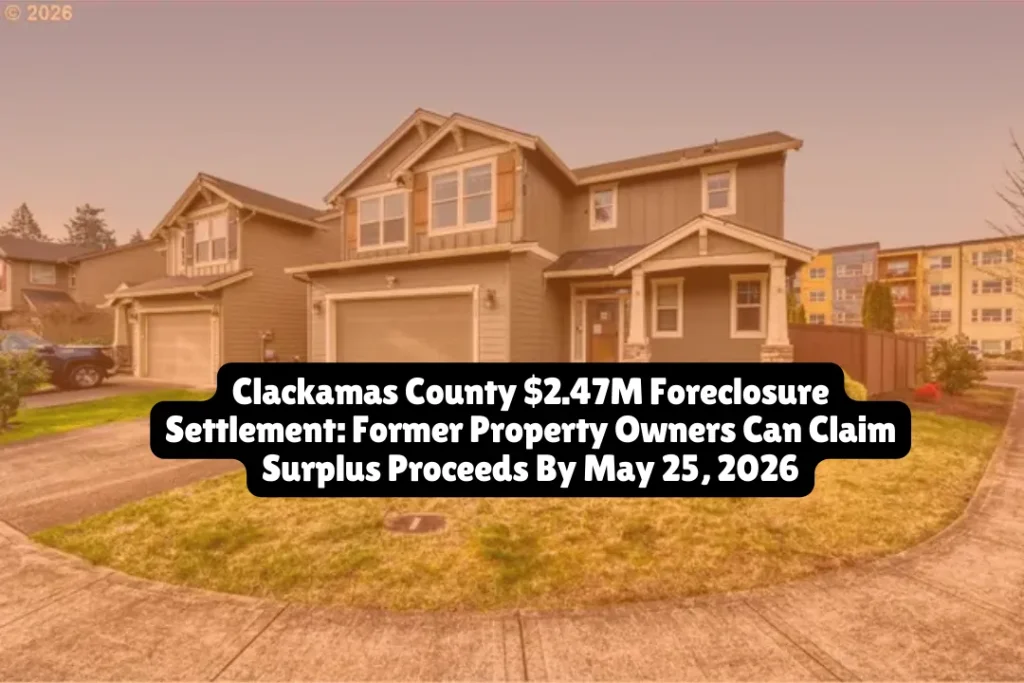
Clackamas County $2.47M Foreclosure Settlement, Former Property Owners Can Claim Surplus Proceeds By May 25, 2026
If you owned property in Clackamas County, Oregon that was foreclosed for unpaid property taxes between October 12, 2017 and January 12, 2024, you can claim surplus proceeds from a $2.47 million class action settlement. The claim deadline is May 25, 2026.
This groundbreaking settlement follows the Supreme Court’s 2023 decision in Tyler v. Hennepin County, which ruled that counties violate constitutional rights when they keep surplus equity from tax foreclosure sales. Now Clackamas County is paying back property owners whose homes were worth more than their tax debt.
What The Clackamas County Foreclosure Litigation Involves
The class action lawsuit Martin Lynch et al. v. Clackamas County et al. (Case No. 3:23-cv-01502) alleged that Clackamas County violated property owners’ Fifth Amendment rights by keeping surplus proceeds from tax foreclosure sales.
Here’s how it worked: When property owners fell behind on property taxes for three or more years, the county would foreclose on the property. If the property sold for more than the tax debt owed, the county kept the entire sale price instead of returning the excess to the former owner.
For example, if you owed $15,000 in back taxes and the county sold your property for $75,000, you received nothing—the county kept the full $75,000. The Supreme Court ruled in Tyler v. Hennepin County that this practice constitutes an unconstitutional taking of private property.
Who Is Affected By The Settlement
You’re a settlement class member if you meet these requirements:
You owned, inherited, or held an interest in real property located in Clackamas County, Oregon that was foreclosed on for non-payment of property taxes.
The redemption period for that property lapsed between October 12, 2017 and January 12, 2024.
Clackamas County either sold the property or retained it after the foreclosure.
Common interests in real property include ownership, mortgage interests, mechanic’s liens, tax liens, and judgment liens. Heirs and successors to deceased property owners also qualify if they can prove their relationship to the original owner.
Similar to recent property rights cases like the Blue Cross Blue Shield Class Action Lawsuit 2026, $2.67B Subscriber Settlement Payments Start May 2026—What You Need To Know, this settlement addresses systemic practices that financially harmed consumers.
The $2.47 Million Settlement Explained
Clackamas County agreed to pay $2,466,403.68 into a settlement fund to resolve these claims. The county denies any wrongdoing but settled to avoid the costs and uncertainties of continued litigation.
Here’s how the settlement fund will be distributed:
Attorneys’ fees: Up to 30% of the settlement fund (approximately $740,000)
Settlement administration costs: Amount to be determined by the settlement administrator Kroll
Class member payments: Remaining funds distributed to eligible claimants based on their surplus proceeds
Each class member who submits a valid claim will receive payment of the surplus proceeds from the sale of their foreclosed property. The exact amount you’ll receive depends on how much your property sold for compared to your tax debt.
How Surplus Proceeds Are Calculated
Your surplus proceeds equal the difference between:
Sale price of your property (what the county sold it for or its assessed value if retained)
Minus: Total tax debt (all unpaid taxes, penalties, interest, and foreclosure costs)
Equals: Your surplus proceeds
For properties the county still owns and sells in the future, Clackamas County agreed to pay the surplus amount either into the settlement fund or directly to the former owner.
The total payment amount cannot be calculated until all claims are submitted and validated. If total valid claims exceed the settlement fund, payments will be reduced proportionally (pro rata).
Settlement Timeline And Important Deadlines
January 9, 2026: Settlement announced and notice process began
March 13, 2026: Deadline to opt out of settlement or file objections
March 18, 2026: Final approval hearing at 9:00 AM PT (United States District Court for the District of Oregon, 1000 SW 3rd Ave, Portland, Oregon)
May 25, 2026: Claim filing deadline (11:59 PM PT)
Approximately 45-60 days after final approval: Payment distribution begins (assuming no appeals)
How To File Your Claim By May 25, 2026
You must submit a completed claim form to receive any settlement payment. Here’s how:
File Online: Visit www.ClackamasTaxForeclosureSettlement.com and complete the electronic claim form. This is the fastest and most secure method.
File By Mail: Download the claim form from the settlement website, complete it, and mail to:
Lynch v. Multnomah County (Clackamas County)
c/o Kroll Settlement Administration
PO Box 225391
New York, NY 10150-5391
The claim deadline is 11:59 PM PT on May 25, 2026. Claims submitted online must be completed by this time. Claims submitted by mail must be postmarked by this date.
If you do nothing, you will not receive any money but will still be legally bound by the settlement and give up your right to sue for these claims.
What Documentation You Need To Submit
The claim form will require information about your foreclosed property:
- Property address
- Parcel number (found on old property tax statements)
- Approximate dates of ownership
- Nature of your interest (owner, heir, lienholder)
- Proof of interest if you’re an heir or successor (death certificate, will, probate documents)
- Any documentation showing the property’s value or sale price
The settlement administrator may request additional documentation to verify your claim. Keep copies of all property tax statements, foreclosure notices, and ownership documents.
Current Settlement Status And Next Steps
As of February 2026, the settlement has received preliminary court approval and is moving toward the final approval hearing scheduled for March 18, 2026.
The settlement administrator Kroll is currently accepting claims through the official website. Class members who owned foreclosed properties should have received notice by mail in January 2026.
If the court grants final approval and no appeals are filed, payment processing will begin approximately 45-60 days later. Most class members should receive their surplus proceeds by summer 2026.
Like other major settlements including the $4M Numotion Data Breach Data Breach Class Action Settlement Claim Up To $15,000 By March 18, 2026, the actual payout timeline depends on whether objectors file appeals after final approval.
What Settlement Class Members Should Know
This settlement only covers Clackamas County. Other Oregon counties named in the original lawsuit are not participating. If you had property foreclosed in Multnomah County, Washington County, or other Oregon counties, those cases are still pending separately.
The settlement is nonreversionary. After paying all valid claims, legal fees, and administration costs, any remaining funds stay in the settlement fund. The money doesn’t go back to Clackamas County.
You’re still protected even if your property hasn’t been sold yet. For properties Clackamas County retained and still owns, the settlement agreement requires the county to pay surplus proceeds when these properties eventually sell.
The Supreme Court’s Tyler decision changed everything. Before this landmark 2023 ruling, counties across the country routinely kept surplus equity from tax foreclosures. Now this practice is unconstitutional, opening the door for similar lawsuits nationwide.
Common Misconceptions About The Settlement
Myth: Only the original property owner can claim surplus proceeds.
Reality: Heirs, successors, and lienholders can also claim if they prove their legal interest in the property.
Myth: You can’t claim if you still owe other debts.
Reality: Surplus proceeds belong to you regardless of other debts (though creditors may try to collect afterward).
Myth: Filing a claim admits you owed the taxes.
Reality: The settlement doesn’t dispute that taxes were owed—only that the county kept more than it was entitled to keep.
Myth: You’ll get the full value of your old property.
Reality: You only receive the difference between the sale price and your tax debt. If your property sold for less than you owed, there are no surplus proceeds.
What To Do Right Now
Step 1: Locate your foreclosure documents. Find any notices you received from Clackamas County about your tax foreclosure, including sale notices and redemption period information.
Step 2: Determine your property’s sale price. Contact Clackamas County Tax Assessor’s Office or check online records to find out what your property sold for (or its assessed value if the county still owns it).
Step 3: Calculate your potential surplus. Subtract your total tax debt (including penalties, interest, and fees) from the sale price. This is approximately what you could receive.
Step 4: File your claim before May 25, 2026. Don’t wait—visit www.ClackamasTaxForeclosureSettlement.com now to submit your claim online.
Step 5: Keep copies of everything. Save confirmation emails, claim numbers, and all supporting documentation.
Where To Find Official Settlement Information
Official Settlement Website: www.ClackamasTaxForeclosureSettlement.com
Settlement Administrator Contact:
Phone: (833) 754-9045
Email: Available through contact form on settlement website
Mail: Lynch v. Multnomah County (Clackamas County), c/o Kroll Settlement Administration, PO Box 225391, New York, NY 10150-5391
Court Information:
United States District Court for the District of Oregon
Case No. 3:23-cv-01502
Final Approval Hearing: March 18, 2026 at 9:00 AM PT
Location: 1000 SW 3rd Ave, Portland, Oregon
For information on other active class action settlements, check settlements currently accepting claims.
Frequently Asked Questions
What is the Clackamas County foreclosure class action settlement about?
The settlement resolves claims that Clackamas County unconstitutionally kept surplus proceeds when it foreclosed on properties for unpaid taxes and sold them for more than the tax debt owed, violating the Fifth Amendment’s Takings Clause.
Who is eligible to claim from this settlement?
Anyone who owned, inherited, or held a lien on property in Clackamas County that was tax-foreclosed with a redemption period lapsing between October 12, 2017 and January 12, 2024, including heirs and successors.
What is the deadline to file a claim?
May 25, 2026 at 11:59 PM PT for online claims or postmark date for mailed claims. Missing this deadline means you forfeit your right to receive surplus proceeds.
How much money could I receive?
The amount equals your property’s sale price minus your total tax debt (taxes, penalties, interest, fees). The exact amount depends on your specific property and how many claims are filed.
How do I file a claim?
Visit www.ClackamasTaxForeclosureSettlement.com to file online, or download and mail a paper claim form to Kroll Settlement Administration, PO Box 225391, New York, NY 10150-5391 (postmarked by May 25, 2026).
What documentation do I need to submit?
Property address, parcel number, proof of ownership or interest (deeds, tax statements), and for heirs: death certificates, wills, or probate documents proving your relationship to the deceased owner.
How long will it take to receive my payout?
Approximately 45-60 days after the court grants final approval on March 18, 2026, assuming no appeals are filed. Most payments should arrive by summer 2026.
Last Updated: February 10, 2026
Disclaimer: This article provides general information about the Clackamas County foreclosure class action settlement and does not constitute legal advice. For specific questions about your eligibility or claim, contact the settlement administrator at (833) 754-9045 or consult a qualified attorney.
Lost your property to tax foreclosure? You may be entitled to surplus proceeds. File your claim before May 25, 2026 at ClackamasTaxForeclosureSettlement.com.
Stay informed, stay protected. — AllAboutLawyer.com
About the Author

Sarah Klein, JD, is a licensed attorney and legal content strategist with over 12 years of experience across civil, criminal, family, and regulatory law. At All About Lawyer, she covers a wide range of legal topics — from high-profile lawsuits and courtroom stories to state traffic laws and everyday legal questions — all with a focus on accuracy, clarity, and public understanding.
Her writing blends real legal insight with plain-English explanations, helping readers stay informed and legally aware.
Read more about Sarah