
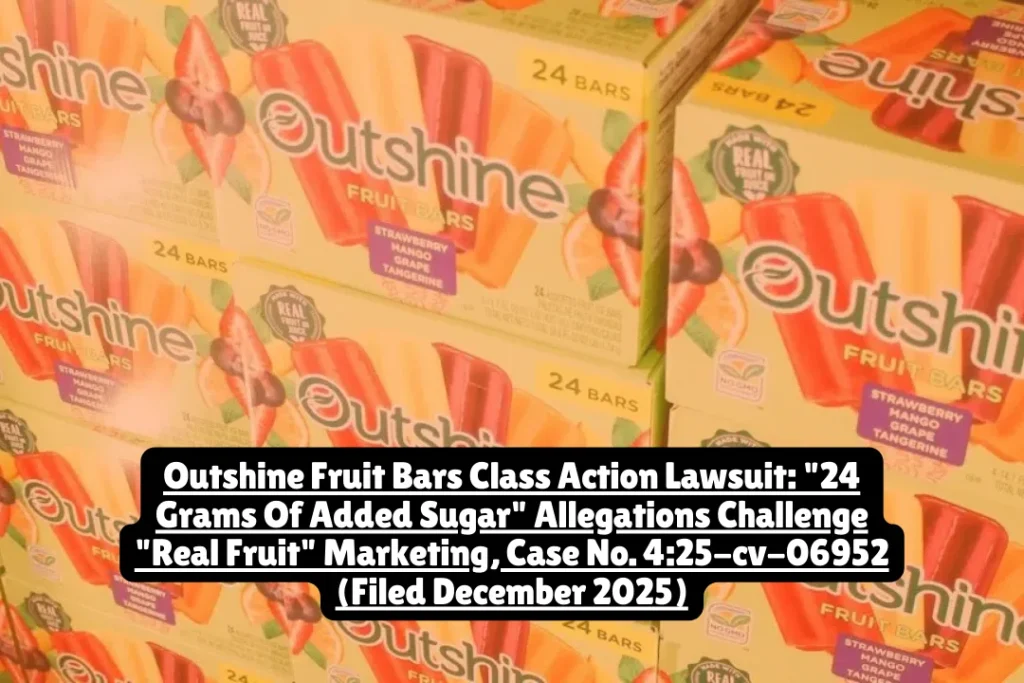
Outshine Fruit Bars Class Action Lawsuit, “24 Grams Of Added Sugar” Allegations Challenge “Real Fruit” Marketing, Case No. 4:25-cv-06952 (Filed December 2025)
A class action lawsuit filed December 9, 2025 accuses Dreyer’s Grand Ice Cream of misleading consumers by marketing Outshine fruit bars as healthy, real-fruit products while the bars allegedly contain 24 grams of added sugar—twice the sugar content of equivalent real fruit servings—plus synthetic ingredients and artificial flavoring agents. The lawsuit seeks compensation for all U.S. consumers who purchased Outshine fruit bars during the applicable statute of limitations period.
What The Outshine Fruit Bars Lawsuit Alleges
Plaintiff Rebecca Gomez filed a 44-page complaint in U.S. District Court for the Northern District of California alleging Dreyer’s Grand Ice Cream misrepresents its Outshine frozen fruit bars as containing only real fruit and plant-based ingredients. According to court filings in Gomez v. Dreyer’s Grand Ice Cream Inc., Case No. 4:25-cv-06952, the products contain high levels of added cane sugar, water, and synthetic ingredients that contradict the brand’s health-focused marketing claims.
The lawsuit alleges Dreyer’s markets Outshine bars with phrases like “made with real fruit,” “plant-based,” and “tastes like biting into a piece of ripe fruit,” leading consumers to believe they’re purchasing a nutritionally equivalent alternative to eating whole fruit. Instead, Gomez claims the products are “cane sugar with water on a stick” containing 24 grams of added sugar per serving—double the sugar content of an equivalent serving of real fruit.
The complaint further alleges Outshine bars derive most of their sweetness from refined cane sugar added during manufacturing, while the front packaging fails to disclose this high added sugar content or that the majority of sugar isn’t the natural sugar found in whole fruit.
Synthetic Ingredients And Artificial Flavoring Agents
The class action lawsuit alleges Outshine fruit bars contain synthetic and artificial flavoring agents not typically found in real fruit, including ascorbic acid, citric acid, and malic acid. According to the complaint, these ingredients are added to simulate or enhance the tart fruit flavors consumers expect from products marketed as “real fruit.”
The lawsuit claims reasonable consumers led to believe Outshine bars are healthy, made predominantly of the depicted fruit, nutritionally equivalent to real fruit, free of synthetic ingredients, and free of artificial flavors are being deceived. Court filings argue Dreyer’s creates a “healthy aura” through its labeling and marketing while masking the fact that products contain highly processed and synthetic ingredients.
Consumers don’t look at products “in a vacuum,” the lawsuit explains. Instead, they compare Outshine bars to similar frozen fruit offerings from other brands, and Dreyer’s marketing allegedly positions these bars as superior health choices when their nutritional profile contradicts those claims.
Who Qualifies For The Proposed Class Action
The lawsuit seeks to represent all United States residents who purchased Outshine Fruit Bars primarily for consumption during the applicable statutory period. No specific timeframe has been established yet because the case remains in preliminary litigation stages without class certification granted.
Eligibility will likely depend on when you purchased Outshine fruit bars and whether you can demonstrate you relied on the allegedly misleading marketing claims. Unlike settlements like the Walmart Class Action Lawsuit, Shoppers Are Getting Checks Right Now—Here’s How To Claim Your $45 Million Settlement Money In December 2025, this Outshine case hasn’t reached settlement or established specific eligibility requirements.
California residents who purchased Outshine fruit bars may have particularly strong claims under California’s consumer protection statutes cited in the complaint, though the proposed class covers all U.S. purchasers.
Legal Violations Alleged Against Dreyer’s Grand Ice Cream
Gomez is suing for violations of California’s Consumers Legal Remedies Act, Unfair Competition Law, and False Advertising Law, plus breach of express warranty. These statutes prohibit companies from making false or misleading statements about product characteristics, nutritional value, or ingredients.
The complaint argues reasonable consumers are “not expected to inspect” nutrition facts panels to verify health claims made on product packaging. Numerous studies demonstrate most consumers cannot make accurate assessments of a food’s healthfulness based solely on the Nutrition Facts Panel, the lawsuit mentions, so they rely heavily on front-of-package marketing and representations.
Dreyer’s allegedly violates consumer protection laws by creating a false impression through coordinated marketing elements including product names (“fruit bars”), front-label images showing fresh fruit, plant-based claims, and taste descriptions comparing the bars to eating fresh ripe fruit—all while omitting disclosures about added sugar content and synthetic ingredients that fundamentally alter the nutritional profile.
Current Status Of The Lawsuit As Of February 2026
The Outshine fruit bars class action lawsuit was filed December 9, 2025, and remains in very early litigation stages. No settlement has been proposed, no class has been certified, and no claims administrator has been appointed. Dreyer’s Grand Ice Cream has not yet publicly responded to the allegations.
The case follows a pattern of false advertising lawsuits targeting food products marketed as healthy despite containing high sugar levels. In 2025, consumers filed a lawsuit against Simply Delicious Inc. alleging the company falsely advertised Bobo’s oat bars as healthy despite containing large amounts of added sugar, demonstrating growing consumer awareness and legal action around deceptive food marketing.
The plaintiff is represented by Adrian Gucovschi of Gucovschi Law Firm PLLC. The case will likely proceed through discovery, where both sides exchange evidence and documents, before any settlement discussions or class certification motions.
No Settlement Or Claims Process Exists Yet
Because no settlement has been reached, there is no claims process, deadline, or website for Outshine fruit bars purchasers. If you believe you were affected by allegedly misleading marketing, save all documentation including purchase receipts, packaging showing product claims, credit card or debit card statements reflecting Outshine purchases, and any promotional materials you relied on when making purchase decisions.
If the case eventually settles or proceeds to judgment with class certification, affected consumers will receive official notice through mail, email, or publication with detailed claim instructions and deadlines. Class members are automatically included once a class is certified unless they opt out, preserving individual lawsuit rights while forfeiting class settlement benefits.
Compensation amounts in false advertising settlements vary widely. Similar cases like the Sierra Mist Lawsuit Untold Story Of False Advertising Claims, Product Liability demonstrate that food and beverage companies face significant liability when marketing products using misleading health claims.
What Consumers Should Know About “Natural” Food Marketing
The Outshine lawsuit highlights broader issues with food labeling and marketing using terms like “natural,” “real,” and “healthy.” These terms are often lightly regulated or undefined under federal law, allowing companies flexibility in how they market products while potentially misleading health-conscious consumers.
The FDA doesn’t have a formal definition for “natural” on food labels, though it has a longstanding policy considering “natural” to mean nothing artificial or synthetic has been included or added to a food that wouldn’t normally be expected in that food. The lawsuit alleges Outshine violates even this informal standard by adding synthetic flavoring agents not found in whole fruit.
Consumer advocates emphasize the importance of reading ingredient lists and nutrition facts panels rather than relying solely on front-of-package marketing claims. However, the Outshine lawsuit argues consumers shouldn’t be expected to conduct detailed nutritional analysis when companies make clear representations about product healthfulness on packaging.
What Is The Outshine Fruit Bars Class Action Lawsuit?
The lawsuit alleges Dreyer’s Grand Ice Cream misrepresents Outshine fruit bars as healthy, real-fruit products when they contain 24 grams of added sugar per serving, synthetic ingredients, and artificial flavoring agents, violating California consumer protection laws.
How Many Consumers Are Affected By The Outshine Fruit Bars Lawsuit?
The lawsuit estimates hundreds of thousands of U.S. consumers purchased Outshine fruit bars based on allegedly misleading marketing claims. Exact numbers haven’t been disclosed because the case remains in early litigation without class certification.
What Misleading Claims Did Outshine Make About Real Fruit And Sugar Content?
The lawsuit alleges Outshine marketed bars as “made with real fruit,” “plant-based,” and tasting “like biting into a piece of ripe fruit” while failing to disclose that products contain twice the sugar of equivalent real fruit servings, with most sweetness coming from added refined cane sugar rather than natural fruit sugar.
Which Consumers Are Eligible For Compensation?
The proposed class includes all U.S. residents who purchased Outshine Fruit Bars primarily for consumption during the applicable statutory period. No specific eligibility requirements exist yet because no settlement has been reached and class certification hasn’t been granted.
How Do I Check If I’m Eligible For The Outshine Class Action Settlement?
No settlement or claims process exists yet. The lawsuit was filed December 9, 2025, and remains in preliminary litigation. If a settlement is eventually reached, affected consumers will receive official notice with eligibility criteria and claim instructions.
How Do I File A Claim In The Outshine Fruit Bars Class Action?
No claims process exists yet because no settlement has been reached. Save purchase receipts, product packaging, and payment records showing Outshine fruit bars purchases. If the case settles, you’ll receive notice with claim filing instructions.
What Is The Deadline To File A Claim?
No claim deadline exists yet. If a settlement is reached or the case proceeds to judgment with class certification, official notices will provide specific deadlines, typically 60-180 days after settlement preliminary approval or final judgment.
Where Can I Find Official Information About The Lawsuit And Claims Process?
The case is Gomez v. Dreyer’s Grand Ice Cream Inc., Case No. 4:25-cv-06952, in the U.S. District Court for the Northern District of California. Court filings are available through PACER or by contacting the plaintiff’s attorney at Gucovschi Law Firm PLLC.
Last Updated: February 7, 2026
Disclaimer: This article provides informational content only and does not constitute legal advice. Consult an attorney for guidance on your specific situation.
If you purchased Outshine fruit bars believing they were a healthy real-fruit alternative, save your purchase documentation. The lawsuit is ongoing and may result in compensation for affected consumers.
Stay informed, stay protected. — AllAboutLawyer.com
About the Author

Sarah Klein, JD, is a licensed attorney and legal content strategist with over 12 years of experience across civil, criminal, family, and regulatory law. At All About Lawyer, she covers a wide range of legal topics — from high-profile lawsuits and courtroom stories to state traffic laws and everyday legal questions — all with a focus on accuracy, clarity, and public understanding.
Her writing blends real legal insight with plain-English explanations, helping readers stay informed and legally aware.
Read more about Sarah