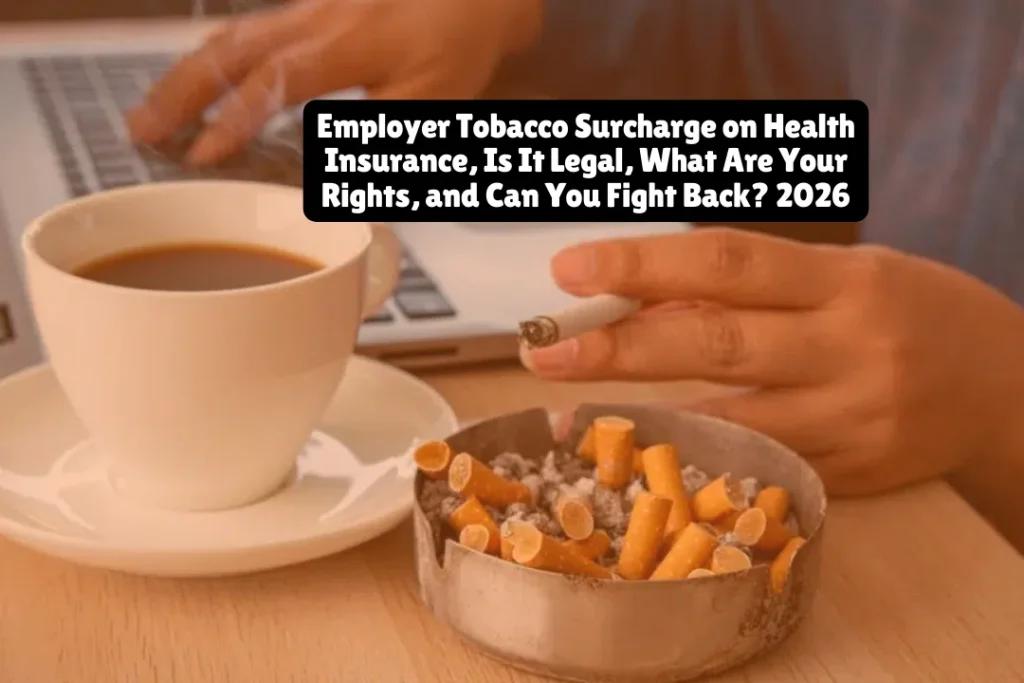
Employer Tobacco Surcharge on Health Insurance, Is It Legal, What Are Your Rights, and Can You Fight Back? 2026
Your employer is charging you extra on your health insurance because you smoke — or because you won’t prove that you don’t. It feels unfair. But is it actually legal? The short answer: it depends on where you live and whether your employer followed the rules. Here’s everything you need to know.
Is a Tobacco Surcharge Actually Legal?
Yes — at the federal level. The Affordable Care Act (ACA) and the Health Insurance Portability and Accountability Act (HIPAA) both allow employers to charge tobacco users more for health insurance as part of a wellness program. The surcharge can be as high as 50% of the cost of employee-only coverage.
But here’s the catch: that surcharge is only legal if the employer’s wellness program passes a 5-factor compliance test under HIPAA. If the program fails even one factor, the surcharge may be illegal — and employees may have legal grounds to challenge it.
The 5 Rules Your Employer Must Follow
For a tobacco surcharge to be legally compliant, the employer’s wellness program must meet all five of these requirements:
Annual opportunity. Employees must get a chance to qualify for the lower premium at least once per year.
Incentive cap. The surcharge cannot exceed 50% of the cost of employee-only coverage.
Reasonable design. The program must be designed to promote health or prevent disease — not simply punish employees.
Reasonable alternative standard. This is the big one. The employer must offer an alternative way to avoid the surcharge — usually a smoking cessation program. If an employee completes that program, they get the lower rate, even if they keep smoking.
Clear notice. Employees must be told about the reasonable alternative standard in their plan documents, open enrollment materials, and summary plan descriptions.
What Happened When Bass Pro Shops Got It Wrong
In 2025, a Missouri federal court gave final approval to a $4.95 million settlement in Ruiz v. Bass Pro Group LLC (Case No. 6:24-cv-03122). Bass Pro had been charging employees $2,080 per year in tobacco surcharges from April 2018 through October 2024.
The problem? Bass Pro never properly told employees they had a reasonable alternative standard to avoid the surcharge. That violated ERISA — the federal law that governs employer health plans. Approximately 5,500 employees received payments averaging over $580 each.
This case set a clear signal: employers who fail to follow the rules will face consequences.
Do All States Allow Tobacco Surcharges?
No. Several states have banned tobacco surcharges entirely. As of January 2026, the states that prohibit them include California, Massachusetts, New Jersey, New York, Rhode Island, Vermont, and Washington, D.C. Virginia banned them for 2024 and 2025 under state legislation, though additional action was needed to extend that ban beyond 2025.
If you live in one of these states, your employer cannot legally charge you a tobacco surcharge — period.
What You Must Know as an Employee
If your employer is charging you a tobacco surcharge, you have specific rights. You have the right to know about any reasonable alternative standard available to you. You have the right to enroll in a cessation program to avoid the surcharge. You have the right to challenge the surcharge if your employer failed to notify you properly or did not offer an alternative. And if you complete a reasonable alternative program, you are entitled to a retroactive refund of any surcharges you paid during that plan year.
As legal analysts noted in September 2025, employers across the country are now facing a surge in ERISA class action lawsuits over non-compliant tobacco surcharge programs. The Bass Pro settlement is only the beginning.
What to Do Next
Step 1: Check your plan documents. Look at your Summary Plan Description or open enrollment materials. Do they mention a reasonable alternative standard or a smoking cessation program? If not, that’s a red flag.
Step 2: Request information in writing. Contact your HR department or benefits administrator and ask them to explain in writing how the tobacco surcharge works and what alternatives are available.
Step 3: Know your state law. If you live in California, New York, Massachusetts, New Jersey, Rhode Island, Vermont, or D.C., a tobacco surcharge may be illegal in your state regardless of federal rules.
Step 4: File a complaint if needed. If you believe the surcharge violates your rights, you can file a complaint with the U.S. Department of Labor’s Employee Benefits Security Administration (EBSA) at dol.gov/ebsa. You can also learn the broader complaint process through resources like the How To File A Wage And Hour Complaint | Employee Rights Guide on AllAboutLawyer.com.
The same federal protections that cover wage disputes also protect employees facing unlawful health plan surcharges. Cases like the Workday Class Action Lawsuit, Millions Of Job Seekers Over 40 Just Got Green Light To Sue Workday show that courts are increasingly willing to hold employers accountable when federal employee protections are violated.
FAQs
Is it legal for my employer to charge me a tobacco surcharge?
It is legal under federal law only if the employer’s wellness program follows all HIPAA compliance rules, including offering a reasonable alternative standard. If the program is non-compliant, the surcharge may be illegal.
How much can my employer charge?
The maximum tobacco surcharge under federal law is 50% of the cost of employee-only health coverage. Any amount above that is a violation.
What if my employer never told me about a smoking cessation program?
That is a potential violation of HIPAA’s notice requirements. The Bass Pro settlement in 2025 resulted in $4.95 million in payments specifically because the employer failed to inform employees about available alternatives.
Can I refuse to pay the surcharge?
You cannot simply refuse without consequence — but you can challenge it legally if it does not comply with federal or state law. Filing a complaint with the DOL’s EBSA is the recommended first step.
Do I have to tell my employer if I smoke?
Most tobacco surcharge programs use self-certification — meaning you attest to your tobacco use status during open enrollment. Employers generally cannot use medical tests to verify tobacco use without additional consent requirements under the ADA.
What states ban tobacco surcharges?
As of January 2026, California, Massachusetts, New Jersey, New York, Rhode Island, Vermont, and Washington, D.C. prohibit tobacco surcharges. Virginia banned them for 2024–2025 under specific legislation.
What changed in 2025 regarding tobacco surcharges?
The $4.95 million Bass Pro settlement (final approval May 30, 2025) and a documented surge in ERISA class action lawsuits put employers on notice that non-compliant tobacco surcharge programs will face legal action.
Last Updated: January 28, 2026
Disclaimer: This article is for informational purposes only and does not constitute legal advice. Consult a qualified employment attorney for guidance specific to your situation.
If your employer is charging you a tobacco surcharge, start by reviewing your plan documents today — what you find could determine whether you have grounds to challenge it.
Stay informed, stay protected. — AllAboutLawyer.com
About the Author

Sarah Klein, JD, is a licensed attorney and legal content strategist with over 12 years of experience across civil, criminal, family, and regulatory law. At All About Lawyer, she covers a wide range of legal topics — from high-profile lawsuits and courtroom stories to state traffic laws and everyday legal questions — all with a focus on accuracy, clarity, and public understanding.
Her writing blends real legal insight with plain-English explanations, helping readers stay informed and legally aware.
Read more about Sarah