
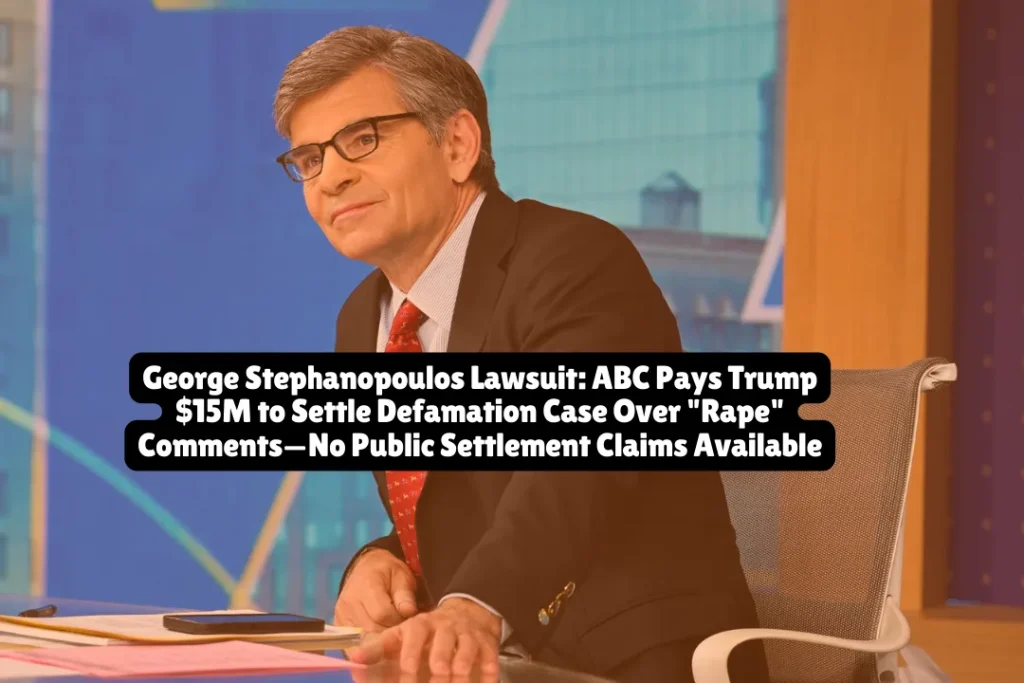
George Stephanopoulos Lawsuit, ABC Pays Trump $15M to Settle Defamation Case Over “Rape” Comments—No Public Settlement Claims Available
ABC News and anchor George Stephanopoulos agreed to pay President-elect Donald Trump $15 million toward his presidential library plus $1 million in legal fees to settle a defamation lawsuit filed in March 2024. The settlement, finalized on December 14, 2024, resolved Trump’s claims that Stephanopoulos defamed him during a March 10, 2024, “This Week” interview when the anchor repeatedly stated Trump had been “found liable for rape” in E. Jean Carroll’s civil lawsuits.
The case was settled just one day before both Trump and Stephanopoulos were scheduled to sit for court-ordered depositions, and there is no public settlement fund, no claims process, and no eligibility requirements for third parties—this was a direct payment from ABC to Trump’s future presidential foundation.
What George Stephanopoulos Said That Triggered the Lawsuit
During a March 10, 2024, live interview with Rep. Nancy Mace (R-S.C.) on ABC’s “This Week,” Stephanopoulos asked Mace how she could support Trump “after judges and two separate juries have found him liable for rape.” He repeated variations of this statement at least 10 times during the contentious interview, pressing Mace about her endorsement of someone who had been “found liable for rape” and was “defaming the victim of that rape.”
The problem? No jury ever found Trump liable for rape under New York law. In May 2023, a federal jury in Manhattan found Trump liable for sexually abusing writer E. Jean Carroll and defaming her, awarding Carroll $5 million in damages. In January 2024, a second jury awarded Carroll an additional $83.3 million for further defamation claims. However, neither verdict involved a finding of rape as specifically defined under New York Penal Law.
Under New York law, rape requires vaginal penetration by a penis. The jury’s verdict found Trump liable for “sexual abuse,” which under New York Penal Law Section 130.65 includes forcible penetration of the vagina or other bodily orifices by fingers or objects other than a penis. Judge Lewis Kaplan, who presided over both Carroll trials, clarified in an August 2023 ruling that while Trump wasn’t found liable for rape under New York’s narrow statutory definition, “the jury found that Mr. Trump in fact did exactly that” according to how rape is “commonly understood” in everyday language and defined in many other jurisdictions.
Who Filed the Lawsuit and What Legal Claims Were Made
Trump filed his defamation lawsuit against ABC News, ABC, and George Stephanopoulos on March 18, 2024, in the U.S. District Court for the Southern District of Florida (Miami Division). The complaint alleged that Stephanopoulos made false and defamatory statements with “actual malice”—the heightened legal standard public figures like Trump must prove in defamation cases under New York Times Co. v. Sullivan (1964).
Actual malice means the defendant either knew the statement was false when they made it or acted with reckless disregard for whether it was true or false. Trump’s legal team argued that Stephanopoulos couldn’t possibly have believed Trump was found liable for rape when the jury verdicts specifically found him liable for sexual abuse, not rape. The complaint claimed Stephanopoulos knew the distinction between the legal terms but chose to use “rape” anyway to maximize reputational damage.
Trump sought unspecified damages for harm to his reputation, emotional distress, and punitive damages to punish what he characterized as deliberate misrepresentation. The lawsuit named three defendants: ABC Inc., ABC News Inc., and George Stephanopoulos individually. All three defendants were represented by the same legal team and presented a unified defense.
How ABC Defended the Case and Why It Settled
ABC filed a motion to dismiss the lawsuit in May 2024, arguing that Stephanopoulos’s statements were substantially true because Judge Kaplan had explicitly ruled that Trump “raped” Carroll as the term is commonly understood, even if not under New York’s narrow statutory definition. ABC’s lawyers contended that the First Amendment protects journalists who accurately report judicial findings, and that Stephanopoulos was simply conveying the judge’s interpretation of the verdict.
On July 11, 2024, U.S. District Judge Cecilia M. Altonaga denied ABC’s motion to dismiss, finding that Trump had stated sufficient facts to proceed with his defamation claim. Judge Altonaga ruled that whether Stephanopoulos’s characterization of the verdict was “substantially true” and whether he acted with actual malice were questions for a jury to decide at trial, not issues that could be resolved through a motion to dismiss.
This ruling triggered the discovery phase of litigation, during which Trump’s attorneys could subpoena Stephanopoulos’s emails, text messages, and internal ABC communications to search for evidence of actual malice. On December 13, 2024—the day before the settlement was announced—Magistrate Judge Lisette Reid ordered both Trump and Stephanopoulos to appear for depositions the following week, with each deposition limited to four hours.
The settlement came together quickly after that order. According to court documents filed December 14, 2024, the parties reached agreement on settlement terms the previous Friday (December 13), avoiding the scheduled depositions. Legal experts speculated that ABC wanted to prevent the discovery process from exposing internal editorial discussions that might reveal knowledge of the legal distinction between rape and sexual abuse under New York law.
Settlement Terms: $15M to Trump’s Presidential Library Plus $1M Legal Fees
The settlement agreement requires ABC News, ABC, and George Stephanopoulos to pay $15 million as a “charitable contribution” to a non-profit organization established in connection with Trump’s future presidential library and museum. The money must be transferred within 10 days of the settlement and placed in escrow until the presidential foundation is formally established.
Additionally, the defendants agreed to pay $1 million to cover Trump’s attorney fees incurred during the litigation. The settlement specified that payment goes to the law firm of Alejandro Brito, Trump’s lead attorney in the case. This brings the total settlement value to $16 million.
As part of the agreement, ABC News posted an editor’s note at the bottom of the March 10, 2024, article about the Stephanopoulos interview. The note reads: “ABC News and George Stephanopoulos regret statements regarding President Donald J. Trump made during an interview by George Stephanopoulos with Rep. Nancy Mace on ABC’s This Week on March 10, 2024.”
Critically, the settlement does not include an admission of liability or wrongdoing by ABC or Stephanopoulos. The language carefully uses the word “regret” rather than acknowledging the statements were false. This is standard in media defamation settlements where defendants want to avoid admitting fault while still resolving the case.
What You Must Know About Defamation Law for Public Figures
The actual malice standard makes it extraordinarily difficult for public figures to win defamation cases. Trump, as a former president and presidential candidate, qualifies as a public figure and thus bears the burden of proving Stephanopoulos knew his statements were false or acted with reckless disregard for the truth. This is a much higher bar than the standard for private citizens, who only need to prove negligence in most states.
First Amendment attorney Floyd Abrams told CNN the settlement represents “a major victory” for Trump despite the fact that defamation cases against media outlets are notoriously hard for public figures to win. Abrams noted that “George Stephanopoulos had inaccurately summarized the jury verdict as one in which the jury had found Trump liable for rape when it had instead found him liable for ‘sexual abuse’ and not rape.”
The settlement avoided a trial where a jury would have decided whether Stephanopoulos’s statements were substantially true (because Judge Kaplan said Trump “raped” Carroll in common understanding) or legally false (because the jury verdict found sexual abuse, not rape under New York law). Media law experts were divided on ABC’s chances at trial—some believed the network had a strong First Amendment defense, while others thought the clear legal distinction between the verdict (sexual abuse) and Stephanopoulos’s characterization (rape) created genuine risk of liability.
The timing of the settlement—one day before depositions—suggests ABC may have been concerned about what internal communications might reveal. In defamation cases, evidence that journalists knew about factual errors before publication or broadcast is devastating to the defense. If ABC’s legal team discovered emails or messages showing Stephanopoulos or his producers discussed the rape-versus-sexual-abuse distinction before the interview aired, that could establish actual malice.
How This Compares to Other High-Profile Media Defamation Cases
The $16 million total settlement ranks among the larger media defamation payouts in recent years but remains far below the largest verdicts. For comparison, Fox News paid Dominion Voting Systems $787.5 million in 2023 to settle defamation claims over false election fraud allegations—the biggest known media defamation settlement in U.S. history. That same law firm, Clare Locke, now represents French President Emmanuel Macron and First Lady Brigitte Macron in their Candace Owens Lawsuit Update, Latest In The Macron Defamation Case.
The ABC settlement is comparable to other celebrity defamation cases that settled before trial. Johnny Depp won a $10.35 million jury verdict against Amber Heard in 2022, though that case ultimately settled for $1 million. Rudy Giuliani’s $148 million defamation judgment to Georgia election workers Ruby Freeman and Shaye Moss represents the high end of defamation damages when cases go to trial.
What makes the ABC settlement unusual is that it occurred before trial and before extensive discovery. Most media companies fight defamation cases through trial because the actual malice standard heavily favors defendants. ABC’s decision to settle relatively early suggests the network weighed the costs of prolonged litigation, the risk of embarrassing internal communications being exposed during discovery, and the potential for a much larger jury verdict if the case went poorly at trial.
Why the Settlement Amount Goes to Trump’s Library, Not Him Personally
The settlement structure—directing the $15 million to Trump’s presidential foundation rather than to Trump personally—serves several purposes. First, it allows ABC to characterize the payment as a “charitable contribution” rather than a personal payout to Trump. This framing may have tax advantages for ABC and helps the network argue it’s supporting presidential history preservation, not enriching Trump personally.
Second, presidential libraries are typically established as non-profit organizations under Section 501(c)(3) of the Internal Revenue Code, meaning the money will eventually be used for educational and historical purposes rather than Trump’s personal benefit. However, Trump will control the foundation that receives the funds, giving him significant discretion over how the money is used within legal constraints governing presidential library foundations.
Third, the structure avoided direct payment to Trump that might create political complications for ABC’s parent company Disney. Directing funds to a future presidential library allows ABC to maintain that it’s honoring the institution of the presidency rather than settling a personal dispute with a politician who may return to the White House.
The settlement agreement specifies that if no presidential foundation or museum is established within a reasonable timeframe, the escrowed funds will be released according to terms determined by the court. This prevents the money from remaining in escrow indefinitely.
What to Do Next If You’re Following Defamation Cases Against Media
Court records for this case are available through the U.S. District Court for the Southern District of Florida’s Public Access to Court Electronic Records (PACER) system at pacer.uscourts.gov. Search for case number 1:24-cv-20920 to view the complaint, ABC’s motion to dismiss, Judge Altonaga’s ruling, and the settlement agreement filed December 14, 2024.
For the latest developments in high-profile defamation litigation, monitor established legal news sources including Law360, Legal Intelligencer, Reuters Legal, and The Hollywood Reporter’s legal coverage. These outlets provide accurate reporting on media liability cases as they develop. Avoid relying solely on social media for legal news, as misinformation about lawsuit settlements and outcomes spreads rapidly online.
If you’re a journalist or media professional concerned about defamation liability, consult with a media law attorney before publishing stories about public figures that could be construed as defamatory. The actual malice standard provides substantial protection for good-faith reporting, but errors in stating factual claims—particularly legal findings like jury verdicts—can create liability even for established news organizations.
For those interested in understanding how defamation law applies to political speech and election-related claims, the Rudy Giuliani $148 million settlement demonstrates how false statements about private individuals face lower legal protections than statements about public figures. The distinction between public and private figures fundamentally shapes defamation law in the United States.
Is There a Settlement Fund I Can Claim Money From?
No. This was a defamation lawsuit between Donald Trump (as plaintiff) and ABC News/George Stephanopoulos (as defendants). The $16 million settlement is paid directly from ABC to Trump’s presidential library foundation. There is no class action, no settlement administrator, no claims process, and no eligibility requirements for third parties to receive money.
Did George Stephanopoulos Admit He Lied About Trump?
No. The settlement includes a statement of “regret” but not an admission that the statements were false or made with actual malice. Stephanopoulos has not publicly apologized or retracted his characterization of the jury verdict. The settlement allows both sides to end the litigation without conceding the other side’s legal position.
Can Trump Still Sue Other Media Outlets for Similar Comments?
Yes. The settlement only resolves Trump’s claims against ABC, ABC News, and George Stephanopoulos arising from the March 10, 2024, interview. Trump retains the right to sue other media outlets or individuals for separate defamatory statements. However, each case would require proving actual malice anew, and Trump’s status as a public figure makes these cases difficult to win even when the statements are factually incorrect.
Why Did ABC Settle If They Had a Strong First Amendment Defense?
Legal experts cite several possible reasons: (1) Avoiding embarrassing discovery where internal communications might reveal knowledge of the legal distinction between rape and sexual abuse; (2) Eliminating the risk of a runaway jury verdict that could far exceed $16 million; (3) Preventing Trump from using the deposition process to grandstand about media bias; and (4) Protecting Stephanopoulos from the stress and reputational damage of a lengthy public trial. Settlement allows ABC to control costs and move on.
What Happened to the Scheduled Depositions?
The December 13, 2024, court order requiring Trump and Stephanopoulos to sit for depositions was mooted by the settlement reached the same day. Neither deposition took place. This was likely a key factor in ABC’s decision to settle—depositions in defamation cases often uncover damaging information and can be used strategically by plaintiffs to embarrass defendants even if the case doesn’t proceed to trial.
Has Stephanopoulos Discussed the Settlement On Air?
No. George Stephanopoulos did not mention the settlement on the December 15, 2024, episode of “This Week”—the Sunday immediately after the settlement was announced. ABC News has not reported on the settlement in its television broadcasts, though the network issued a written statement saying it was “pleased that the parties have reached an agreement to dismiss the lawsuit.” This silence on air contrasts with how ABC typically covers major legal developments involving other media organizations.
Will This Settlement Encourage More Lawsuits Against Media Companies?
Possibly. Legal experts note that Trump has filed numerous unsuccessful defamation cases against media outlets over the years, but the ABC settlement represents one of his few victories. The settlement may encourage other public figures to file defamation suits even when they face the high bar of proving actual malice, betting that media companies will settle to avoid discovery costs and trial risks rather than fight through to verdict. However, most defamation cases against media defendants still fail because of robust First Amendment protections.
What Does This Mean for How Journalists Report on Court Verdicts?
Journalists should exercise extreme caution when characterizing jury verdicts and judicial findings, particularly in cases involving public figures who have the resources to sue for defamation. Even when a judge makes interpretive comments (like Judge Kaplan saying Trump “raped” Carroll as commonly understood), journalists risk liability by stating those interpretations as if they were the jury’s actual verdict. The safest practice is to report precisely what the jury found without editorializing or paraphrasing legal terms of art.
Last Updated: February 2, 2026
Disclaimer: This article provides general information about the George Stephanopoulos defamation lawsuit and should not be considered legal advice.
Need guidance? If you’re a media professional facing defamation concerns or a public figure considering legal action for allegedly false statements, consult with a media law or defamation attorney licensed in your jurisdiction to understand your rights and obligations.
Stay informed, stay protected. — AllAboutLawyer.com
About the Author

Sarah Klein, JD, is a licensed attorney and legal content strategist with over 12 years of experience across civil, criminal, family, and regulatory law. At All About Lawyer, she covers a wide range of legal topics — from high-profile lawsuits and courtroom stories to state traffic laws and everyday legal questions — all with a focus on accuracy, clarity, and public understanding.
Her writing blends real legal insight with plain-English explanations, helping readers stay informed and legally aware.
Read more about Sarah