
Lawsuit Against Justice Roberts Dismissed, What the FOIA Case Means for Judicial Independence 2026
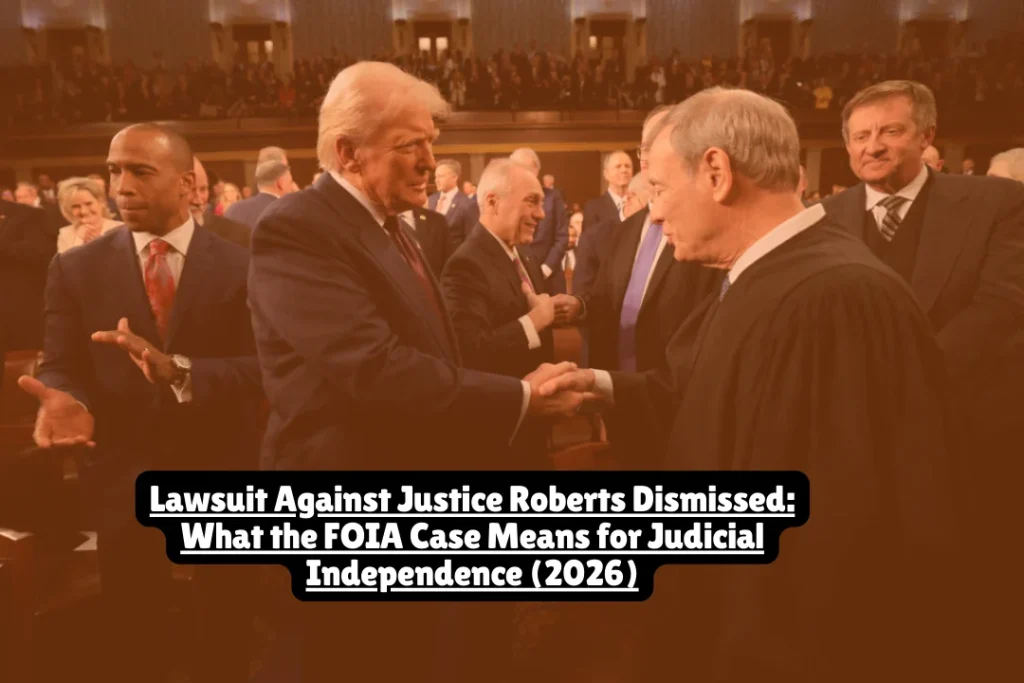
A federal judge dismissed the lawsuit against Chief Justice John Roberts on December 19, 2025. The case—America First Legal Foundation v. Roberts—was filed in April 2025 seeking access to judicial records under the Freedom of Information Act. U.S. District Judge Trevor McFadden ruled the court lacked jurisdiction because the Judicial Conference and Administrative Office are part of the judicial branch, not executive agencies subject to FOIA. The dismissal preserves judicial independence but leaves questions about transparency in court administration.
What Was the Lawsuit Against Chief Justice Roberts About?
The America First Legal Foundation filed the lawsuit on April 22, 2025, in the U.S. District Court for the District of Columbia. The case was officially titled America First Legal Foundation v. Roberts, Case No. 1:25-cv-01232.
Chief Justice Roberts was named as a defendant in his official capacity as Presiding Officer of the Judicial Conference of the United States. Robert J. Conrad, Director of the Administrative Office of the U.S. Courts, was also named as a defendant.
Here’s what the lawsuit claimed: America First Legal argued that the Judicial Conference and Administrative Office were performing regulatory functions beyond their core judicial duties. Specifically, the group pointed to actions these bodies took in 2023 to investigate ethics allegations against Justices Clarence Thomas and Samuel Alito and to develop a code of conduct for Supreme Court justices.
The lawsuit contended these activities were executive functions that should be subject to presidential oversight and therefore fall under FOIA—the federal law requiring disclosure of government records. FOIA applies to executive branch agencies but explicitly exempts Congress and the federal courts.
America First Legal requested documents showing communications between the Judicial Conference and Senator Sheldon Whitehouse and Representative Hank Johnson, two Democratic lawmakers who had raised ethics concerns about conservative justices.
Why Did America First Legal Sue Chief Justice Roberts?
The lawsuit was part of broader tensions between the Trump administration and federal courts.
America First Legal Foundation is a conservative legal group founded by Stephen Miller, who served as a top adviser during Trump’s first term and returned to the White House in 2025. While Miller is no longer affiliated with the group, it maintains close ties to Trump allies.
The organization argued that communications between judicial administrators and Democratic lawmakers constituted regulatory activity that exceeded the judiciary’s constitutional role. They claimed this made the Judicial Conference and Administrative Office subject to the same transparency requirements as executive agencies.
The legal theory was aggressive: if successful, it would have subjected key judicial bodies to executive branch control and oversight, fundamentally altering the separation of powers. America First Legal contended that “accommodations with Congress are the province of the executive branch,” not the judiciary.
The group wanted access to records showing how the Judicial Conference responded to congressional pressure to impose ethics rules on Supreme Court justices—a politically charged issue following reports that Justices Thomas and Alito accepted gifts and hospitality from wealthy donors.
What Did Judge McFadden Rule in Dismissing the Case?
Judge Trevor McFadden—a Trump appointee himself—dismissed the lawsuit for lack of subject matter jurisdiction on December 19, 2025.
His ruling centered on a fundamental question: Are the Judicial Conference and Administrative Office part of the judicial branch or the executive branch?
McFadden concluded they’re clearly judicial. Both bodies were created by Congress to support the federal court system, not to serve executive functions. The Judicial Conference makes policy for lower federal courts, while the Administrative Office handles administrative tasks like budgeting and operations.
Here’s McFadden’s key reasoning: FOIA exempts “courts” from disclosure requirements. America First Legal argued “courts” means only judges and their immediate staff like law clerks. McFadden rejected this narrow interpretation.
“Indeed, if America First were right that only judges and ‘law clerks,’ who ‘directly report to the judge,’ count as part of ‘the courts,’ numerous questions arise, and senseless line drawing ensues,” McFadden wrote.
He explained that FOIA’s exemption covers the full range of “judicial adjuncts”—clerks, court reporters, and others performing tasks integral to the judicial process. The Judicial Conference and Administrative Office fall within this category.
McFadden emphasized that nothing about these entities suggests they need presidential supervision or accountability to executive officers. They’re designed to preserve judicial independence, not undermine it.
What Is the Judicial Conference and Why Does This Matter?
The Judicial Conference of the United States is the policymaking body for the federal court system. Established by Congress in 1922, it’s chaired by the Chief Justice and includes representatives from different federal courts.
The conference makes recommendations about court rules, judicial conduct, and administrative practices. It investigates complaints against federal judges and can recommend impeachment in serious cases.
The Administrative Office, created in 1939, handles day-to-day operations—budgets, personnel, technology, and support services for federal courts nationwide.
Both bodies exist to keep courts independent from political pressure. Without them, federal courts would need to rely on executive agencies for basic functions, potentially compromising judicial autonomy.
The lawsuit challenged this independence by arguing these bodies had crossed into executive territory by responding to congressional inquiries about justice ethics. If successful, it would have subjected internal court administration to executive control and public records requests.
Courts have consistently rejected this argument. Previous FOIA lawsuits against the Administrative Office failed in both the Second Circuit and D.C. federal courts, with judges ruling these bodies are integral parts of the judiciary.
What Are the Implications for Judicial Independence?
McFadden’s dismissal preserves a critical boundary between branches of government.
If the lawsuit had succeeded, the executive branch could have demanded records from judicial administrators, monitored internal court deliberations, and potentially influenced judicial policy through transparency threats. This would undermine the constitutional separation of powers.
Federal judges hold lifetime appointments specifically to insulate them from political pressure. The administrative bodies supporting courts exist for the same reason—to prevent outside interference with judicial functions.
At the same time, the case raises legitimate questions about accountability. The Judicial Conference recently adopted a code of conduct for Supreme Court justices, but critics note it lacks enforcement mechanisms. Justices aren’t subject to the same ethics rules as lower court judges.
Some legal scholars argue judicial administration should have more transparency, even if FOIA doesn’t apply. Others warn that opening internal court communications to public scrutiny would chill deliberations and compromise judicial independence.
The tension won’t disappear. With hundreds of federal lawsuits challenging Trump administration policies in 2025, friction between the executive and judicial branches remains high.
What Role Did Supreme Court Ethics Controversies Play?
The lawsuit directly targeted how judicial administrators responded to ethics allegations against conservative justices.
In 2023, Senator Whitehouse and Representative Johnson raised concerns about Justices Thomas and Alito after reports revealed they accepted luxury travel, hospitality, and gifts from wealthy conservative donors. These included private jet trips, yacht excursions, and resort stays worth hundreds of thousands of dollars.
The lawmakers asked the Judicial Conference to investigate and develop ethics standards for Supreme Court justices. In response, the conference issued guidance clarifying that justices must disclose travel and gifts, with narrow exceptions for personal hospitality.
The Supreme Court then adopted its first formal code of conduct in November 2023. While this addressed some concerns, critics noted the code has no enforcement mechanism and relies on individual justices’ judgment about when to recuse themselves from cases.
America First Legal argued this entire process—responding to congressional inquiries, investigating justices, and creating ethics rules—constituted regulatory activity beyond the judiciary’s core function of deciding cases. They claimed it made these bodies subject to FOIA as executive agencies.
The argument failed because courts have long held that judicial administration, including ethics oversight, is inherently judicial, not executive.
What Happens Next in the Case?
The dismissal appears final. America First Legal could appeal to the U.S. Court of Appeals for the D.C. Circuit, but precedent strongly favors the judiciary’s position.
As of January 2026, no appeal has been filed. The case record shows the dismissal was entered on December 19, 2025, giving plaintiffs time to decide whether to pursue an appeal.
Even if they appeal, success is unlikely. Both the Second Circuit and D.C. Circuit have previously ruled that judicial administrative bodies are exempt from FOIA. The Supreme Court has also suggested in dicta that FOIA’s court exemption extends beyond judges themselves.
For Chief Justice Roberts, the dismissal ends his involvement as a defendant. He was sued in his official capacity as head of the Judicial Conference, not personally.
The broader political tensions driving the lawsuit remain. Trump administration officials have criticized federal judges for blocking executive orders on immigration, voting, and other priorities. Conservative legal groups continue seeking ways to challenge judicial authority and increase transparency in court operations.
What Can Citizens Do About Judicial Transparency?
While FOIA doesn’t apply to courts, other mechanisms exist for judicial accountability.
Congress has constitutional authority to regulate the federal court system under Article III. It can pass legislation requiring ethics disclosures, creating enforcement mechanisms, or imposing recusal standards on Supreme Court justices.
Citizens can contact their representatives to support judicial ethics reform. Several bills have been introduced to strengthen Supreme Court ethics rules, though none have passed.
Court proceedings themselves are generally public. You can access case filings, court opinions, and oral arguments for most federal cases. The Supreme Court posts transcripts and audio recordings of oral arguments on its website.
For concerns about specific judges, the judiciary has a complaint process. The Judicial Conference investigates misconduct complaints and can recommend disciplinary action or impeachment.
The key limitation is that Supreme Court justices aren’t subject to the same oversight as lower court judges. This remains a contentious issue with no easy solution.
Last Updated: January 28, 2026
Disclaimer: This article is for informational purposes only and does not constitute legal advice.
The lawsuit against Chief Justice Roberts was dismissed, preserving judicial independence while leaving unresolved questions about Supreme Court ethics and accountability. Stay informed about separation of powers issues affecting our courts.
Stay informed, stay protected. — AllAboutLawyer.com
About the Author

Sarah Klein, JD, is a licensed attorney and legal content strategist with over 12 years of experience across civil, criminal, family, and regulatory law. At All About Lawyer, she covers a wide range of legal topics — from high-profile lawsuits and courtroom stories to state traffic laws and everyday legal questions — all with a focus on accuracy, clarity, and public understanding.
Her writing blends real legal insight with plain-English explanations, helping readers stay informed and legally aware.
Read more about Sarah