
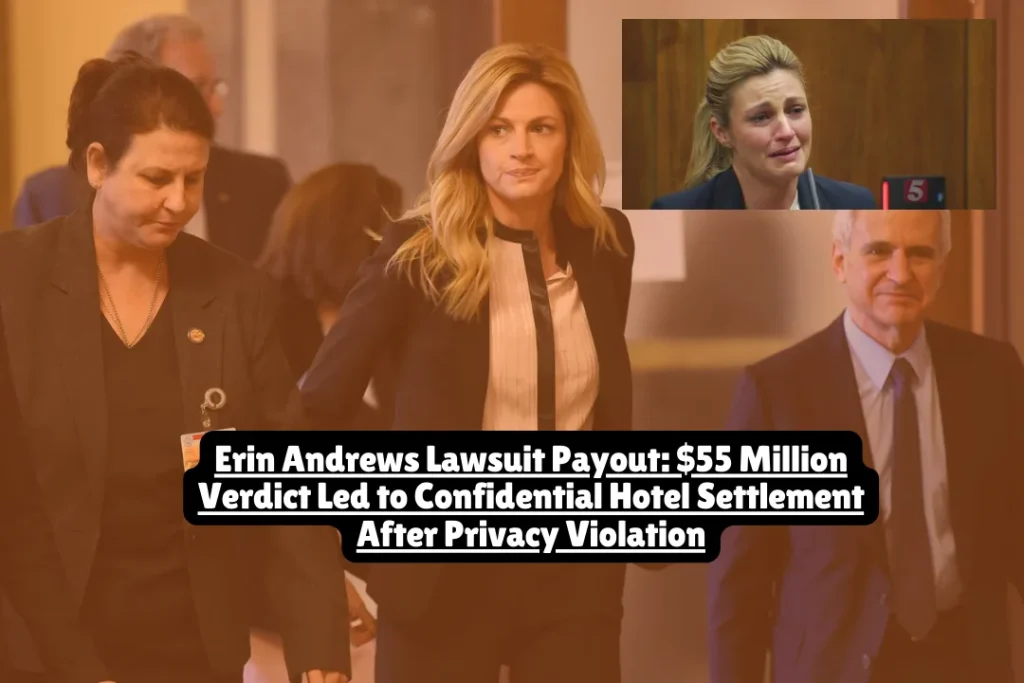
Erin Andrews Lawsuit Payout, $55 Million Verdict Led to Confidential Hotel Settlement After Privacy Violation
A Nashville jury awarded sportscaster Erin Andrews $55 million in March 2016 after a stalker secretly filmed her nude in a hotel room and posted the video online. The case settled confidentially with the hotel defendants in April 2016, just weeks after the verdict.
Andrews sued the Nashville Marriott at Vanderbilt University and stalker Michael David Barrett for invasion of privacy after Barrett altered her hotel room’s peephole in 2008 and recorded her changing clothes. The jury found Barrett 51% responsible ($28 million) and the hotel companies 49% responsible ($27 million) for failing to protect her privacy.
What the Erin Andrews Privacy Lawsuit Was About
Michael David Barrett stalked Andrews to a Nashville Marriott in September 2008 while she covered a Vanderbilt football game for ESPN. Barrett called the hotel pretending to be part of Andrews’ group and confirmed her reservation. He then used an in-house employee phone to learn her room number and requested the room next door.
Barrett modified Andrews’ hotel room door peephole using a hacksaw and recorded her nude for over four minutes. He initially tried selling the video to celebrity gossip website TMZ but was refused. Barrett then posted the footage online in 2009, where it received over 17 million views.
The FBI investigation revealed Barrett had filmed at least 10 other women using similar methods at hotels in Nashville and Columbus, Ohio.
Legal Claims in the Hotel Privacy Case
Andrews filed her invasion of privacy lawsuit in 2010 against West End Hotel Partners (the hotel owner), Windsor Capital Group (the hotel operator), and Barrett. The case centered on whether the hotel breached its duty to protect guest safety and privacy.
Andrews’ attorneys argued the hotel committed negligent security by revealing her room location to a stranger and allowing him to book the adjacent room without notifying her. The hotel defendants claimed Barrett was solely responsible as a determined criminal whose actions they couldn’t have anticipated.
Judge Hamilton Gayden found Barrett at fault before trial. The jury then decided whether hotel companies shared responsibility for the privacy invasion and resulting emotional distress.
How the Jury Split Fault and Damages
After deliberating on March 7, 2016, the jury awarded Andrews $55 million in damages. They assigned 51% fault to Barrett ($28 million) and 49% fault to the two hotel companies combined ($27 million).
Andrews testified she suffered humiliation, shame, depression, and ongoing emotional distress because people continued watching and taunting her about the videos years later. Her parents described the terror of not knowing who filmed their daughter or whether she remained in danger.
The hotel’s defense strategy of suggesting Andrews’ successful career proved she wasn’t seriously harmed backfired with jurors. One juror explained the verdict sent a message that hotels must protect guest safety and privacy.
Confidential Settlement Reached in April 2016
Andrews reached a confidential settlement with West End Hotel Partners and Windsor Capital Group on April 25, 2016, approximately six weeks after the jury verdict. Settlement terms remain undisclosed.
Legal experts note Andrews likely received substantially less than $55 million. Barrett was judgment-proof with no assets, meaning the $28 million assigned to him was uncollectible. The hotel companies’ insurance limits, legal fees, and potential tax obligations on emotional distress damages would have reduced her actual payout significantly.
Attorneys estimated if Andrews settled with the hotel companies for approximately $20 million, her net recovery after legal fees and taxes could have been $10 million or less—roughly 18% of the widely reported $55 million verdict.
The settlement occurred hours before lawyers were scheduled to return to court on a joint liability issue that could have made hotel companies responsible for the full $55 million.
Related Article: 12th Man Lawsuit, Texas A&M Donor Breach of Contract Case Cleared for Trial After Judge Denies Dismissal (2025)
Impact on Hotel Security and Privacy Law
The case prompted significant changes to hotel procedures nationwide to protect guest safety, security, and privacy. Hotels implemented stricter protocols about disclosing guest information and requests for specific room locations.
The verdict established that hotels can be held liable for foreseeable privacy invasions when they fail to implement basic security measures. Courts recognized that even though a criminal committed the actual violation, businesses sharing fault through negligence must compensate victims.
The case also helped mobilize efforts to pass stronger stalking laws and heavier penalties for illegally photographing people for sexual gratification.
What You Must Know About Privacy Rights in Hotels
Hotels owe guests a duty of reasonable care to protect their safety and privacy. This includes not disclosing room numbers to unauthorized persons and questioning suspicious requests for rooms adjacent to specific guests.
The Erin Andrews case demonstrates that businesses can face substantial liability when security lapses enable foreseeable harm, even when a third party commits the wrongful act. Courts increasingly hold that privacy violations in hotel settings justify significant damages for emotional distress.
For anyone experiencing similar privacy violations, documentation is critical. Andrews’ case succeeded partly because FBI investigators established Barrett’s pattern of conduct and the hotel’s specific security failures.
How to Protect Your Privacy Rights
Verify Hotel Security Practices
When booking hotels, ask about their policies for protecting guest information and room assignments. Never assume standard procedures prevent privacy violations.
Report Privacy Violations Immediately
Contact law enforcement and hotel management immediately if you discover unauthorized recording devices or suspect privacy violations. Federal and state wiretapping laws provide criminal penalties and civil remedies.
Consult Privacy Law Attorneys
If you’ve experienced privacy invasions at hotels or businesses, consult attorneys specializing in privacy torts, premises liability, or civil rights law. Most offer free consultations to evaluate potential claims.
Similar Gmail Class Action Lawsuit cases show courts increasingly recognize substantial damages for privacy violations even without physical harm.
Where to Find Official Case Information
Court Records and Legal Documents
Davidson County Circuit Court in Nashville maintains public records for Andrews v. West End Hotel Partners, et al. Court filings include the complaint, jury verdict, and settlement approval documents.
Legal Research Databases
Westlaw and LexisNexis provide access to court opinions and legal analysis of the case. Law libraries offer free public access to these databases.
News Coverage of the Verdict
Major legal publications including Bloomberg Law, Reuters, and the American Bar Association published detailed coverage of the trial, verdict, and settlement.
Frequently Asked Questions
What was the Erin Andrews lawsuit about?
Andrews sued a Nashville hotel and stalker for invasion of privacy after the stalker secretly filmed her nude through a modified peephole and posted the video online in 2009.
How much did Erin Andrews receive in her lawsuit payout?
The jury awarded $55 million, but Andrews settled confidentially with the hotel companies in April 2016 for undisclosed terms likely substantially less than the verdict amount.
Who was sued in the Erin Andrews privacy case?
Andrews sued Michael David Barrett (the stalker), West End Hotel Partners (hotel owner), and Windsor Capital Group (hotel operator). Marriott International was initially named but dismissed.
What legal claims were involved?
The lawsuit alleged invasion of privacy, negligent security, and emotional distress. The jury found both Barrett and the hotel companies shared fault for the privacy violation.
When did Erin Andrews receive her settlement?
The confidential settlement was reached in April 2016, approximately six weeks after the March 2016 jury verdict. Payment details remain undisclosed.
What happened to Michael David Barrett?
Barrett pleaded guilty to stalking Andrews and was sentenced to 30 months in prison. He served his sentence but was judgment-proof with no assets to satisfy the $28 million damages.
What impact did this case have on privacy law?
The case established that hotels can be held liable for privacy invasions when security failures enable foreseeable harm. It prompted nationwide changes to hotel security procedures and stronger stalking laws.
Last Updated: January 26, 2026
Disclaimer: This article provides general information about the Erin Andrews lawsuit and is not legal advice. Individuals should consult qualified attorneys specializing in privacy law, media law, or civil litigation for case-specific guidance.
Stay informed about your privacy rights and understand how businesses must protect your personal information. — AllAboutLawyer.com
About the Author

Sarah Klein, JD, is a licensed attorney and legal content strategist with over 12 years of experience across civil, criminal, family, and regulatory law. At All About Lawyer, she covers a wide range of legal topics — from high-profile lawsuits and courtroom stories to state traffic laws and everyday legal questions — all with a focus on accuracy, clarity, and public understanding.
Her writing blends real legal insight with plain-English explanations, helping readers stay informed and legally aware.
Read more about Sarah