
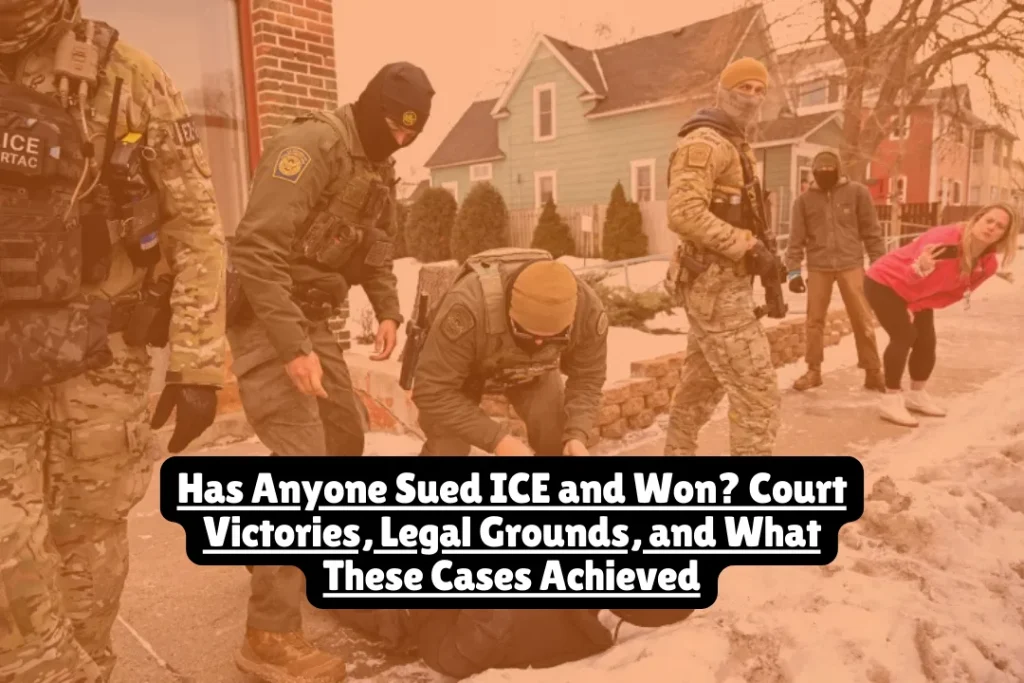
Has Anyone Sued ICE and Won? Court Victories, Legal Grounds, and What These Cases Achieved
Yes, individuals and organizations have successfully sued ICE and won in federal courts. Victories include court orders stopping unlawful detentions, requiring due process protections, blocking unconstitutional enforcement practices, awarding damages for civil rights violations, and mandating policy changes. In December 2025, a federal court enforced a 2021 permanent injunction blocking a new Trump administration policy to automatically jail unaccompanied minors who turn 18, showing courts continue to hold ICE accountable.
Types of Successful Lawsuits Against ICE
Prolonged Detention and Bond Hearing Cases
The landmark case Rodriguez v. Robbins (Ninth Circuit, 2015) established that immigration detainees held for six months or longer have a constitutional right to bond hearings. The court ruled that prolonged detention without an individualized determination of dangerousness or flight risk violates due process under the Fifth Amendment.
Under the court’s permanent injunction, ICE must provide bond hearings where the government—not the detainee—must prove by clear and convincing evidence that continued detention is justified. This ruling has benefited thousands of immigration detainees, with many securing release after ICE failed to meet its burden of proof.
The Ninth Circuit held that detention under 8 U.S.C. § 1226(c) and § 1225(b) is limited to six months absent a finding of flight risk or dangerousness. While the Supreme Court later narrowed some aspects of this ruling, court-ordered bond hearings continue in California’s Central District under a permanent injunction.
Fourth Amendment Violations and Unlawful Home Raids
Federal courts have repeatedly found ICE violated the Fourth Amendment by entering homes without judicial warrants or using deceptive tactics. In Kidd v. Noem (2025), a court settlement prohibited ICE officers from identifying themselves as state or local law enforcement and banned ruses misrepresenting their governmental identity.
The settlement bars ICE from falsely claiming they are conducting criminal investigations, looking for someone else, or misrepresenting danger to residents. ICE officers must now wear visible “ICE” identifiers and cannot enter the curtilage—private area around a home—without a judicial warrant or consent.
In Gonzalez v. ICE (Central District of California, 2017), the court ruled that ICE and the Los Angeles County Sheriff’s Department unlawfully detained thousands on the basis of unconstitutional immigration detainers issued without probable cause. The decision entitled class members to both injunctive relief and monetary damages.
Class Actions Securing Systemic Reforms
Garcia Ramirez v. ICE achieved a permanent injunction requiring ICE to comply with statutory obligations for unaccompanied minors who turn 18. The court pointed to ICE’s “pervasive violations” and “pattern of agency recalcitrance” in failing to consider less restrictive placements as required by the Trafficking Victims Protection Reauthorization Act.
The injunction requires ICE to consider the least restrictive setting for every unaccompanied child turning 18, make all “age-outs” eligible for alternatives to detention, and document custody decisions on standardized worksheets. In December 2025, the court enforced this injunction against new Trump administration policies attempting to automatically detain youth.
Legal Grounds That Have Succeeded
Constitutional Claims That Work
Fourth Amendment violations for warrantless home entries and searches have produced successful outcomes. Courts recognize that entering private property without judicial warrants or using deceptive tactics violates constitutional protections against unreasonable searches and seizures.
Fifth Amendment Due Process claims challenging prolonged detention without hearings have secured releases and bond hearings. The Supreme Court established in Zadvydas v. Davis (2001) that indefinite detention violates due process when removal is not reasonably foreseeable. For more on how courts review detention authority, see Federal Judge Orders ICE To Immediately Release Kilmar Abrego Garcia, What It Means For Immigration Detention.
Habeas Corpus Petitions
Writs of habeas corpus under 28 U.S.C. § 2241 allow detained individuals to challenge whether ICE has lawful authority to continue holding them. These petitions have successfully secured releases when courts found detention exceeded statutory authority, violated constitutional protections, or continued despite winning immigration relief.
Recent habeas victories include cases where ICE detained individuals months after immigration judges granted them withholding of removal or protection under the Convention Against Torture, violating both law and ICE’s own policies.
Statutory Violations
Courts have found ICE violated specific federal statutes, including the Trafficking Victims Protection Reauthorization Act requirement to consider less restrictive placements for youth. Statutory claims often succeed because they involve clear congressional mandates ICE failed to follow.
What Remedies Courts Have Ordered
Immediate Release From Detention
Federal judges have ordered ICE to immediately release individuals when detention lacks lawful authority. In habeas corpus cases, courts can grant release within days of ruling if they find constitutional or statutory violations.
However, winning release doesn’t automatically resolve immigration cases—it means the person can fight deportation from outside detention, significantly improving their chances of success with legal representation and community support.
Related Article: Can I Have a Loaded Gun in My Car in Minnesota? Yes With a Permit—Storage Rules and Penalties Explained
Injunctive Relief and Policy Changes
Courts have issued permanent injunctions requiring ICE to change enforcement practices. These include mandating bond hearings after six months detention, prohibiting deceptive tactics during home raids, requiring consideration of less restrictive alternatives for detained youth, and banning warrantless entries into home curtilage.
Injunctive relief protects entire classes of people, not just individual plaintiffs. The Garcia Ramirez injunction applies nationwide to all unaccompanied minors turning 18 in ICE custody.
Monetary Damages
While less common than injunctive relief, some plaintiffs have won monetary damages. In Gonzalez v. ICE, class members became entitled to damages for Fourth Amendment violations. Damage claims typically require showing constitutional violations by individual ICE agents under Bivens actions or through the Federal Tort Claims Act.
What People Get Wrong About Suing ICE
“You Can’t Sue Federal Agencies”
This is false. While sovereign immunity generally bars suits against the federal government, Congress has created specific pathways to challenge government actions. Habeas corpus petitions, constitutional claims under Bivens, and Federal Tort Claims Act provisions allow litigation against ICE and individual agents.
The key is understanding which legal vehicle applies. Habeas corpus challenges detention authority. Bivens actions target individual officers for constitutional violations. FTCA claims address negligence or wrongful acts by federal employees.
“ICE Has Complete Immunity”
Recent cases prove ICE can be held accountable. From 2013-2025, courts have issued major rulings against ICE for constitutional violations, statutory non-compliance, and policy failures. While qualified immunity can protect individual officers in some circumstances, it doesn’t shield clearly established constitutional violations.
The Supreme Court’s 2025 decision in Martin v. United States hinted that victims of federal law enforcement abuse should be able to sue when injured, pushing back against overly broad immunity claims.
Practical Realities of ICE Litigation
Most Victories Are Releases, Not Money
Successful ICE lawsuits typically result in release from detention, bond hearings, or policy changes rather than monetary compensation. Habeas corpus petitions seek liberty, not damages. Class action injunctions mandate systemic reforms.
While some plaintiffs win monetary damages, these cases are complex, require substantial evidence, and face qualified immunity defenses. For most detained individuals, securing release is the primary goal and most achievable outcome.
You Need Experienced Legal Representation
Litigation against federal agencies requires specialized expertise in immigration law, constitutional litigation, and federal procedure. Nonprofit legal organizations like the ACLU, National Immigration Law Center, and immigrant rights groups often handle ICE litigation through class actions.
Individual cases may qualify for pro bono representation from law firms or legal aid organizations. However, evaluating whether you have viable claims, navigating federal court procedures, and overcoming government defenses demands professional legal assistance.
What to Do If ICE Violated Your Rights
If you believe ICE violated your constitutional rights or is detaining you unlawfully, consult an immigration attorney or civil rights lawyer immediately. Viable claims include detention for six months or longer without a bond hearing in certain jurisdictions, warrantless entry into your home or property, use of deceptive tactics to gain entry or secure arrest, detention after winning immigration relief, and excessive force or unsafe detention conditions.
Strict deadlines apply to different types of claims. Habeas corpus petitions can be filed while detained, but other claims have specific filing windows under the Federal Tort Claims Act and other statutes.
Organizations like the ACLU, National Immigration Project, and local immigrant rights groups sometimes take cases challenging ICE practices. Contact them to inquire about representation or referrals to attorneys handling ICE litigation.
Frequently Asked Questions
Can you sue ICE for wrongful detention?
Yes, through habeas corpus petitions under 28 U.S.C. § 2241 challenging whether ICE has lawful authority to detain you. Courts have ordered releases when detention exceeded statutory authority, violated due process protections, or continued despite winning immigration relief. The Rodriguez v. Robbins cases established that prolonged detention for six months or longer without bond hearings raises constitutional concerns, resulting in court-ordered releases for thousands of detainees who ICE couldn’t prove were flight risks or dangers to the community.
Has anyone won money from suing ICE?
Yes, though less commonly than winning release or policy changes. In Gonzalez v. ICE, a class action challenging unconstitutional immigration detainers, class members won both injunctive relief and monetary damages for Fourth Amendment violations. Individual plaintiffs have also won damages under Bivens actions for constitutional violations and through the Federal Tort Claims Act for excessive force or negligence. However, these cases require substantial evidence, face qualified immunity defenses, and are more complex than habeas petitions seeking release.
What happens if you win a lawsuit against ICE?
It depends on the type of claim. Habeas corpus victories typically result in immediate release from detention. Class action injunctions can require ICE to change policies affecting thousands of people, like providing bond hearings or prohibiting deceptive tactics. Some successful lawsuits result in settlements where ICE agrees to policy changes without admitting wrongdoing. Monetary damages are possible but less common. Winning a detention challenge doesn’t automatically resolve your immigration case—it means you can fight deportation from outside detention, significantly improving your chances with legal representation.
Do I need a lawyer to sue ICE?
Practically speaking, yes. While individuals can file habeas corpus petitions pro se (representing themselves), federal litigation against ICE is complex and requires understanding constitutional law, immigration statutes, federal procedure, and government immunity doctrines. Nonprofit legal organizations often handle ICE litigation through class actions. Some immigration attorneys and civil rights lawyers take individual cases. Many successful ICE lawsuits involve coordination between multiple legal organizations with specialized expertise. Without legal representation, navigating these cases successfully is extremely difficult.
Can ICE be held accountable in court?
Yes, federal courts have repeatedly held ICE accountable for constitutional violations, statutory non-compliance, and policy failures. From 2013-2025, major court victories include the Rodriguez v. Robbins bond hearing requirements, Garcia Ramirez v. ICE permanent injunction protecting unaccompanied minors, Kidd v. Noem settlement banning deceptive tactics, and Gonzalez v. ICE ruling against unconstitutional detainers. Courts can order immediate releases, mandate policy changes, issue permanent injunctions, and in some cases award damages. However, accountability requires strong legal grounds, experienced attorneys, and patience with federal litigation processes.
What are the most common successful claims against ICE?
The most successful claims are habeas corpus petitions challenging prolonged detention without bond hearings (following Rodriguez v. Robbins), Fourth Amendment violations for warrantless home entries or unconstitutional detainers, statutory violations like failing to comply with the Trafficking Victims Protection Reauthorization Act, and due process claims for indefinite detention when removal isn’t reasonably foreseeable. Class actions challenging systemic ICE practices have achieved major victories requiring policy changes. Individual claims for excessive force or unsafe detention conditions can succeed under the Federal Tort Claims Act with substantial evidence.
Last Updated: January 25, 2026
Disclaimer: This article provides general educational information about successful lawsuits against ICE and is not legal advice for your specific situation.
If you believe ICE violated your constitutional rights or you have questions about potential legal claims, consult an immigration attorney or civil rights lawyer immediately. Every case is unique, and an attorney can evaluate your specific circumstances, explain applicable deadlines, and determine whether you have viable claims.
Stay informed, stay protected. — AllAboutLawyer.com
Sources Cited:
- Rodriguez v. Robbins, 804 F.3d 1060 (9th Cir. 2015) (prolonged detention and bond hearings)
- Garcia Ramirez v. ICE (D.D.C. 2021) (permanent injunction on unaccompanied minors)
- Kidd v. Noem (C.D. Cal. 2025) (settlement prohibiting deceptive tactics)
- Gonzalez v. ICE (C.D. Cal. 2017) (unconstitutional immigration detainers)
- Zadvydas v. Davis, 533 U.S. 678 (2001) (indefinite detention limits)
- Martin v. United States (U.S. Supreme Court 2025) (federal law enforcement accountability)
- U.S. Constitution, Fourth Amendment (protection against unreasonable searches and seizures)
- U.S. Constitution, Fifth Amendment Due Process Clause
- 8 U.S.C. § 1226 (detention during removal proceedings)
- 8 U.S.C. § 1231 (post-removal detention)
- 28 U.S.C. § 2241 (habeas corpus statute)
- Trafficking Victims Protection Reauthorization Act (TVPRA)
- Federal Tort Claims Act provisions
- Bivens v. Six Unknown Named Agents, 403 U.S. 388 (1971) (constitutional tort claims against federal officers)
- ACLU litigation documentation and case reports
- National Immigration Law Center resources
- National Immigration Project case documentation
About the Author

Sarah Klein, JD, is a legal writer with experience in immigration and migration law, covering topics like green cards, marriage-based visas, and asylum applications. Through All About Lawyer, she provides straightforward legal insights to help individuals and families navigate complex immigration processes with clarity and confidence.
Read more about Sarah