
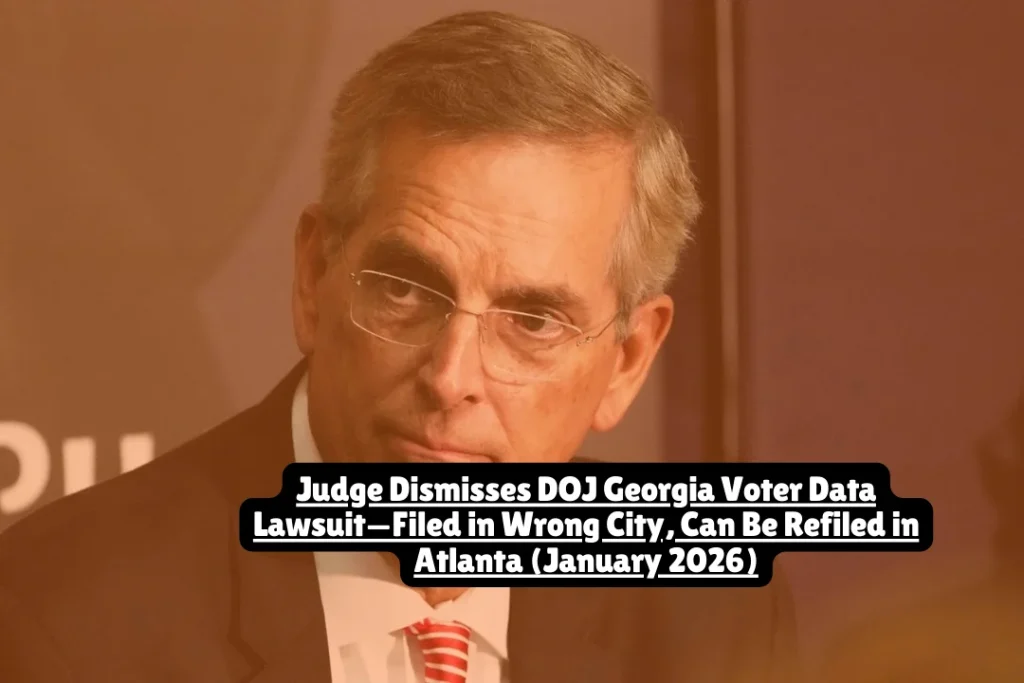
Judge Dismisses DOJ Georgia Voter Data Lawsuit—Filed in Wrong City, Can Be Refiled in Atlanta (January 2026)
U.S. District Judge Ashley Royal dismissed the Justice Department’s lawsuit seeking voter information from Georgia on January 23, 2026—not because the government’s claims lack merit, but because the DOJ sued in Macon instead of Atlanta where Georgia Secretary of State Brad Raffensperger’s principal office is located. The dismissal was “without prejudice,” meaning the Justice Department can immediately refile the case in the correct venue.
Why the Judge Dismissed the DOJ’s Lawsuit
The Venue Error That Derailed the Case
Federal jurisdiction rules under 28 U.S.C. § 1391 require lawsuits against government officials to be filed in the district where the defendant “resides”—typically interpreted as their principal place of business. Judge Royal determined that Secretary of State Brad Raffensperger’s principal office is in Atlanta, making the Northern District of Georgia (Atlanta) the proper venue for this lawsuit.
The Justice Department filed the case in the Middle District of Georgia (Macon), where Raffensperger maintains a satellite office. While Raffensperger does have an office presence in Macon, Judge Royal ruled this secondary location doesn’t satisfy federal venue requirements when the official’s primary headquarters is clearly in another district.
This ruling illustrates how technical procedural requirements can derail even government lawsuits. The “without prejudice” dismissal means the DOJ made a fixable mistake—they simply sued in the wrong courthouse—rather than a fatal flaw in their legal claims.
What “Without Prejudice” Means
When a court dismisses a case “without prejudice,” it means the plaintiff can refile the exact same lawsuit again, typically in the correct venue or after correcting procedural defects. This is fundamentally different from dismissal “with prejudice,” which permanently bars refiling the same claims.
For the Justice Department, this means they can—and likely will—refile the voter data lawsuit in Atlanta’s federal district court within days or weeks. The venue error adds time to the case timeline but doesn’t resolve the underlying legal dispute about whether Georgia must provide the requested voter information.
State Senator Randall Robertson, who supports compelling Georgia to provide the data, called the dismissal “frustrating” because even if the Justice Department refiles the lawsuit in Atlanta, the procedural error delays resolution of whether Georgia must comply with the federal government’s voter data request.
What the DOJ Seeks From Georgia
The Nationwide Voter Data Collection Effort
The Justice Department has filed lawsuits against 24 states and the District of Columbia seeking voter information as part of its effort to collect detailed voting data nationwide. The requests include highly sensitive personal information: dates of birth, driver’s license numbers, and Social Security numbers.
Federal officials claim this data collection serves legitimate law enforcement and election security purposes. However, the scope and sensitivity of the requested information has raised significant concerns among voting rights advocates, privacy experts, and state election officials about potential misuse, data security risks, and voter intimidation.
The DOJ’s voter data requests mirror similar efforts during previous administrations, though the current scale—25 jurisdictions sued simultaneously—is unprecedented. Civil rights organizations have expressed concern that collecting comprehensive voter files at the federal level could facilitate voter suppression efforts or intimidate eligible voters from participating in elections.
Raffensperger’s Refusal and Political Context
Georgia Secretary of State Brad Raffensperger’s refusal to hand over the records has become a significant issue in his 2026 run for governor. Raffensperger famously refused President Donald Trump’s demand in a January 2021 phone call to “find” enough votes to overturn Democrat Joe Biden’s win in Georgia’s 2020 presidential election.
Many Trump-supporting Republicans still hold a grudge against Raffensperger for that decision. His continued refusal to provide voter data to the Trump administration’s Justice Department has intensified political tensions, with some viewing it as another instance of Raffensperger defying Trump’s agenda, while others see it as a principled defense of voter privacy.
Raffensperger argues that providing Social Security numbers, birthdates, and driver’s license numbers to the federal government creates unacceptable risks to voter privacy and data security. He contends Georgia law protects this sensitive information and that federal officials haven’t demonstrated sufficient justification for accessing it.
Georgia Legislative Response to DOJ Lawsuit
Republican Senators Criticize Raffensperger
On January 22, 2026—just one day before the federal court ruling—a Georgia state Senate committee hearing turned contentious as multiple Republican state senators criticized Raffensperger for failing to comply with the DOJ’s voter data request. The committee voted along party lines to advance a resolution calling on Raffensperger to hand over the data.
The resolution labeled Raffensperger’s refusal the “latest example of a pattern of behavior by the secretary and his office to refuse oversight of his administration of Georgia’s elections.” Republican senators argued that refusing to cooperate with federal law enforcement undermines election integrity and violates principles of intergovernmental cooperation.
Democratic senators defended Raffensperger’s position, arguing that protecting voter privacy from federal overreach is precisely the secretary of state’s responsibility. They noted the irony that Republicans who typically champion states’ rights and limited federal government were now demanding Georgia surrender sensitive voter information to Washington.
Related Article: Arizona Stand Your Ground Law, No Duty to Retreat—What You Must Know About Self-Defense Rights 2026
The Timing of the Venue Dismissal
The dismissal came just 24 hours after the contentious Senate committee hearing, creating an awkward political dynamic. Raffensperger’s office could point to the venue dismissal as evidence the DOJ’s legal approach was flawed from the start, while critics argued the procedural error doesn’t resolve the substantive question of whether Georgia must comply.
State Senator Robertson noted the dismissal was “frustrating” because it delays resolution without addressing whether federal authorities have legal grounds to demand this voter information. Both sides now await the DOJ’s decision on whether and when to refile the lawsuit in Atlanta.
Federal Jurisdiction and Venue Rules Explained
Why Venue Matters in Federal Lawsuits
Federal venue rules serve important purposes: they ensure defendants aren’t forced to litigate in distant, inconvenient locations chosen strategically by plaintiffs, they direct cases to courts with logical connections to the disputes, and they prevent forum shopping where plaintiffs file in jurisdictions they perceive as favorable.
For lawsuits against government officials, 28 U.S.C. § 1391 requires filing in the district where the official “resides.” Courts interpret this as the district containing the official’s principal office or headquarters, not any location where the official might maintain a presence.
The Justice Department’s decision to file in Macon rather than Atlanta is puzzling to legal observers. Atlanta is clearly Georgia’s capital and contains Raffensperger’s main office. Some speculate the DOJ hoped Macon’s federal judges might be more favorable to their position, or that attorneys simply made an error in identifying the proper venue.
What Happens When Venue Is Improper
When a federal court determines venue is improper, it has two options under Federal Rule of Civil Procedure 12(b)(3): dismiss the case (as Judge Royal did here) or transfer the case to a proper venue. Dismissal without prejudice allows the plaintiff to correct the error and refile, while transfer would move the existing case to the correct court.
Judge Royal chose dismissal rather than transfer, requiring the Justice Department to file a completely new lawsuit in Atlanta. This approach gives the DOJ a fresh start but resets procedural timelines for serving complaints, filing initial motions, and conducting discovery.
Similar venue issues arise in many federal lawsuits. Understanding federal jurisdiction and procedural rules helps litigants avoid costly mistakes that delay case resolution.
What This Means for Georgia Voters
Voter Privacy and Data Security Concerns
Georgia voters concerned about privacy should understand that the venue dismissal doesn’t resolve whether the federal government can access their personal voting information. The substantive legal battle over voter data access will continue once the DOJ refiles in Atlanta.
The requested information—Social Security numbers, birthdates, and driver’s license numbers combined with voting history—creates significant identity theft and privacy risks if improperly secured or misused. Voter privacy advocates argue this data collection serves no legitimate election security purpose and instead creates vulnerabilities.
Organizations like the ACLU and Brennan Center for Justice have raised concerns that comprehensive federal voter databases could facilitate voter suppression, enable discriminatory enforcement actions, or chill voter participation through intimidation. Georgia voters can monitor these organizations’ advocacy work on voter privacy protections.
Election Administration and Federal Oversight
The lawsuit raises fundamental questions about the proper balance between federal election oversight and state administration of elections. The Constitution grants states primary authority over election administration, while federal law establishes certain minimum standards and protections.
Proponents of the DOJ’s data request argue federal authorities need comprehensive voter information to investigate election fraud, enforce voting rights laws, and ensure election integrity. Opponents counter that states already cooperate with legitimate federal investigations on a case-by-case basis without surrendering entire voter databases.
Understanding your rights in voting rights and election law helps you stay informed about legal developments affecting your ability to participate in elections without intimidation or privacy violations.
What Happens Next
DOJ Refiling Timeline
The Justice Department faces no statutory deadline for refiling the lawsuit in Atlanta, but practical considerations suggest they’ll act quickly. Election cycles continue moving forward, and the DOJ’s stated need for voter data presumably remains urgent if their claims about election security are genuine.
Expect the DOJ to refile within 2 to 4 weeks in the U.S. District Court for the Northern District of Georgia. The new complaint will likely mirror the original Macon filing but correct the venue error by naming Atlanta as the proper district based on Raffensperger’s principal office location.
Once refiled, Raffensperger will have 21 days to respond, typically by filing a motion to dismiss on other grounds (such as sovereign immunity, lack of federal authority, or privacy law protections) or by answering the complaint and asserting defenses. The case will then proceed through normal federal litigation stages: discovery, motions, and potentially trial.
State Legislative Action
The Georgia Senate committee’s resolution calling on Raffensperger to comply with the DOJ request has no legal force—it’s a political statement rather than binding law. However, the Republican-controlled legislature could attempt to pass legislation requiring the secretary of state to provide requested voter data to federal authorities.
Such legislation would face challenges: it might conflict with existing Georgia privacy statutes, raise constitutional concerns about voter intimidation and privacy rights, and require Governor Brian Kemp’s signature, creating political complications given Kemp’s own complicated history with Trump.
Monitoring Case Developments
Georgia voters and election law observers can monitor case developments through several channels. Check PACER (Public Access to Court Electronic Records) for federal court filings once the case is refiled in Atlanta. The case will receive a new docket number in the Northern District of Georgia.
Follow announcements from the Georgia Secretary of State’s office at sos.ga.gov for official statements about the litigation and voter data privacy. National organizations like the Brennan Center for Justice, ACLU, and Fair Fight Action closely monitor federal voter data collection efforts and publish analysis of legal developments.
Frequently Asked Questions
Does this ruling mean Georgia won the case?
No. This is a procedural ruling about where the case should be heard, not a judgment on whether Georgia must provide voter data to the DOJ. The dismissal was “without prejudice,” allowing the Justice Department to refile the lawsuit in Atlanta’s federal district court. The substantive legal battle hasn’t been resolved.
What voter information is the DOJ requesting from Georgia?
The Justice Department seeks dates of birth, driver’s license numbers, and Social Security numbers combined with voting history records. This comprehensive personal information raises significant privacy and identity theft concerns if not properly secured or if misused for voter intimidation.
Can the DOJ force Georgia to hand over voter data?
That’s the central legal question this lawsuit seeks to resolve. Federal authorities argue they have statutory authority to collect this data for election security and law enforcement purposes. Georgia argues state privacy laws protect this information and the federal government hasn’t demonstrated sufficient justification for accessing it. Courts will ultimately decide which argument prevails.
Why does venue matter in this case?
Federal law requires lawsuits against government officials to be filed in the correct judicial district—typically where the official’s principal office is located. Filing in the wrong district violates these rules and requires dismissal, even if the underlying claims have merit. This procedural requirement ensures cases are heard in appropriate venues and defendants aren’t forced to litigate in distant, strategically chosen locations.
Will this affect my ability to vote in Georgia?
No. The venue dismissal and potential refiling don’t affect voter registration, voting procedures, or election administration in Georgia. However, the underlying legal dispute about federal access to voter data could eventually impact voter privacy protections if the DOJ prevails and obtains comprehensive voter information.
How long will this case take to resolve?
Federal civil cases typically take 12 to 24 months from filing to resolution through trial or settlement. The venue error adds several weeks to the timeline. If the DOJ refiles in February 2026, expect initial motions and responses through spring 2026, discovery in summer and fall 2026, and potentially trial in 2027 unless the parties settle or the court dismisses on other grounds.
What can Georgia voters do about privacy concerns?
Contact your state legislators to express views on voter data privacy protections. Support organizations like the ACLU, Brennan Center, or Fair Fight Action that advocate for voter privacy. Monitor official communications from the Secretary of State’s office. Stay informed about the lawsuit’s progress and potential legislative responses at the state level.
Last Updated: January 24, 2026
Disclaimer: This article provides general information about the DOJ Georgia voter data lawsuit venue ruling and is not legal advice. Individuals should consult qualified attorneys specializing in election law or voting rights for case-specific guidance.
Monitor this developing legal case to stay informed about voter privacy protections and federal-state election law disputes. Check official state election websites and voting rights organizations for updates.
Stay informed, stay protected. — AllAboutLawyer.com
Sources:
- U.S. District Judge Ashley Royal venue ruling (January 23, 2026)
- 28 U.S.C. § 1391 (federal venue statute)
- Federal Rule of Civil Procedure 12(b)(3)
- Georgia Secretary of State official statements
- NPR coverage of Georgia voter data case
- Associated Press reporting on venue dismissal
- Georgia State Senate committee proceedings (January 22, 2026)
- Brennan Center for Justice voting rights analysis
- ACLU voter privacy advocacy materials
About the Author

Sarah Klein, JD, is a licensed attorney and legal content strategist with over 12 years of experience across civil, criminal, family, and regulatory law. At All About Lawyer, she covers a wide range of legal topics — from high-profile lawsuits and courtroom stories to state traffic laws and everyday legal questions — all with a focus on accuracy, clarity, and public understanding.
Her writing blends real legal insight with plain-English explanations, helping readers stay informed and legally aware.
Read more about Sarah