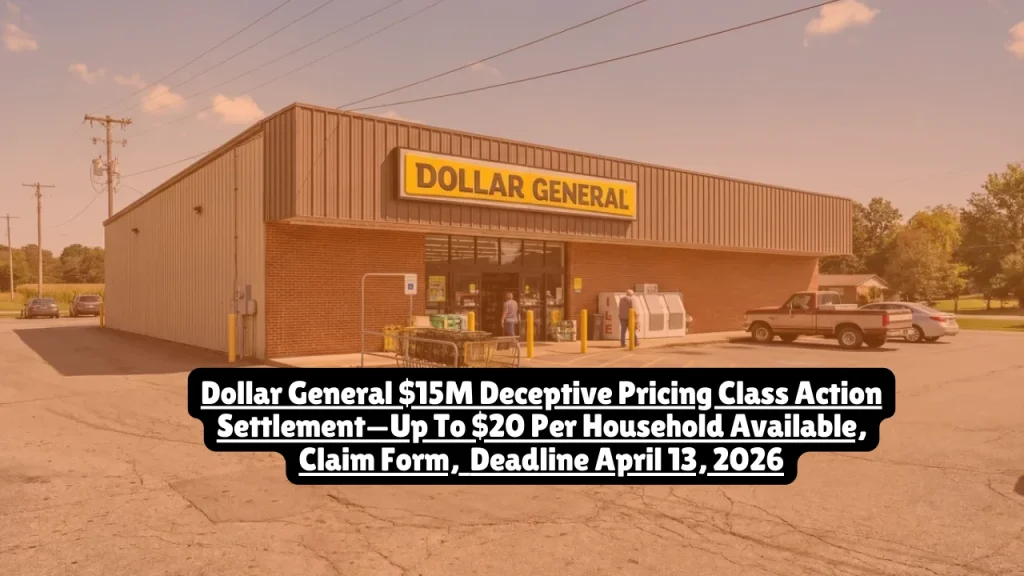
Dollar General $15M Deceptive Pricing Class Action Settlement—Up To $20 Per Household Available, Claim Form, Deadline April 13, 2026
The Dollar General deceptive pricing class action settlement resolves allegations that Dolgencorp, LLC charged customers higher prices at checkout than advertised on shelf labels nationwide. Under the proposed $15 million settlement, approved preliminarily by New Jersey Superior Court on November 19, 2025, customers who paid more (or less) than advertised prices between October 10, 2016 and November 19, 2025 can claim up to $20 per household with proof, or receive a $3 store discount during a two-day window. The final approval hearing is March 19, 2026, with the claim deadline set for April 13, 2026.
Here’s what makes this case different: Dollar General admits no wrongdoing, but this settlement consolidates lawsuits filed in multiple states alleging the same systematic pricing discrepancies affecting millions of low-income shoppers.
What The Lawsuits Alleged About Dollar General’s Pricing Practices
Six consumers—Jennifer Braun, Joseph Wolf, Carmen Wolf, Lori Hartline, Sharlia Cotton, and Ryan Button—filed the consolidated class action in Braun v. Dolgencorp, LLC d/b/a Dollar General (Case No.: MID-L-00950-25). The plaintiffs alleged Dollar General violated consumer protection laws by maintaining discrepancies between shelf prices and register prices across its 19,000 U.S. stores.
The lawsuit claims Dollar General “engages in a pattern or practice of charging its consumers more at the register when they check out than the price advertised on the store shelves.” According to court filings, detailed research by plaintiffs’ experts found the average overcharge was $0.27 per transaction.
While $0.27 seems small, the lawsuit argues when multiplied across hundreds of thousands or millions of transactions daily, these pricing errors create systemic harm to price-sensitive consumers who rely on accurate shelf pricing to make purchasing decisions.
Plaintiffs claimed Dollar General used the same procedures nationwide, creating a consistent pattern rather than isolated mistakes. The complaint alleges it was Dollar General’s “policy and practice to charge a higher price at the register for merchandise than the price advertised on the unit price labels for the same merchandise on the shelves.”
How The $15 Million Settlement Breaks Down
Dollar General agreed to settle without admitting wrongdoing to avoid litigation costs and uncertainty. The settlement includes two benefit types: cash payments and store discounts.
For cash payments with proof of overcharge, class members can receive $10 or the actual overcharge amount (whichever is higher) for up to two separate documented overcharges, creating a maximum $20 household recovery. Acceptable proof includes contemporaneous complaints filed with governmental entities or Dollar General referencing specific price overcharges not previously resolved, or objective, contemporaneous documentation of overcharges (photos of shelf tags and receipts showing the discrepancy).
For the store discount benefit, all class members—even those without proof of overcharge—can receive a $3 discount on purchases of $10 or more (pretax) during a two-day window to be announced. This benefit appears automatically in myDG accounts or can be claimed through a registration form. The discount excludes phone cards, gift cards, prepaid financial cards, Rug Doctor rental, propane, tobacco, alcohol, and milk.
The settlement also allocates $6.5 million for pricing accuracy improvements over the next two years, including dedicated store labor to prevent discrepancies, third-party pricing audits, and a full-time employee tracking and reporting pricing issues every two months.
Class counsel will seek up to 33.3% of the total settlement value in attorneys’ fees plus expenses. Class representatives who were deposed can receive $7,500 service awards; those not deposed can receive $5,000, subject to court approval.
Related Article: Google Play Store Lawsuit, $8.25M Settlement Over Children’s Privacy Violations—Millions Of Kids Affected By AdMob Data Collection
Why Dollar General Keeps Getting Sued For The Same Issue
This isn’t Dollar General’s first pricing accuracy problem. State attorneys general have extracted millions in settlements over identical allegations. Wisconsin regulators secured $850,000 in November 2023 after finding Dollar General stores overcharged customers on 9% of products evaluated.
Vermont obtained $1.75 million after state inspectors found pricing errors at least 50 times, with Dollar General charging higher register prices than shelf prices even after repeated warnings. Pennsylvania secured $1.55 million in a similar settlement announced recently.
Missouri, Ohio, and multiple other states have filed separate lawsuits alleging Dollar General systematically overcharges customers, particularly targeting low-income communities where residents depend on accurate pricing because every dollar matters.
Critics argue the pattern reveals deliberate business decisions rather than honest mistakes. Dollar General serves predominantly low-income neighborhoods where residents have limited shopping alternatives and may be less likely to notice or challenge small overcharges.
Former Ohio Attorney General Marc Dann, who represents plaintiffs in the consolidated class action, stated the company may be taking a dollar from customers “unknowingly…at such an immense scale that, over their 19,000 stores, they may be [doing it to] the tune of $100 million a year.”
Similar to cases involving Walmart class action lawsuit shoppers are getting checks right now over weighted goods pricing errors, the Dollar General settlement demonstrates how small per-transaction overcharges create massive aggregate consumer harm when retailers serve millions of customers.
What You Must Know
Who Qualifies As A Settlement Class Member
The settlement class includes “all consumers in the United States who paid more or less for merchandise than the advertised price labeled on the shelf at a Dollar General store from October 10, 2016, through November 19, 2025.”
Notably, the settlement covers both overcharges and undercharges, meaning even if Dollar General charged you less than the shelf price, you can still file a claim and receive the $10 payment if you have documentation.
The settlement doesn’t require you to prove harm or even remember specific transactions if you’re only claiming the $3 store discount. Anyone who shopped at Dollar General during the nine-year class period automatically qualifies for the in-store benefit.
Key Deadlines And Court Proceedings
Several critical dates govern your rights under this settlement. The exclusion and objection deadline is March 2, 2026. Class members who wish to opt out and preserve rights to sue Dollar General individually must submit written opt-out requests by this date. Similarly, objections to the settlement fairness must be filed by March 2, 2026.
The final approval hearing is scheduled for March 19, 2026, in Superior Court of New Jersey, Law Division – Middlesex County, located at 56 Paterson Street, New Brunswick, NJ 08903. The court will determine whether the settlement is fair, reasonable, and adequate. Class members may appear at the hearing to voice concerns, though appearance isn’t required if you’ve filed a written objection.
The claim form deadline is April 13, 2026. Online claims must be submitted through the official settlement website at www.DGPriceSettlement.com by this date. Paper claim forms must be postmarked no later than April 13, 2026, and mailed to the settlement administrator.
Payments will be distributed approximately 30 days after final approval, assuming no appeals. Checks expire 60 days after mailing. Cases like the Lowe’s hit with fresh lawsuit massive discount pricing scheme exposed show similar retail pricing litigation typically resolves through settlements rather than trial.
What Claims You’re Releasing If You Participate
By remaining in the settlement class and not opting out, you release all claims against Dollar General related to pricing discrepancies between shelf labels and register prices during the class period. This includes consumer protection claims, false advertising violations, fraud, unjust enrichment, and any other theories based on charging higher or lower prices than advertised.
Importantly, the release only covers pricing discrepancy claims. You retain rights to sue Dollar General for other issues unrelated to shelf-versus-register pricing differences. You also specifically reserve the right to dispute individual transactions and seek actual damages for pricing errors outside the settlement process.
If you opt out by March 2, 2026, you give up settlement benefits but preserve your right to file an individual lawsuit against Dollar General for the same pricing claims.
What To Do Next
How To File A Claim For Cash Payment Or Store Discount
Visit www.DGPriceSettlement.com and complete the online claim form by April 13, 2026. For cash claims with proof, upload documentation showing either a contemporaneous complaint to authorities or Dollar General about specific overcharges, or objective evidence like photos of shelf tags next to receipts showing discrepancies.
For the $3 store discount (no proof required), register through the settlement website or ensure your myDG account is active. The specific two-day redemption window will be announced after final approval. Monitor the settlement website or your myDG account for dates.
For paper claims, download the form from www.DGPriceSettlement.com and mail completed forms postmarked by April 13, 2026 to: Braun v Dolgencorp LLC d/b/a Dollar General Settlement Administrator, P.O. Box 58220, Philadelphia, PA 19102.
Questions can be directed to the settlement administrator at 1-844-262-4248 or [email protected].
Where To Find Official Court Documents
The complete settlement agreement and all court filings are publicly available through the Superior Court of New Jersey, Law Division – Middlesex County. Contact the Clerk of Court at 732-645-4300 and reference Case No.: MID-L-00950-25.
Court-approved settlement documents, including the long-form notice, settlement agreement, and claim form, are available at www.DGPriceSettlement.com. The Dann Law Firm (Class Counsel) maintains case information at their office: 825 Georges Road, 2nd Floor, North Brunswick, NJ 08902, phone (216) 373-0539.
When Legal Counsel May Be Appropriate
Most class members can participate without hiring individual attorneys—the claim process is designed for direct consumer filing. However, consult a consumer protection attorney if you’re considering opting out to pursue individual claims for substantial documented damages exceeding the $20 settlement maximum.
If you experienced significant harm from pricing errors (such as financial hardship, bounced checks due to unexpected charges, or other consequential damages), an attorney can assess whether individual litigation justifies opting out. Most consumer protection attorneys offer free consultations and work on contingency for strong cases.
Frequently Asked Questions
Can I claim for purchases I don’t have receipts for?
Yes, for the $3 store discount. No proof of purchase or overcharge is required—just registration through the settlement website or a myDG account. For cash payments, you need contemporaneous documentation of specific overcharges (complaints filed at the time or photos/receipts showing the discrepancy).
What if I was undercharged instead of overcharged?
You can still file a claim. The settlement class includes people who paid “more or less” than advertised prices. If you have documentation showing Dollar General charged you less than the shelf price and you meet the proof requirements, you’re eligible for the $10 payment.
How much will I actually receive if I file a claim?
With qualifying proof, you receive $10 or the actual overcharge amount (whichever is higher) for up to two separate incidents, maximum $20 per household. If total claims exceed the settlement fund after administrative costs and attorney fees, payments may be reduced proportionally. If fewer people claim than expected, payments could increase.
Can I get both the cash payment and the store discount?
Yes. Filing a cash claim doesn’t prevent you from also receiving the $3 store discount. They are separate benefits—one requires proof, the other doesn’t.
What happens to unclaimed settlement money?
Any uncashed checks will be donated as a cy pres award to a national food bank organization with no restrictions on use. This is standard practice in class action settlements when settlement funds remain unclaimed.
Does this settlement prevent Dollar General from continuing the same pricing practices?
The settlement requires Dollar General to spend $6.5 million on pricing accuracy improvements including dedicated labor, third-party audits, and a full-time compliance employee reporting every two months for two years. However, Dollar General admits no wrongdoing and these requirements expire after two years.
Can I still shop at Dollar General while the settlement is pending?
Yes. The settlement doesn’t restrict Dollar General’s operations or your ability to shop there. Participating in the settlement doesn’t require you to stop shopping at Dollar General stores.
Last Updated: January 21, 2026
Disclaimer: This article provides information about the pending Dollar General class action settlement based on court-approved settlement documents—it is not legal advice.
If you shopped at Dollar General between 2016 and 2025, don’t miss the April 13, 2026 deadline to file your claim for up to $20 cash or the $3 store discount. Visit the official settlement website today to see if you qualify.
Stay informed, stay protected. — AllAboutLawyer.com
About the Author

Sarah Klein, JD, is a licensed attorney and legal content strategist with over 12 years of experience across civil, criminal, family, and regulatory law. At All About Lawyer, she covers a wide range of legal topics — from high-profile lawsuits and courtroom stories to state traffic laws and everyday legal questions — all with a focus on accuracy, clarity, and public understanding.
Her writing blends real legal insight with plain-English explanations, helping readers stay informed and legally aware.
Read more about Sarah
The link to submit a claim is not working properly
Working on my side please try to open it on aagin