
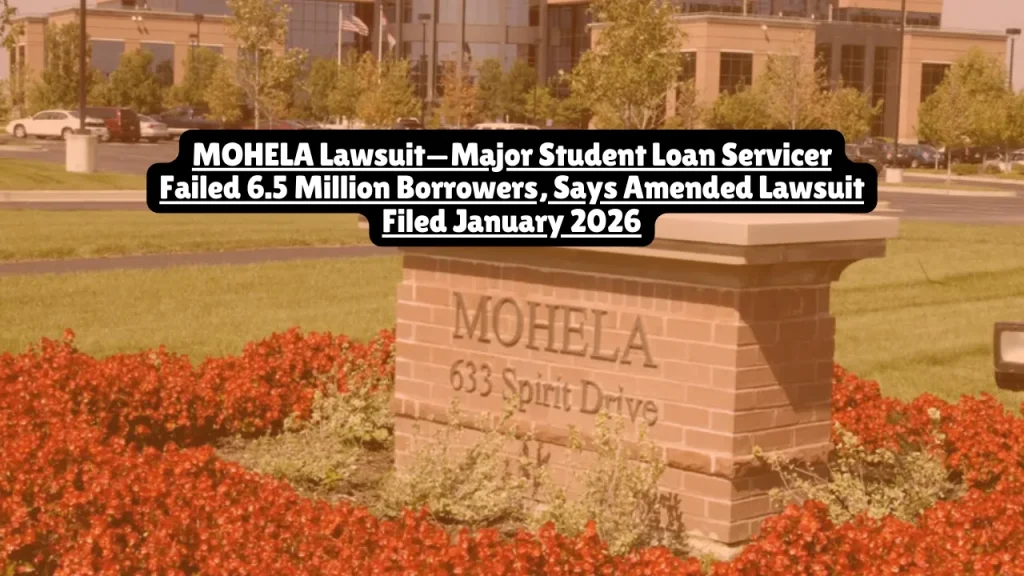
MOHELA Lawsuit—Major Student Loan Servicer Failed 6.5 Million Borrowers, Says Amended Lawsuit Filed January 2026
The MOHELA lawsuit alleges the Higher Education Loan Authority of the State of Missouri systematically failed 6.5 million student loan borrowers through illegal servicing practices. Filed initially in July 2024 by the American Federation of Teachers and amended in January 2026, the case claims MOHELA violated consumer protection laws by providing inadequate customer service, processing delays, billing errors, and deceptive business practices that cost borrowers money and damaged credit.
Here’s what makes this case unprecedented: it’s one of the few lawsuits to directly challenge a federally contracted student loan servicer’s core operations, potentially affecting millions of Americans struggling with student debt.
Who Filed The Lawsuit And What They’re Claiming
The American Federation of Teachers filed the original complaint in July 2024 in D.C. Superior Court. The union represents 1.8 million educators and public service workers—many of whom qualify for Public Service Loan Forgiveness and other federal student loan programs serviced by MOHELA.
AFT amended its complaint in January 2026 to include fresh allegations of ongoing misconduct. The lawsuit is supported by Protect Borrowers (formerly Student Borrower Protection Center), National Consumer Law Center, and Selendy Gay PLLC.
The amended complaint alleges MOHELA has continued harming borrowers since the original filing despite knowing it was under legal scrutiny. According to court documents, the company’s failures aren’t isolated mistakes but systematic business decisions not to invest in proper loan servicing.
The Staggering Customer Service Failures Documented In Court Filings
Federal data included in the January 2026 amended complaint reveals MOHELA’s customer service ranks worst among the five main federal student loan servicers. MOHELA borrowers wait approximately seven times longer than ED Financial borrowers to reach a representative, and more than 50 times longer than borrowers with Aidvantage, CRI, and NelNet.
The abandon rate tells an even more disturbing story. While no other major servicer sees more than 5% of callers give up while on hold, MOHELA’s abandon rate exceeds 14%. That means one in seven borrowers trying to reach MOHELA for help with their student loans simply gives up.
Court filings describe this as deliberate “call deflection”—a company-wide scheme to funnel borrowers away from live representatives and toward inadequate self-service platforms. The strategy saves MOHELA money but leaves borrowers unable to correct errors or get accurate information about their accounts.
The Billing Crisis That Sent 800,000 Borrowers Into Delinquency
In October 2023, when student loan payments resumed after the COVID-19 payment pause, MOHELA failed to send monthly bills to 2.5 million borrowers. The U.S. Department of Education publicly disclosed this failure, which MOHELA acknowledged.
As a direct result, 800,000 borrowers became delinquent on their loans. These weren’t borrowers choosing not to pay—they were borrowers who never received bills telling them payment was due.
The amended complaint alleges MOHELA also sent inaccurately high bills to many borrowers, used outdated 2022 federal poverty guidelines instead of current 2023 guidelines to calculate SAVE plan payments (resulting in higher payments), and delayed processing applications for income-driven repayment plans, causing interest to accrue that otherwise would have been waived.
Related Article: Vital Farms Eggs Lawsuit—Company Won Dismissal Of Class Action Claims, PETA Dropped Out, Case Officially Closed January 2025
MOHELA’s Failures Extended Beyond Basic Billing
The lawsuit details systematic problems across MOHELA’s entire operation. When borrowers applied for the SAVE repayment plan—a program designed to reduce monthly payments based on income—MOHELA created delays that cost borrowers money through unnecessary interest accrual.
For Public Service Loan Forgiveness enrollees, MOHELA’s processing failures meant educators, healthcare workers, and other public servants couldn’t get accurate counts of qualifying payments toward the 120 payments required for loan forgiveness.
The complaint also alleges MOHELA provided inaccurate information through undertrained customer service representatives, making it impossible for borrowers to correct problems the company created.
What You Must Know
The Legal Theories Behind The Lawsuit
AFT’s lawsuit asserts violations of D.C.’s Consumer Protection Procedures Act. This law prohibits deceptive trade practices and requires businesses to provide services they promise to deliver.
The amended complaint argues MOHELA took on servicing responsibilities for 6.5 million borrowers, accepted over $1.1 billion in federal payments since 2011 to perform that job, then willfully disregarded those responsibilities while gobbling up more market share.
Similar consumer protection lawsuits like Lexington law have resulted in significant financial penalties and mandatory business practice changes when companies fail to deliver promised services.
Current Status And Recent Court Developments
The case remains in active litigation as of January 2026. MOHELA has vigorously denied the allegations and stated that providing support to borrowers is its “utmost priority.”
A separate MOHELA lawsuit filed in September 2024—Maldonado v. MOHELA—survived two dismissal attempts. That California case alleges MOHELA failed to process loan discharges ordered by the Department of Education for students defrauded by predatory for-profit colleges.
In July 2025, a federal judge denied MOHELA’s second motion to dismiss the Maldonado case. Class certification hearings are scheduled for January 22, 2026.
What This Means For The 6.5 Million Affected Borrowers
If AFT prevails, the lawsuit could force MOHELA to overhaul its business practices, improve customer service systems, accurately process applications and payments, and potentially provide restitution to harmed borrowers.
The case also puts pressure on the U.S. Department of Education to hold contractors accountable. Since 2021, MOHELA tripled its portfolio of ED-held federal loans despite documented servicing failures.
Senators Bernie Sanders, Elizabeth Warren, and Chuck Schumer have called for federal agencies to investigate MOHELA and for the Department of Education to take action protecting borrowers from future abuses.
What To Do Next
How To Access Court Documents And Track Case Progress
The AFT v. MOHELA complaint is publicly available through the D.C. Superior Court system. The amended complaint filed in January 2026 is accessible through the American Federation of Teachers website at aft.org and through Protect Borrowers at protectborrowers.org.
For the Maldonado v. MOHELA case, documents are available through PACER (Public Access to Court Electronic Records) under Case No. 3:24-cv-06904 in the U.S. District Court for the Northern District of California.
Where To Find Verified Reporting And Official Resources
The Consumer Financial Protection Bureau maintains a complaint database where borrowers can report servicing issues at consumerfinance.gov/complaint. These complaints become part of the public record and inform regulatory oversight.
The Department of Education’s Federal Student Aid office provides information about borrower rights and servicer responsibilities at studentaid.gov. AFT maintains updates about the lawsuit at aft.org/MOHELA.
When Legal Counsel May Be Appropriate
If you’re a MOHELA borrower experiencing servicing problems—billing errors, delayed application processing, inaccurate payment counts for PSLF, or credit reporting errors—document everything with screenshots, save all correspondence, and file complaints with the CFPB.
You generally don’t need individual legal counsel to benefit from the AFT class action. If the case succeeds and achieves class certification, affected borrowers would receive notice with instructions for participation.
However, if you’ve suffered significant documented harm—like denied loan forgiveness due to MOHELA’s errors, damaged credit affecting major purchases, or financial losses from incorrect billing—consulting a consumer protection attorney about individual claims may be appropriate. Cases involving T-Mobile class action lawsuit hidden fees data breaches and refunds show how consumer protection laws can provide remedies for systematic corporate failures.
Frequently Asked Questions
Am I part of the class if I have loans with MOHELA?
The lawsuit was filed on behalf of AFT and its members, but if certified as a class action, it could potentially cover millions of MOHELA borrowers. Class certification hasn’t been granted yet. If certification occurs, eligible class members will receive official notice with options to participate, opt out, or object.
Can I still get Public Service Loan Forgiveness if MOHELA messed up my payment counts?
Yes, but you may need to fight for it. The Department of Education conducted an IDR Account Adjustment and Limited PSLF Waiver that corrected many count errors. If your counts are still wrong, file complaints with ED’s Federal Student Aid Ombudsman and the CFPB, and document all communication with MOHELA about your payment history.
What if MOHELA reported incorrect information to credit bureaus?
You can dispute inaccurate credit reporting directly with the three major credit bureaus (Equifax, Experian, TransUnion). Document the error with proof from ED’s website showing correct loan status. File a CFPB complaint. The Fair Credit Reporting Act provides remedies for inaccurate credit reporting that damages consumers.
How long do class action lawsuits like this typically take?
Consumer class actions against large servicers usually take 2-4 years from filing to resolution. The AFT case was filed in July 2024 and amended in January 2026, so it’s still in relatively early stages. Expect motion practice, discovery, potential class certification hearings, and either settlement negotiations or trial before final resolution.
Is MOHELA still servicing federal student loans?
Yes. Despite the lawsuits and documented failures, MOHELA continues servicing federal student loans as of January 2026. In early 2025, MOHELA took over all of Navient’s private and federal loan portfolios, making it one of the largest student loan servicers in the country.
What’s the difference between the AFT lawsuit and the Maldonado case?
The AFT lawsuit challenges MOHELA’s overall business practices affecting millions of borrowers—billing errors, customer service failures, application processing delays. The Maldonado case specifically involves MOHELA’s failure to implement loan discharges ordered by the Department of Education for students defrauded by predatory for-profit colleges. Both cases allege violations of consumer protection laws but involve different specific harms.
Can MOHELA just transfer my loans to another servicer without my consent?
Federal student loan servicers are contractors for the Department of Education, which owns your federal loans. ED can reassign servicing without borrower consent. If your loans transfer to a different servicer, you should receive advance notice, and all your loan terms, forgiveness progress, and repayment plan enrollment should transfer with your account.
Last Updated: January 21, 2026
Disclaimer: This article provides information about pending litigation based on court filings and verified reporting—it is not legal advice.
Are you a MOHELA borrower dealing with servicing problems? Document everything, file complaints with the CFPB, and stay informed about this landmark case that could reshape student loan servicing.
Stay informed, stay protected. — AllAboutLawyer.com
About the Author

Sarah Klein, JD, is a licensed attorney and legal content strategist with over 12 years of experience across civil, criminal, family, and regulatory law. At All About Lawyer, she covers a wide range of legal topics — from high-profile lawsuits and courtroom stories to state traffic laws and everyday legal questions — all with a focus on accuracy, clarity, and public understanding.
Her writing blends real legal insight with plain-English explanations, helping readers stay informed and legally aware.
Read more about Sarah