
William McNeil Jr. Lawsuit, $100K Federal Case Against Jacksonville Officers After Viral Traffic Stop Beating
William McNeil Jr., a 22-year-old college student, filed a federal lawsuit seeking $100,000 in damages after a Jacksonville Sheriff’s Office officer punched him in the face during a February 2025 traffic stop. The case highlights critical questions about police use of force, racial profiling, and accountability when video evidence contradicts official accounts.
What Happened to William McNeil Jr.?
On February 19, 2025, William McNeil Jr. was pulled over in Jacksonville, Florida, by deputies who claimed he didn’t have his headlights on. The problem? McNeil’s cellphone video shows it was broad daylight, and Florida law only requires headlights from sunset to sunrise or during rain, smoke, or fog.
McNeil remained calm behind the wheel, seat belt fastened, repeatedly asking to speak with a supervisor. Instead of de-escalating, Officer D. Bowers broke McNeil’s driver’s-side window and struck him in the face multiple times before dragging him from the vehicle.
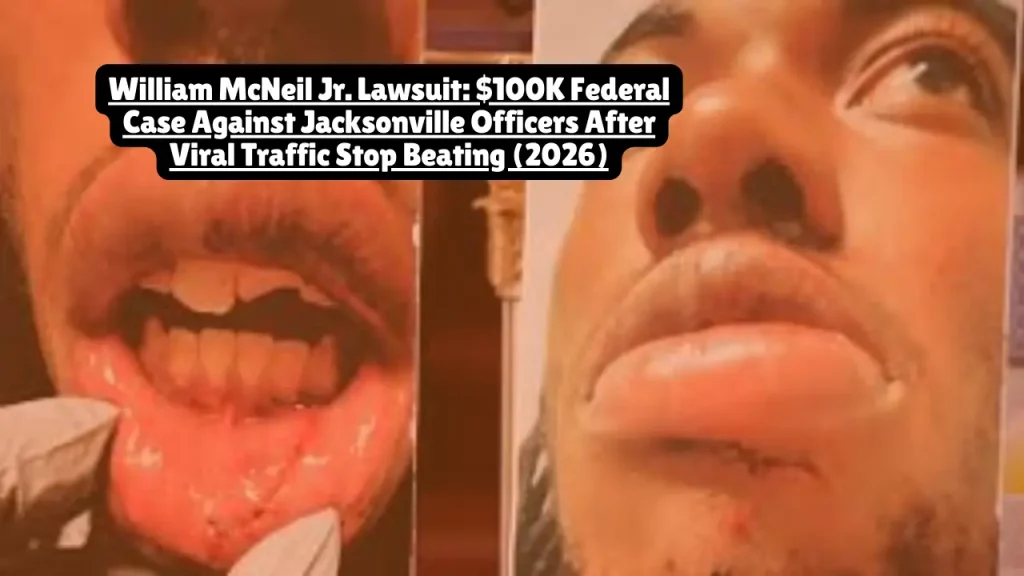
The viral video sparked nationwide outrage. McNeil suffered a fractured tooth, lacerations to his chin and lip, and what his attorneys say is an ongoing traumatic brain injury. He also faces PTSD-like symptoms including nightmares and flashbacks.
The Lawsuit Details
Filed September 10, 2025, in U.S. District Court for the Middle District of Florida, the lawsuit names Officer D. Bowers, Officer D. Miller, Sheriff Thomas Kevin Waters, and the City of Jacksonville as defendants.
McNeil seeks:
- $100,000 in damages for physical and emotional injuries
- $100,000 in punitive damages
- Attorney fees and court costs
- A jury trial
His legal team—civil rights attorneys Ben Crump and Harry Daniels—argues the Jacksonville Sheriff’s Office enforces policies that allow excessive force without accountability. The lawsuit claims officers aren’t required to report all uses of force, creating an environment where brutality goes unchecked.
Criminal Charges That Don’t Add Up
Despite the video evidence, McNeil was arrested and charged with resisting a police officer without violence and driving on a suspended license. He pleaded guilty to both charges.
Then came a twist. The State Attorney’s Office cleared all three officers of criminal wrongdoing in August 2025, stating McNeil’s refusal to follow commands rose to criminal resistance. Their report said McNeil received “12 individual lawful commands” he refused to obey.
But McNeil’s attorneys point to a glaring contradiction: If the stop itself was unlawful—as they claim it was—then any commands flowing from it couldn’t be lawful either.
What Makes This Case Different?
Similar to the Warren Sapp lawsuit, where the NFL Hall of Famer sued after charges were dropped and the sheriff’s office admitted errors, McNeil’s case involves a questionable traffic stop followed by excessive force. Both cases raise critical questions about police accountability when prosecutors decline to file charges despite video evidence.
The William McNeil Jr. lawsuit stands out for several reasons:
Dual Video Evidence: Both McNeil’s cellphone footage and body camera video captured the incident. Attorneys later revealed additional footage showing an officer pointing a gun at McNeil—though the Jacksonville Sheriff’s Office says this wasn’t new information.
Documented Injuries: Medical records confirm McNeil’s fractured tooth and traumatic brain injury, making this more than just a false arrest claim.
Pattern of Unreported Force: Officer Bowers initially left the face strike out of his Response to Resistance report. An internal investigation later reprimanded him for this omission, though it found his use of force was “within JSO policy.”
Federal Civil Rights Investigation: McNeil’s attorneys sent a letter to the Department of Justice’s Civil Rights Division on September 8, 2025, requesting an investigation into whether the arrest violated 18 U.S.C. § 242 (Deprivation of Rights Under Color of Law).
Related Article: Midland Credit Management Lawsuit Settlement, $52 Million in Consumer Refunds, How to Claim Yours and Who Qualifies
The Racial Profiling Allegations
McNeil’s legal team argues this wasn’t just excessive force—it was racial profiling from the start. According to prosecutors’ own reports, Officer Bowers stopped McNeil after seeing his SUV parked outside a house the officer was surveilling for “drug activity.”
The headlight violation appears to have been a pretext. Video shows another police vehicle arriving at the scene with its headlights clearly off during the same daylight conditions.
Attorney Harry Daniels stated at a press conference: “He gets pulled over for a bogus allegation…to be subjected to this type of brutality is so inhumane. William was calm and compliant. Yet instead of answers, he got his window smashed and was punched in the face, all over a questionable claim about headlights in broad daylight.”
What’s At Stake Beyond Money
While the lawsuit seeks $200,000 total, this case isn’t really about the dollar amount. It’s about accountability in a system where internal investigations rarely find policy violations.
McNeil’s attorneys provided statistics showing the Jacksonville Sheriff’s Office almost never finds its officers violated use-of-force policies. Similar patterns appear in civil rights cases nationwide, including the James Hodges lawsuit where a blind veteran was wrongfully arrested with his walking cane, highlighting how officers sometimes escalate situations rather than recognize when someone isn’t being defiant.
The broader implications include:
Qualified Immunity: Officers often avoid liability unless they violate “clearly established” constitutional rights. McNeil’s case challenges whether punching someone who poses no threat violates clearly established law.
Police Training: Should officers receive better training on de-escalation, particularly when dealing with people who request a supervisor?
Policy Changes: The lawsuit argues JSO’s failure to require reporting of all force incidents enables brutality without consequences.
Jacksonville’s Response
The Jacksonville Sheriff’s Office declined to comment, citing pending litigation. The City of Jacksonville did not respond to requests for comment.
Sheriff T.K. Waters previously stated there’s “more to the story” than the viral video and defended his officers’ actions. He rejected claims of racial profiling, saying “I’m not playing the race game. This is not about race, it never is.”
That statement rang hollow for many watching a Black college student get punched in the face during broad daylight for requesting a supervisor.
What Happens Next
As of January 2026, the lawsuit is proceeding through federal court. Here’s the likely timeline:
Discovery Phase (6-12 months): Both sides will exchange evidence, including complete body camera footage, training records, and internal communications.
Settlement Negotiations: Most civil rights cases settle before trial. Given the video evidence and the state attorney’s decision not to prosecute, Jacksonville faces significant liability exposure.
Trial (if no settlement): A jury would decide whether officers violated McNeil’s constitutional rights and what damages are appropriate.
Department of Justice Investigation: Separately, the DOJ may investigate whether this incident reflects a pattern of civil rights violations at JSO.
How to Protect Your Rights During Traffic Stops
McNeil’s case offers critical lessons for anyone pulled over by police:
Record everything: Use your phone to document the interaction. You have a constitutional right to record police in public.
Stay calm: Even when you believe the stop is unlawful, arguing won’t help at the scene. Fight it in court later.
Request a supervisor: You can politely ask for a supervisor, though as McNeil’s case shows, officers don’t always honor that request.
Know your rights: You don’t have to consent to searches. You can remain silent except for providing ID when required.
Document injuries: If force is used, photograph injuries and seek medical attention immediately.
Contact an attorney: If you believe your rights were violated, consult a civil rights lawyer quickly. Evidence can disappear.
Frequently Asked Questions
What is the William McNeil Jr. lawsuit about?
The lawsuit claims Jacksonville Sheriff’s Office officers violated McNeil’s civil rights by using excessive force during a questionable traffic stop in February 2025. McNeil seeks $100,000 in compensatory damages and $100,000 in punitive damages for injuries including a fractured tooth and traumatic brain injury.
Were the officers charged with any crimes?
No. The State Attorney’s Office for the Fourth Judicial Circuit cleared all officers of criminal wrongdoing in August 2025, stating McNeil’s refusal to exit his vehicle constituted criminal resistance. Officer D. Bowers was later reprimanded administratively for failing to report the face strike in his initial report.
What evidence exists in the case?
Multiple video sources captured the incident: McNeil’s cellphone video showing the punch through the broken window, body camera footage from multiple officers, and additional angles showing an officer pointing a gun at McNeil. Medical records document McNeil’s injuries.
Can you sue police even if they weren’t criminally charged?
Yes. Civil rights lawsuits operate under different legal standards than criminal prosecutions. You can sue under 42 U.S.C. § 1983 for constitutional violations even when prosecutors decline criminal charges. The burden of proof is lower in civil cases (preponderance of evidence vs. beyond reasonable doubt).
How long do civil rights lawsuits take?
Most civil rights cases against police take 1-3 years from filing to resolution. Many settle before trial, particularly when video evidence strongly supports the plaintiff’s version of events.
What is qualified immunity?
Qualified immunity protects government officials from civil liability unless they violated “clearly established” constitutional rights. McNeil’s attorneys must show that punching a non-threatening person during a traffic stop violates clearly established Fourth Amendment protections against excessive force.
Is the Department of Justice investigating this case?
McNeil’s attorneys formally requested a DOJ Civil Rights Division investigation in September 2025. As of January 2026, the DOJ has not publicly confirmed whether an investigation is underway. Federal investigations can take months or years.
Last Updated: January 20, 2026
Disclaimer: This article provides general information about the William McNeil Jr. lawsuit and is not legal advice.
Call to Action: Have you experienced excessive force during a traffic stop? Share your story in the comments or consult with a civil rights attorney to understand your legal options.
Stay informed, stay protected. — AllAboutLawyer.com
About the Author
Sarah Klein, JD, is a licensed attorney and legal content strategist with over 12 years of experience across civil, criminal, family, and regulatory law. At All About Lawyer, she covers a wide range of legal topics — from high-profile lawsuits and courtroom stories to state traffic laws and everyday legal questions — all with a focus on accuracy, clarity, and public understanding.
Her writing blends real legal insight with plain-English explanations, helping readers stay informed and legally aware.
Read more about Sarah