
Minnesota Ice Lawsuit, Federal Agents Sued Over Racial Profiling and Constitutional Violations During Immigration Surge
The Minnesota Ice lawsuit refers to two separate federal lawsuits filed in January 2026 challenging Immigration and Customs Enforcement operations in the Twin Cities. The first lawsuit was filed on January 12, 2026, by Minnesota Attorney General Keith Ellison on behalf of the state and the cities of Minneapolis and St. Paul against the Department of Homeland Security.
The second lawsuit was filed on January 15, 2026, by the American Civil Liberties Union as a class-action case on behalf of three Minnesota residents. Both lawsuits allege that federal immigration agents engaged in racial profiling, warrantless arrests, and excessive force during Operation Metro Surge, which deployed over 2,000 federal agents to Minnesota starting in December 2025.
What Caused the Minnesota Ice Lawsuits
Operation Metro Surge began in December 2025 when the Trump administration deployed thousands of armed and masked federal agents from ICE and Customs and Border Protection to the Twin Cities. Officials stated the operation targeted immigration law violations and fraud allegations involving Somali-run daycare facilities, though state investigators found no evidence supporting these fraud claims. The operation intensified following the January 7, 2026, fatal shooting of Renee Nicole Good, a 37-year-old U.S. citizen and mother of three, by ICE agent Jonathan Ross in Minneapolis. This shooting triggered widespread protests and prompted both legal challenges.
Who Is Involved in the Lawsuits
The state lawsuit plaintiffs include the State of Minnesota, represented by Attorney General Keith Ellison, and the cities of Minneapolis and St. Paul. Defendants include the Department of Homeland Security, ICE, CBP, and various federal officials including DHS Secretary Kristi Noem. The ACLU class-action lawsuit represents three named plaintiffs: Mubashir Khalif Hussen, a 20-year-old U.S. citizen detained on December 10, 2025; Mahamed Eydarus, a 25-year-old U.S. citizen questioned by agents; and a third community member. The class action seeks to represent all Minnesotans whose constitutional rights were violated by federal immigration enforcement.
Legal Claims in the Minnesota Ice Lawsuits
Both lawsuits allege serious constitutional violations. The state lawsuit claims federal agents violated the Fourth Amendment through warrantless arrests and unreasonable seizures, the First Amendment by retaliating against peaceful protesters with excessive force including tear gas and pepper spray, and the Tenth Amendment by commandeering state police resources and disrupting local governance.
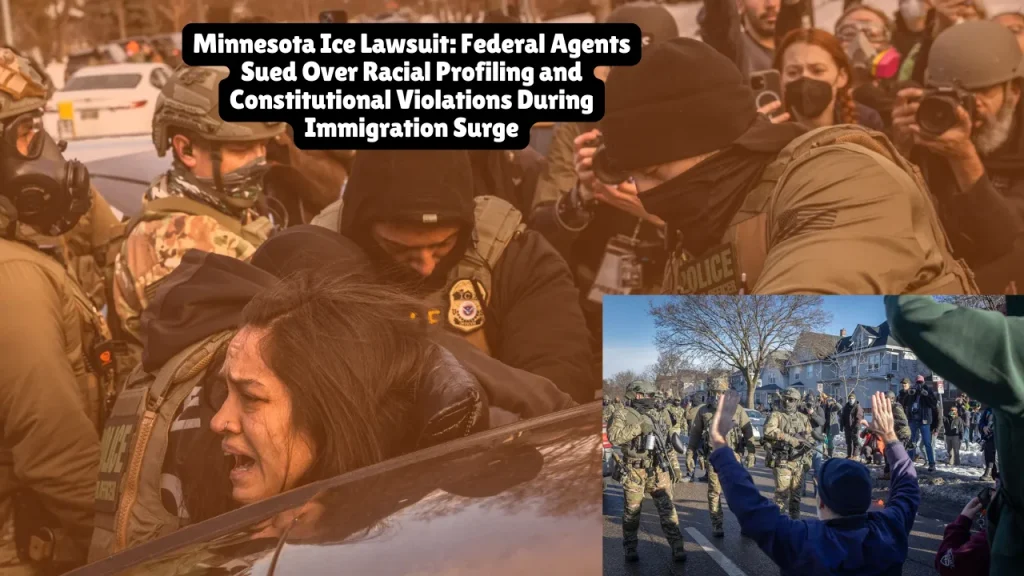
The complaint alleges agents violated the Administrative Procedure Act by engaging in arbitrary and capricious actions. The ACLU lawsuit focuses on racial profiling and equal protection violations, arguing that agents targeted Minnesotans based solely on perceived Somali or Latino ethnicity without probable cause or warrants. Like the Warren Sapp $20M civil rights claim after wrongful arrest, these cases involve allegations that law enforcement violated citizens’ constitutional rights during arrests and detentions.
Documented Incidents of Constitutional Violations
Court filings detail numerous troubling encounters. Mubashir Khalif Hussen was stopped by masked ICE agents during his lunch break on December 10, 2025, in the Cedar-Riverside neighborhood. Despite repeatedly stating he was a U.S. citizen, agents refused to examine his identification, placed him in an SUV, drove him to a processing center, shackled him, and took his fingerprints before finally releasing him after he showed a passport photo. Mahamed Eydarus and his mother, both U.S. citizens, were questioned by agents on December 10, 2025, while shoveling snow.
Agents asked why they were speaking a foreign language and only left after both showed identification. The state lawsuit documents that four Minneapolis Public Works employees were approached by agents who questioned the three non-white workers about citizenship but did not question the white employee.
Impact on Minnesota Communities and Resources
The federal operation caused widespread disruption across the Twin Cities. Schools went into lockdown to protect students, businesses and restaurants closed temporarily due to fear, and local police departments were overwhelmed responding to ICE-related incidents. Between January 7 and January 9, 2026, Minneapolis Police officers worked over 3,000 hours of overtime responding to protests, abandoned vehicles left by federal agents, and emergency calls from residents uncertain whether ICE apprehensions were kidnappings.
Taxpayers faced an estimated $2 million in overtime costs for just four days. Agents allegedly targeted sensitive locations including schools, medical facilities, places of worship, daycares, and funeral homes.
Current Status and Federal Government Response
On January 15, 2026, a federal judge declined to immediately issue a temporary restraining order in the state lawsuit, requesting additional evidence before ruling. The Department of Homeland Security denied all allegations, stating in a statement that claims of racial profiling are “disgusting, reckless, and categorically FALSE.” DHS officials emphasized that agents use “reasonable suspicion” protected by the Fourth Amendment and that immigration status, not race or ethnicity, determines enforcement targets.
President Donald Trump posted on Truth Social following the ruling that ICE would continue operations. DHS warned on social media that obstructing law enforcement is a federal felony and threatened prosecution for anyone who interferes with agents or destroys federal property.
What Minnesota Residents Should Know
If you have been questioned, stopped, arrested, or detained by ICE agents where officers did not have a warrant or where the encounter appeared to involve racial profiling, the ACLU of Minnesota is collecting information at aclu-mn.org/ice-feds-form. Anyone experiencing or witnessing federal immigration enforcement should document the encounter including date, time, location, number of agents, vehicle descriptions, and whether agents presented warrants.
You have constitutional rights during any law enforcement encounter including the right to remain silent and the right to refuse consent to searches. Both lawsuits remain ongoing as of January 2026.
Last Updated: January 17, 2026
Disclaimer: This article is for informational purposes only and does not constitute legal advice.
If you have been affected by federal immigration enforcement operations in Minnesota, consult with a qualified civil rights or immigration attorney to understand your legal rights and options.
Stay informed, stay protected. — AllAboutLawyer.com
About the Author

Sarah Klein, JD, is a licensed attorney and legal content strategist with over 12 years of experience across civil, criminal, family, and regulatory law. At All About Lawyer, she covers a wide range of legal topics — from high-profile lawsuits and courtroom stories to state traffic laws and everyday legal questions — all with a focus on accuracy, clarity, and public understanding.
Her writing blends real legal insight with plain-English explanations, helping readers stay informed and legally aware.
Read more about Sarah