
Is the Insurrection Act the Same as Martial Law? Key Differences Between Military Deployment and Military Governance
No, the Insurrection Act is not the same as martial law—they are fundamentally different legal frameworks with distinct authorities and constitutional implications. The Insurrection Act (10 U.S.C. §§ 251-255) authorizes the president to deploy federal military forces to assist civilian authorities during insurrection or civil disorder, while martial law involves military governance replacing civilian authority and suspending ordinary legal processes.
What the Insurrection Act Authorizes
The Insurrection Act is a federal statute that grants presidents authority to deploy U.S. military forces domestically under specific emergency circumstances. Originally enacted in 1807 and amended during the Civil War and Reconstruction, this law now occupies Sections 251 through 255 of Title 10 in the United States Code.
The statute authorizes presidential action in three distinct scenarios. Section 251 permits deployment when a state’s legislature or governor formally requests federal military assistance to suppress an insurrection against that state’s government. Section 252 allows deployment when unlawful obstructions, combinations, assemblages, or rebellion make it impractical to enforce federal laws through ordinary judicial proceedings. Section 253 authorizes intervention when domestic violence or conspiracy deprives people of constitutional rights and protections, or when such conditions oppose or obstruct execution of federal laws.
Before deploying troops under any of these sections, Section 254 requires the president to issue a proclamation—a formal public order commanding those engaged in the insurrection or obstruction to disperse and return to their homes within a limited time. This procedural requirement provides notice and opportunity for compliance before military force arrives.
The Insurrection Act serves as the primary exception to the Posse Comitatus Act (18 U.S.C. § 1385), an 1878 federal law that generally prohibits using the Army and Air Force for domestic law enforcement. When the president invokes the Insurrection Act, this prohibition is temporarily suspended, allowing military forces to assist civilian authorities with law enforcement functions.
What Martial Law Means Under U.S. Law
Martial law has no precise legal definition in American law and no single authorizing federal statute. The Supreme Court noted in Duncan v. Kahanamoku (1946) that the term “martial law” carries no precise meaning and is not defined in the Constitution or in any act of Congress.
Despite this lack of formal definition, martial law generally refers to the temporary imposition of military authority over civilian governmental functions during extreme emergencies. Under martial law, military commanders exercise powers normally held by civilian officials. This typically involves suspending ordinary legal processes, closing or limiting civilian courts, imposing curfews enforced by military personnel, suspending habeas corpus (the right to challenge unlawful detention), and sometimes subjecting civilians to military tribunals rather than jury trials in civilian courts.
Historically in the United States, martial law has been declared at state or local levels during extreme emergencies such as natural disasters, labor disputes, riots, or warfare. President Abraham Lincoln declared martial law in certain parts of the country during the Civil War. The most extensive federal martial law imposition occurred in Hawaii following Japan’s December 1941 attack on Pearl Harbor, where military rule continued until October 1944.
Related article: What Is the Insurrection Law? Federal Statute That Carries 10 Years in Prison and Office Disqualification
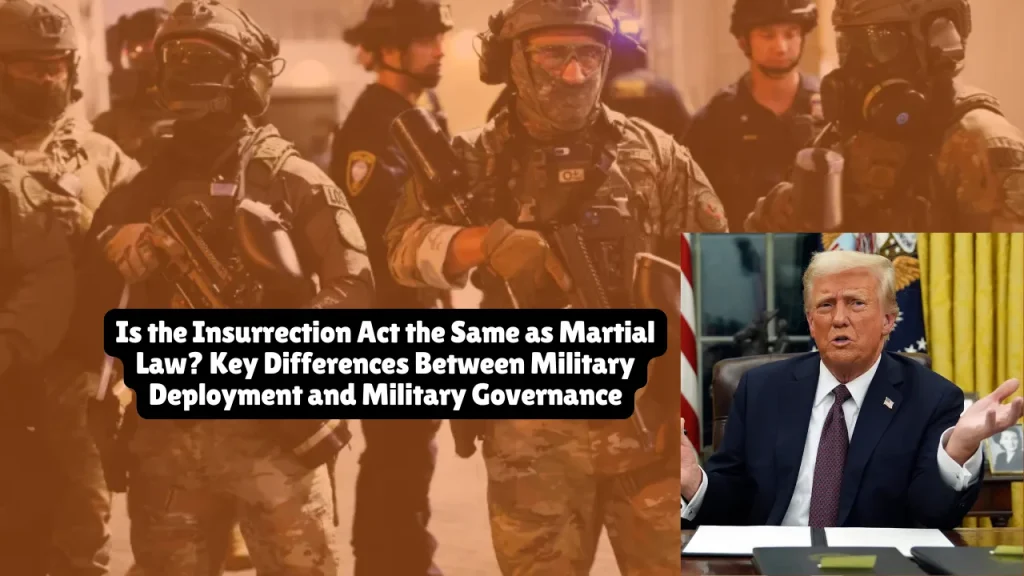
The critical legal distinction is that martial law represents military governance replacing civilian authority, while the Insurrection Act authorizes military forces to support and assist civilian authority.
Key Legal Differences Between Martial Law and the Insurrection Act
Understanding the distinctions between these frameworks is essential to American constitutional governance. The differences are fundamental, not merely technical.
Statutory vs. Emergency Authority: The Insurrection Act operates within an established legal framework—it’s a statute passed by Congress defining when and how presidents can deploy military forces domestically. Martial law claims emergency powers that exist outside normal statutory authority and lack standardized federal procedures or congressional authorization.
Military Assistance vs. Military Governance: When presidents invoke the Insurrection Act, civilian government continues operating. Federal troops assist local law enforcement and civilian authorities but don’t replace them. Courts remain open, constitutional rights stay in effect, and civilian officials retain their governmental functions. The military acts in support of civil power, not as a substitute.
Martial law, by contrast, involves military commanders assuming governmental authority typically exercised by civilian officials. Civilian courts may close or have their jurisdiction severely limited. Normal legal processes can be suspended. Military tribunals may try civilians for offenses. The military doesn’t merely assist civilian government—it becomes the government in the affected area.
Constitutional Protections: The Supreme Court established clear boundaries on military authority over civilians in Ex parte Milligan (1866), ruling that military tribunals cannot try civilians where civilian courts are open and functioning. Justice David Davis wrote: “Martial rule can never exist where the courts are open, and in the proper and unobstructed exercise of their jurisdiction.”
This precedent means that even during Insurrection Act deployments, civilians retain constitutional rights including trial by jury, due process, protection against unreasonable searches, and habeas corpus unless Congress suspends it pursuant to Article I, Section 9 of the Constitution during rebellion or invasion when public safety requires. Invoking the Insurrection Act does not automatically suspend these constitutional protections.
Congressional Oversight: The Insurrection Act operates with congressional oversight. Congress retains authority to pass legislation limiting or ending military deployments, investigate how troops are used, and deny funding for operations it deems inappropriate. Martial law historically has claimed broader emergency powers with less clear congressional checks.
Historical Uses of the Insurrection Act
Presidential invocations demonstrate how the Insurrection Act functions as support for civilian authority rather than replacement. President Dwight D. Eisenhower invoked the Act in September 1957 when Arkansas Governor Orval Faubus used the National Guard to prevent nine Black students from entering Little Rock Central High School despite federal court orders. Eisenhower federalized the Arkansas National Guard and deployed the 101st Airborne Division to enforce court-ordered desegregation.
Similarly, President John F. Kennedy invoked the Act in September 1962 when riots erupted at the University of Mississippi to prevent James Meredith, a Black student, from enrolling. Kennedy federalized the Mississippi National Guard and deployed federal troops to enforce federal court orders. In both cases, troops supported civilian authority—the federal courts—without replacing civilian government or suspending constitutional protections.
The most recent invocation occurred in May 1992 when President George H.W. Bush deployed federal troops during the Los Angeles riots following acquittal of police officers charged in the beating of Rodney King. California Governor Pete Wilson formally requested federal assistance after determining local law enforcement and the California National Guard couldn’t contain the violence. Bush issued Executive Order 12804, federalizing the California National Guard and deploying approximately 4,000 Army soldiers and Marines. Once order was restored, federal troops withdrew and civilian authority resumed complete control.
This represents the last Insurrection Act invocation—over 33 years ago as of January 2026, the longest period without use in modern American history.
Past Declarations of Martial Law in U.S. History
True martial law declarations in American history have been controversial and legally questionable. The Hawaii martial law following Pearl Harbor represents the most extensive example. Military Governor General Delos Emmons suspended habeas corpus, closed civilian courts, and imposed military rule. Civilians were tried in military tribunals for offenses ranging from curfew violations to serious crimes.
The Supreme Court later ruled in Duncan v. Kahanamoku (1946) that military tribunals lacked authority to try civilians for ordinary crimes in Hawaii because civilian courts could have functioned despite wartime conditions. This decision reinforced constitutional limits on military authority over civilians and established that martial law cannot exist where civilian courts remain open and capable of functioning.
State governors have occasionally declared martial law during labor disputes, natural disasters, or civil unrest, though courts have often questioned these declarations’ legality and scope.
Myth: The Insurrection Act and Martial Law Are the Same Thing
This widespread misconception conflates two fundamentally different legal concepts. The Insurrection Act is congressional authorization for military deployment to support civilian law enforcement under specific circumstances. Martial law is military assumption of governmental powers normally exercised by civilians.
The Brennan Center for Justice, a nonprofit policy institute specializing in constitutional law, explicitly states: “The Insurrection Act does not authorize martial law. The term ‘martial law’ has no established definition, but it is generally understood as a power that allows the military to take over the role of civilian government in an emergency. By contrast, the Insurrection Act generally permits the military to assist civilian authorities (whether state or federal), not take their place.”
When presidents invoke the Insurrection Act, they’re exercising statutory authority granted by Congress within constitutional boundaries. The deployment has defined purposes—suppressing insurrection, enforcing federal law, or protecting constitutional rights. Civilian government continues operating throughout.
Myth: Invoking the Insurrection Act Automatically Declares Martial Law
Federal troop deployment under the Insurrection Act does not trigger martial law or suspend constitutional protections. These are separate legal frameworks that can exist independently of each other.
As legal experts explained to multiple news organizations in recent weeks, martial law typically refers to imposing military law on civilians, while the Insurrection Act uses the military to impose civilian law. The distinction matters enormously for constitutional rights.
Department of Defense directives governing domestic military operations emphasize that forces must operate in support of civilian authorities, respect constitutional rights, and minimize their law enforcement role. Military personnel don’t replace police officers, don’t govern municipalities, and don’t suspend civilian legal processes.
Understanding the Scope of Military Authority During Deployments
When federal troops deploy under the Insurrection Act, their role is carefully circumscribed by law and Department of Defense policy. They typically perform functions like protecting federal property, ensuring safe passage for those exercising constitutional rights, assisting overwhelmed local law enforcement, and enforcing federal court orders.
Your constitutional rights remain in effect during Insurrection Act deployments. The Fourth Amendment still protects against unreasonable searches and seizures, the First Amendment still protects speech and assembly, and the Fifth Amendment still guarantees due process. These protections continue unless Congress specifically suspends habeas corpus under its Article I, Section 9 authority during rebellion or invasion.
If you’re in an area where the Insurrection Act has been invoked, civilian courts retain jurisdiction. If military personnel violate your rights, you can seek legal recourse through civilian courts. Organizations like the American Civil Liberties Union often monitor military deployments and can provide resources. For more information on ICE arrest powers beyond immigration when federal agents can detain citizens, which discusses related Fourth Amendment protections during federal law enforcement operations, consult additional resources.
When Legal Concerns Arise
Stay informed through official government channels during any military deployment. Presidential proclamations invoking the Insurrection Act must be publicly announced. Monitor statements from the Department of Defense, Department of Justice, and affected state governments for accurate information about the scope and purpose of deployments.
If you witness or experience what you believe to be unlawful military action, document incidents thoroughly with dates, times, locations, and witness information. Contact an attorney experienced in constitutional law or civil rights litigation. Constitutional protections remain in force even during military deployments.
Frequently Asked Questions
Is the Insurrection Act the same as martial law?
No. The Insurrection Act is a federal statute authorizing military deployment to assist civilian authorities during insurrection or civil disorder. Martial law involves military governance replacing civilian authority and suspending ordinary legal processes. They are distinct legal frameworks with fundamentally different authorities and constitutional implications.
What’s the difference between martial law and the Insurrection Act?
The Insurrection Act operates under congressional authorization with defined procedures, allowing military forces to support civilian law enforcement while preserving civilian government and constitutional rights. Martial law claims emergency powers to suspend civilian authority, close civilian courts, and impose military governance—it has no single authorizing federal statute and represents military control replacing civilian control.
Does the Insurrection Act declare martial law?
No. Invoking the Insurrection Act does not declare or authorize martial law. The Brennan Center for Justice confirms that the Insurrection Act “generally permits the military to assist civilian authorities (whether state or federal), not take their place,” which is the fundamental distinction from martial law.
When was the Insurrection Act last used?
President George H.W. Bush last invoked the Insurrection Act in May 1992 during the Los Angeles riots following the Rodney King verdict. At California Governor Pete Wilson’s request, Bush deployed federal troops and federalized the California National Guard. This remains the most recent invocation as of January 2026—over 33 years ago.
Can the president declare martial law?
Legal experts disagree on whether the president has constitutional authority to declare nationwide martial law. No federal statute authorizes such a declaration. While martial law has been imposed at state or local levels during extreme emergencies, and President Lincoln declared it in certain areas during the Civil War, the president lacks explicit statutory authority to impose military governance over civilian functions across the country.
Does the Insurrection Act suspend constitutional rights?
No. The Supreme Court ruled in Ex parte Milligan (1866) that civilians retain constitutional rights including trial by jury and due process even during military deployments. Constitutional protections remain in force unless Congress suspends habeas corpus under Article I, Section 9 during rebellion or invasion when public safety requires. Invoking the Insurrection Act does not automatically suspend any constitutional rights.
Last Updated: January 16, 2026
Disclaimer: This article provides general legal information only and does not constitute legal advice. For specific questions about military authority, constitutional rights during emergencies, or legal concerns arising from federal military deployments, consult a qualified attorney.
Understanding the critical legal distinctions between the Insurrection Act and martial law protects constitutional principles essential to American democracy. These frameworks serve fundamentally different purposes under law.
Stay informed, stay protected. — AllAboutLawyer.com
Citations
- 10 U.S.C. §§ 251-255 – Insurrection Act, Cornell Legal Information Institute, https://www.law.cornell.edu/uscode/text/10/subtitle-A/part-I/chapter-13
- 18 U.S.C. § 1385 – Posse Comitatus Act, Cornell Legal Information Institute, https://www.law.cornell.edu/uscode/text/18/1385
- The Insurrection Act, Explained, Brennan Center for Justice, https://www.brennancenter.org/our-work/research-reports/insurrection-act-explained
- Ex parte Milligan, 71 U.S. 2 (1866), Supreme Court of the United States, https://supreme.justia.com/cases/federal/us/71/2/
- Duncan v. Kahanamoku, 327 U.S. 304 (1946), Supreme Court of the United States, https://supreme.justia.com/cases/federal/us/327/304/
- Executive Order 12804 – Ordering the Selected Reserve of the Armed Forces to Active Duty, May 1, 1992, George H.W. Bush Presidential Library
About the Author

Sarah Klein, JD, is a licensed attorney and legal content strategist with over 12 years of experience across civil, criminal, family, and regulatory law. At All About Lawyer, she covers a wide range of legal topics — from high-profile lawsuits and courtroom stories to state traffic laws and everyday legal questions — all with a focus on accuracy, clarity, and public understanding.
Her writing blends real legal insight with plain-English explanations, helping readers stay informed and legally aware.
Read more about Sarah